Showing posts with label California. Show all posts

Wednesday, January 31, 2018

LACMA: Outside Looking In (#lacmaoutsidein)

Oasis #lacmaoutsidein #losangeles #publicspace


A week ago, I was visiting my son in Los Angeles. When he headed out for an appointment one morning, I asked him to drop me off at the LA County Museum of Art.

I was looking forward to seeing the latest exhibitions so much that it didn't even occur to me that LACMA wouldn't be open yet at 9:30 in the morning.

I was momentarily disoriented when I realized I was going to be outside the gate for an hour and a half -- on the streets of Los Angeles! without a car! But then I took a deep breath . . . got my heartbeat back down . . . and started to explore.

Then a few things happened in rapid succession:

* I noticed a phenomenal "shutter" effect as I walked alongside the fence with the sun shining through -- light-dark-light-dark-light-dark.

* I took a picture and shared it with my daughter in Chicago. (When she can't come to the museum with me in person, she cheers me on virtually.) We "LOL'd" about the fact that I was so eager I came before the museum even opened.

* I decided to walk around the (extensive) perimeter of LACMA and take a bunch of pictures.

* I realized I was seeing a new side of LACMA. I was documenting my experience of being "outside looking in."

* I thought about doing an exhibition of my photographs (and video) -- on social media. I decided Instagram was the right place for it.

* I wondered if a hashtag could be used to tie together my "virtual exhibition." I decided to use #lacmaoutsidein.

In the last year I've become aware -- along with many observers of the tech scene and social media -- that Instagram has important lessons for us about how to communicate better. My #lacmaoutsidein experiment was conducted with no particular end in mind -- other than to have fun, discover something new, and perhaps make something beautiful. I did suspect that it might hold lessons for all kinds of communication, including very intentional activist efforts. And, indeed, the images and the way people interact with them in a "virtual exhibition" stimulated all kinds of unexpected thoughts for me.

Please check out my #lacmaoutsidein "virtual exhibition" on Instagram. (And if you're really interested, you can see my "exhibition notes" on Twitter using the same hashtag!)

Meanwhile, I'm getting busy dreaming up my next project . . . .


Please share this post . . . .

Tuesday, January 30, 2018

California and Climate Crisis: The End?

Luke Butler, The End XXIII
Exhibited as part of Way Bay show at
Berkeley Art Museum and Pacific Film Archive (BAMPFA).


A week ago, I was enjoying a beautiful drive through California's Central Valley, en route from Berkeley to Los Angeles. I had just dropped a family member at SFO, and so I had had a rare taste of Bay Area rush hour traffic in two directions. It reminded me of how overwhelming US car culture is.
 
I thought about the pessimism of a friend of mine -- an environmental engineer -- and I also thought about having heard a local pastor describe a pending building project as a "hundred year decision."

"Where are we headed -- really?" I wondered. "What would it mean to take a realistic 100-year perspective on what's likely to happen with the climate crisis?"

I spent a large part of that long drive thinking about it.

It occurred to me that there is analysis that one can learn from -- I had recently read about FEMA revising the flood plain projections for the New York City area, for instance -- and I promised myself that when I got home from my LA trip, I would look up some studies.

If I needed another nudge in that direction, I saw this the next day:

[T]he world’s diplomatic meanderings — from the ineffectual call in Toronto for a reduction in emissions to the summit meeting in Paris, where each country was allowed simply to pledge whatever it could to the global effort — suggest that the diplomats, policymakers and environmentalists trying to slow climate change still cannot cope with its unforgiving math. They are, instead, trying to ignore it. And that will definitely not work.

("Fighting Climate Change? We’re Not Even Landing a Punch" by Eduardo Porter in The New York Times, January 23, 2018.)

So I've begun to do my homework.

Here are two starting points -- in-depth analyses of the situation we face in California:

Rising Seas in California: An Update on Sea-Level Rise Science

California's Flood Future (November 2013): Recommendations for Managing the State's Flood Risk

(Full supporting documents relating to the latter document can be accessed via the document library on the California Department of Water Resources website.)

I encourage everyone to study them, and take seriously their "unforgiving math."

To be continued . . . . 


Please share this post . . . . 

Monday, February 20, 2017

Which Comes First? Loyalty? or Equity?

About 50 people gathered on Sunday at First Church Berkeley for an art response to the anniversary of the 1942 executive order #9066 that resulted in the internment of 120,000 Japanese-Americans. Two survivors of those internment camps shared 1,000 paper cranes with the participants. We were asked to think of ways to make use of them to say, "Never again." So now I'm sharing with you.


One of a thousand cranes distributed at the 2/19 event.


I moved to California about a year ago. While the US internment of people of Japanese descent during World War II is a legacy that every person in the US must own, it is particularly relevant to California, the home of so many of the people interned.

During the past year, I read Farewell to Manzanar - a memoir that is frequently assigned in high school and college classes here. It is a high impact book -- easy to read, and full of insights about the life of a second-generation girl of Japanese descent who was sent with her family to an internment camp in central California.

Farewell to Manzanar
I say "easy to read," but there is a part of the story that I just can't seem to get past.  Up until 1924, hundreds of thousands of Japanese were allowed to come to the US (plus Hawaii) to work, but they were not allowed to become US citizens. Then, in 1924, immigration from Japan to the US was cut off entirely by US law. (Details here and here.) Any children born to those immigrants in the US were automatically US citizens. All of them were rounded up and interned after war broke out. The pretext was: "You are of Japanese descent and we don't know where your loyalties lie."

In a way characteristic of this country, the US had created a situation combining mistreatment based on "race" identity with discrimination based on (involuntary) lack of citizenship

In 1943, the US government began to try to undo what it had done. It circulated a questionnaire to the internees, including "loyalty questions." If you answered the questions properly, you could obtain leave from internment.

Imagine having been rounded up and sent off to an internment camp, held for a long period, and then being given the "opportunity" to state where your loyalties lie. How would you feel? How would you feel if you were a US citizen? How would you feel if you were an immigrant who had been denied the possibility of ever becoming a US citizen?

The situation faced by those internees in 1943 is relevant to the continuing situation of various groups in the US today, especially immigrant populations and people subject to discrimination. Which properly comes first: loyalty? or equitable treatment? (Is the answer different if you're "white"?)


MORE:

SANCTUARY (Church, City, State) and Solidarity with Immigrants 

Dirty Wars and Extrajudicial Execution (So 1984!)
 
Does a Civilian Police Accountability Council (CPAC) need to be part of a "new plan of Chicago"?
 
360 Degree Feedback in New York (2014 NPT Prepcom and How the World Views the United States))


Please share this post . . . .

Wednesday, October 19, 2016

SAY HER NAME: Kayla Moore and the Struggle for Justice

Did police response to a call involving mental health distress obey the Americans with Disabilities Act (ADA)? A court will look at Kayla Moore's experience . . . .


We remember Kayla Moore
4-17-71 to 2-13-13
poet, singer, sister, daughter, genius, friend
black trans woman with a mental health diagnosis
killed by Berkeley Police in her own home.
they tried to blame her death on "obesity" !!!
SHAME ON BPD!
JUSTICE FOR KAYLA
(Original art: Nomy Lamm)


Kayla Moore died at the hands of Berkeley police on February 13, 2013. Read "We Remember Kayla Moore" by Nomy Lamm (who created the poster above) to learn about Kayla Moore's life and how she died.

The Justice 4 Kayla Moore movement has grown steadily in the Bay Area. I was present at Federal Court in San Francisco on Monday when Judge Breyer said he would move forward with the court case brought by the family. He will hear arguments on the part of the complaint related to the Americans with Disabilities Act (ADA). Judge Breyer dismissed the parts related to excessive force and equal protection. (More to come on the possibility of appeal on those issues.) The month of November will provide important opportunities to support Kayla's family and the Justice 4 Kayla Moore movement.

When I lived in Chicago, I learned about the need for police accountability. I was very focused on Chicago, but I also learned about the situation in other parts of the country, particularly when leaders from around the country gathered in Chicago for the National Forum on Police Crimes. So I have arrived in Berkeley with my eyes open.

A particular case I learned about in Chicago involved Stephon Watts. It was my first introduction to what goes wrong when police use confrontation instead of de-escalation in responding to mental health-related distress calls.

The struggle for police accountability has been a difficult one in Chicago. It's turning out to be a difficult one throughout the country.  I expect it will be a difficult one in Berkeley.

But I'm inspired to see the strength of the growing movement here. And it's about to get stronger . . .

To be continued . . . .


Related posts


In the city where I live, "normal" or "right" or "acceptable" has been given a brutal construction by the power structure:

Police encounter black man on street
Police shoot black man
Black man dies
(Business as usual in Chicago.)

 (See We need to get the police off the streets of Chicago. QED.)


The State's Attorney for the Chicago area finally got around to bringing a charge against a police officer who shot and killed a citizen. Why, I wondered, didn't Anita Alvarez charge him with murder?

Then I remembered my Chicago vocabulary lesson.

(See Chicago Vocabulary Lesson: "Overcharging" and "Undercharging" )


Cook County Jail is the perfect example of the nationwide injustice that Michelle Alexander described in her groundbreaking book, The New Jim Crow: mass incarceration, focused principally one people of color, in which "crimes" (often related to drug possession or other low-level offenses) become the mechanism for entrapping people in a cycle of incarceration that is brutalizing and often begins a downward spiral of lifetime discrimination.

(See Free Them All )

Thursday, June 2, 2016

Worldwide War and Conflict (Brought to you by Silicon Valley)

Are high tech workers and communities adequately owning up to their responsibility in providing ever more lethal generations of weaponry and other war materiel?

Image from PC World: "DARPA, SRC pony up
$194 million to fund chip research"
I've been attentive to the predicament of technologists involved in providing the machines of modern war since I wrote about the Chicago scientists who played such a large role in creating nuclear weapons. (See Unfinished Business in Chicago (Nuclear disarmament, that is))

When I worked in the field of patent licensing about a decade ago, I had a crash course in the structure of the semiconductor industry, and a peek into how many semiconductors find application in the military field.  If I needed any reminder of this fact, I got it when the Secretary of Defense payed a high-profile visit to California a few weeks ago: "Pentagon Turns to Silicon Valley for Edge in Artificial Intelligence."

When we think about high-tech weapons, we often think of big stuff like fighter jets and drones. But none of today's weapons are possible without the semiconductors and software that make them smart.

In the California defense industry, Southern California has been where the military aerospace comes together. But all those Silicon Valley chip and software engineers in Northern California are the key link.

(I don't know how many people living in California's 17th congressional district, the Silicon Valley area represented by Mike Honda, think of themselves as dependent on the defense industry . . . . )

It's really a fascinating dilemma. "Hey, I just make this little part of the thing .... " The protestations of scientists involved in napalm production come to mind: "Hey, I just work in the quality control department .... " (See American Fire: Still Spreading, Still Inextinguishable)


High tech weaponry (last year's model).
There are some people inside the technology field who are starting to ask questions about engineers' involvement in supporting innovations in killing. Notably, the International Committee for Robot Arms Control consists of computer scientists, engineers, artificial intelligence experts, roboticists and professionals from related disciplines who have called for "a ban on the development and deployment of weapon systems in which the decision to apply violent force is made autonomously." (See also "UC Berkeley Professor Leads Call for Ban on Autonomous Weapons," interview of Stuart Russell by Michael Krasny, Forum on KQED, August 5, 2015. )

Autonomous weapons are the cutting edge. What would happen if people working in the tech industry said that they wanted to give all military applications a wide berth? What if they quit the weapons business cold turkey?

"Social responsibility" and "ethics" is a topic that appears to be just beginning to gain traction within the EE community. I note that an annual "humanitarian" conference associated with IEEE will take place again in October, 2016, in Seattle. (You can get a sense of the proceedings from the Global Humanitarian Technology Conference (GHTC) 2015 program book.)

Right now, "humanitarian" in the EE field seems to be associated principally with affirmative efforts -- providing energy, health, communications, education, aid and similar benefits. But what about ceasing to contribute to violence?

Can we see a clear path to enabling EEs to choose to work in weapons-free zones?


Related posts

In four hundred and thirty-five Congressional districts, there is an inseparable relationship between campaign funding for Congressional races and the military contractors. How do we push back?


(See IT'S A LOCK: Why the US Can't Break Its Addiction to War)


Met Lab scientists had a rude awakening: "We're interested in your technology, not your political advice." As one of the Met Lab scientists said, "I might as well have thrown those recommendations [about abstaining from using the bomb] into Lake Michigan."

(See Unfinished Business in Chicago (Nuclear disarmament, that is))


"Because of the intensified division of labor," the narrator explains, "many technicians and scientists can no longer recognize the contribution the have made to weapons of destruction." "Our department extracts lareic, oleic, and naptha acids . . . . "  "I'm a chemist. What should I do? If I develop a substance, it can be good for humanity . . . ."  "Besides napalm, Dow Chemical produces 800 other products . . . ." Does this familiar to you?

(See American Fire: Still Spreading, Still Inextinguishable

Tuesday, May 31, 2016

Decolonize Lutheranism -- A Northern California Installment


NICE . . . !  But have you got something in Jello???


Pastor Jeff Johnson was telling people about #decololonizelutheranism ("hashtag decolonize Lutheranism") on Sunday at University Lutheran Chapel in Berkeley.

I got a kick out of it for three reasons:

(1) It's exactly what I've been thinking about -- at a low level since moving to Berkeley from Chicago in recent months, as I've tried to get my bearings, and with growing intensity in the past few weeks since hearing Mark Braverman from Kairos USA speak in Santa Cruz. (See KAIROS: The Moment You've Been Waiting For?)

(2) Pastor Jeff put it in terms of what we're going to be doing over the coming months at the Chapel. (Some churches use the rubric "ordinary time" for these months between Sunday and Advent; we call it "movement time.")

(3) I got to see my Chicago friends like Kwame Pitts and Francisco Herrera in the #decololonizelutheranism video Pastor Jeff shared as part of his sermon. :-)


To be sitting in Berkeley and seeing in front of my eyes the spreading of this idea that started in Texas and was nurtured in Philadelphia and got agitated in Chicago felt like a real Pentecost moment.


Looking forward to seeing how this develops in the weeks ahead . . . !


Related posts

The exhibition at the Chapel invites you to look into the eyes of the people affected by the war, and enter into their stories. There are dozens of examples I could share with you.

(See Syria: Do you dare make a human connection?)


I adapted the text of Exodus 4, about the way an "unexpected leader" -- Moses -- was encouraged to act, to tell the story in terms of the way leaders came forward against slavery in the US . . . .

(See Salvation History: "Follow the Drinking Gourd")


Perhaps what makes a book good for a discussion group is that it combines startling candor, brevity, and the courage to leap again and again into the middle of mysterious questions.

(See Finding Accidental Saints in Berkeley)


Thursday, May 19, 2016

21st c. Berkeley: More Relevant Than Ever to Antiwar Movement

As a "peace" enclave within California's concentrated military/defense economy, Berkeley and the East Bay have a role to play in the discussion about China.


BERKELEY: Looking west -- the bay, San Francisco . . . and beyond.


As I set out to understand California's entanglement in the military-industrial complex, I started where I live: Berkeley.

Reading a letter to the editor from our representative in Congress, Barbara Lee, a few days ago reminded me that the 13th district is kind of unusual: "As the National Defense Authorization Act comes up for a vote, I will once again co-lead a bipartisan amendment to audit the Pentagon." (Read more on Barbara Lee's position on the Authorization for Use of Military Force Against Terrorists (AUMF).)

Yup, this is different than the town I just came from. Chicago's star corporate citizen is mega military contractor Boeing.

Of course, Berkeley was ground zero for the antiwar movement during the '60s. But what's its relevance today?


A bridge to China

As a long-time student of China and the Chinese language, I am enchanted to find myself in a city whose university attracts lots of the very smartest students from China and other parts of Asia. (See "Berkeley - International Student Enrollment - Fall 2015") Many other Berkeley students who are US citizens claim Asian ethnicity. (See "Berkeley - Enrollment Data")

If California, and especially the Bay Area, is the historic link between the US and China, Berkeley is a particularly vital US-China hub right now.

We all say things like "youth are our future" . . . . What would happen if we encouraged a serious discussion between the diverse people in the Berkeley community (and from other communities) about the future of peace and security in the Pacific region?


SOUTH CHINA SEA FACE OFF:
Does this make ANY sense?
The discussion we need to have

I wrote recently about the growing tensions in the South China Sea.

As I read the Chinese language paper every day, it is clear to me that -- in the absence of sustained civic discourse on the security issues in the Pacific region -- our future is being shaped by military posturing.

I think a good way to re-direct the conversation would be to get a large number of young people who know and care about the situation in the region to get together and talk. It should include people from the various countries and territories concerned. It should be directed at the future we're all trying to build together. It should place a strong premium on listening. It should be open-ended.


Some possible starting points

The good thing about a university town is that it has many of the ingredients necessary to conduct forums.

Now this I understand . . . !
(Image: Android Authority)
Here are a few available in Berkeley that might assist the type of discussion I am suggesting:

* Student associations, including Chinese Students Association, Taiwanese American Student Association,
Hong Kong Student Association, . . . .

* University departments, including International Relations and  Institute of East Asian Studies

* Citizen groups, including United Nations Association - East Bay

* Relevant University affiliates, such as Office of International Relations and International House - UC Berkeley


My hope and belief is that a Berkeley forum on peace and prosperity in the Pacific would reveal a shared interest in de-escalating the South China Sea confrontation, and dramatically increase awareness of shared Pacific prospects for well-being.


Related Posts

In four hundred and thirty-five Congressional districts, there is an inseparable relationship between campaign funding for Congressional races and the military contractors. How do we push back?


(See IT'S A LOCK: Why the US Can't Break Its Addiction to War)


What people in Asia (and others) have seen for the past century is that something is happening in the Pacific, and it's being driven in part by advances in naval (and, subsequently, aviation and electronics) technology, and in part by powerful nations (principally, but not limited to, the U.S.) proximate to the area.

(See The Imperialized Pacific: What We Need to Understand)


"Although we know the end from the very beginning," says Walker, "the story is no less compelling to watch." A man, gloriously alone (except for his own reflection) on an ice-covered lake; the soothing pastel colors of the distant sky; and what seems surely to be a circle he is digging around himself with a pick-axe. A perfect parable for our headlong rush toward climate crisis?

(See How Do You Say "Suicide Narcissus" in Chinese?)

Thursday, April 28, 2016

IT'S A LOCK: Why the US Can't Break Its Addiction to War


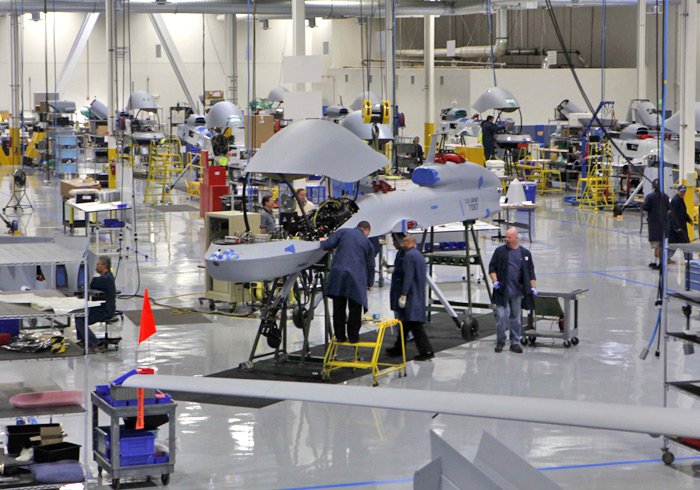
"Technicians at Poway [CA]-based General Atomics Aeronautical Systems
worked on the fuselage of a Sky Warrior drone . . . . The company’s unmanned-
aerial-vehicle program includes the Sky Warrior, the Predator and the Predator B."
(2009 photo - John Gibbins / Union-Tribune)


The new film about the arms trade, Shadow World, screened last night in Berkeley.

There is much that is provocative in the film, and everybody who cares about ending war should see it and share it with others in their community.

In particular, the segment about the Pentagon whistleblower Franklin Spinney caught my attention. Spinney talked about the systemic nature of the problem -- military spending that penetrates every single Congressional district. In effect, we're stuck. To break the hold of war on the US, we need to break the hold of military spending on every Congressional district.

Let's admit it: we've got a problem.
This was reinforced in the discussion following the screening, when Andrew Feinstein -- author of the book on which the film is based -- pointed to the inseparable relationship between campaign funding for Congressional races and the military contractors.

This idea is not new to me. I moved to California last year, fully aware that much of the beautiful California lifestyle is built on weapons manufacturing. The Concise Untold History of the United States by Oliver Stone and Peter Kuznick tells us that, between 1951 and 1963, California benefited from $67 billion in defense contracts (p. 218-9). In my own work on the problem of drones, I've come to learn that a relatively new player in defense, General Atomics, has become a star in the San Diego area economy by building Predator and Reaper drones.

Can drone jobs be "good jobs"?
But the question of how to push back against the problem has seemed gargantuan. Four hundred and thirty-five Congressional districts: how to begin?

It occurred to me that I could start by looking into California's 53 Congressional districts. But that alone is a huge job . . . and it's still just one state.

By coincidence, yesterday I was also thinking about another question: the readership of my blog is growing very fast . . . but where is it all headed? What do I hope the outcome is?

And then I realized that what I hope for is actually quite simple: I hope to suggest to people that they can use simple tools like blogs to get important information out to a wider audience.  In effect, these blogs and other social media are our answer to the complaint that the mainstream media doesn't report the important stories, and distorts the stories they do report. We need to be our own media.

Chicago activists are taking on Boeing
None of us has to do the whole job his/her self. We're a swarm.

So here's my promise: I will knuckle down and get to work on those 53 districts in California. And if you're writing about the hold of defense contractors and the Pentagon on those or other districts around the country, share your work with me via Twitter at @scarry. I'll make sure that it gets a big audience.

Posts related to California congressional districts

13th (East Bay): 21st c. Berkeley: More Relevant Than Ever to Antiwar Movement

17th (Silicon Valley): Worldwide War and Conflict (Brought to you by Silicon Valley)


More related posts

There's been a lot of talk in recent weeks and months about the problem of gun trafficking in Illinois, and how we will never meet our goal of stopping the violence in our communities if we can't stop the flow of guns. Maybe it's time for us to eat our own dog food . . . .

(See What If Illinois Became a "War-Profiteer-Free Zone" ? )


How might an uprising against inequality and dismantling the military-industrial complex dovetail?

(See WHERE'S MINE? Inequality in the US and the Military-Industrial Complex )


I've realized that when we ask ourselves, "What is it that we hope people will do?" we must include an element of recursivity: One of the things we want people to do is to involve more people in doing it. In a way, that element of recursivity -- dare I say "evangelism"? -- defines what it means for people to really become part of a movement.

(See Invite More People into Activism! (Pass It Along!) )


More than anyone else, the beneficiaries of permawar are the politicians who thrive on the power to make and control wars. The number one prime beneficiary is the President, as well as presidential aspirants. But it doesn't end there . . . .

(See J'ACCUSE: The Beneficiaries of Permawar )

Thursday, April 21, 2016

WELCOME MAT USA: Come in! Come in! (Get out! Get out!)


Ester Hernandez, Sun Raid
Un-naturally harvested
SUN*RAID
RAISINS
Guaranteed Deportation
Mextecos, Zapotecos, Triques, Purepechas
by-product of NAFTA


Saturday is the anniversary of Cesar Chavez' death in 1993, and it seems like an opportune time to lift up the work of artist Ester Hernandez.  I first saw her poster Sun Raid at the "Fires Will Burn" exhibition at DePaul University in Chicago.

Sun Raid is a searing reminder that people in the US have always been happy to welcome immigrants to help make their businesses profitable and make sure they had cheap stuff and cheap labor . . . . but how dare they expect to be treated like people!

(For a book-length treatment of this subject, see Juan Gonzalez's Harvest of Empire: A History of Latinos in America.)

We are living in a year in which we are seeing Donald Trump get away with demonizing immigrants. Maybe we need to take advantage of this moment and turn the phenomenon on its head. Who, after all, are the immigrants? Who is "entitled" to be here? What can it possibly mean anymore to say that certain people are tolerated and others are "illegals"?

I've heard people say that the problem is that Trump is a master at using the media to get attention, and the rest of us need to get with the times. Okay, here's my contribution:


Eva Longoria on The Late Show with Stephen Colbert:
"We didn't cross the border, the border crossed us."
Maybe when Eva Longoria says it, people will remember???
(Please retweet this message.)


A few weeks ago, on The Late Show with Stephen Colbert, super-celebrity Eva Longoria repeated the expression familiar to many of us: "We didn't cross the border, the border crossed us." Maybe when she says it, people will remember???

More on "We didn't cross the border, the border crossed us" here.


Related posts

It will take me multiple posts to spell out everything that I feel needs to be said about the Ayotzinapa 43.  People in the US need to work to change their own attitude about Mexico, and about the culpability or all of us here in the US in the wrongs that are being done down there. The Ayotzinapa 43 were persecuted for saying "the future can be different." It's time for us to take up their cry.

(See Ayotzinapa43: US People Need an Attitude Adjustment )


El Buen Pastor by Luis Jiménez depicts Ezekiel Hernandez -- a shepherd who was shot by U.S. marines in the area around the US-Mexico border as he was tending his sheep. The artist has said, "having [marines] patrolling the border in the 'war on drugs' is 'an accident waiting to happen.'"

(See Holy Week 2016 and "El Buen Pastor")


Part of what I loved about Du Hai was the way it used large pieces of fabric to convey the sensation of being in a boat among billowing waves, and the multiple uses to which they put the fabric - sea, clouds, sail, and more. Even a newcomer to modern dance, such as myself, could grasp what was going on.

(See Wanna Fix the U.S.A? Welcome an Immigrant Today! )

Sunday, March 13, 2016

Cal: Savvy Fossil Fuel Divesters

"Carbon bubble" and "stranded assets" are concepts that climate activists in the University of California are learning to emphasize:

"[I]nvesting in fossil fuels places the UC on top of a carbon bubble that is doomed to pop. Fossil fuel companies currently hold five times as much carbon in their reserves as the United Nations Framework Convention on Climate Change deem as safe to burn. That means the UC is investing in companies with trillions of dollars in stranded assets and stocks that are doomed to collapse as the globe transitions to a less carbon-intensive economy." ("It’s time to fully divest from fossil fuels," Daily Californian, March 13, 2016.)

As I explained in a recent post, they are actually doing their institution a favor by getting them to see The Feel-Good Folly of Fossil-Fuel Valuation.

Who knows? Maybe the "radical" Cal community will beat the "Nobel club" at U Chicago to the finish line by being the first to arrive at a sound, post-fossil-fuel era investment portfolio?