Showing posts with label racism. Show all posts

Friday, May 18, 2018

"Denuclearization" - A Graphic to Focus the Mind

ICAN logo
I've recommended an important article in the New York Review of Books.

I featured the logo of the International Campaign for the Abolition of Nuclear Weapons (ICAN) in my post. The post (and the article it recommended) was not about ICAN and the nuclear ban treaty -- at least not directly. But I used the image for three reasons.


Ad hominem

First: I have a strong objection to the image that did accompany the NYRB article. Oh, I think the graphic is very artistic, with its portrait of a deathly pale Kim Jong-un flanked by skulls. But I object to the use of it in connection with this article -- which is, after all, about multiple nuclear weapons states. The suggestion of death is appropriate to any discussion of nuclear weapons, but it is false to focus on the deadliness of a person instead of the deadliness of the nuclear weapons, themselves, and the nuclear weapons architecture and the roles people play in it.


Kim Jong-un by Siegried Woldhek in the New York Review of Books


This is especially true at a moment when people in the US -- that is, many of the very people who make up the readership of NYRB -- are struggling to develop a fact-based understanding of Korea, its northern and southern parts, and the role of the US in negotiations about conflict and nuclear weapons there. That's why I wrote A Checklist for Critically Reading (and Writing) About North Korea and Can You Judge a Nuclear Confrontation by Its Cover?

(By the way: you could fault me for the many times I have used pejorative images of Donald Trump to suggest the danger he poses as the commander of US nuclear weapons. More to come on this subject . . . . )


"Denuclearization"

Second, one of the essential points of the NYRB article is that the term "denuclearization" is being used by both Kim Jong-un and Donald Trump, but the two mean different things when they use it.

Kim means, in essence, "we want a situation in which we're not threatened by your nuclear weapons and you're not threatened by ours."

Trump means "we want a situation in which you give up your nuclear weapons capability and we keep ours."

Anyone who is familiar with US nuclear doctrine to date understands why Trump thinks his version is the way things work.

Anyone who is familiar with the history of Korea understands why Kim is committed to his version.

And what results is a discourse. People get to dig into the issue, learn about it, try to understand it, and discuss it with others.

So: back to that graphic. I believe that the ICAN logo -- the image of a nuclear weapon being broken -- is an image that helps us focus on the core discourse: denuclearization.


A Proprietary Image?

It's debatable whether the logo of ICAN is fair game for the Korea Spring and denuclearization. ICAN is not a party to the talks, and the talks are not connected to the central project of ICAN, the nuclear ban treaty -- directly.

And yet . . . .

The discourse on denuclearization is impossible to separate from the discourse on the Nonproliferation Treaty (NPT), which has now become impossible to separate from the discourse on the global nuclear ban treaty.

Just as "Nature abhors a vacuum," people innately sense and reject inequity. The longstanding de facto architecture of nuclear weapons -- "some've got 'em and others don't get to have 'em" -- withers a little more each time another person comes to see it and think about it and understand it and talk about it.

And right now the Trump-Kim Summit is shining a bright light on the discourse of denuclearization and that inequity.


Please share this post . . . . 

Thursday, March 22, 2018

Can You Judge a Nuclear Confrontation by Its Cover?

I want to write in more detail about the article I talked about in yesterday's post -- When Writing About North Korea Is a "Downer" -- but I realized that first I should say something about the cover of the issue of The New Yorker in which it appeared.

I wrote two days ago about how important images are -- North Korea: Who Am I To Look At You?. The article from the Bulletin of Concerned Asian Scholars that I referenced there directed our attention to how caricatures may cross the line from commentary on an individual to ethnic stereotype. Consider this example:


"Let's see -- my old man said the top button is to launch and the
bottom button is to cancel -- or is it the other way around?"
Kim Jong Il caricatured by Don Wright, Palm Beach Post
c. 1994


Commenting on the cartoon, scholar Robert Perkinson says, "[T]he cartoon not only ridicules North Korea's likely new president Kim Jong Il by exaggerating both his lack of expertise and his perceived menace to the West, but also employs anti-Asian racial stereotypes." (Introduction to "Notes from the Field: The Korean Nuclear Crisis.)

Having been alerted by Perkinson, I notice several things about this cartoon:

* Kim's feet don't reach the ground. (They barely reach beyond the edge of his chair.) This suggests:

- the physical fact that Kim Jung Il was relatively short (5' 3")
- short stature as a metaphor for youth, in turn a metaphor for inexperience and/or lack of expertise
- infantilization of Asians as a racial stereotype

* Kim has big glasses and barely visible eyes, i.e. the representation is in no way realistic. Does this reflect:

- reliance upon a long-standing and innocent cartooning convention?
- reliance upon a long-standing and anti-Asian racist cartooning convention?

* Kim can't keep straight the simplest instructions concerning this mechanism. Is this:

- a dig at his inexperience and/or lack of expertise?
- an anti-Asian racist stereotype, suggesting Asians are too simple to understand machines?

I know, it's hard work; we've been looking at images like this for so long without thinking about these questions.

The New Yorker cover for September 18, 2017 is interesting.


The New Yorker, September 18, 2017


It is by Eric Drooker and is entitled "Warhead."

What I noticed about this image is that it puts Kim Jong Un on a par with Donald Trump. After months of graphics that made use of what had become a true cultural meme -- Trump's orange mop of hair -- we were now seeing an image saying to us, in effect, "There's another leader that you know just by looking at his hair!" (and, possibly, "Compare to Trump - similar? different? . . . . ")

Using the up/down/level scoring approach that I talked about in yesterday's post, I would give this a "level." If all it were suggesting was "Kim is scary" (i.e. the message implied by the image's title, "Warhead"), then I would rate it "down." But in my opinion the image makes people think.

I'm confirmed in my judgement by comparing it with an earlier New Yorker cover depicting Kim:


The New Yorker, January 18, 2016


It is by Anita Kunz and is entitled "New Toys."

Here the questions raised by the Don Wright cartoon come to mind. It seems perfectly legitimate to provide commentary that suggests that a leader lacks the maturity to handle his or her country's military and weapons responsibly. However, I believe it also involves an anti-Asian racial stereotype when an Asian leader is shown as a baby playing with his toys. (Why isn't he shown side-by-side with his US counterpart, also depicted as a child?)

So: between January, 2016, and September, 2017, the story the public has gotten from The New Yorker has progressed from "down" to "level."

At least, if you can judge a nuclear confrontation by its cover . . . .


More:

The US and North Korea: Suspense, Discomfort, Regret

"Denuclearization" - A Graphic to Focus the Mind


Please share this post . . . .
Monday, March 19, 2018

A Checklist for Critically Reading (and Writing) About North Korea

cover, Bulletin of Concerned Asian Scholars,
January - June 2000
I recently began doing something I wish I'd done forty years ago when I was a college student: reading and thinking about the Bulletin of Concerned Asian Scholars (now Critical Asian Studies) - the publication of the Committee of Concerned Asian Scholars.

You can read this publication free online:

Bulletin of Concerned Asian Scholars (1968-2000)
Critical Asian Studies (2001 onward)

I plan to talk in a more general way about this important publication in a future post. Here I will begin with a relevant example of its important work.

In a 1994 issue of the Bulletin, there is a group of articles about North Korea and nuclear weapons: "Notes from the Field: The Korean Nuclear Crisis." The articles are:

* Robert Perkinson - "Introduction"

* Bruce Cummings - "Old and New Korean Wars"

* Minn Chung - "'Seoul Will Become a Sea of Fire . . .'"

* Reunification Committee of National Council of Churches in Korea - "Statement on Peace and Reunification of the Korean Peninsula"

* Catherine B. Wrenn - "The Nuclear Non-Proliferation Treaty in Retrospect: The Case of North Korea"

* Tom Clements - "Nuclear-Free Korean Peninsula: Visit of "MV Greenpeace" Spotlights South Korean Nukes"

* Minn Chung - "Chronology of Crisis: Important Developments for Peace, Reconciliation, and Denuclearization in Korea"

(You can read all these articles in pdf form In the Bulletin of Concerned Asian Scholars Volume 26 (No. 1 and 2).)

Robert Perkinson's introductory article calls our attention to the need to read critically -- in general, and as we comment on places and cultures that are not our own, and especially in charged contexts like the relationship between the United States and North Korea.

I jotted down some words from Robert Perkinson's article:

Western media spin . . .

monolithic ideological line  . . .

portraying . . .

condemning . . .

demonizing . . .

target the North Korean people as well . . .

overt racism . . .

mocking . . .

demeaning anecdotes . . .

"hysteria" . . .

epithets . . .

jingoistic . .

anti-Asian racial stereotypes . . .

denigrating . . . 

All of these are examples of behaviors that we who write about countries and cultures not our own must be on guard against. At a minimum, our unending effort to produce "colorful writing" -- stuff that people actually feel compelled to read -- is filled with the risk of leading readers by the nose instead of giving them the material to think for themselves. At a deeper level, the power we wield as observers and interpreters and writers generally needs much, much, much more acknowledgement, not to mention careful, measured, respectful, peaceful application.

I decided it would be valuable to spend some time examining how my own writing might be improved by paying attention to these behaviors.

I also decided to examine some specific examples of recent writing (by others) about the US, about North Korea, and about the US-North Korea situation, and try to highlight the ways in which these (and other) behaviors play a role in forming the impression that might be formed by readers.

The good news is that much is being written and shared today about North Korea.

The bad news is that we -- readers, writers, all of us -- have a lot of unexamined biases.

Let the critical reading begin . . . . 


Follow-up posts:

North Korea: Who Am I To Look At You?

When Writing About North Korea Is a "Downer"

Can You Judge a Nuclear Confrontation by Its Cover?

The US and North Korea: Suspense, Discomfort, Regret


Please share this post . . . .

Monday, February 20, 2017

Which Comes First? Loyalty? or Equity?

About 50 people gathered on Sunday at First Church Berkeley for an art response to the anniversary of the 1942 executive order #9066 that resulted in the internment of 120,000 Japanese-Americans. Two survivors of those internment camps shared 1,000 paper cranes with the participants. We were asked to think of ways to make use of them to say, "Never again." So now I'm sharing with you.


One of a thousand cranes distributed at the 2/19 event.


I moved to California about a year ago. While the US internment of people of Japanese descent during World War II is a legacy that every person in the US must own, it is particularly relevant to California, the home of so many of the people interned.

During the past year, I read Farewell to Manzanar - a memoir that is frequently assigned in high school and college classes here. It is a high impact book -- easy to read, and full of insights about the life of a second-generation girl of Japanese descent who was sent with her family to an internment camp in central California.

Farewell to Manzanar
I say "easy to read," but there is a part of the story that I just can't seem to get past.  Up until 1924, hundreds of thousands of Japanese were allowed to come to the US (plus Hawaii) to work, but they were not allowed to become US citizens. Then, in 1924, immigration from Japan to the US was cut off entirely by US law. (Details here and here.) Any children born to those immigrants in the US were automatically US citizens. All of them were rounded up and interned after war broke out. The pretext was: "You are of Japanese descent and we don't know where your loyalties lie."

In a way characteristic of this country, the US had created a situation combining mistreatment based on "race" identity with discrimination based on (involuntary) lack of citizenship

In 1943, the US government began to try to undo what it had done. It circulated a questionnaire to the internees, including "loyalty questions." If you answered the questions properly, you could obtain leave from internment.

Imagine having been rounded up and sent off to an internment camp, held for a long period, and then being given the "opportunity" to state where your loyalties lie. How would you feel? How would you feel if you were a US citizen? How would you feel if you were an immigrant who had been denied the possibility of ever becoming a US citizen?

The situation faced by those internees in 1943 is relevant to the continuing situation of various groups in the US today, especially immigrant populations and people subject to discrimination. Which properly comes first: loyalty? or equitable treatment? (Is the answer different if you're "white"?)


MORE:

SANCTUARY (Church, City, State) and Solidarity with Immigrants 

Dirty Wars and Extrajudicial Execution (So 1984!)
 
Does a Civilian Police Accountability Council (CPAC) need to be part of a "new plan of Chicago"?
 
360 Degree Feedback in New York (2014 NPT Prepcom and How the World Views the United States))


Please share this post . . . .

Monday, February 13, 2017

Berkeley Organizing Congregations for Action (BOCA) Leads Black History Month Vigil: "Remember Our Names"

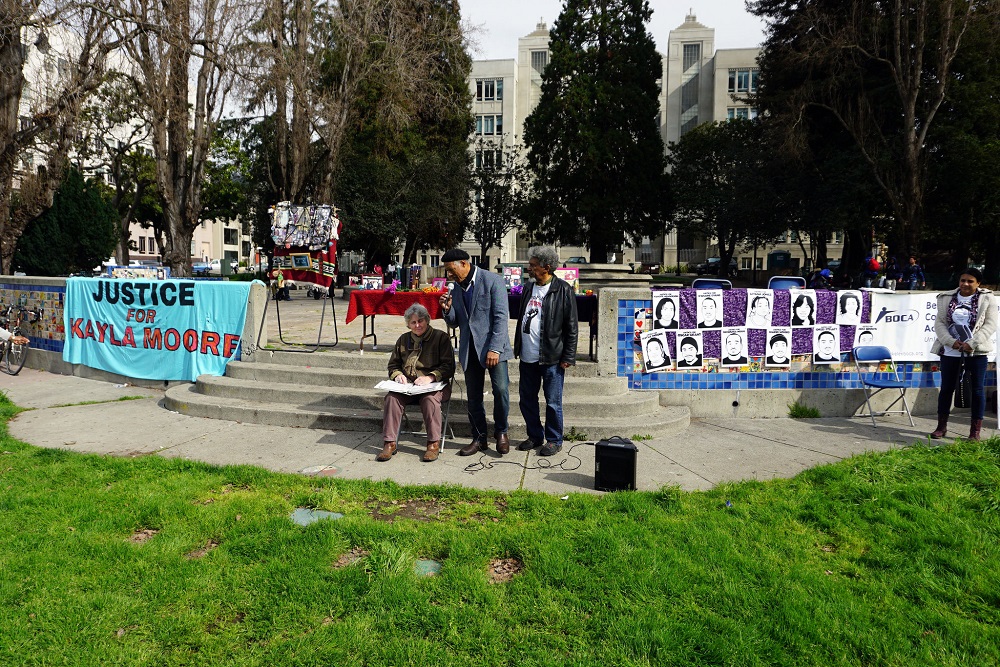
Several groups worked together on Monday in Berkeley to lift up the names and stories of people who have suffered from police violence and other forms of systemic racism in the US. The vigil by members of Berkeley Organizing Congregations for Action (BOCA), Justice 4 Kayla Moore, and Berkeley Copwatch was titled "Remember Our Names Black History Month Prayer Vigil" - and took place for five hours between noon and 5:00 p.m. in the Martin Luther King Jr. Civic Center Park, facing Berkeley City Hall and the headquarters of the Berkeley Police Department.


Members of St. John's Presbyterian Church share names and stories.
(Photo: Mark Coplan)


February 13 is the anniversary of the murder of transgender African American woman Kayla Moore by the Berkeley Police Department 4 years ago. (See SAY HER NAME: Kayla Moore and the Struggle for Justice)

"Remember Our Names Black History Month Prayer Vigil"
(Photo: Mark Coplan)
The photo at right shows the backdrop for the event: the Justice for Kayla Moore banner at left, images of victims of killings by police at right, and artwork by event founder (and BOCA executive director) Rev. Daniel Buford on the raised central area. Rev. Buford is at center, wearing the beret. Kayla Moore's sister, Maria Moore, stands at the far right.

Many people gave testimony about the violence being carried out by representatives of the state all across this country, and particularly against people of color. Dozens of accounts, from research compiled by Rev. Buford, were read and discussed. People shared stories of violence and killings and other injustice that they had been subjected to, or that had affected their friends or families or other members of their communities.

Many people from the congregation I attend, University Lutheran Church (ULC), participated in the vigil. We at ULC have made an intentional commitment to anti-racism work, joining in solidarity with other justice activists in our city, our state, and nationally.

For my own part, I used my time at the microphone during the vigil to lift up the names of some people I have known and/or learned about through my work in Chicago before coming to Berkeley.

I talked about Flint Farmer, who was shot in the back by Chicago police and killed, as he lay face down on the ground. (See: We need to get the police off the streets of Chicago. QED. ) And I talked about Flint's father, Emmett, who I has become a tireless campaigner for justice on behalf of all people subjected to police violence. I said that each time I see the way Maria Moore has devoted herself to activism in response to what happen to her sister, Kayla, I always think of Emmett Farmer.

"Remember Our Names Black History Month Prayer Vigil"
(Photo: Mark Coplan)
I talked about Rekia Boyd, who was shot in the head by an off-duty Chicago police officer. (See: Chicago Vocabulary Lesson: "Overcharging" and "Undercharging") I talked about how people in Chicago made a commitment to #SayHerName, so that everyone would know Rekia's story. I talked about how the systemic injustice included not just the police, but the also the district attorney's office that failed to hold the police accountable. And I talked about how the people of Chicago voted states attorney Anita Alvarez out of office for her failures in cases like that of Rekia Boyd.

I talked about people who had suffered from police torture in Chicago -- people like Darrell Cannon and Mark Clements. I talked about seeing Mark show up to speak at protest after protest after protest against police crimes. If Mark -- freed after spending 28 years imprisoned on trumped-up charges -- can find the energy and courage to keep showing up to be an advocate for others, what's stopping the rest of us?

In the course of the afternoon, we lifted up the names of stories of people from dozens of places around the country. Systemic violence against people of color is not just a Bay Area thing, it's not just a Chicago thing, it's happening everywhere. (Flashback: National Forum on Police Crimes, May 2014)


A full album of photographs from the event is available on Flickr.


RELATED POSTS

CHICAGO: Accountability ... Police AND City Council
Chicago Justice: Connecting the Dots


Please share this post . . . .

Thursday, December 29, 2016

Which Way for the Church? Anti-Racism? or Comfort?

The Evangelical Lutheran Church in America (ELCA) -- and other US denominations -- can and should choose to emphasize anti-racism work in 2017. (I think it is a critical moment.)


From @scarry:
What if we all did a personal inventory of how our "personal
success story" was built on white privilege? #ELCAcwa

(Image: ELCA presiding bishop Rev. Elizabeth Eaton and quote:
"When my dad came back from the war, the GI bill meant he and
my mom could get a low interest loan. That was not available to
African American veterans. That's white privilege. It's baked into
the system. Now, we didn't create it, but if we don't work to
change it, we are complicit."


The tweet shown above was very heavily shared when I posted it during the churchwide assembly of the Evangelical Lutheran Church in America (ELCA) this past summer.

I have been very hopeful that the Church -- Lutheran and other denominations -- will be a leading force in working against racism. (If not the leading force.)

Some of the things I've written:

How Might the White Church "Die to 'Whiteness'"?

"Personal Success Story"? "White Privilege"? or Both?

Can "Lutheran" Be a #BlackLivesMatter Denomination?

Decolonize Lutheranism -- A Northern California Installment

At the same time, I think there's a lot in the Church that makes it just want to turn its back on the world and seek comfort. I think that impulse is acute as 2016 draws to a close.

Which will it be?

From where I sit, it seems that the choice to emphasize anti-racism work is a matter of life and death for the Church.

My personal belief is that it will require a choice by the entire membership -- and not just isolated acts of leadership by a few people in the churchwide office, or a handful of charismatic pastors. It certainly can't be left to a few stalwarts on the "Social Justice" committee.

It needs to be the work of the whole Church.

The Church, after all, is the people.

Please share this post . . .

Friday, November 18, 2016

The Meaning of "Race" in the USA: Class Is In Session ....

In his confirmation hearings for attorney general, Trump-appointee Senator Jeff Sessions will be asked to define the word "race." The nation will be listening . . . .


The USA is about to get a national tutorial on the definition of #race"
(Please share this message on Twitter.)


When Senator Jeff Sessions goes before the Capitol Hill hearing on his confirmation as attorney general in the administration of President Donald Trump, he will be asked about the time he called a  civil-rights lawyer a "disgrace to his race."

What may surprise some people is the amount of time that will be spent exploring the question, "What does the word 'race' mean?"

I will refrain from guessing what is in Senator Sessions' mind, or how the questions will unfold. That will all come out in the hearing.

Instead, I will explain why I think the process will be important for the rest of us.


What comes first?

A significant part of my past several months were devoted to reading and discussing Between the World and Me by Ta-Nehisi Coates, together with others from my church.

I can attest to the fact that the statement from the book that provoked the most discussion was:

"[R]ace is the child of racism, not the father." (p. 7)

. . . and the discussion that proved the most difficult, and required the most time, involved understanding the difference believing that "race" is biological and understanding that it is a social construct.

What I noticed in those discussions was that people were so nervous about acknowledging an obvious physical fact -- skin that is dark brown or light brown or beige or pink or something in-between -- that they had trouble separating in their minds two distinct phenomena:

* the biological ramifications of those skin colors (very few)

* the ways society has acted over and over again -- with reference to those skins colors -- to impact the realities of those in those skins (very many)

One helpful step was to recognize that a social construct -- once it is constructed -- has real consequences. (You're not imagining that people in the US with dark skin have a very different experience than people with light skin.) A social construct, however, has no claims to being natural or right. And it certainly need not persist.


So 19th century . . . 

Louis Agissiz in 1879
It is fascinating to see how many great (and not-so-great) thinkers in the past took a shot at using biology to posit "racial" differences. You can read the role of (dis)honor in the Wikipedia article on "Scientific Racism."

One example that stands out in my mind -- in part because there are several important buildings at Harvard that bear his name -- is Louis Agissiz. Agissez was the very model of a modern 19th century scientist and public intellectual. He led expeditions all over the world, collected lots and lots of specimens, lectured widely, and published thousands of pages worth of scientific writing.

The only problem: on the biological determination of race (his big topic) he was dead wrong.


Freedom of thought

People are allowed to believe what they want to believe. (It's a free country.)

The challenge before the members of the committee evaluating the Sessions nomination, however, will be whether it matters what the attorney general of the United States thinks "race" means.

Here's an exercise: Read the words of any of the many US laws the attorney general is sworn to uphold -- the 15th Amendment to the US Constitution, for instance, or Title VII of the Civil Rights Act of 1964.

The protections afforded by such laws against discrimination based on "race" -- are those protections provided in the face of biological differences? Or in the face of socially-caused differences?

What do you think? Does it matter? Why?


Related posts

The heart of the matter, at least as I understand it, is that race is a social construct, and it's concerned with power. "Whiteness" is a condition of power over and against people who get defined as "not white." "Dying to 'whiteness'," then, will involved giving up power, I think.

(See How Might the White Church "Die to 'Whiteness'"?)


The ELCA's presiding bishop, Rev. Elizabeth Eaton, has set an example: own the white privilege we've experienced in our lives. Will Lutherans step up?

(See "Personal Success Story"? "White Privilege"? or Both?)


"We need to first acknowledge the genocidal origins of OUR nation’s history of ethnic cleansing and occupation."

(See Native American Rights: Acknowledge the Occupation)

Tuesday, October 25, 2016

How Might the White Church "Die to 'Whiteness'"?

"White" Christians, "white" congregations, the "white" church -- these words don't make any sense. But how do we change them?


Edvard Munch, Two Women on the Shore


At University Lutheran Chapel in Berkeley, we've been reading Between the World and Me by Ta-Nehisi Coates. Among other things, the book is a wake-up call for "people who think themselves white." And once awake, it's impossible for those people not to ask, "How might I think of myself?"

Three days ago, I attended a panel discussion featuring four ministers from the Bay Area. The discussion took place at the Oakland Museum of California, during a multi-day symposium on the 50th anniversary of the Black Panther Party, and the topic of the panel was "Liberation Theology - The Black Panther Party and the Church." In response from a question from an audience member about what the white church needs to do, Rev. Michael McBride said,

"The white church needs to die to 'whiteness'."

And I thought, "Of course."


How might the white church "die to 'whiteness'"?

For the past three days, I've been thinking a lot about what Pastor Mike said.

I certainly like the sound of it.

I'm not sure I know how to do it.

My first impulse is to say: we need to quash symbols of white ethnicity -- Bach hymns and Norwegian sweaters and Swedish coffee cake -- and open ourselves up to other cultural referents.

Pretty soon I'm off and running with visions of different ways to adorn the church, different ways to do worship, different ways to do fellowship . . . .

But something brings me up short.

I think there is valuable conversation to be had about music and attire and food -- about the signals we send to ourselves and others about who we are and where we seek our comfort -- but I also think it can obscure the heart of the matter.

The heart of the matter, at least as I understand it, is that race is a social construct, and it's concerned with power. "Whiteness" is a condition of power over and against people who get defined as "not white." "Dying to 'whiteness'," then, will involved giving up power, I think.

It may be difficult to understand how to give up power, particularly in a church context, in which (we may think) we aren't exercising any power. (At least not in the sense of physical power.)

But several possibilities come to mind.

In the church context, a lot of our power comes from our prerogative to interpret and re-interpret . . .

What might happen if we devoted ourselves to ("merely") listening to the experiences of those who have been defined as "not white" -- and check our habit of explaining what the "real" meaning of what we are hearing is?

In the church context, a lot of our power comes from our position as mediators . . .

What might happen if we took upon ourselves the demands of those who have been defined as "not white" -- and forgo our habit of watering down those demands to make them more "palatable" or "realistic"?

In the church context, a lot of our power comes from our role as managers . . .

What might happen if we went to work in the service of the solutions devised by those who have been defined as "not white" -- even solutions that we don't get to direct and control?

These are just a few thoughts that have occurred to me.

The real value, of course, will come as large numbers of people who "think themselves white" devote themselves to this question: How might I -- how might this Church -- "die to 'whiteness'"? (And: What lies on the other side?)


Related posts

Maybe a good next step is to read Coates' book and sit with it . . . listening to what comes up . . . but not jumping immediately into "solving."

(See On Reading Ta-Nehisi Coates (A Confession))


"I am convinced that we are in denial about the racism that saturates our society and from which we directly benefit. That denial produces predictable twin reactions from white people: either silence about the racism that plainly reinforces our way of living or surprise at the frustration and outrage African Americans and others express at how they are treated."

(See Can "Lutheran" Be a #BlackLivesMatter Denomination?)


How will the organized power of 4 million Lutherans in the US be brought to bear on the fact that we are living on occupied land.

(See DECOLONIZE THIS: The ELCA's Doctrine of Discovery Challenge)

Wednesday, October 19, 2016

SAY HER NAME: Kayla Moore and the Struggle for Justice

Did police response to a call involving mental health distress obey the Americans with Disabilities Act (ADA)? A court will look at Kayla Moore's experience . . . .


We remember Kayla Moore
4-17-71 to 2-13-13
poet, singer, sister, daughter, genius, friend
black trans woman with a mental health diagnosis
killed by Berkeley Police in her own home.
they tried to blame her death on "obesity" !!!
SHAME ON BPD!
JUSTICE FOR KAYLA
(Original art: Nomy Lamm)


Kayla Moore died at the hands of Berkeley police on February 13, 2013. Read "We Remember Kayla Moore" by Nomy Lamm (who created the poster above) to learn about Kayla Moore's life and how she died.

The Justice 4 Kayla Moore movement has grown steadily in the Bay Area. I was present at Federal Court in San Francisco on Monday when Judge Breyer said he would move forward with the court case brought by the family. He will hear arguments on the part of the complaint related to the Americans with Disabilities Act (ADA). Judge Breyer dismissed the parts related to excessive force and equal protection. (More to come on the possibility of appeal on those issues.) The month of November will provide important opportunities to support Kayla's family and the Justice 4 Kayla Moore movement.

When I lived in Chicago, I learned about the need for police accountability. I was very focused on Chicago, but I also learned about the situation in other parts of the country, particularly when leaders from around the country gathered in Chicago for the National Forum on Police Crimes. So I have arrived in Berkeley with my eyes open.

A particular case I learned about in Chicago involved Stephon Watts. It was my first introduction to what goes wrong when police use confrontation instead of de-escalation in responding to mental health-related distress calls.

The struggle for police accountability has been a difficult one in Chicago. It's turning out to be a difficult one throughout the country.  I expect it will be a difficult one in Berkeley.

But I'm inspired to see the strength of the growing movement here. And it's about to get stronger . . .

To be continued . . . .


Related posts


In the city where I live, "normal" or "right" or "acceptable" has been given a brutal construction by the power structure:

Police encounter black man on street
Police shoot black man
Black man dies
(Business as usual in Chicago.)

 (See We need to get the police off the streets of Chicago. QED.)


The State's Attorney for the Chicago area finally got around to bringing a charge against a police officer who shot and killed a citizen. Why, I wondered, didn't Anita Alvarez charge him with murder?

Then I remembered my Chicago vocabulary lesson.

(See Chicago Vocabulary Lesson: "Overcharging" and "Undercharging" )


Cook County Jail is the perfect example of the nationwide injustice that Michelle Alexander described in her groundbreaking book, The New Jim Crow: mass incarceration, focused principally one people of color, in which "crimes" (often related to drug possession or other low-level offenses) become the mechanism for entrapping people in a cycle of incarceration that is brutalizing and often begins a downward spiral of lifetime discrimination.

(See Free Them All )

Tuesday, August 16, 2016

"Personal Success Story"? "White Privilege"? or Both?

The ELCA's presiding bishop, Rev. Elizabeth Eaton, has set an example: own the white privilege we've experienced in our lives. Will Lutherans step up?


From @scarry:
What if we all did a personal inventory of how our "personal
success story" was built on white privilege? #ELCAcwa

(Image: ELCA presiding bishop Rev. Elizabeth Eaton and quote:
"When my dad came back from the war, the GI bill meant he and
my mom could get a low interest loan. That was not available to
African American veterans. That's white privilege. It's baked into
the system. Now, we didn't create it, but if we don't work to
change it, we are complicit."


The tweet above coincided with the every-three-years national gathering of the major US denomination of Lutherans -- the churchwide assembly of the Evangelical Lutheran Church in America (ELCA). The presiding bishop, Rev. Elizabeth Eaton, had shared a meme of herself on Twitter, and I found it inspiring. So I added my own take on it, and shared it. It stimulated a lot of activity.

The ELCA has a growing emphasis on anti-racism, and Bishop Eaton's message puts that emphasis front and center.  I found Bishop Eaton's meme powerful for three reasons in particular:

(1) It's about systemic racism . . . in this case, a government benefit. A big part of our anti-racism work is understanding that racism is institutionalized in the US, and that we are called to change that.

(1) It names "white privilege." Without taking anything away from her dad, who served in the war, and worked hard in other ways, Bishop Eaton points out that some of what she has benefited from is based on an inequity: white privilege.

(3) It's personal. It's about Bishop Eaton and her dad and her mom. It's real.

It seemed obvious to me that this act of leadership was saying to all of us, There, I did it; you can do it too: you can think about it . . . you can stand up and say it publicly . . . and you can help spur the conversation! 

Bishop Eaton has a "big soapbox." The ELCA has about 4 million members. Imagine if just a fraction of those people responded to this act of leadership.

So, in response to her initiative, and in the spirit of learning from Bishop Eaton about how to use social media effectively, I'm creating and sharing my own meme about how I've experienced white privilege.

This is just a first step, and it involves selecting one example out of many. This one builds on something I was reminded of by Bishop Eaton's testimony - a benefit stemming from military service in my own family. (Stay tuned for a future installment about my experience with the criminal justice system.)


The personal success story

My mother was the daughter of a coal miner in Eastern Pennsylvania. My "granddaddy" Melker had served in World War I.

My mother got college scholarship money for an essay she wrote for a veterans organization her father belonged to -- the Veterans of Foreign Wars (VFW). Together with other scholarship money, that money enabled her to attend college at Temple University in Philadelphia.

My mother met my father at Temple.

They got married.

Time passed.

I was born.


The question

You can't imagine how many times this legend has been repeated in our family. "Just imagine -- if Mom had never won that scholarship . . . !"

Very few teenagers from the coal fields of Pennsylvania got to go to college in those days; my mom was certainly the first person in her family to make the leap.  

And she earned it. She was really, really smart. And she was a hero in many, many ways.

At the same time . . . . I'm now wondering, "Was that scholarship a privilege that could not be accessed by the children of African-American veterans?" I've researched a little, and it's hard to prove one way or another. I did learn that 370,000 African-Americans were inducted into service in World War I. I've seen reference to the de facto (white) ethnic character of particular VFW posts; I've also read that there were all-black VFW posts, and that the VFW wasn't very widespread in the South.

Beyond the Bonus March and GI Bill: How Veteran Politics Shaped the New Deal Era by Stephen R. Ortiz says:

While marked differences existed at the leadership level and in the national status of the [American] Legion and the VFW, more subtle differences could be found in their rank-and-file memberships. Both organizations took pride in a cross-class national membership. The thorny issue of race, however, tested the supposed inclusiveness of the organizations. Each allowed state departments to decide on racial matters, in tacit complicity with the southern Jim Crow system and the racial system that was emerging in the north during the 1920s. Therefore, while both the VFW and the Legion included African-American veterans as members, typically they were shunted into segregated posts in both northern and southern states. (p. 19, accessed via Google Books)

This will be a question that I will continue to research. (Maybe some of the people who know the history can share comments to this blog.)

My family went from the coal fields to the college quadrangle,
with the help of a scholarship from the VFW.

"Personal Success Story"?
"White Privilege"?
or both?

(Share on Twitter)


Related posts

"I am convinced that we are in denial about the racism that saturates our society and from which we directly benefit. That denial produces predictable twin reactions from white people: either silence about the racism that plainly reinforces our way of living or surprise at the frustration and outrage African Americans and others express at how they are treated."

(See Can "Lutheran" Be a #BlackLivesMatter Denomination?)


To be sitting in Berkeley and seeing in front of my eyes the spreading of this idea that started in Texas and was nurtured in Philadelphia and got agitated in Chicago felt like a real Pentecost moment.


(See Decolonize Lutheranism -- A Northern California Installment)


I believe that once the Church comes out of the closet -- that is, once we start speaking quite openly about the difference between the world as we find it and the world as we believe God wishes it to be -- there is no way this old world will be able to stay the same.

(See Let the Church Out of the Closet )

Tuesday, July 19, 2016

Chicago Aldermen Stepping Up for Police Accountability

A bill is going before Chicago City council to assure a democratically elected civilian body holds the police accountable.


In the past I publicized a poster showing the members of Chicago City Council with the word MISSING in bold red letters superimposed over it.  Now it's time to replace that with a new poster, because some members of Chicago City Council are stepping up for police accountability.

What this means is accountability for Chicago's police and also for the City Council itself.

The bill's sponsor is Carlos Ramirez-Rosa (35th) (P) and he is reported to have the support of 8 more aldermen (including 3 who are fellow members of the Progressive Caucus, and 3 who are members of the Black Caucus):

Joe Moreno (1st)
Susan Sadlowski Garza (10th) (P)
Toni Foulkes (16th) (P) (BC)
Howard Brookins Jr. (21st) (BC)
Ricardo Munoz (22nd) (P)
Roberto Maldonado (26th)
Emma Mitts (37th) (BC)
Ameya Pawar (47th)

Members of the Progressive Caucus are designated with a (P). It is hoped that they will bring along other members of the 11-member Progressive Caucus as well.

Members of the Black Caucus are designated with (BC). Other members are Chair Ald. Roderick T. Sawyer (6), Ald. Pat Dowell (3), Ald. Will Burns (4), Ald. Leslie Hairston (5), Ald. Greg Mitchell (7), Ald. Michelle Harris (8), Ald. Anthony Beale (9), Ald. David Moore (17), Ald. Derrick Curtis (18), Ald. Willie B. Cochran (20), Ald. Michael Scott (24), Ald. Walter Burnett (27), Ald. Jason Ervin (28), Ald. Chris Taliaferro (29), Ald Carrie Austin (34) and Ald. Emma Mitts (37)

You can help by reaching out to your alderman today. (Find your alderman and contact info here.) If they're already a supporter (list above) - thank them. If they're not yet a supporter - urge them to become a co-sponsor.


More background on the campaign for police accountability in Chicago:

Will Chicago Televise Hearings on Civilian Police Accountability Agency?

CHICAGO CITY COUNCIL: Impose Civilian Control on CPD

A Modest Proposal for Chicago's Progressive Caucus: Support CPAC

Does a Civilian Police Accountability Council (CPAC) need to be part of a "new plan of Chicago"?

#PeopleOverPolice: Is This What Democracy Looks Like?

Chicago Vocabulary Lesson: "Overcharging" and "Undercharging"

We need to get the police off the streets of Chicago. QED.

CHICAGO: Twilight Zone? Constitution-Free Zone? (What's it look like to YOU?)

Tuesday, July 12, 2016

Can "Lutheran" Be a #BlackLivesMatter Denomination?

LSTC president James Nieman
I've been heartened to see a #decolonizelutheranism movement coinciding with #BlackLivesMatter and the 500th anniversary of the Reformation. Now the head of Lutheran School of Theology at Chicago (LSTC) has chimed in.

Below, I'm reproducing in full the open letter from LSTC president James Nieman.

For myself, I particularly notice three things:

(1) I like what President Nieman says about stopping to think . . . and confess. (See On Reading Ta-Nehisi Coates (A Confession))

(2) OVERALL: It's a reminder that, in the Lutheran denomination at least, seminaries are in the thick of the conflict of the times --  not an escapist ivory tower. As we approach the 500th anniversary of the Reformation and try to get in touch with what we're all about, it's good to remember this.

(3) Most important, he zeroes in those words that are so difficult for white people to swallow: "white privilege" and "racism" and "denial." A lot of work is going to have to be done to pry "Lutheranism" apart from "white privilege" . . . and guess who's going to have to do that work?

I'd love comments from others on what they notice in this letter. 


From President James Nieman:

The events of the past week in this country have culminated an escalating, sickening cycle of violence. This cycle has been inflicted predominantly upon African Americans and became more visible and acute since Ferguson, but in fact stretches back for decades, let alone centuries. Recently, others have been subjected to hate crimes (at Pulse in Orlando) or targeted for killing (the police in Dallas), and these atrocities also deserve our sober reflection and mourning. Consistent about a topic I have raised many times before, though, my focus in this letter is specifically about the role of white privilege and racism in creating the heinous harm consuming us these days, and how our school can play a part in dismantling it.

In particular, I am writing this mainly to white people like me at our seminary. I am convinced that we are in denial about the racism that saturates our society and from which we directly benefit. That denial produces predictable twin reactions from white people: either silence about the racism that plainly reinforces our way of living or surprise at the frustration and outrage African Americans and others express at how they are treated. I believe this denial, with its attendant silence and surprise, is nothing other than a refusal to acknowledge the privilege we hold and the degradation it inflicts on others. If we as white people have any conscience left, if we at this moment feel any distress at all with recent events, then we should at least have the moral courage in a seminary to admit that how we live is destructive for other people and ultimately unsustainable for ourselves. As white people, we must acknowledge our racism. [yellow highlighting added]


From various quarters there are calls for religious communities to pray or speak or march, and of course there is a place for all these actions. I am proposing, though, that white people like me must first engage the more basic, disturbing work of thinking and confessing. These practices are not at all neat and tidy, for taken seriously they are actually agonizing. But without first thinking about who we are and then confessing how we have benefitted, all of our praying and speaking and even marching become an insubstantial, self-serving charade. My point, then, is to share with white people at our seminary three resources toward a more disciplined kind of thinking and confessing. I assure you than none of these readings is easy to absorb.

First, I urge you to read “Death in Black and White,” an opinion column by Michael Eric Dyson appearing in The New York Times (click here). Second, I urge you to review recent postings on the seminary’s “We Talk. We Listen.” diversity blog hosted by Linda Thomas, including Dr. Thomas’s own excellent, poignant essay from this morning (click here). Third, I urge you to consider “White Fragility,” a scholarly article by Robin DiAngelo published in the International Journal of Critical Pedagogy .... All three readings are like a relentless mirror reflecting back to us the white privilege and racism in which we are embedded. May these be aids to your thinking and confessing about racism.

I realize some readers may find this letter harsh and uncomfortable, while others may think it doesn’t go nearly far enough. Isn’t reading articles just another kind of intellectual escapism? Can thinking and confessing ever be potent practices that make a difference? My aim, though, is theological – and theology in the name of the Crucified begins with telling the truth (cf. article 21 of the Heidelberg Disputation), both about ourselves and the evil that envelops us. As white people within the LSTC community, let us (as Luther put it in 1518) “call the thing what it is,” honestly name our complicity in racism, and commit to meaningful repentance. Only then will all our other words and deeds – and yes, even prayers – hold any promise for those whom our white privilege has persistently destroyed.

James Nieman
President


Related posts

Maybe a good next step is to read Coates' book and sit with it . . . listening to what comes up . . . but not jumping immediately into "solving."

(See On Reading Ta-Nehisi Coates (A Confession))


It suddenly occurs to me that everyone in the US should be studying the behavior of England toward India, and asking ourselves, "What might this tell people in the US about coming to our senses?"

(See PROBLEM: How does an entire country exorcise a national delusion?)


To be sitting in Berkeley and seeing in front of my eyes the spreading of this idea that started in Texas and was nurtured in Philadelphia and got agitated in Chicago felt like a real Pentecost moment.


(See Decolonize Lutheranism -- A Northern California Installment)


KAIROS: that moment of clarity, in which it is no longer "business as usual"; that moment in which you feel an earthquake impending.

(See KAIROS: The Moment You've Been Waiting For?) 

Monday, July 11, 2016

Memo to #Hillary: #BlackLivesMatter

Just about the only way Hillary Clinton could manage to fail to beat Donald Trump in 2016 is if a large block of voters abandons her in disgust.


Memo to #Hillary: #BlackLivesMatter (please retweet)


I'm perplexed that the Democratic Party does not have a more forthright response to the urgent need to intervene in the most life-threatening racist institutions in the US.

The obvious consequence of their failure to step up will be that people who believe #BlackLivesMatter will refuse to vote in November.

Maybe we should tell them loud and clear right now: tell us what you're gonna do or face a voter boycott.

I said it a year ago: "If elected . . . ." (The Election 2016 and #BlackLivesMatter Nexus)

(Cue sound of sand running through hourglass . . . . )

Friday, July 1, 2016

Crime Without Remorse: A USA Specialty

Dostoevsky's Crime and Punishment is about an individual student in 19th century Russia who murders an old woman. But it also tells the story of the USA . . . .

Dostoevsky, Crime and Punishment
I sat at an antiracism training sponsored by the ELCA Sierra Pacific Synod last week. One of the participants said, "Our country - we adopt the attitude that nothing we do is ever wrong." I thought it was a simple, elegant explanation of what is meant by "American exceptionalism." It certainly resonated with me, as I have been thinking about the question, "What is it that we as Christians need to face up to in this country? at the most fundamental level?"

I've been reading Dostoevsky's Crime and Punishment again. This time I'm enjoying reading it in an old paperback edition -- the same one that was around our house when I was growing up. Every time I read it I'm struck by layers of meaning that I can't remember noticing before. 

As I began reading, I recalled that a few years ago Edward Snowden was given a copy of Crime and Punishment by his Russian lawyer. At the time I suggested the attorney was using the book to subtly raise the question, "Where are the real crimes that we should be focusing on?"

I noticed three things as I read Crime and Punishment this time:

Jacques-Louis David,
The Emperor Napoleon in His Study
at the Tuileries
(Art Institute Chicago)
(1) It's about politics. I had never before taken seriously the importance of Napoleon as a model for the kind of actor on the world stage who is "entitled" to bring about suffering, because it is offset by his great accomplishments. Perhaps to us readers today, Napoleon is a caricature; but at the time the novel was written, he had transformed society, and people who wanted to do things in the world pondered his example very seriously. (Consider: who are the "big players" that people look up to today?)

(2) It's about relativism. The murder committed by the book's protagonist is about as horrible as you could imagine. The book relentlessly zeroes in on him and his physical, emotional, and moral state. And yet . . . . I was struck by this statement, a kind of throwaway line from another character in the book: "It's as well that you only killed the old woman. If you'd invented another theory you might perhaps have done something a thousand times more hideous." (Bantam paperback, p. 396) (Consider: what are the theories we use to justify suffering by other people at our hands today?)

(3) It's about our resistance to remorse. Up until the very last pages, the protagonist is unable to simply say, "I was wrong." (Consider: why can't we admit we were wrong? what are we afraid might happen?)

I wonder: what would happen if students were encouraged to read this book and given the following guidance:  "Dostoevsky's Crime and Punishment is about an individual student in 19th century Russia who murders an old woman. But it also tells the story of the USA . . . . " ? ? ?


Related posts

With drones, people become just dots. "Bugs." People who no longer count as people . . . .

(See Drone Victims: Just Dots? Just Dirt? )


Now that it is available online, every American should read the Justice Department memo approving the targeted killing of Anwar Al-Awlaki. Let's face it: the Obama administration and the rest of the U.S. government know that they have a big problem: they want to go to war against anyone they suspect is an enemy -- and skip the rule of law. They wish that a miracle could happen and everyone would just let them do it.

(See A Layman Reads Obama's "Targeted Killing" Memo )


A big Hollywood production of Ender's Game is scheduled for release on November 1. It's a perfect opportunity for us to ask: Are we happy seeing our schools turned into "Battle Schools"?

(See "Ender's Game" and the Militarization of Youth: Can We Talk About This? )


"Once the boat went to full pressure, there was really no other option."

(See In Whose Machine Will YOU Be a Cog? )


Svetlana Geier, translator of Dostoevsky's "elephants" (The Brothers Karamazov, Crime and Punishment, The Idiot, The Devils, and Raw Youth) into German.

(See Would You Buy an Elephant from This Woman?)