Showing posts with label Berkeley. Show all posts

Monday, February 13, 2017

Berkeley Organizing Congregations for Action (BOCA) Leads Black History Month Vigil: "Remember Our Names"

Several groups worked together on Monday in Berkeley to lift up the names and stories of people who have suffered from police violence and other forms of systemic racism in the US. The vigil by members of Berkeley Organizing Congregations for Action (BOCA), Justice 4 Kayla Moore, and Berkeley Copwatch was titled "Remember Our Names Black History Month Prayer Vigil" - and took place for five hours between noon and 5:00 p.m. in the Martin Luther King Jr. Civic Center Park, facing Berkeley City Hall and the headquarters of the Berkeley Police Department.


Members of St. John's Presbyterian Church share names and stories.
(Photo: Mark Coplan)


February 13 is the anniversary of the murder of transgender African American woman Kayla Moore by the Berkeley Police Department 4 years ago. (See SAY HER NAME: Kayla Moore and the Struggle for Justice)
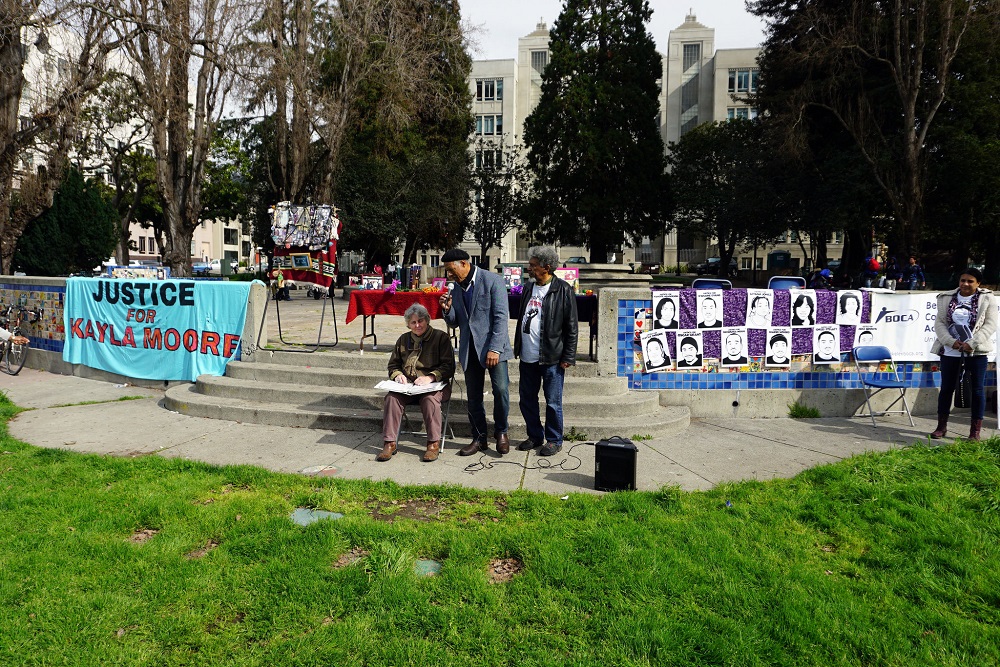
"Remember Our Names Black History Month Prayer Vigil"
(Photo: Mark Coplan)
The photo at right shows the backdrop for the event: the Justice for Kayla Moore banner at left, images of victims of killings by police at right, and artwork by event founder (and BOCA executive director) Rev. Daniel Buford on the raised central area. Rev. Buford is at center, wearing the beret. Kayla Moore's sister, Maria Moore, stands at the far right.

Many people gave testimony about the violence being carried out by representatives of the state all across this country, and particularly against people of color. Dozens of accounts, from research compiled by Rev. Buford, were read and discussed. People shared stories of violence and killings and other injustice that they had been subjected to, or that had affected their friends or families or other members of their communities.

Many people from the congregation I attend, University Lutheran Church (ULC), participated in the vigil. We at ULC have made an intentional commitment to anti-racism work, joining in solidarity with other justice activists in our city, our state, and nationally.

For my own part, I used my time at the microphone during the vigil to lift up the names of some people I have known and/or learned about through my work in Chicago before coming to Berkeley.

I talked about Flint Farmer, who was shot in the back by Chicago police and killed, as he lay face down on the ground. (See: We need to get the police off the streets of Chicago. QED. ) And I talked about Flint's father, Emmett, who I has become a tireless campaigner for justice on behalf of all people subjected to police violence. I said that each time I see the way Maria Moore has devoted herself to activism in response to what happen to her sister, Kayla, I always think of Emmett Farmer.

"Remember Our Names Black History Month Prayer Vigil"
(Photo: Mark Coplan)
I talked about Rekia Boyd, who was shot in the head by an off-duty Chicago police officer. (See: Chicago Vocabulary Lesson: "Overcharging" and "Undercharging") I talked about how people in Chicago made a commitment to #SayHerName, so that everyone would know Rekia's story. I talked about how the systemic injustice included not just the police, but the also the district attorney's office that failed to hold the police accountable. And I talked about how the people of Chicago voted states attorney Anita Alvarez out of office for her failures in cases like that of Rekia Boyd.

I talked about people who had suffered from police torture in Chicago -- people like Darrell Cannon and Mark Clements. I talked about seeing Mark show up to speak at protest after protest after protest against police crimes. If Mark -- freed after spending 28 years imprisoned on trumped-up charges -- can find the energy and courage to keep showing up to be an advocate for others, what's stopping the rest of us?

In the course of the afternoon, we lifted up the names of stories of people from dozens of places around the country. Systemic violence against people of color is not just a Bay Area thing, it's not just a Chicago thing, it's happening everywhere. (Flashback: National Forum on Police Crimes, May 2014)


A full album of photographs from the event is available on Flickr.


RELATED POSTS

CHICAGO: Accountability ... Police AND City Council
Chicago Justice: Connecting the Dots


Please share this post . . . .

Wednesday, October 19, 2016

SAY HER NAME: Kayla Moore and the Struggle for Justice

Did police response to a call involving mental health distress obey the Americans with Disabilities Act (ADA)? A court will look at Kayla Moore's experience . . . .


We remember Kayla Moore
4-17-71 to 2-13-13
poet, singer, sister, daughter, genius, friend
black trans woman with a mental health diagnosis
killed by Berkeley Police in her own home.
they tried to blame her death on "obesity" !!!
SHAME ON BPD!
JUSTICE FOR KAYLA
(Original art: Nomy Lamm)


Kayla Moore died at the hands of Berkeley police on February 13, 2013. Read "We Remember Kayla Moore" by Nomy Lamm (who created the poster above) to learn about Kayla Moore's life and how she died.

The Justice 4 Kayla Moore movement has grown steadily in the Bay Area. I was present at Federal Court in San Francisco on Monday when Judge Breyer said he would move forward with the court case brought by the family. He will hear arguments on the part of the complaint related to the Americans with Disabilities Act (ADA). Judge Breyer dismissed the parts related to excessive force and equal protection. (More to come on the possibility of appeal on those issues.) The month of November will provide important opportunities to support Kayla's family and the Justice 4 Kayla Moore movement.

When I lived in Chicago, I learned about the need for police accountability. I was very focused on Chicago, but I also learned about the situation in other parts of the country, particularly when leaders from around the country gathered in Chicago for the National Forum on Police Crimes. So I have arrived in Berkeley with my eyes open.

A particular case I learned about in Chicago involved Stephon Watts. It was my first introduction to what goes wrong when police use confrontation instead of de-escalation in responding to mental health-related distress calls.

The struggle for police accountability has been a difficult one in Chicago. It's turning out to be a difficult one throughout the country.  I expect it will be a difficult one in Berkeley.

But I'm inspired to see the strength of the growing movement here. And it's about to get stronger . . .

To be continued . . . .


Related posts


In the city where I live, "normal" or "right" or "acceptable" has been given a brutal construction by the power structure:

Police encounter black man on street
Police shoot black man
Black man dies
(Business as usual in Chicago.)

 (See We need to get the police off the streets of Chicago. QED.)


The State's Attorney for the Chicago area finally got around to bringing a charge against a police officer who shot and killed a citizen. Why, I wondered, didn't Anita Alvarez charge him with murder?

Then I remembered my Chicago vocabulary lesson.

(See Chicago Vocabulary Lesson: "Overcharging" and "Undercharging" )


Cook County Jail is the perfect example of the nationwide injustice that Michelle Alexander described in her groundbreaking book, The New Jim Crow: mass incarceration, focused principally one people of color, in which "crimes" (often related to drug possession or other low-level offenses) become the mechanism for entrapping people in a cycle of incarceration that is brutalizing and often begins a downward spiral of lifetime discrimination.

(See Free Them All )

Thursday, May 19, 2016

21st c. Berkeley: More Relevant Than Ever to Antiwar Movement

As a "peace" enclave within California's concentrated military/defense economy, Berkeley and the East Bay have a role to play in the discussion about China.


BERKELEY: Looking west -- the bay, San Francisco . . . and beyond.


As I set out to understand California's entanglement in the military-industrial complex, I started where I live: Berkeley.

Reading a letter to the editor from our representative in Congress, Barbara Lee, a few days ago reminded me that the 13th district is kind of unusual: "As the National Defense Authorization Act comes up for a vote, I will once again co-lead a bipartisan amendment to audit the Pentagon." (Read more on Barbara Lee's position on the Authorization for Use of Military Force Against Terrorists (AUMF).)

Yup, this is different than the town I just came from. Chicago's star corporate citizen is mega military contractor Boeing.

Of course, Berkeley was ground zero for the antiwar movement during the '60s. But what's its relevance today?


A bridge to China

As a long-time student of China and the Chinese language, I am enchanted to find myself in a city whose university attracts lots of the very smartest students from China and other parts of Asia. (See "Berkeley - International Student Enrollment - Fall 2015") Many other Berkeley students who are US citizens claim Asian ethnicity. (See "Berkeley - Enrollment Data")

If California, and especially the Bay Area, is the historic link between the US and China, Berkeley is a particularly vital US-China hub right now.

We all say things like "youth are our future" . . . . What would happen if we encouraged a serious discussion between the diverse people in the Berkeley community (and from other communities) about the future of peace and security in the Pacific region?


SOUTH CHINA SEA FACE OFF:
Does this make ANY sense?
The discussion we need to have

I wrote recently about the growing tensions in the South China Sea.

As I read the Chinese language paper every day, it is clear to me that -- in the absence of sustained civic discourse on the security issues in the Pacific region -- our future is being shaped by military posturing.

I think a good way to re-direct the conversation would be to get a large number of young people who know and care about the situation in the region to get together and talk. It should include people from the various countries and territories concerned. It should be directed at the future we're all trying to build together. It should place a strong premium on listening. It should be open-ended.


Some possible starting points

The good thing about a university town is that it has many of the ingredients necessary to conduct forums.

Now this I understand . . . !
(Image: Android Authority)
Here are a few available in Berkeley that might assist the type of discussion I am suggesting:

* Student associations, including Chinese Students Association, Taiwanese American Student Association,
Hong Kong Student Association, . . . .

* University departments, including International Relations and  Institute of East Asian Studies

* Citizen groups, including United Nations Association - East Bay

* Relevant University affiliates, such as Office of International Relations and International House - UC Berkeley


My hope and belief is that a Berkeley forum on peace and prosperity in the Pacific would reveal a shared interest in de-escalating the South China Sea confrontation, and dramatically increase awareness of shared Pacific prospects for well-being.


Related Posts

In four hundred and thirty-five Congressional districts, there is an inseparable relationship between campaign funding for Congressional races and the military contractors. How do we push back?


(See IT'S A LOCK: Why the US Can't Break Its Addiction to War)


What people in Asia (and others) have seen for the past century is that something is happening in the Pacific, and it's being driven in part by advances in naval (and, subsequently, aviation and electronics) technology, and in part by powerful nations (principally, but not limited to, the U.S.) proximate to the area.

(See The Imperialized Pacific: What We Need to Understand)


"Although we know the end from the very beginning," says Walker, "the story is no less compelling to watch." A man, gloriously alone (except for his own reflection) on an ice-covered lake; the soothing pastel colors of the distant sky; and what seems surely to be a circle he is digging around himself with a pick-axe. A perfect parable for our headlong rush toward climate crisis?

(See How Do You Say "Suicide Narcissus" in Chinese?)