Showing posts with label visual arts. Show all posts

Sunday, February 11, 2018

Trump and Nuclear Weapons? We need a different future . . . .

Dunne, Raby, and Anastassiades,
"Priscilla Huggable Atomic Mushroom"
from Designs for Fragile Personalities in Anxious Times


Yesterday I was at the Art Institute of Chicago and saw a staggering piece of art: "Priscilla Huggable Atomic Mushroom," from Designs for Fragile Personalities in Anxious Times by Anthony Dunne, Fiona Raby, and Michael Anastassiades.

The plush mushroom cloud is the perfect size to hug while curled up in a fetal position: "The soft, toylike object allows users to confront (and cuddle) their fear of nuclear annihilation directly."


"The soft, toylike object allows users to confront (and
cuddle) their fear of nuclear annihilation directly."
Dunne, Raby, and Anastassiades,
"Priscilla Huggable Atomic Mushroom"
 

I immediately thought of the Kurosawa film I Live in Fear, about a man who is alert to the risk of the next atom bomb dropping and can't rest until he finds some sort of solution.


Fearless samurai portrayer Toshiro Mifune plays against type
as the haunted protagonist of I Live in Fear.


And then there is what people in Hawaii experienced recently . . . .

Dunne and Raby have a book entitled Speculative Everything: Design, Fiction, and Social Dreaming, directed to getting us outside the ruts we're stuck in and inviting us to think about how the world could be completely different: "Dunne and Raby pose 'what if' questions that are intended to open debate and discussion about the kind of future people want (and do not want)."

What a perfect coincidence with the events of the past few days! We have just seen a vote of confidence in a new future by the people of Korea, as the teams from the North and the South marched together under one flag at the opening ceremony for the 2018 Winter Olympics in Pyeongchang.


Athletes march under the flag of a united Korea
at the 2018 Winter Olympic Games in Pyeongchang.
(New York Times photo)
.


Could there be a starker contrast with the stuck-in-the-past behavior of the current US president?


"CNN BREAKING NEWS . . . .
Trump: If N Korea keeps threatening, will be met with 'fire'."


And people in the US were confronted with that very mushroom cloud imagery again this past week as the cover story of TIME described Trump administration efforts to ramp up the US nuclear weapons program. The TIME piece described how the US government is toting out all the old arguments -- "we need more, bigger, better so that they don't get a step ahead of us!" -- while also reporting the argument for an alternative future: "Enough! We don't have to do this!"

For anyone willing to imagine the alternative future, here are two ways to work to make it happen:

(1) Support the effort of members of the US Congress to restrict the US president's ability to conduct a nuclear first strike.

(2) Support the effort of countries worldwide to bring about a global ban on nuclear weapons. (It's happening now at the United Nations!)

Working for an alternative future: do we really have any other choice?


LIMITED TIME ONLY!
O F F I C I A L
Trump Administration
Collectible Plush Toy
MEMORABILIA!
offer good while supplies last . . . .


Related posts

Bunker Mentality

Is Kim Jong-un giving the US its "Suez Crisis"?

Korea: A History of Living Under Nuclear Terror

Nuclear Weapons: People Power Over Trump Power

133 Is a Lot of #Nuclearban-Supporting Countries


Please share this post . . . .

Thursday, April 21, 2016

WELCOME MAT USA: Come in! Come in! (Get out! Get out!)


Ester Hernandez, Sun Raid
Un-naturally harvested
SUN*RAID
RAISINS
Guaranteed Deportation
Mextecos, Zapotecos, Triques, Purepechas
by-product of NAFTA


Saturday is the anniversary of Cesar Chavez' death in 1993, and it seems like an opportune time to lift up the work of artist Ester Hernandez.  I first saw her poster Sun Raid at the "Fires Will Burn" exhibition at DePaul University in Chicago.

Sun Raid is a searing reminder that people in the US have always been happy to welcome immigrants to help make their businesses profitable and make sure they had cheap stuff and cheap labor . . . . but how dare they expect to be treated like people!

(For a book-length treatment of this subject, see Juan Gonzalez's Harvest of Empire: A History of Latinos in America.)

We are living in a year in which we are seeing Donald Trump get away with demonizing immigrants. Maybe we need to take advantage of this moment and turn the phenomenon on its head. Who, after all, are the immigrants? Who is "entitled" to be here? What can it possibly mean anymore to say that certain people are tolerated and others are "illegals"?

I've heard people say that the problem is that Trump is a master at using the media to get attention, and the rest of us need to get with the times. Okay, here's my contribution:


Eva Longoria on The Late Show with Stephen Colbert:
"We didn't cross the border, the border crossed us."
Maybe when Eva Longoria says it, people will remember???
(Please retweet this message.)


A few weeks ago, on The Late Show with Stephen Colbert, super-celebrity Eva Longoria repeated the expression familiar to many of us: "We didn't cross the border, the border crossed us." Maybe when she says it, people will remember???

More on "We didn't cross the border, the border crossed us" here.


Related posts

It will take me multiple posts to spell out everything that I feel needs to be said about the Ayotzinapa 43.  People in the US need to work to change their own attitude about Mexico, and about the culpability or all of us here in the US in the wrongs that are being done down there. The Ayotzinapa 43 were persecuted for saying "the future can be different." It's time for us to take up their cry.

(See Ayotzinapa43: US People Need an Attitude Adjustment )


El Buen Pastor by Luis Jiménez depicts Ezekiel Hernandez -- a shepherd who was shot by U.S. marines in the area around the US-Mexico border as he was tending his sheep. The artist has said, "having [marines] patrolling the border in the 'war on drugs' is 'an accident waiting to happen.'"

(See Holy Week 2016 and "El Buen Pastor")


Part of what I loved about Du Hai was the way it used large pieces of fabric to convey the sensation of being in a boat among billowing waves, and the multiple uses to which they put the fabric - sea, clouds, sail, and more. Even a newcomer to modern dance, such as myself, could grasp what was going on.

(See Wanna Fix the U.S.A? Welcome an Immigrant Today! )

Monday, April 18, 2016

Do you dare make THIS human connection? ("Humans of Syria" Photography Exhibit at University Lutheran Chapel)


Humans of Syria photo exhibition at University Lutheran Chapel in Berkeley


On Saturday night I attended the opening of the photo exhibition Humans of Syria at University Lutheran Chapel in Berkeley.

All of us have heard a lot about the war in Syria and the refugee crisis. How many of us can picture an actual Syrian person?

The exhibition at the Chapel invites you to look into the eyes of the people affected by the war, and enter into their stories. There are dozens of examples I could share with you.  The story of this little boy was the most unforgettable to me:


"I stopped going to school because of the situation here, but I miss it. I carry
 a pen with me wherever I go and write on anything I can. I write down my name,
 and the names of my dad and brother. My dad is in prison and my brother was
killed two years ago." (Moaz, 9 years old. He has been living under siege
for the past two years. Photo taken 08/04/2015 - Douma, Eastern Ghouta, Syria)


Perhaps the story is unforgettable because it is a story about a boy who identifies himself as I identify myself: as a writer. And maybe it is unforgettable because, when I look closely at the features of this boy's face, I see a remarkable resemblance to the face of my own sown.

You can look at lots of photos online. But I encourage you to go to see the exhibition in person and experience it up close, in the company of others.

Logan Square laments with Syria
I also encourage you to attend worship on a Sunday morning in the Chapel.  It provides an entirely new perspective on "going to church" when the sights and sounds and smells and fellowship of the liturgy are all amplified by the a photo exhibition like this -- and vice versa. It has a way of saying "this is not just an abstract exercise we're engaged in here."  This past Sunday, as I sat in the chapel, participating in the Eucharist and taking in the images all around me, I remembered the months in 2012 when we at St. Luke's Lutheran Church in Logan Square, Chicago, were surrounded with images of the war in Afghanistan. And I remembered praying under the eagle monument in Logan Square during a vigil for those suffering in Syria.

Many of us are already involved in advocacy and service in connection with the war in Syria and the refugee crisis. This exhibition reminded me that if we hope to be effective we must keep seeking to make a deeper and deeper human connection.


For hours and additional information on the exhibition, see the details on the Facebook event page for the exhibition opening.


Related posts

Perhaps the most troubling residue of the Syria crisis is that so much of our national discussion was centered on what our interests are, and whether we can force others to do what we want, and who our friends and who our enemies are. What's missing in all this is the question: what can we do to alleviate the suffering of the people of Syria?

(See Syria: Where Have We Ended Up?)


If we are willing to see the beauty will it help us to overcome our fear?

(See Syria - Strange and Dangerous? or Familiar and Beautiful?)


Sergey Ponomarev won first prize in the 2016 World Press Photo awards: General News for this November 16, 2015 photo: "Refugees arrive by boat near the village of Skala on Lesbos, Greece."
(See Image to Action: Sergey Ponomarev on the Refugee Crisis)


If we are going to stave off a U.S. war against Iran, we are going to have to have some very difficult conversations with other Americans. Some people are extremely hostile. It's confusing and a bit frightening, but we're going to have to confront it.

(See Why Does Iran Arouse So Much Hostility?)

Monday, November 30, 2015

When the facts all point to one conclusion: "No More Nukes"

Ronald Reagan and Mikhail Gorbachev
About 9 months ago I wrote a post about the Reagan-Gorbachev meeting in Iceland, and I said that, "what Reykjavich does tell us is: Obama and Putin need to sit down together and talk total nuclear disarmament."

Two days ago, in one of my posts after returning from the World Nuclear Victims Forum in Hiroshima, I talked about the fact that activists need to master the scientific data about nuclear radiation - including that from nuclear power and nuclear weapons.

During my time in Hiroshima, I was fortunate to have the opportunity to talk with the forum's keynote speaker, Dr. Tilman Ruff, about these issues. When we talked about Reykjavich, Dr. Ruff told me about the key role played by physicians who met with Gorbachev and laid out the science for him. Dr. Ruff has generously compiled the references to that story - which I share here . . . .

Mikhail Gorbachev
Mikhail Gorbachev commented in an interview in 1994 that when he received control over the Soviet nuclear arsenal: “Perhaps there was an emotional side to it…. But it was rectified by my knowledge of the might that had been accumulated. One-thousandth of this might was enough to destroy all living things on earth. And I knew the report on ‘nuclear winter.’” In "Mikhail Gorbachev explains what's rotten in Russia” (Mark Hertsgaard, Salon.com, Sept. 7, 2000), he said,“Models made by Russian and American scientists showed that a nuclear war would result in a nuclear winter that would be extremely destructive to all life on Earth; the knowledge of that was a great stimulus to us, to people of honor and morality, to act in that situation.”

Gorbachev credited International Physicians for the Prevention of Nuclear War (IPPNW) with his decision to halt nuclear testing and reach agreements to reduce nuclear arms with the US:

“I admire both your movement and its work … We take into account the activities of your movement in shaping our foreign policy” (M Gorbachev, communication to IPPNW, 2 June 1987)

"I want to thank you for your great contribution to preventing nuclear war. Without it and other effective antinuclear initiatives this [INF] Treaty would probably have been impossible.” (Mikhail Gorbachev 1993)

“Their work commands great respect. For what they say and what they do is prompted by accurate knowledge and a passionate desire to warn humanity about the danger looming over it. In light of their arguments and the strictly scientific data which they possess, there seems to be no room left for politicking. And no serious politician has the right to disregard their conclusions.” (Mikhail Gorbachev, about IPPNW, in his political autobiography, Perestroika, 1987)

International Physicians for the
Prevention of Nuclear War (IPPNW)
When Ronald Reagan was asked about the effects of nuclear war for a February 12, 1985 interview in The New York Times, he said:“A great many reputable scientists are telling us that such a war could just end up in no victory for anyone because we would wipe out the earth as we know it. And if you think back to ... natural calamities - back in the last century, in the 1800’s, ... volcanoes - we saw the weather so changed that there was snow in July in many temperate countries. And they called it the year in which there was no summer. Now if one volcano can do that, what are we talking about with the whole nuclear exchange, the nuclear winter that scientists have been talking about? It’s possible ...”

(And at the 1986 IPPNW World Congress in Cologne – New Zealand Prime Minister David Lange credited New Zealand doctors through IPPNW with having played a significant role in the development of New Zealand’s nuclear free status: “You have made medical reality a part of political reality.”)


The moral of the story: the data about the threat from nuclear weapons and nuclear radiation -- when made known -- can put an end to politics as usual.


Related posts

It can all happen very fast . . . . No one really knows ahead of time what will happen . . . . That's why it's so important for people to get together and talk.
(See The Lesson of Reykjavik: TALK About Nuclear Disarmament (You Never Know) )


Nuclear radiation is invisible. It needs to be measured and counted to be recognized, and it requires careful scientific method to be understood. Measuring and counting and science are difficult. But . . .

(See GLOBAL HIBAKUSHA: Doing the work to render the invisible visible)


The logic is simple: nuclear power and nuclear weapons result in irreparable harm to human health. Decades of evidence is in. There's no more disagreement. Now it's just a political problem. (And everyone knows: Bill Gates is nothing if not logical.)

(See NO NUKES PHILANTHROPY: How to spend $1 billion wisely)

Friday, October 30, 2015

In Praise of Nonconformity: Vagrants, Misfits, Rebels, and Liumang

The Vagrants: A Novel by Li Yiyun
I've just finished reading The Vagrants: A Novel by Li Yiyun.

Now the first thing I'll say is that everyone should read everything Li Yiyun writes. I particularly like the stories in the collection, Gold Boy, Emerald Girl.

A couple of things about The Vagrants struck me particularly.

One is that this novel is gives a very realistic account of people in China being swept up in all kinds of different ways in a political campaign. I've read a lot of fiction from China that deals with this issue, but I've never read anything that does so while also conveying the feeling of private life and inner life so convincingly.

Another -- and this is what inspired this blog post -- is that I found myself taken with the central character -- a boy named Bashi -- despite the fact that he is an odd duck . . . a nuisance . . . and potentially worse. (Bashi isn't the only "vagrant" in Li's novel.  In fact, just about everybody who is described has broken free of the moorings of that crushing social system, or nearly so.)

I kept thinking to myself, "This Bashi is just like all those odd boys in Flannery O'Connor novels and stories -- the abrasive Enoch Emery in Wise Blood, the stuck-in-his-ways Francis Tarwater in The Violent Bear It Away." Those were characters who made me more and more anxious with each page I read, because they not only had wacky ideas, but they were living them out. I read a lot of O'Connor in college, and wrote quite a bit about her works, and it's only just now becoming clear to me what I really felt as I was doing it.

Wise Blood by Flannery O'Connor
These characters often cross the line from "different" to "criminal." (As I said, anyone reading The Vagrants will wonder when Bashi is going to do something really awful.)  After all, Flannery O'Connor didn't just subject me to Enoch Emery and Francis Tarwater, she also made me witness the sadism of "The Misfit" (in "A Good Man is Hard to Find").

Thinking about this has put me in mind of one of my favorite films, City of Sadness. In it, the patriarch of a Taiwanese family describes how his family were always liumang -- operating at cross-purposes with the authority being imposed by the Japanese occupiers in the first half of the 20th century, or by the officials sent by the central Chinese government before that -- in short, anyone who tried to tell them what to do.  Liumang is common Chinese vocabulary word, which we students were taught meant something along the line of "juvenile delinquents" or "bad apples," and in etymology it has some of that flavor of "unmoored." But it was the pride with which the old man in described his family's traditional liumang status that made me thing of it as something to valorize.


The film's subtitiles translate liumang as "gangsters." Take two minutes to click on the City of Sadness trailer above, and see what it feels like to you. Yes, there is a definite element of racketeering. But there's also a feeling of simple, youthful, impulsive, bad behavior. Sort of The Godfather meets Rebel Without a Cause. meets Rome, Open City. (More about this aspect of City of Sadness here.)

I guess the lesson for me in all of this is that we need vagrants, misfits, rebels, and liumang. And that while anxiety is worth noticing, that's not the same as saying it's undesirable, or should be shunned.

So: here's to nonconformity! And to the anxiety it creates . . . .


Related posts

 So as I watched Ziggy for the first time last night, I asked myself, "What is it? What is it? What is the frisson that one feels? It's part charisma, part sexuality, partly the thrill of gender-bending, partly adolescent rebellion . . . . But what is it that Ziggy did (and does) for so many people?" (It can't be a single thing, can it?)

(See "You're NOT alone!" (Ziggy the Subversive) )


The very act of free expression, itself, has become so hazardous ... what you say hardly matters . . . "He could not help feeling a twinge of panic. It was absurd, since the writing of those particular words was not more dangerous than the initial act of opening the diary." (From 1984 by George Orwell)

(See Building Metropolises of Self-Censorship )


I believe that once the Church comes out of the closet -- that is, once we start speaking quite openly about the difference between the world as we find it and the world as we believe God wishes it to be -- there is no way this old world will be able to stay the same.

(See Let the Church Out of the Closet )


In a composition suggestive of a yin-yang symbol, a woman in a burka (but wearing audacious red glitter platform heels) is surrounded by genie-ish tableaus of the many male obsessions/pastimes that some of us rail about frequently -- sexualized pop singers, professional sports -- as well as some that we probably should rail about more (such as patriarchy in religion and political violence).

(See VIOLENCE: " . . . and the women must live with the consequences . . . " )


Posterboard and markers: $21.79
Leaflets: $7:50
Bullhorn: $99.99
Standing up for peace and justice when everyone around you is saying "Get a job!" and "GO F**K YOURSELF!": PRICELESS!

(See Dissent: PRICELESS!)


Monday, September 22, 2014

Channeling Zhong Kui (the Demon Queller)

One of my favorite memories of my time in Taipei was a museum exhibit devoted to a character named Zhong Kui - "the demon queller."

The National Palace Museum is the repository of an enormous treasure trove of art objects transported to Taiwan c. 1949, when the KMT government lost control of the mainland to the Chinese Communist Party. Whatever you think about the morality of that development -- whether you view it as "looting" or "preservation" -- the fact is that it provided hours and hours of exquisite enjoyment for a student living in Taipei in 1979.

I can still close my eyes and remember being inside the Palace Museum - cases containing Song masterpiece after Song masterpiece, in quite, softly-lit, elegantly-outfitted, vaguely aromatic (sandalwood?) galleries. Each of the paintings contained a miniature world, inviting you to enter deeper and deeper in, so that it seemed you would never have the time to explore all of the worlds they offered.  In addition to paintings, there were galleries for all the different types of Chinese artwork - porcelain, bronzes, carvings, etc.


Zhong Kui painted by the Shun Zhi Emperor (detail)
Zhong Kui as a portal

The Zhong Kui exhibit at the Palace Museum had dozens of paintings and other objects, all related to the character Zhong Kui.

I particularly like the way Zhong Kui's eyes were depicted. They were almost always shown enlarged, as if Zhong Kui were in some sort of trance or manic episode.

Sometimes, they seemed to be shown to be directed in 2 different directions, much like those of the comic actor Marty Feldman.

(Why did I find this maniac look so charming?)

I also particularly liked several of the paintings that combined the story of Zhong Kui with some of the other conventions of traditional Chinese painting; it made it seem like a particularly worthwhile invitation to enter into the painting and go on an exploration:


Zhong Kui by Huang Shen


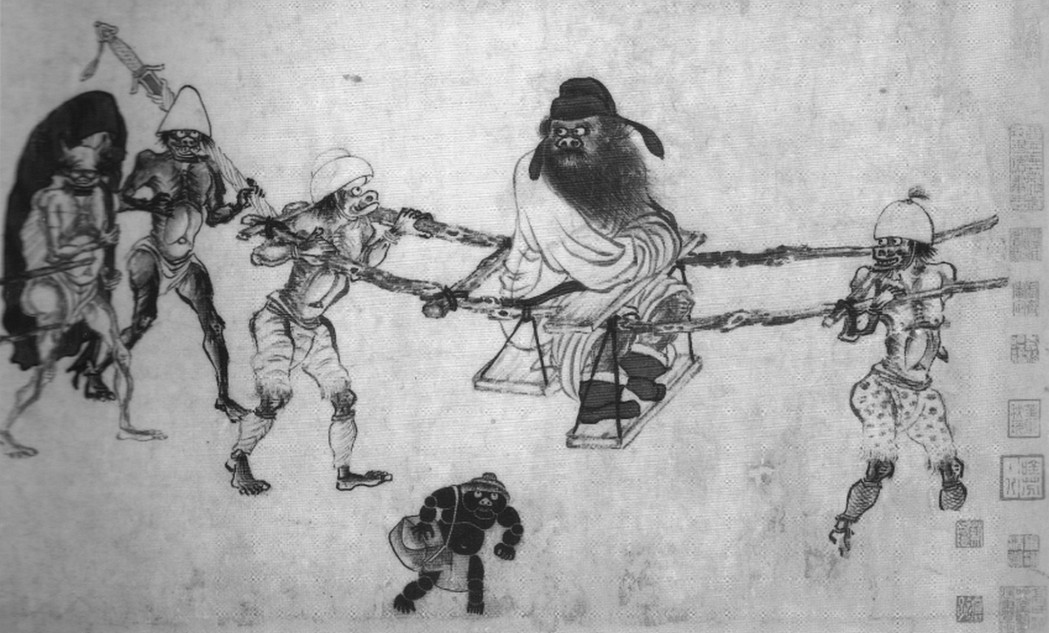
And I was captivated by a long scroll which showed Zhong Kui together with his rather ghoulish minions - each of which as interesting as Zhong Kui himself:


Gong Kai, Zhong Kui Traveling (c. 1304)
Freer Gallery of Art in Washington, D.C.
(Click to see large-size image.)

Here's a close-up:


Gong Kai, Zhong Kui Traveling
(Click to see large-size image.)

Variations on a theme

Most of all, I think I liked the way there could be so many different genres in which to depict a single character like Zhong Kui, while still remaining within the four walls of "Chinese" culture.

For instance, there's Zhong Kui as character in Peking opera:


Peking Opera: Zhong Kui Marry His Younger Sister Off


Zhong Kui in folk art decoration:


Zhong Kui: Chinese New Year Decoration (stamp)

and folk craft:


Zhong Kui depicted in Chinese-style paper cutting


Objets-d'art such as snuff bottles . . .


Nephrite Jade Zhong Kui snuff bottle


And on and on . . . .

Not surprisingly, as with much else in Chinese culture, the Zhong Kui story has passed into Japanese culture as an object of interest, and he is known there as Shoki. Hence we see a whole panoply of Japanese versions of Shoki the demon queller . . . .

I'm particularly fascinated by the Japanese-style tattoos of Zhong Kui:


Full-back Shoki tattoo


. . . and also Shoki netsuke:


Shoki netsuke


Notably, it fell to a Japanese ukio-e (woodblock print) artist to create a depiction of the first great Chinese artist to paint Zhong Kui:


Totoya Hokkei, Wu Daozi Painting Zhong Kui
(Read the description on the Harvard Art Museums website.)
(Click to see large-size image.)


The Zhong Kui story, and Zhong Kui as metaphor

Of course, the most charming thing about Zhong Kui is his story. His characteristic outfit is the robe and special hat of the scholar, and that is because he only became the demon queller after first successfully passing the imperial examinations, only to be refused admission to the official ranks because the judges found him to be too ugly.  Infuriated and despondent, Zhong Kui took his own life by dashing his head against a wall. At the gates of Hell, the King of Hell recognized Zhong Kui's virtue and so put him to work quelling demons.

I suppose I found this especially appealing because, at the time, I and my fellow students were in a Chinese language program that involved 4 hours a day of class (2 hours 1-on-1 and 2 hours 1-on-2) that often left us feeling like we had been washed up at the gates of Hell. The notion of having one's virtue recognized -- by somebody -- was hard to ignore.

At the time, I, myself, probably paid inadequate attention to the centrality of ghosts and demons to Chinese folk religion. This was not the case with some of my fellow students, notably Buzzy Teiser, author of The Ghost Festival in Medieval China.

Years later, however, in the days when I traveled frequently to China and brought home picture books for my children depicting the adventures of Monkey battling all manner of demons, I began to take seriously the importance of demons and demon-quelling as a metaphor.  (And that includes here and now in our own culture.)


So . . . if perchance you happen to see me 
walking along . . . bearing a wild, bristling beard . . . 
and a dazed expression . . . fear not! 

I'm simply channeling Zhong Kui . . . !


Joe Scarry (photo courtesty Roger Beltrami)

More about Taipei c. 1979 . . . .


Related posts

Ai Weiwei is a fascinating character, and particularly interesting to me because of my years of involvement with China. But at some point I started to wonder if the situation of Ai Weiwei and other dissidents in China isn't just too remote to be relevant to most Americans. Somehow it was only when I saw these re-creations of the detention experience that I saw how directly connected the experience of Ai Weiwei is to that of people the U.S. persecutes.

(See Ai Weiwei: So Far Away, and Yet So Close (Take 1) )


So there are these terrible things called nuclear weapons, and it just turns out that they hover around the Korean peninsula, as if "Korea" and "crazy nuclear terror" belonged together. And I thought to myself, "Where have I heard this before?"

(See The Cynical American Scapegoating of Korea as a Cover for Nuclear Terror )


In the January 2010 Hong Kong demonstrations, black- and white-costumed protesters with placards that said that "functional constituencies trample workers" reminded me of commedia dell'arte characters.

(See Black and White in HK )


One of my other favorite discoveries about Taipei of that time was Cloud Gate Dance Theater

(See Taiwan Kinaesthetics: Cloud Gate Dance Theater )