Showing posts with label police. Show all posts

Monday, February 13, 2017

Berkeley Organizing Congregations for Action (BOCA) Leads Black History Month Vigil: "Remember Our Names"

Several groups worked together on Monday in Berkeley to lift up the names and stories of people who have suffered from police violence and other forms of systemic racism in the US. The vigil by members of Berkeley Organizing Congregations for Action (BOCA), Justice 4 Kayla Moore, and Berkeley Copwatch was titled "Remember Our Names Black History Month Prayer Vigil" - and took place for five hours between noon and 5:00 p.m. in the Martin Luther King Jr. Civic Center Park, facing Berkeley City Hall and the headquarters of the Berkeley Police Department.


Members of St. John's Presbyterian Church share names and stories.
(Photo: Mark Coplan)


February 13 is the anniversary of the murder of transgender African American woman Kayla Moore by the Berkeley Police Department 4 years ago. (See SAY HER NAME: Kayla Moore and the Struggle for Justice)
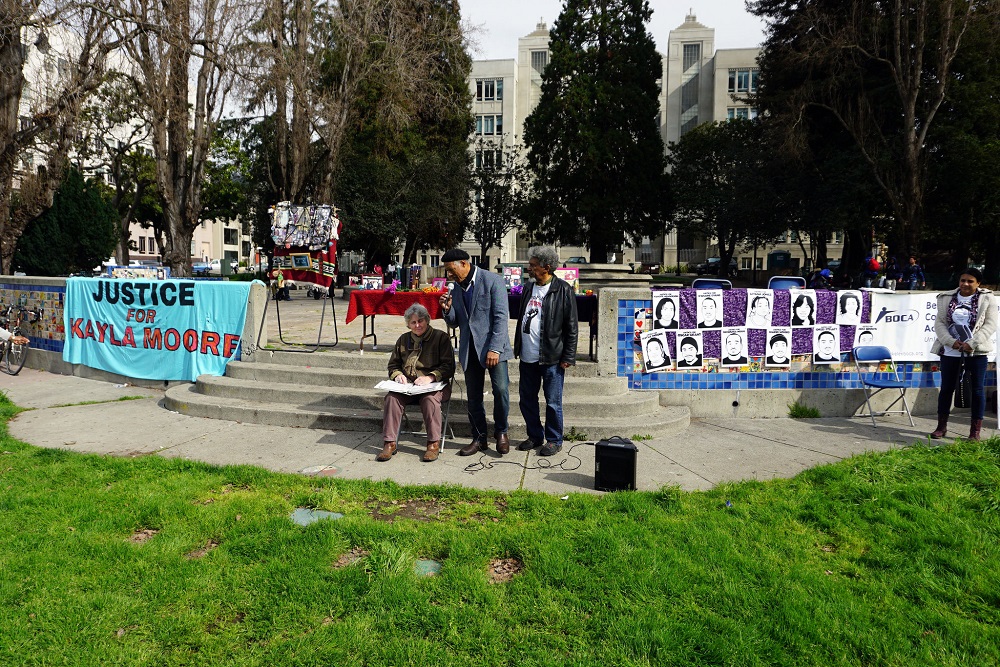
"Remember Our Names Black History Month Prayer Vigil"
(Photo: Mark Coplan)
The photo at right shows the backdrop for the event: the Justice for Kayla Moore banner at left, images of victims of killings by police at right, and artwork by event founder (and BOCA executive director) Rev. Daniel Buford on the raised central area. Rev. Buford is at center, wearing the beret. Kayla Moore's sister, Maria Moore, stands at the far right.

Many people gave testimony about the violence being carried out by representatives of the state all across this country, and particularly against people of color. Dozens of accounts, from research compiled by Rev. Buford, were read and discussed. People shared stories of violence and killings and other injustice that they had been subjected to, or that had affected their friends or families or other members of their communities.

Many people from the congregation I attend, University Lutheran Church (ULC), participated in the vigil. We at ULC have made an intentional commitment to anti-racism work, joining in solidarity with other justice activists in our city, our state, and nationally.

For my own part, I used my time at the microphone during the vigil to lift up the names of some people I have known and/or learned about through my work in Chicago before coming to Berkeley.

I talked about Flint Farmer, who was shot in the back by Chicago police and killed, as he lay face down on the ground. (See: We need to get the police off the streets of Chicago. QED. ) And I talked about Flint's father, Emmett, who I has become a tireless campaigner for justice on behalf of all people subjected to police violence. I said that each time I see the way Maria Moore has devoted herself to activism in response to what happen to her sister, Kayla, I always think of Emmett Farmer.

"Remember Our Names Black History Month Prayer Vigil"
(Photo: Mark Coplan)
I talked about Rekia Boyd, who was shot in the head by an off-duty Chicago police officer. (See: Chicago Vocabulary Lesson: "Overcharging" and "Undercharging") I talked about how people in Chicago made a commitment to #SayHerName, so that everyone would know Rekia's story. I talked about how the systemic injustice included not just the police, but the also the district attorney's office that failed to hold the police accountable. And I talked about how the people of Chicago voted states attorney Anita Alvarez out of office for her failures in cases like that of Rekia Boyd.

I talked about people who had suffered from police torture in Chicago -- people like Darrell Cannon and Mark Clements. I talked about seeing Mark show up to speak at protest after protest after protest against police crimes. If Mark -- freed after spending 28 years imprisoned on trumped-up charges -- can find the energy and courage to keep showing up to be an advocate for others, what's stopping the rest of us?

In the course of the afternoon, we lifted up the names of stories of people from dozens of places around the country. Systemic violence against people of color is not just a Bay Area thing, it's not just a Chicago thing, it's happening everywhere. (Flashback: National Forum on Police Crimes, May 2014)


A full album of photographs from the event is available on Flickr.


RELATED POSTS

CHICAGO: Accountability ... Police AND City Council
Chicago Justice: Connecting the Dots


Please share this post . . . .

Wednesday, October 19, 2016

SAY HER NAME: Kayla Moore and the Struggle for Justice

Did police response to a call involving mental health distress obey the Americans with Disabilities Act (ADA)? A court will look at Kayla Moore's experience . . . .


We remember Kayla Moore
4-17-71 to 2-13-13
poet, singer, sister, daughter, genius, friend
black trans woman with a mental health diagnosis
killed by Berkeley Police in her own home.
they tried to blame her death on "obesity" !!!
SHAME ON BPD!
JUSTICE FOR KAYLA
(Original art: Nomy Lamm)


Kayla Moore died at the hands of Berkeley police on February 13, 2013. Read "We Remember Kayla Moore" by Nomy Lamm (who created the poster above) to learn about Kayla Moore's life and how she died.

The Justice 4 Kayla Moore movement has grown steadily in the Bay Area. I was present at Federal Court in San Francisco on Monday when Judge Breyer said he would move forward with the court case brought by the family. He will hear arguments on the part of the complaint related to the Americans with Disabilities Act (ADA). Judge Breyer dismissed the parts related to excessive force and equal protection. (More to come on the possibility of appeal on those issues.) The month of November will provide important opportunities to support Kayla's family and the Justice 4 Kayla Moore movement.

When I lived in Chicago, I learned about the need for police accountability. I was very focused on Chicago, but I also learned about the situation in other parts of the country, particularly when leaders from around the country gathered in Chicago for the National Forum on Police Crimes. So I have arrived in Berkeley with my eyes open.

A particular case I learned about in Chicago involved Stephon Watts. It was my first introduction to what goes wrong when police use confrontation instead of de-escalation in responding to mental health-related distress calls.

The struggle for police accountability has been a difficult one in Chicago. It's turning out to be a difficult one throughout the country.  I expect it will be a difficult one in Berkeley.

But I'm inspired to see the strength of the growing movement here. And it's about to get stronger . . .

To be continued . . . .


Related posts


In the city where I live, "normal" or "right" or "acceptable" has been given a brutal construction by the power structure:

Police encounter black man on street
Police shoot black man
Black man dies
(Business as usual in Chicago.)

 (See We need to get the police off the streets of Chicago. QED.)


The State's Attorney for the Chicago area finally got around to bringing a charge against a police officer who shot and killed a citizen. Why, I wondered, didn't Anita Alvarez charge him with murder?

Then I remembered my Chicago vocabulary lesson.

(See Chicago Vocabulary Lesson: "Overcharging" and "Undercharging" )


Cook County Jail is the perfect example of the nationwide injustice that Michelle Alexander described in her groundbreaking book, The New Jim Crow: mass incarceration, focused principally one people of color, in which "crimes" (often related to drug possession or other low-level offenses) become the mechanism for entrapping people in a cycle of incarceration that is brutalizing and often begins a downward spiral of lifetime discrimination.

(See Free Them All )

Tuesday, July 19, 2016

Chicago Aldermen Stepping Up for Police Accountability

A bill is going before Chicago City council to assure a democratically elected civilian body holds the police accountable.


In the past I publicized a poster showing the members of Chicago City Council with the word MISSING in bold red letters superimposed over it.  Now it's time to replace that with a new poster, because some members of Chicago City Council are stepping up for police accountability.

What this means is accountability for Chicago's police and also for the City Council itself.

The bill's sponsor is Carlos Ramirez-Rosa (35th) (P) and he is reported to have the support of 8 more aldermen (including 3 who are fellow members of the Progressive Caucus, and 3 who are members of the Black Caucus):

Joe Moreno (1st)
Susan Sadlowski Garza (10th) (P)
Toni Foulkes (16th) (P) (BC)
Howard Brookins Jr. (21st) (BC)
Ricardo Munoz (22nd) (P)
Roberto Maldonado (26th)
Emma Mitts (37th) (BC)
Ameya Pawar (47th)

Members of the Progressive Caucus are designated with a (P). It is hoped that they will bring along other members of the 11-member Progressive Caucus as well.

Members of the Black Caucus are designated with (BC). Other members are Chair Ald. Roderick T. Sawyer (6), Ald. Pat Dowell (3), Ald. Will Burns (4), Ald. Leslie Hairston (5), Ald. Greg Mitchell (7), Ald. Michelle Harris (8), Ald. Anthony Beale (9), Ald. David Moore (17), Ald. Derrick Curtis (18), Ald. Willie B. Cochran (20), Ald. Michael Scott (24), Ald. Walter Burnett (27), Ald. Jason Ervin (28), Ald. Chris Taliaferro (29), Ald Carrie Austin (34) and Ald. Emma Mitts (37)

You can help by reaching out to your alderman today. (Find your alderman and contact info here.) If they're already a supporter (list above) - thank them. If they're not yet a supporter - urge them to become a co-sponsor.


More background on the campaign for police accountability in Chicago:

Will Chicago Televise Hearings on Civilian Police Accountability Agency?

CHICAGO CITY COUNCIL: Impose Civilian Control on CPD

A Modest Proposal for Chicago's Progressive Caucus: Support CPAC

Does a Civilian Police Accountability Council (CPAC) need to be part of a "new plan of Chicago"?

#PeopleOverPolice: Is This What Democracy Looks Like?

Chicago Vocabulary Lesson: "Overcharging" and "Undercharging"

We need to get the police off the streets of Chicago. QED.

CHICAGO: Twilight Zone? Constitution-Free Zone? (What's it look like to YOU?)

Monday, July 11, 2016

Memo to #Hillary: #BlackLivesMatter

Just about the only way Hillary Clinton could manage to fail to beat Donald Trump in 2016 is if a large block of voters abandons her in disgust.


Memo to #Hillary: #BlackLivesMatter (please retweet)


I'm perplexed that the Democratic Party does not have a more forthright response to the urgent need to intervene in the most life-threatening racist institutions in the US.

The obvious consequence of their failure to step up will be that people who believe #BlackLivesMatter will refuse to vote in November.

Maybe we should tell them loud and clear right now: tell us what you're gonna do or face a voter boycott.

I said it a year ago: "If elected . . . ." (The Election 2016 and #BlackLivesMatter Nexus)

(Cue sound of sand running through hourglass . . . . )

Friday, July 1, 2016

Crime Without Remorse: A USA Specialty

Dostoevsky's Crime and Punishment is about an individual student in 19th century Russia who murders an old woman. But it also tells the story of the USA . . . .

Dostoevsky, Crime and Punishment
I sat at an antiracism training sponsored by the ELCA Sierra Pacific Synod last week. One of the participants said, "Our country - we adopt the attitude that nothing we do is ever wrong." I thought it was a simple, elegant explanation of what is meant by "American exceptionalism." It certainly resonated with me, as I have been thinking about the question, "What is it that we as Christians need to face up to in this country? at the most fundamental level?"

I've been reading Dostoevsky's Crime and Punishment again. This time I'm enjoying reading it in an old paperback edition -- the same one that was around our house when I was growing up. Every time I read it I'm struck by layers of meaning that I can't remember noticing before. 

As I began reading, I recalled that a few years ago Edward Snowden was given a copy of Crime and Punishment by his Russian lawyer. At the time I suggested the attorney was using the book to subtly raise the question, "Where are the real crimes that we should be focusing on?"

I noticed three things as I read Crime and Punishment this time:

Jacques-Louis David,
The Emperor Napoleon in His Study
at the Tuileries
(Art Institute Chicago)
(1) It's about politics. I had never before taken seriously the importance of Napoleon as a model for the kind of actor on the world stage who is "entitled" to bring about suffering, because it is offset by his great accomplishments. Perhaps to us readers today, Napoleon is a caricature; but at the time the novel was written, he had transformed society, and people who wanted to do things in the world pondered his example very seriously. (Consider: who are the "big players" that people look up to today?)

(2) It's about relativism. The murder committed by the book's protagonist is about as horrible as you could imagine. The book relentlessly zeroes in on him and his physical, emotional, and moral state. And yet . . . . I was struck by this statement, a kind of throwaway line from another character in the book: "It's as well that you only killed the old woman. If you'd invented another theory you might perhaps have done something a thousand times more hideous." (Bantam paperback, p. 396) (Consider: what are the theories we use to justify suffering by other people at our hands today?)

(3) It's about our resistance to remorse. Up until the very last pages, the protagonist is unable to simply say, "I was wrong." (Consider: why can't we admit we were wrong? what are we afraid might happen?)

I wonder: what would happen if students were encouraged to read this book and given the following guidance:  "Dostoevsky's Crime and Punishment is about an individual student in 19th century Russia who murders an old woman. But it also tells the story of the USA . . . . " ? ? ?


Related posts

With drones, people become just dots. "Bugs." People who no longer count as people . . . .

(See Drone Victims: Just Dots? Just Dirt? )


Now that it is available online, every American should read the Justice Department memo approving the targeted killing of Anwar Al-Awlaki. Let's face it: the Obama administration and the rest of the U.S. government know that they have a big problem: they want to go to war against anyone they suspect is an enemy -- and skip the rule of law. They wish that a miracle could happen and everyone would just let them do it.

(See A Layman Reads Obama's "Targeted Killing" Memo )


A big Hollywood production of Ender's Game is scheduled for release on November 1. It's a perfect opportunity for us to ask: Are we happy seeing our schools turned into "Battle Schools"?

(See "Ender's Game" and the Militarization of Youth: Can We Talk About This? )


"Once the boat went to full pressure, there was really no other option."

(See In Whose Machine Will YOU Be a Cog? )


Svetlana Geier, translator of Dostoevsky's "elephants" (The Brothers Karamazov, Crime and PunishmentThe Idiot, The Devils, and Raw Youth) into German.

(See Would You Buy an Elephant from This Woman?)

Tuesday, June 21, 2016

To Grab the Win, Might Trump or Hillary Surprise Us?

Election 2016: hijinks at the Democratic and Republican conventions notwithstanding, it's gonna be Donald Trump and Hillary Clinton . . . and it's still about ISIS and Black Lives Matter.


It's time to ask again: where are you on #war and #BlackLivesMatter?
(Please retweet this message.)


A year ago, I suggested that election 2016 will come down to how the candidates proposed to deal with ISIS, and whether they could respond to the urgency of the Black Lives Matter movement.

Well, if what I meant was that by this time, we would have heard substantive, coherent, memorable proposals from Donald Trump and Hillary Clinton, then I was wrong. But I still stand by my prediction that these are the two issues that will matter.


Trump and Hillary on Foreign Policy

ISIS control areas and US-led coalition air strikes
(Through Feb 2016, BBC graphic)
The question for Donald Trump is whether he can say anything on foreign policy that will lead the Republican establishment to support him. He's in a terrible position right now because (a) he's let on that he's starting from zero on foreign affairs; and (b) his opponent sounds like a Republican on foreign affairs.

Furthermore, Hillary Clinton has been handed a present by the State Department, where a group of career foreign affairs staffers, using the "dissent" channel, have filed a memo basically saying that the Syria situation is being mishandled and there should be more military force used -- against the Assad government mind you, not against ISIS. It sounds like a situation that only a real expert -- someone who has served as Secretary of State, perhaps? -- can sort out.

But there is an out for Donald Trump. All he has to do is say, "This comes down to a question of war and peace. Under the US Constitution, it falls to the Congress to decide if war is to be declared. So the first thing that will have to happen is Congress will have to do its job. After that, my role would be as commander-in-chief, and I would be well advised by the Joint Chiefs of Staff on the military conduct of any war."

Now, it may seem impossible to believe that Donald Trump might be able to say those words. Nonetheless, it must be admitted that if he were to adopt this position, it would be difficult for Republicans to ignore him. After all, the Republican Party is the one that has the utmost respect for the fundamentals of the Constitution, and for the military, right?

The only thing that could possibly trip up Trump? If Hillary says it first . . . .

[Related story: May 31, 2016, "U.S. House rejects Rep. Barbara Lee's push to end war authorization" ]

Trump and Hillary on Domestic Policy

Challenge in Chicago: clean up racist police force
The question for Hillary Clinton is whether she wants to be President enough to swallow her pride and acknowledge the position of the Black Lives Matter movement.

Of course, Trump has no hope of getting black votes. It is simply a question of whether black voters will turn out for Hillary.

Take a look at how Hillary comes off to people of color: the "super predators" speech and subsequent interactions, and Bill Clinton's response. She has saddled herself with an aura of "I'm blameless." I don't think that passes muster. Certainly not coming from a leader of the power establishment in a country with interlocking systems of institutional racism.

But there is an out for Hillary Clinton. All she has to do is say, "I've heard the Black Lives Matter movement. We need to make sure nobody is subject to racism at the hands of the police. The Justice Department is currently investigating the Chicago Police Department -- a department characterized as racist by the city's own review a few months ago. My first act as President will be to support the Justice Department investigation of racist policing in Chicago, and expand the investigation to other racist police forces nationwide."

It's a layup. No one can disagree with the proposition that racist police forces should be investigated. And no one can demand that Hillary Clinton have all the answers today about which ones are the biggest problems. What's important is that she will have the entire Justice Department at her disposal once she's elected.

The only thing that could possibly trip up Hillary? If Trump says it first . . . .

[Related story: March 31, 2016, "Hillary Clinton’s Support Among Nonwhite Voters Has Collapsed" ]


To be continued . . . .


Related posts


US Army Capt. Nathan Michael Smith has sued the commander-in-chief, President Obama, for ordering war in violation of the US Constitution. Therein lie 5 lessons . . . .

(See Confronting Permawar: 5 Lessons from Captain Smith)


We can't imagine that anti-racism work is just about specific police officers or even specific departments. Entire institutions of racist law enforcement need to be brought to heel in real time. It's a task worthy of a society-wide, national, federal effort. And it's top priority. No leader can ignore this reality . . . .

(See "If elected . . . ." (The Election 2016 and #BlackLivesMatter Nexus) )

Monday, June 20, 2016

CHICAGO: Accountability ... Police AND City Council

MISSING: Chicago City Council
(Please retweet this message.)


Chicago aldermen who yield to Rahm Emanuel on police accountability are sending a message to the electorate that they don't what the responsibility that comes with the job. Tell them they'll be voted out in 2019.

It is important to recognize that Rahm Emanuel's pitch on June 22 will count on the desire of members of Chicago City Council to sidestep the issue of police accountability and glide past the 2019 aldermanic elections.

On June 22, the Mayor will swear up and down that he's going to make this solution work; City Council will be glad that he's putting his name on it (instead of theirs). To their way of thinking, the worst that can happen is that down the road it's found unsatisfactory, in which case the Mayor will take the fall for it. And anyway, that will be after the 2019 elections, more likely than not.

But there's another possibility.

If (and only if) large numbers of constituents tell their aldermen (a) we're holding you responsible; and (b) we want to elect that police review board, then City Council will understand they can't take a back seat.

To repeat: aldermen have a very strong incentive to yield to the Mayor on this. They don't want to be accountable unless they're forced to.

Which is precisely why citizens need to pick up the phone and call their aldermen. Yes, it's about control of the police. And, yes, it's also about making aldermen accountable to their constituents.

By the way, I can understand if there are aldermen who say, "Hell, if I"m gonna hafta be accountable, let someone else have the job! It's too much work!" If that's how they feel, we should know it now, so folks who do want the job can step forward for 2019.

In fact, why don't we say this? "Any alderman who yields to Emanuel on June 22 is, in ffect, announcing that their seat is open for someone else to take in 2019."

Then, once the ones who plan to stay on have taken control of the issue, they can get to work with a real plan for citizen-controlled police accountability . . . and measures to start genuinely governing the city.


Related posts

Will Chicago Televise Hearings on Civilian Police Accountability Agency?

CHICAGO CITY COUNCIL: Impose Civilian Control on CPD

Does a Civilian Police Accountability Council (CPAC) need to be part of a "new plan of Chicago"?


Thursday, May 12, 2016

Stopping Gun Violence: Time to get effective ....

If people really want to put a stop to gun violence, they'll need to do the unthinkable: learn from the National Rifle Association (NRA).

"Sha’Quille Kornegay shot herself with
a 9-millimeter handgun she found while
staying at her father’s house."
(Photo: Haven Parrish, Jr.)
I was struck by the coincidence of the obituary of the creator of the famous sculpture of a gun with a knotted barrel (Carl Frederik Reutersward, below), with a heartbreaking story on toddlers dying in gun accidents.

Now today I see that George Zimmerman is making headlines auctioning off the gun he used to murder Trayvon Martin.

The US is a country addicted to violence; violence defines our domestic lives and our foreign affairs. Certainly the long-term solution that is needed is a wholesale turn to nonviolence. (See Campaign Nonviolence.)

A medium term solution lies, in my opinion, in the public health approach of groups such as Cure Violence: to try to get more and more people to stop and think in between the urge to violence and the actual act of violence.

Carl Fredrik Reutersward and "Non-Violence" sculpture
The short term solution, though, is clearly gun safety and gun control. The best advice I've heard on how to get to a solution in the short term came from Capitol Hill.

It was spring, 2014, and I had gone to the Hart Senate Office Building together with six other faith activists to meet with our senators' and representatives' staff. The issue we were there to talk about was gun safety and gun control, and the meetings were to give thanks where thanks were due, and also to urge greater efforts in the days ahead.

In one office, we said, "We know the Senator is consistently with us on gun safety and gun control. Thank you for that. Now tell us: what will it take for him to build more support for gun control with others in Congress."

"The best thing you could possibly do," said the staffer, "is realize how effective the NRA is at getting constituents to send targeted communications to their elected representatives. They focus on the right piece of legislation at the exactly the right moment, and they make sure large numbers of constituents are communicating directly with their representatives and senators with clear messages."

"Your hearts are in the right place," he added. "But you have to be more effective than the NRA."

I realized then and there that all the good intentions in the world won't get the job done unless we are organized. To reach our gun safety and gun control goals, we need skilled coordination to help us:

* focus on the right legislation
* act at the right time
* mobilize constituents
* communicate clearly and convincingly

To be effective at stopping gun violence, find an effective group and commit your time, energy, skills, and money. One place to start is Everytown for Gun Safety.


Related posts

A virus is able to be so successful precisely because it (most of the time) doesn't kill its host. I can't help thinking that we simply are not being intelligent about how to respond to violence.   How might recognizing the "viral" nature of violence help us to respond to it more intelligently?

(See Violence: Taking Over Like a Virus)


The United States is like that alcoholic family member, for whom every circumstance is an excuse to hit the bottle. Except, with the US, the bottle is violence.

(See It's Time for the United States to Stop Hitting the Bottle)


There are some people, at least, who see a very clear connection between violence on the streets of cities like Chicago and violence carried out by the U.S. military, the CIA, and other U.S. government agencies around the world.

(See Time for Ceasefire? Barack Obama and Speaking About Violence )


There are all kinds of efforts to change the way policing is done in Chicago, and how it gets managed. These efforts mirror those being made in cities nationwide. I support those efforts, and am committed to working on them until we accomplish sweeping change. But sweeping change will take time . . . .

(See Disarm the CPD)


It's way too easy to launch U.S. missiles. (Maybe if it were a little more costly, challenging, or painful to carry out these attacks, they would at least require someone to give an explanation that makes sense first.)

(See AMERICANS: Happy As Long As They're Blowing Something Up )

Wednesday, April 27, 2016

How Is the US Implicated in Argentina's "Years of Lead"?


Carlos Alonso, from the series "Manos Anónimas"


I have been mediating on the terrifying images created by artists in Argentina, relating to the period of state repression and terror 40 years ago, known as the "Years of Lead (Años de Plomo)" or "dirty war (guerra sucia)."

The images can be viewed on the website of La Voz.

Luis Felipe “Yuyo” Noé,
La Memoria (Memory)
I have a clear memory of learning about the abuses in Argentina by reading books available in the early '80s like Prisoner Without a Name, Cell Without a Number by Jacobo Timerman (1981) and The Return of Eva Perón and the Killings in Trinidad by V. S. Naipaul (1980).

At the time, I found the situation described to be fascinating and deplorable, and scary. I'm embarrassed to say I didn't look deep enough to see the connection with my own country and society. I certainly never imagined "that kind of thing" could happen here.

Fast forward to the years after 9/11. "The dark side" -- Guantanamo and Abu Ghraib, torture and police shootings and drone assassinations, mass surveillance and mass incarceration -- has come to define the US.

How did this happen?

The second half of the 20th century saw massive human rights violations in countries throughout Central America and South America, committed principally by governments and government-sanctioned paramilitaries. The United States government encouraged and enabled this through arms shipments, training, and other forms of support.

In the case of Argentina, it is said that the US government, in the person of Secretary of State Henry Kissinger, "green lighted" the abuses of the '70s.

Everyone should form a picture of Argentina's "Years of Lead," and explore for themselves how the US contributed to that awful time.


Juan Delfini, En Cautiverio (In Captivity)
Drawing published in “Los Swat, el hospital y la muerte” by Víctor Lavagno (1990).
(See LA Times, "Torture Called Specialty at Argentine Hospital")


Related posts


It is perhaps the signal achievement of the film "Beneath the Blindfold" that it portrays four different survivors, each of whose experience of torture was distinct from that of any of the others, and each of whom has an otherwise unique personality, and yet each makes clear that they share a long-lasting trauma. One leaves the film with a deeply-felt sense of the lasting trauma caused by torture of any kind.

(See The Revelations of "Beneath the Blindfold" )


Can there be any doubt that Obama and his administration, who think it is their right to wage war in secret, kill anyone they want to, and destroy whole societies, took their cues from Kissinger and Nixon and their "Imperial (and criminal) Presidency"?

(See No Statute of Limitations for War Crimes (Henry Kissinger in Chicago) )


Perhaps, like me, you will read a sentence like, "In 2001, many people came to her neighbourhood looking for a new home, fleeing from the Naya River where the paramilitaries had massacred and displaced the Afro-Colombian communities," and wonder what it refers to.

(See COLOMBIA: Where did the violence come from?)


Millions of people have learned what force-feeding is really about by watching this video of Yasiin Bey (aka Mos Def) voluntarily undergoing force-feeding using the methods employed at Guantanamo.

(See GUANTANAMO: "Is that who we are?" )


In a composition suggestive of a yin-yang symbol, a woman in a burka (but wearing audacious red glitter platform heels) is surrounded by genie-ish tableaus of the many male obsessions/pastimes that some of us rail about frequently -- sexualized pop singers, professional sports -- as well as some that we probably should rail about more (such as patriarchy in religion and political violence).

(See VIOLENCE: " . . . and the women must live with the consequences . . . " )

Thursday, April 14, 2016

Will Chicago Televise Hearings on Civilian Police Accountability Agency?

#ChiPAC: Chicago Police Accountability Council:
Televise the hearings!
(Please retweet and share this message!)


The task force report is loud and clear: policing in Chicago is plagued by systemic racism, and one essential change is the creation of a "civilian police investigative agency."

#ChiPAC: It's time!
I told MY alderman we need an all-elected
Civilian Police Accountability Council for Chicago!
(Please retweet this message.)
Creation of such an agency will require legislation and that legislation should originate with City Council.  City Council has been sitting on its hands, but now it's time to take action. There are important questions to consider, and City Council should hold high profile public hearings, and those hearings should be televised.  (I'm envisioning something like the Watergate Hearings, which the whole country watched every day when I was a teenager.)

A key question is whether the new agency will be democratically elected. I think people need to have their eyes open when they agree to implement an elected agency or council to handle police accountability. I think hearings will help make it clear just how widespread the demand for an elected body is, how many qualified people there are who would be willing to step forward and participate, and how important it is to have full community support and involvement in order to begin to reverse the accumulated factors that add up to institutionalized racism.

READ: "How Chicago's 'Fraternal Order of Propaganda' shapes
the story of fatal police shootings"
in the Chicago Reader.
Another key question is the powers of the new agency: will it have the power to hire and fire? What processes will it have to follow? Hearings will be an excellent opportunity to hear from representatives of the police union -- and to ask them question -- and reveal to the public the wall of resistance that exists against due process in police misconduct cases.

Do you have any doubt that this is a job for City Council? Rahm Emanuel's statement in connection with this story makes it clearer than ever that he just doesn't get it: "I don’t really think you need a task force to know that we have racism in America, we have racism in Illinois, or that there’s racism that exists in the city of Chicago and obviously could be in our department." Chicago City Council: do YOU get it?


More related posts

What if #ChicagoPD and #BlackLivesMatter started to trend together?

TIME FOR OBAMA TO LOWER THE BOOM: Investigate Homan Square

CHICAGO: Twilight Zone? Constitution-Free Zone? (What's it look like to YOU?)

"COSTLY": What's Keeping Us From Standing Up to Police Violence?

A Modest Proposal for Chicago's Progressive Caucus: Support CPAC

Disarm the CPD

#PeopleOverPolice: Is This What Democracy Looks Like?

Tuesday, March 29, 2016

Chicago asks: Where's MINE? 04.01.2016


Chicago asks: Where's MINE? #WheresMine 04.01.2016
On Friday night, October 7, 2011, I was sitting with colleagues in a restaurant in Chicago's Greektown. We were anticipating the next day's Antiwar march on the 10th anniversary of the US invasion of Afghanistan, and we were also thinking ahead to the spring, 2012, NATO/G8 summit in Chicago.

We were talking about possible protest activities against NATO/G8, and their location relative to the summit meeting at McCormick Place. I remember saying something like, "It would be wonderful to see participation in every neighborhood in Chicago -- after all, the people in the our Chicago communities have a real beef with the elites that are terrorizing the rest of the world with war and failing to deliver for people here at home. Protests in every neighborhood in Chicago -- that would be the perfect 'welcome' for NATO/G8."

I even had a theme: #WheresMine. (Columnist Mike Royko said in his book Boss that the motto of Chicago is "City in a Garden" but it should be "Where's mine?")

OK, ok, spring 2012 may have been a little early to call for a general strike in Chicago.

Spring 2016 on the other hand . . . . 

The Chicago Teacher's Union has called for a general strike in Chicago to take place just three days from now, on April 1.

As I look back over posts (below) from recent months, it's no mystery why they'll be successful. Illinois budget cuts . . . police murders . . . abuses at Cook County Jail . . . the Homan Square black site scandal . . .   Failures of the CHA . . . . and more.

Want to get involved? It will be easy. Just walk outside your door and look for the protests on April 1.

Just look in any neighborhood in Chicago . . . .


Related posts

How might an uprising against inequality and dismantling the military-industrial complex dovetail?

(See WHERE'S MINE? Inequality in the US and the Military-Industrial Complex )


People in Illinois are standing up against the attempt by Governor Bruce Rauner to gut services in the state.  Courageous people are demanding change in "Moral Monday" protests.

(See PROTESTS IN ILLINOIS: Do these people look like they're gonna back down? )


In Chicago, one of the things that means is noticing the worsening housing situation, and the failure of the City to live up to its responsibility to help people who live their have affordable housing.

(See Palm Sunday March 20 in Chicago: Occupy!)


Poll figures indicate that SIXTY-FOUR PERCENT of Chicagoans think cover-ups and a code of silence are "a widespread problem" at the Chicago Police Department.

(See #ChiPAC: It's time. (Civilian Control of the Police in Chicago))


Cook County Jail is the perfect example of the nationwide injustice that Michelle Alexander described in her groundbreaking book, The New Jim Crow: mass incarceration, focused principally one people of color, in which "crimes" (often related to drug possession or other low-level offenses) become the mechanism for entrapping people in a cycle of incarceration that is brutalizing and often begins a downward spiral of lifetime discrimination.

(See Free Them All )


People around the world reading the exposé in The Guardian today about the thousands of (mostly African-American) people denied their rights while being detained at a secret Chicago Police Department location at Homan Square might wonder if anyone in Chicago is doing anything in an attempt to get control of the police.

(See CHICAGO: Twilight Zone? Constitution-Free Zone? (What's it look like to YOU?) )