Showing posts with label election2016. Show all posts

Tuesday, July 26, 2016

The Election 2016 Diet: Invest 100 Hours for Peace

GOP in Cleveland . . . Dems in Philadelphia . . . Donald Trump . . . Hillary Clinton . . . Bernie Sanders . . . DNC . . . emails . . . Russians . . . NATO . . . FOX . . . CNN . . .  aaaaaaaaaaaaa!!!!!!!

2016
I support ANTI-WAR candidates!
(Know Any?)
The 2016 US presidential election is one of the most perplexing ever for people who oppose war and militarism.

The Democratic candidate is running on her credentials as a tough hawk; the Republican candidate makes random remarks that oddly align with some antiwar positions. The circus atmosphere is bigger than ever and the third-party antiwar candidates that we might usually place some hope in are lost in the swirl of events.

This year seems to underline a difficult truth: in the run-up to the US presidential election, it always seems axiomatic that this will be the opportune time to make headway on the antiwar agenda; but in the craziness of election season itself it becomes obvious just how far out of the action we antiwar people are.

As I reeled from last week's GOP convention shenanigans and find myself drenched in another week of party-business-as-usual during the Democratic convention, I'm having a moment of clarity: these people are stealing my time.

There are, what, 100 days remaining until the election in November? Am I really going to let the next 100 days be commandeered by the minutiae and couch-quarterbacking of this election?


Consider: what if each of us claimed back the time that election 2016 is trying to demand of us? What if we said, "I am not giving you my attention?" What if, instead, we acknowledged that we know right now what we're going to do on election day, and we don't need any more TV coverage or newspaper stories or Facebook posts or tweets, and that instead we were going to use that time in a way of our own choosing?

What would you do with that extra 30 minutes or hour or . . . ?

Here's a radical proposal: what if each of us spent that extra hour a day over the next 100 days to simply think? Imagine saying, "I am investing these 100 hours in thinking deeply about what it will take to change the war-like ways of this country I live in. I am going to ask hard questions, confront what's really standing in the way, think creatively, and come up with new ways to be an effective peace worker. This is my time and I am going to make the best use of it."

Taking a break to think.  The results could be . . . revolutionary . . . !


Think about . . . how to get to a world beyond war FASTER . . .

Think about . . . getting networked with others in the peace movement . . .

Think about . . . how to use social media more effectively . . .

Think about . . . roles women play in the peace process . . . 

Think about . . . having difficult conversations . . .

Think about . . . the structural problem of "thermonuclear monarchy" . . .

Think about . . . US Constitution and what we might do differently . . .

Think about . . . all the people doing peace work, and what part YOU want to play . . .

Think about . . . creative resistance to war and militarism . . .

Think about . . . how people encourage more people to be their best and make a difference . . .

Think about . . . ? . . .


Related posts
In four hundred and thirty-five Congressional districts, there is an inseparable relationship between campaign funding for Congressional races and the military contractors. How do we push back?


(See IT'S A LOCK: Why the US Can't Break Its Addiction to War)


It will benefit us antiwar activists in the US to attend to and reflect upon the importance of these Sustainable Development Goals to achieving the goal of ending war.

(See PEACE DAY 2016: What comes first? Demilitarization? or Development?)


Election 2016 will come down to how the candidates propose to deal with ISIS, and whether they respond to the urgency of the Black Lives Matter movement.

(See To Grab the Win, Might Trump or Hillary Surprise Us?)


Monday, July 11, 2016

Memo to #Hillary: #BlackLivesMatter

Just about the only way Hillary Clinton could manage to fail to beat Donald Trump in 2016 is if a large block of voters abandons her in disgust.


Memo to #Hillary: #BlackLivesMatter (please retweet)


I'm perplexed that the Democratic Party does not have a more forthright response to the urgent need to intervene in the most life-threatening racist institutions in the US.

The obvious consequence of their failure to step up will be that people who believe #BlackLivesMatter will refuse to vote in November.

Maybe we should tell them loud and clear right now: tell us what you're gonna do or face a voter boycott.

I said it a year ago: "If elected . . . ." (The Election 2016 and #BlackLivesMatter Nexus)

(Cue sound of sand running through hourglass . . . . )

Tuesday, June 21, 2016

To Grab the Win, Might Trump or Hillary Surprise Us?

Election 2016: hijinks at the Democratic and Republican conventions notwithstanding, it's gonna be Donald Trump and Hillary Clinton . . . and it's still about ISIS and Black Lives Matter.


It's time to ask again: where are you on #war and #BlackLivesMatter?
(Please retweet this message.)


A year ago, I suggested that election 2016 will come down to how the candidates proposed to deal with ISIS, and whether they could respond to the urgency of the Black Lives Matter movement.

Well, if what I meant was that by this time, we would have heard substantive, coherent, memorable proposals from Donald Trump and Hillary Clinton, then I was wrong. But I still stand by my prediction that these are the two issues that will matter.


Trump and Hillary on Foreign Policy

ISIS control areas and US-led coalition air strikes
(Through Feb 2016, BBC graphic)
The question for Donald Trump is whether he can say anything on foreign policy that will lead the Republican establishment to support him. He's in a terrible position right now because (a) he's let on that he's starting from zero on foreign affairs; and (b) his opponent sounds like a Republican on foreign affairs.

Furthermore, Hillary Clinton has been handed a present by the State Department, where a group of career foreign affairs staffers, using the "dissent" channel, have filed a memo basically saying that the Syria situation is being mishandled and there should be more military force used -- against the Assad government mind you, not against ISIS. It sounds like a situation that only a real expert -- someone who has served as Secretary of State, perhaps? -- can sort out.

But there is an out for Donald Trump. All he has to do is say, "This comes down to a question of war and peace. Under the US Constitution, it falls to the Congress to decide if war is to be declared. So the first thing that will have to happen is Congress will have to do its job. After that, my role would be as commander-in-chief, and I would be well advised by the Joint Chiefs of Staff on the military conduct of any war."

Now, it may seem impossible to believe that Donald Trump might be able to say those words. Nonetheless, it must be admitted that if he were to adopt this position, it would be difficult for Republicans to ignore him. After all, the Republican Party is the one that has the utmost respect for the fundamentals of the Constitution, and for the military, right?

The only thing that could possibly trip up Trump? If Hillary says it first . . . .

[Related story: May 31, 2016, "U.S. House rejects Rep. Barbara Lee's push to end war authorization" ]

Trump and Hillary on Domestic Policy

Challenge in Chicago: clean up racist police force
The question for Hillary Clinton is whether she wants to be President enough to swallow her pride and acknowledge the position of the Black Lives Matter movement.

Of course, Trump has no hope of getting black votes. It is simply a question of whether black voters will turn out for Hillary.

Take a look at how Hillary comes off to people of color: the "super predators" speech and subsequent interactions, and Bill Clinton's response. She has saddled herself with an aura of "I'm blameless." I don't think that passes muster. Certainly not coming from a leader of the power establishment in a country with interlocking systems of institutional racism.

But there is an out for Hillary Clinton. All she has to do is say, "I've heard the Black Lives Matter movement. We need to make sure nobody is subject to racism at the hands of the police. The Justice Department is currently investigating the Chicago Police Department -- a department characterized as racist by the city's own review a few months ago. My first act as President will be to support the Justice Department investigation of racist policing in Chicago, and expand the investigation to other racist police forces nationwide."

It's a layup. No one can disagree with the proposition that racist police forces should be investigated. And no one can demand that Hillary Clinton have all the answers today about which ones are the biggest problems. What's important is that she will have the entire Justice Department at her disposal once she's elected.

The only thing that could possibly trip up Hillary? If Trump says it first . . . .

[Related story: March 31, 2016, "Hillary Clinton’s Support Among Nonwhite Voters Has Collapsed" ]


To be continued . . . .


Related posts


US Army Capt. Nathan Michael Smith has sued the commander-in-chief, President Obama, for ordering war in violation of the US Constitution. Therein lie 5 lessons . . . .

(See Confronting Permawar: 5 Lessons from Captain Smith)


We can't imagine that anti-racism work is just about specific police officers or even specific departments. Entire institutions of racist law enforcement need to be brought to heel in real time. It's a task worthy of a society-wide, national, federal effort. And it's top priority. No leader can ignore this reality . . . .

(See "If elected . . . ." (The Election 2016 and #BlackLivesMatter Nexus) )

Thursday, April 28, 2016

IT'S A LOCK: Why the US Can't Break Its Addiction to War


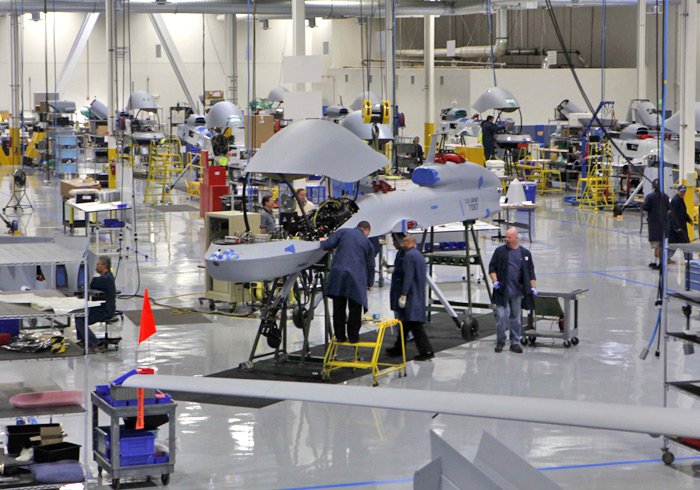
"Technicians at Poway [CA]-based General Atomics Aeronautical Systems
worked on the fuselage of a Sky Warrior drone . . . . The company’s unmanned-
aerial-vehicle program includes the Sky Warrior, the Predator and the Predator B."
(2009 photo - John Gibbins / Union-Tribune)


The new film about the arms trade, Shadow World, screened last night in Berkeley.

There is much that is provocative in the film, and everybody who cares about ending war should see it and share it with others in their community.

In particular, the segment about the Pentagon whistleblower Franklin Spinney caught my attention. Spinney talked about the systemic nature of the problem -- military spending that penetrates every single Congressional district. In effect, we're stuck. To break the hold of war on the US, we need to break the hold of military spending on every Congressional district.

Let's admit it: we've got a problem.
This was reinforced in the discussion following the screening, when Andrew Feinstein -- author of the book on which the film is based -- pointed to the inseparable relationship between campaign funding for Congressional races and the military contractors.

This idea is not new to me. I moved to California last year, fully aware that much of the beautiful California lifestyle is built on weapons manufacturing. The Concise Untold History of the United States by Oliver Stone and Peter Kuznick tells us that, between 1951 and 1963, California benefited from $67 billion in defense contracts (p. 218-9). In my own work on the problem of drones, I've come to learn that a relatively new player in defense, General Atomics, has become a star in the San Diego area economy by building Predator and Reaper drones.

Can drone jobs be "good jobs"?
But the question of how to push back against the problem has seemed gargantuan. Four hundred and thirty-five Congressional districts: how to begin?

It occurred to me that I could start by looking into California's 53 Congressional districts. But that alone is a huge job . . . and it's still just one state.

By coincidence, yesterday I was also thinking about another question: the readership of my blog is growing very fast . . . but where is it all headed? What do I hope the outcome is?

And then I realized that what I hope for is actually quite simple: I hope to suggest to people that they can use simple tools like blogs to get important information out to a wider audience.  In effect, these blogs and other social media are our answer to the complaint that the mainstream media doesn't report the important stories, and distorts the stories they do report. We need to be our own media.

Chicago activists are taking on Boeing
None of us has to do the whole job his/her self. We're a swarm.

So here's my promise: I will knuckle down and get to work on those 53 districts in California. And if you're writing about the hold of defense contractors and the Pentagon on those or other districts around the country, share your work with me via Twitter at @scarry. I'll make sure that it gets a big audience.

Posts related to California congressional districts

13th (East Bay): 21st c. Berkeley: More Relevant Than Ever to Antiwar Movement

17th (Silicon Valley): Worldwide War and Conflict (Brought to you by Silicon Valley)


More related posts

There's been a lot of talk in recent weeks and months about the problem of gun trafficking in Illinois, and how we will never meet our goal of stopping the violence in our communities if we can't stop the flow of guns. Maybe it's time for us to eat our own dog food . . . .

(See What If Illinois Became a "War-Profiteer-Free Zone" ? )


How might an uprising against inequality and dismantling the military-industrial complex dovetail?

(See WHERE'S MINE? Inequality in the US and the Military-Industrial Complex )


I've realized that when we ask ourselves, "What is it that we hope people will do?" we must include an element of recursivity: One of the things we want people to do is to involve more people in doing it. In a way, that element of recursivity -- dare I say "evangelism"? -- defines what it means for people to really become part of a movement.

(See Invite More People into Activism! (Pass It Along!) )


More than anyone else, the beneficiaries of permawar are the politicians who thrive on the power to make and control wars. The number one prime beneficiary is the President, as well as presidential aspirants. But it doesn't end there . . . .

(See J'ACCUSE: The Beneficiaries of Permawar )

Monday, March 14, 2016

Have a Conversation with a Trump Supporter Today

Peter Ross Range,
1924: The Year That Made Hitler
Völkisch is very hard to define and almost untranslatable into English. The word has been rendered as popular, populist, people's, racial, racist, ethnic-chauvinist, nationalistic, communitarian (for Germans only), conservative, traditional, Nordic, romantic -- and it means, in fact, all of those. The völkisch political ideology ranged from a sense of German superiority to a spiritual resistance to "the evils of industrialization and the atomization of modern man," wrote scholar David Jablonsky. But its central component, as Harold J. Gordon, Jr., noted, was always racism. (Peter Ross Range, 1924: The Year That Made Hitler, note p. 27)

I decided I was going to sit down today and tell people about the book I'm currently reading: 1924: The Year That Made Hitler.

I thought it would be helpful to share some of the quotes I have found so chilling as I've encountered them in the book, quotes like:

"It makes no difference whatever whether they laugh at us or revile us," he wrote later. "The main thing is that they mention us." (p. 27)

I thought people should be encouraged to look at this book and notice the similarities between the personality that came out of nowhere in Germany in 1923-1924, and the personality that has grabbed the spotlight in the US in 2015-2016.

Action was his aphrodisiac, his catnip, his default. His impetuosity often overwhelmed all other considerations, as the world would later learn . . . .  (p. 63)

Events in the past 72 hours have only served to further stimulate that idea. Rallies and counter-rallies and shouts and threats and more all seemed to work in favor of that 1923-1924 demagogue.

"Every German should have the right to stand up for the ideals he believes in and to use his fists to strike down others who use their fists to block him or prevent the truth from getting through." (p. 139)

I worry that they are working in the same way for today's demagogue, too.

But I woke up this morning thinking, "It's not his personality that's really at issue; it's actually not really about the fringe views he espouses, either.  It's not even the outward behavior of the supporters of different points of view. What's at stake is: There are a lot of people who are so enormously disillusioned and frustrated and fearful that they are actually finding relief in identifying with all this. What have we got to offer them?"

If people decide they can no longer talk to each other, Trump has won. If, on the other hand, we can find a way to talk with each other, there is hope.

Therefore, I have altered my original plan. Originally I planned to use this space to share aspects of 1924: The Year That Made Hitler that bear an eerie resemblance to Donald Trump and his campaign. Instead, I will try to talk about this question: "What were ordinary Germans experiencing in 1923-1924 that can help us form the basis of conversations with fellow US people in 2016?"

Perhaps that is the most important comparison of all . . . . 


Related posts

I wondered at how we could have covered all that in just a minute or two -- the time it takes to go a few stops.  After all, when I walked onto that bus we were strangers.

(See Listening for Community (A Chicago Encounter))


How might an uprising against inequality and dismantling the military-industrial complex dovetail?

(See WHERE'S MINE? Inequality in the US and the Military-Industrial Complex )


I believe when Jesus broke the bread and poured the wine and said "Remember me this way," he was much more interested in encouraging us to keep having conversations -- conversations that really matter -- with others . . . and finding ways to be in relationship with our neighbors . . . all the while reminding us "never underestimate the power of food" . . .

(See Get Outside Your Comfort Zone and Have A Conversation Today (Welcome to the Ministry))

Thursday, March 3, 2016

An Antiwar Thought Experiment: Swing the Swing States?

There's no time like the present -- i.e. as the US stares down the throat of a possible Trump presidency -- to tee up an electoral thought experiment.

Now I understand antiwar people have totally lost faith in the electoral process. It's okay! So has everyone else!!

But this post is directed at a time in the not-to-distant future when there is a national awakening. (Think: David Byrne singing "My God! What have I done?") I'm thinking about a time when a lot of people actually start to think about how they can have an impact about what this country is and does.

So here's the thing: we all know that elections ultimately come down to the small number of uncommitted voters, especially in swing states. Anyone who wants to succeed devotes a lot of attention to what it will take to win over those voters, in those places.


Swing States 2016
(Source: UVA Center for Politics)


Now, consider a possible situation: any candidate who wants to win over those voters, in those places, will have to contend with a bunch of people who have been thinking a lot about how not to have war. What would happen if the antiwar movement zeroed in on that as a goal?

In other words, put aside for the time being the goal of turning every person in the country into an antiwar activist. In fact, put aside for the moment all of our accepted ideas about what it means to be "antiwar." (And for sure forget about the idea that "antiwar" people look the same everywhere!)

Instead, just focus on this question: if we made a concerted effort, over a reasonable period of time, in a few select places, and paid attention to local circumstances, could we influence a bunch of people in those places to think a lot about how not to have war?

What might be different if that happened?


Related posts

It will be the 2016 presidential election that will provide the main form of entertainment and distraction to the U.S. populace between now an the end of next year. An enormous amount of political fluff will fill our lives -- pushing aside, I suppose, vast amounts of sports fluff and shopping fluff and celebrity fluff and -- well, you get the point.

(See What Will Dominate Election 2016? (ANSWER: ISIS and #BlackLivesMatter) )


The decision about whether to live with the threat of nuclear annihilation is our decision. And that is why the entire country is mobilizing for mass action for nuclear disarmament in 2015. Are we capable of making sure the messengers -- Obama, Putin, the other agents of government -- hear their instructions from us clearly?

(See NEEDED: Heroes to Bring About Nuclear Disarmament )

Yesterday, as all the other senators sat patiently through the obfuscation of Barack Obama's Three Horsemen of the Apocalypse -- Secretary of State John Kerry, Defense Secretary Chuck Hagel, and Chairman of the Joint Chiefs General Martin Dempsey -- Rand Paul gave 'em hell.
"Stand up for us and say you’re going to obey the Constitution and if we vote you down — which is unlikely, by the way — you would go with what the people say through their Congress and you wouldn’t go forward with a war that your Congress votes against."

(See Obama's Syria "Vote" in Congress: Democracy? or Theater? )

Saturday, January 23, 2016

My Ten Favorite "Scarry Thoughts" Blog Posts from 2015

Some of the blog posts I'm happiest about aren't necessarily the ones that get viewed the most.

These twelve made my 2015.


January

I never quite understood how much of a Chicago story the Bomb and opposition to it really is. I can think of at least three reasons why people right here in Chicago -- today -- need to make themselves heard about nuclear disarmament . . .

(See Unfinished Business in Chicago (Nuclear disarmament, that is))


February

Far more important than the historic performance of fossil fuel stocks is the future correlation of fossil fuel stocks to generalized, systemic risk in the market, and their negative correlation to the few sectors of the market that stand apart from that risk.

(See The Feel-Good Folly of Fossil-Fuel Valuation )


March

What I'm feeling particularly energized about is the potential for the thousands of people who have already signed on as supporters of World Beyond War -- as well as millions more who are expected to do so soon -- to become active participants in spreading this good news.

(See News Worth Spreading: "There IS An Alternative to War!" )


April

Can there be any more clear illustration than the one at left to remind us that the work of the Church is liberation?

(See Christian "Church"? How about Christian "Liberation Organization"? )


May

"Once the boat went to full pressure, there was really no other option."

(See In Whose Machine Will YOU Be a Cog? )


June

It will be the 2016 presidential election that will provide the main form of entertainment and distraction to the U.S. populace between now an the end of next year. An enormous amount of political fluff will fill our lives -- pushing aside, I suppose, vast amounts of sports fluff and shopping fluff and celebrity fluff and -- well, you get the point.

(See What Will Dominate Election 2016? (ANSWER: ISIS and #BlackLivesMatter) )


July

It has required years and years of reflection to sort out the good and bad aspects and conclude that the diplomatic and commercial opening of China was part of a massive move away from conflict and toward peace.

(See THE EYES AND EARS OF HISTORY: A Perspective on the Iran Deal)


August

You might think that each person is just another face in the crowd, but if you look closely, they're all carefully drawn to depict an individual, and it's all these individuals working together that is going to stop Japan's return to militarization and war.

(See People Power Against War in Japan: A Lesson for Us All? )


September

Yesterday was the UN International Day of Peace. The day nudged me to think about what -- if anything -- I feel I really know about peace and the movement for peace. Here are 10 things that are true for me . . . .

(See #PeaceDay 2015 - Ten Thoughts on Peace)


October

As I walked home from today's service, I replayed the service in my mind. "The part about the visitor card was pretty good . . . " I thought, "and yet . . . visitor card . . . ? Maybe it's not really a visitor card . . . . Maybe what we should be calling them is participant cards."

(See Being Church in Logan Square, Chicago: An Ecclesiophilic Reflection )


November

"A terrible disease has struck the area . . . people call it the 'flu' . . . many in our own community have fallen to it . . . including someone very dear to you, someone in your own family . . . I'm talking about your sister, Margaret."

(See November 11, 1918: Another Veteran for Peace )


December

Hibakusha is a word that has traditionally been used to refer to people affected by the nuclear blasts in Hiroshima and Nagaski.  It is now being broadened to recognize the many additional victims of acute affects of nuclear radiation (including fallout from tests and radioactivity from mining and processing). In fact, we are all subject to the impact and threat of nuclear radiation spread indiscriminately by nations and corporations.

(See HIROSHIMA: What does it mean to say, "We are ALL 'hibakusha'?")


To be continued . . . . 

Tuesday, January 19, 2016

The REAL Election 2016 Story: Peace, Justice, Sustainability

I suspect that every visitor to this blog cares about the 2016 election, and wants to see the campaign conversation turn to issues of peace and justice.

[UPDATE February 14, 2016 - In the wake of Henry Kissinger's mentoring of Hillary Clinton becoming a flashpoint in the election, there is suddenly widespread attention to antiwar issues. See, for instance, "5 Top Reasons Why Bernie Sanders Would Be Best President for Peace: Why Peace Action PAC is endorsing Bernie Sanders for President" by Kevin Martin, Jon Rainwater in Common Dreams ]

I will regularly update this page with the several posts of mine that I think are the most important to helping to drive that conversation.

Comments are welcome!

The number one threat facing the US and the world is nuclear weapons. Nuclear disarmament is urgent. There are three centers of power that will impact nuclear disarmament: the President, the Congress, and the people. One of them will have to make nuclear disarmament happen.

(See Countdown to U.S. Nuclear Disarmament (With or Without the Politicians) )


It looks like foreign affairs are about to take center state in Election 2016.

(See Election2016 after Paris: It's time for someone to show leadership)


Anyone who has had to write a speech knows that the hardest part is to land on the main idea. Once you've got that right, the rest practically writes itself.

(See "The way to respond to ISIS is not through violence." )


We can't imagine that anti-racism work is just about specific police officers or even specific departments. Entire institutions of racist law enforcement need to be brought to heel in real time. It's a task worthy of a society-wide, national, federal effort. And it's top priority. No leader can ignore this reality . . . .

(See "If elected . . . ." (The Election 2016 and #BlackLivesMatter Nexus) )


The next group of leaders elected will have to tackle the climate crisis while doing crisis management in the face of a collapse in fossil fuel assets values.

(See The Feel-Good Folly of Fossil-Fuel Valuation

Tuesday, December 8, 2015

December 7, 2015: A day that will live in ... [FILL IN THE BLANK]

Donald Trump in front of "Make America Great Again!" banner
on Pearl Harbor Day (December 7) 2015 (Image: Getty)

Yesterday, a possible nominee as the Republican candidate to become the next president of the United States proposed banning Muslims from the US. "I think that we should definitely disallow any Muslims from coming in. Any of them. The reason is simple: we can't identify what their attitude is." (See Trump's call to ban Muslim immigration to the US.)

Two things are possible:

EITHER this will be remembered as the moment the US caved in completely to fascism;

OR this will be the big wake-up call to US people, and the beginning of the dismantling of the post-9/11 nightmare.

What's it gonna be, people?


Update: December 9, 2015

The New York Daily News puts it all together:

New York Daily News, December 9, 2015:
"When Trump came for the Mexicans,
I did not speak out - as I was not a
Mexican. When he came for the Muslims
I did not speak out - as I was not a
Muslim. Then he came for me . . . "
(Share this image from the New York Daily News.)
(Read the Wikipedia article on "First they came . . ." -- "a famous statement and provocative poem written by Pastor Martin Niemöller (1892–1984) about the cowardice of German intellectuals following the Nazis' rise to power and the subsequent purging of their chosen targets, group after group.")


Update: December 12, 2015

Yup: "infamy." (That's what I was afraid of.) "Trump’s anti-Muslim rhetoric will live in infamy in American history," by David Ignatius in the Washington Post.


Related posts

I wonder if, years from now, we will be thinking back to today and feeling surprise at how little we thought about some of the developments in our world, and in our country, and how we talked about them even less. Someday will I have to explain to my kids, or to my kids' kids, why it was that "people just weren't talking about it" . . . ?

(See Why Weren't People Talking About It? )


Thinking about the Holocaust Museum's depiction of the reliance on brutality and intimidation during the Holocaust, all I could think of was the repeated use of similar tactics by the U.S. military against prisoners in Iraq, Afghanistan, and Guantanamo.

(See Holocaust Museum: "Those Nazi Bastards!" )


It looks like foreign affairs are about to take center state in Election 2016.

(See Election2016 after Paris: It's time for someone to show leadership)


The United States is like that alcoholic family member, for whom every circumstance is an excuse to hit the bottle. Except, with the US, the bottle is violence.

(See It's Time for the United States to Stop Hitting the Bottle)


I'm glad that we're starting to debate drone warfare, but I'm concerned that Americans are stuck at the surface of the problem -- the technology, the politics -- and not getting deep enough into the psychology that allows us to tolerate the injury being done to others.

(See Does America Need a Spiritual Awakening?)