Showing posts with label gardens. Show all posts

Wednesday, January 31, 2018

LACMA: Outside Looking In (#lacmaoutsidein)

Oasis #lacmaoutsidein #losangeles #publicspace


A week ago, I was visiting my son in Los Angeles. When he headed out for an appointment one morning, I asked him to drop me off at the LA County Museum of Art.

I was looking forward to seeing the latest exhibitions so much that it didn't even occur to me that LACMA wouldn't be open yet at 9:30 in the morning.

I was momentarily disoriented when I realized I was going to be outside the gate for an hour and a half -- on the streets of Los Angeles! without a car! But then I took a deep breath . . . got my heartbeat back down . . . and started to explore.

Then a few things happened in rapid succession:

* I noticed a phenomenal "shutter" effect as I walked alongside the fence with the sun shining through -- light-dark-light-dark-light-dark.

* I took a picture and shared it with my daughter in Chicago. (When she can't come to the museum with me in person, she cheers me on virtually.) We "LOL'd" about the fact that I was so eager I came before the museum even opened.

* I decided to walk around the (extensive) perimeter of LACMA and take a bunch of pictures.

* I realized I was seeing a new side of LACMA. I was documenting my experience of being "outside looking in."

* I thought about doing an exhibition of my photographs (and video) -- on social media. I decided Instagram was the right place for it.

* I wondered if a hashtag could be used to tie together my "virtual exhibition." I decided to use #lacmaoutsidein.

In the last year I've become aware -- along with many observers of the tech scene and social media -- that Instagram has important lessons for us about how to communicate better. My #lacmaoutsidein experiment was conducted with no particular end in mind -- other than to have fun, discover something new, and perhaps make something beautiful. I did suspect that it might hold lessons for all kinds of communication, including very intentional activist efforts. And, indeed, the images and the way people interact with them in a "virtual exhibition" stimulated all kinds of unexpected thoughts for me.

Please check out my #lacmaoutsidein "virtual exhibition" on Instagram. (And if you're really interested, you can see my "exhibition notes" on Twitter using the same hashtag!)

Meanwhile, I'm getting busy dreaming up my next project . . . .


Please share this post . . . .

Sunday, March 5, 2017

In Palestine: What Might a Flower Signify?

On Saturday we fixed up the garden at University Lutheran Chapel here in Berkeley. The topic of "biblical gardens" game up, and we wondered about doing something like that with our garden beds.

Then I remembered: I have first-hand experience of biblical plants -- from the trip I took to Palestine two years. (A trip which, incidentally, was where I met the Berkeley pastor who is the reason I ended up moving to California from Chicago!)

I've re-posted below a blog post about the flowers of Palestine that I wrote during that trip. (Here is a link to the rest of the posts from that trip . . . Faith in the Face of Empire: A journey in search of hope in the land of conflicting narratives.) (And here is a link to one of the many posts on this blog that emerged from that trip: ELCA Resolution on Palestine / Israel: What Does It Mean for Us? )

While I'm at it -- here are a couple of other garden-related posts: A Dream of a "Dream of Red Chambers" Garden for Chicago and One Word: Wildflowers (on the Zero Carbon Chicago blog).


*   *   *


What Might a Blossom Signify?

(originally published March 20, 2015)

Why was this day different from every other day (on our trip)?

Because today was the day that we hiked through the beautiful nature area in Battir.

As we entered the stone steps into the area, we began to get a sense of its grandeur:


The terraced hillside on our right-hand side was filled with olive trees:


Beautiful red poppies dotted the trail from beginning to end:


Wild irises poked up all along the trail as well:


Occasionally, we would pause at remnants left by long-ago inhabitants of the land, such as this vault carved into the rock hillside:


But mainly this walk on the first day of spring 2015 was about renewed life.

Besides the red poppies and the purple irises, it seemed as if there was a flower to claim each of the colors in the rainbow — such as these yellow ones springing up at trailside . . .


and these magenta cyclamen clinging to the rocks at shoulder level . . .


and lone white poppies here and there . . .


As I walked along, in this place so full of meaning, with these distinctive floral sentinels along every inch of the pathway, it suddenly seemed perfectly understandable that people have so often throughout history thought of each type of flower embodying a specific meaning.

What might these blossoms signify?

Every time I lifted my eyes from the trail, I discovered another slice of hillside that was like something crafted by a jeweler:


and the promise of yet more enchanting discoveries just around the corner:


Not all of the plants sported brilliant colors. Yet everything we encountered, whether pine cones . . .


Or thistle stems . . .


. . . was spectacular in its own way.

 Some flowers cried out from the ground for our attention (“Look at us! We’re magenta, too!”) . . .


while others stretched up to confront us eye-to-eye (“Have you ever seen anything as beautiful as me?”) . . .


and a few stubborn fellows seemed to be doing everything they could to ignore us, staking out lonely spots among the rocks and focusing on the sky (“Summer sun? Bring it on!”)  . . .


As we reached the end of the trail, we saw an almond tree whose blossoms framed a structure on crest of the hill in the distance.


It made me think of the Palestinian poet, Mahmoud Darwish, who wrote,

If a writer were to compose a successful piece
describing the almond blossom, the fog would rise
from the hills, and people, all the people, would say:
This is it.
These are the words of our national anthem.
(See “Review: Darwish, between the national and the human” by Raymond Deane on the Electronic Intifada website.)

Could a writer write the story of “faith in the face of empire” in the language of flowers?


Please share this post . . . .

Friday, March 4, 2016

A Dream of a "Dream of Red Chambers" Garden for Chicago

A piece from a series of brush paintings by Qing Dynasty artist Sun Wen,
depicting a scene from Dream of the Red Chamber [Story of the Stone].
(Source: Wikipedia)


Every day I try to read one chapter of Dream of the Red Chamber [Story of the Stone]. To explain all the reasons why, I'd almost have to tell you what happens chapter by chapter, because it is such a rich evocation of life in elite Chinese society c. 1750. So instead I'll just talk about one of the reasons: the garden.

Much of the story takes place in a fairy-tale garden on the grounds of a massive estate within the capital, and it is in this environment that the story's hero, Baoyu ("precious jade"), has his adventures together with other [principally female] members of his clan.

During the early 2000s, I was involved with a cultural committee in Chicago together with many other people interested in China. It was at around the same time that Millennium Park opened, and I became quite interested in the idea that Chicago should build a Chinese garden as an emblem of the city's respect for its relationship with China. To my mind, the only suitable way to do this was to build a replica of the garden from Dream of the Red Chamber.

Not a bad idea for a city who's motto is Urbs in Horto - City in a Garden - right?

Shanghai: the Qingpu Daguanyuan
One reason I thought this would be so delightful, of course, is that the book doesn't actually show the garden; but it does describe it in loving detail.  Therefore, the effort to recreate the garden based on the text would represent a true devotion to Chinese culture. (I imagined all kinds of ways that there could be collaboration between people in Chicago and people in China in coming up with a design.)

The conversation was driven in part by a long-running effort to re-install a replica of a Chinese temple in Chicago -- the "Golden Temple" from the 1933 Century of Progress exhibition. (But that's a story for another day . . . . )

My case for creating a Red Chamber garden replica was buttressed by the fact that there have actually been projects in China -- essentially, theme parks -- to do just this. (See the Qingpu Daguanyuan.)

I had even identified the perfect location: Chinatown!

Of course, my idea would have involved the removal of a block of buildings in the center of the neighborhood, but to my mind having a public space there would actually serve to re-connect two parts of the neighborhood in a good way.


Chicago Chinatown, with proposed site of
Red Chamber garden shown in green.

It would have been the first thing people encountered as they arrived in Chinatown on the CTA elevated platform.  I actually met with a banker active in the community to talk about the possibilities. (He liked the concept but gently informed me that removing a bunch of existing buildings is no small matter . . . . )

I also had discussions with a landscape architect who was quite experienced in working with the City of Chicago. She also liked the idea, but she pointed out to me that in creating a garden, the installation is merely the first step: you need to have a funding plan to maintain it over the long haul. (Oh, I didn't think about that . . . !)

In fact, the City had just installed a park at the edge of Chinatown, along the Chicago River, in honor of a civic leader from Chinatown, Ping Tom. I saw Ping Tom Park as proof how great another new park would be for Chinatown, but I suppose in other people's eyes Chinatown now had all the green space it needed.

So the upshot was that the idea died a quiet death.

Today, the site I had my eye on is the location of a sparkling new branch of the Chicago Public Library. It's the first thing I see when I step of the EL onto the platform in Chinatown.


New Chinatown branch of Chicago Public Library


And Ping Tom park has some Chinese garden landscaping that is slowly, slowly, slowly coming into its own.


Ping Tom Park, on the northern edge of Chinatown


And as for me? I'll always have a chapter a day of Dream of the Red Chamber . . . .


An 1889 printed depiction of the garden from Dream of the Red Chamber.
(Source: Wikipedia)


Related posts


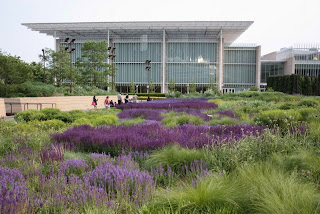
The city contains masterpieces of landscape architecture, with a strong focus on wildflowers.


(See One Word: Wildflowers on the Zero Carbon Chicago blog.)


I thought about Chagall's mural "The Four Seasons." It is located at Monroe and Dearborn, in the plaza of Chase Bank -- what some of us remember as 1st National Bank of Chicago.  I love it not just because it's beautiful, and because I so often have the opportunity to walk by it on my walks through that beautiful neighborhood, but also because of memories.

(See The Human Scale in Chicago on the Zero Carbon Chicago blog.)


Could I point to some analogous concepts and practices that I felt characterized the Chinese approach to being in the world? I rolled the idea around in my mind for a while, and then landed on the word "cultivation."

(See "Puja" in India; "Cultivation" in China )