Showing posts with label listen. Show all posts

Tuesday, July 26, 2016

Four Aids for Those Important, Difficult Conversations

Curiosity, leaning into conflict, humility, respect: the gold standard for peace work and citizenship in 2016!

Pastor Rachel Bauman, FCCB Berkeley
How can we manage to talk successfully with people who believe different things than we do?

Pastor Rachel Bauman at First Congregational Church in Berkeley talked about this on Sunday. She drew from In Faith and In Doubt: How Religious Believers and Nonbelievers Can Create Strong Marriages and Loving Families by Dale McGowan to suggest how people from different faith traditions can learn to listen to and hear each other. (She suggested that these skills can also be used by people who feel that they occupying separate political galaxies, as well!)

Pastor Rachel's distillation of McGowan's work focused on the need to:

* have genuine curiosity

 . . . because it is vital to understanding others, and it deepens your understanding of your own self.

* be willing to lean into conflict

Remember: avoiding conflict actually inhibits intimacy. Just be sure to let go of your desire to convert the other person.

* hold your beliefs with deep humility

 . . . which is not the same as holding them weakly!

* commit to the proposition that personal respect for each other is non-negotiable

Opinions and ideas need to earn respect, but you, as a person, are worthy of respect always.


Check out the full sermon (below) . . . and then go out and do something listening!


Related posts


I wondered at how we could have covered all that in just a minute or two -- the time it takes to go a few stops.  After all, when I walked onto that bus we were strangers.

(See Listening for Community (A Chicago Encounter))


I believe when Jesus broke the bread and poured the wine and said "Remember me this way," he was much more interested in encouraging us to keep having conversations -- conversations that really matter -- with others . . . and finding ways to be in relationship with our neighbors  . . . all the while reminding us "never underestimate the power of food"  . . .

(See Get Outside Your Comfort Zone and Have A Conversation Today (Welcome to the Ministry))


Perhaps what makes a book good for a discussion group is that it combines startling candor, brevity, and the courage to leap again and again into the middle of mysterious questions.

(See Finding Accidental Saints in Berkeley

Thursday, July 21, 2016

Yasujirō Ozu: Saint for Our time

Who has more power than filmmakers? And who, among filmmakers, had more power to invoke the spiritual than Yasujirō Ozu?


Chishū Ryū and Setsuko Hara in Late Spring by Yasujirō Ozu


A few weeks ago, I was inspired by a visit to a San Francisco church that "celebrate[s] those whose lives show God at work, building a deep character to match the godlike image which stamps them as God's own from the start." It was an invitation to think about who, for me, are some of the people -- saints -- who have made a special stamp on the world. (See Who Ya Gonna Call? (Saints for All Times))

Then, several nights ago, I watched once again the film Late Spring by Yasujirō Ozu at a screening at BAMPFA in Berkeley, and I thought, "Oh yeah, he's definitely one of those saints!"

Yasujirō Ozu
(Note the cap ... Ozu brings his own halo!)
Ozu is a hero to a vast community of people who love film, and a great deal has been written about him and his work. I once saw Roger Ebert introduce Ozu's work at a talk at the Siskel Film Center in Chicago, and a post from his blog captures much of what he said:

"To love movies without loving Ozu is an impossibility. When I see his films, I am struck by his presence behind every line, every gesture. Like Shakespeare, he breathes through his characters, and when you have seen several of his films you feel as if you must have known him."

(More at "Saluting a Master Of the Cinema, Yasujiro Ozu")

What I particularly like about Ozu's films is the way they let us listen in on intimate conversations between people. We may not find those conversations full of high drama -- at least not at first -- but if we slow down and look and listen carefully, we realize that we are being privileged to be able to get at the truth about what goes on between people, and within people.

Late Spring is an Ozu masterpiece, and film lovers study it frame by frame. It is about a man and his adult daughter, and the question of whether she will continue living with him or go off to have a life of her own. This is a plot that held quite a bit of interest for me when I was a young adult, when I felt the pull of my widowed mother in conflict with the challenges of figuring out the life I wanted to pursue. Those years have passed, and my own children are adults now, and little by little I'm becoming aware that the this film holds other relevance for me.

There is a moment in the film when the "aging" father says "I'm 56 now . . . ." and I went gulp ...! You can bet I was watching and listening even more closely from then on.

As my years advance, I'm becoming a student of listening. Great films help us hone our listening skills.

Choreographers, poets, playwrights, novelists, jazz musicians - you can find all of them on the walls of St. Gregory of Nyssa church. My array of saints also includes filmmakers . . . .


Related posts

The array of saints on the walls of St. Gregory of Nyssa raise a fascinating question for all communities of faith: who would you select to memorialize and celebrate on the walls of your church?

(See Who Ya Gonna Call? (Saints for All Times))


I often refer to how important the films of Iran have been in helping me open my mind to the possibilities of a peaceful relationship with that country. I have been fortunate to be able to go see some of the best films from Iran every year at the wonderful Siskel Film Center in downtown Chicago. The will be another Festival of Films From Iran showing there in February, 2014.

(See A Force for Peace: Getting to Know Iran Through Film)


The films of Hou Hsiao-hsien came after my time in Taiwan, but for me they are a happy addition to my attempts to understand the place.

(See Taiwan Through "City of Sadness")


I'm not sure the "7 habits of highly effective people" are necessarily identical to the "7 habits of highly effective apostles." But they do pose an interesting framework to consider building from.


(See The 7 Habits of Highly Effective Apostles )


I wondered at how we could have covered all that in just a minute or two -- the time it takes to go a few stops.  After all, when I walked onto that bus we were strangers.

(See Listening for Community (A Chicago Encounter))

Wednesday, June 15, 2016

"Education for Peace"? or "Education IS Peace"?

Education is peace when we value methods, humanism, formal literacy, listening, experimentation, and meta-analysis.

The UN International Day for Peace 2016 has been tied to the 17 Sustainable Development Goals. Quality Education is goal #4.

People working for peace are intensely attuned to the way education impacts peace efforts -- and also war efforts.

Hence, a major section of A Global Security System: An Alternative to War is "Spreading and Funding Peace Education and Peace Research," and education about peace is viewed as central to "Creating a Culture of Peace."

A problem is that individuals, groups, and states recognize the power of education and often co-opt it, hoping to be able to treat humans as instruments of their power.  For instance, schools become pipelines for the military. In many locations, peace groups have begun to push back against the militarization of schools. (See, for instance, the Chicago Veterans for Peace "Education not Militarization" project.)

Denial of education is another (and, thankfully, vanishing) form of the co-opting education by individuals, groups, and states. Thinking about common factors in successful education for peace requires us to consider the ways in which (a) denial of education; (b) hindering of education; (c) slanting of education; and (d) wholesale co-opting of education are all part of the overall threat to peace.

Let's face up to the impossibility of peace without education -- in fact, to the virtual congruence of peace and education! -- and expand our commitment to making education the real thing.

Some food for thought:

(1) Methods that work - The US is experiencing a crisis in education; in my opinion, it's because we have made every teacher a free agent, responsible for rising or falling by their own test results. If we were as serious about our education as we are about our business and industry, we would recognize a responsibility to equip teachers with methods that are proven to work. Not just a list of what is to be taught, but the actual methods that have been proven (see (6) below) to be successful. (Yes, I recognize this represents a wholesale change in the way the job of teaching is currently structured in the US .... )  An important value in a quality education is equipping teachers with methods that work.

(2) People, not machines - That said, our analytic and mechanistic outlook can lead us to view people as little more than another set of tools ... instruments ... input-output boxes. This is especially true now that people everywhere are connected 24/7 to the Internet. Jaron Lanier has delved into this problem in You Are Not a Gadget: A Manifesto. An important value in a quality education is recognizing the whole person.

(3) Literacy - Often what we think of when we think of "education" is literacy - being able to read, being able to write, being able to speak, and basic math skills. Unquestionably, an important value in a quality education is literacy -- literacy opens all doors. At the same time, it is essential to recognize that even the barest literacy is developed within a context, and that context can have just as much importance to the outcome as the formal literacy itself. Hence the succeeding points . . . .

(4) Listening - I spent 17 years in classrooms listening to teachers, but it has only been late in life that I have begun to listen to people -- particularly in that "people, not instruments" sense of point (2) above. Could there be any more important skill in learning to live in peace? How do we see this skill being taught in our schools? In addition to literacy, an equally important value in a quality education is developing the ability to listen to people.

(5) Experiments - The ultimate education is one which encourages people to be successful experimenters. As the world becomes more and more sophisticated, there is more and more temptation to believe that there is no real need to discover truth, that truth is just sitting around, ready to be consumed. In my opinion, the single greatest value in a quality education is that of conducting experiments in the hope of discovering truth.

(6) Meta - Now more than ever, we stand on the shoulders of those who came before us. Yes, we need to be able to go to the source and discover our own truth . . . and, yes, we need to be able to scoop up the abundance of knowledge and experience that others have put at our disposal and make the most of it.(This is, itself, a sort of experiment. It requires choices about what learnings to look to, and how many are needed to find a common truth. This is quite a bit different than simply absorbing a pre-packaged tutelage that is shoveled at you.) An important value in a quality education is being able to learn from what others have learned.

(To be continued . . . . )


Related posts

It will benefit us antiwar activists in the US to attend to and reflect upon the importance of these Sustainable Development Goals to achieving the goal of ending war.

(See PEACE DAY 2016: What comes first? Demilitarization? or Development?)


I wondered at how we could have covered all that in just a minute or two -- the time it takes to go a few stops.  After all, when I walked onto that bus we were strangers.

(See Listening for Community (A Chicago Encounter))


"You may not understand every word, you may feel uncomfortable, you may have to spend time later trying to figure it out or to humble yourself now and ask for help; you may have to work at it. But in the long run . . . a Spanish speaker is what you are . . . because that's the community you're a part of!"

(See Don't speak Spanish? "Sure you do . . . .")


I wonder if, years from now, we will be thinking back to today and feeling surprise at how little we thought about some of the developments in our world, and in our country, and how we talked about them even less. Someday will I have to explain to my kids, or to my kids' kids, why it was that "people just weren't talking about it" . . . ?

(See Why Weren't People Talking About It? )


"To see the atom bomb museum," I said. And again I wondered, what can a child in Nagasaki think when they see a person from the US who has come here to see the atom bomb museum?

(See Encounter in Nagasaki )


I don't think Alanna and I ever talked about what it must be like to be trying to escape a shower of sparks and hot ash. But she seemed to know that the sparks and hot ash are too important a part of the picture to be left out.


(See The Children Are Waiting )


Thursday, May 19, 2016

21st c. Berkeley: More Relevant Than Ever to Antiwar Movement

As a "peace" enclave within California's concentrated military/defense economy, Berkeley and the East Bay have a role to play in the discussion about China.


BERKELEY: Looking west -- the bay, San Francisco . . . and beyond.


As I set out to understand California's entanglement in the military-industrial complex, I started where I live: Berkeley.

Reading a letter to the editor from our representative in Congress, Barbara Lee, a few days ago reminded me that the 13th district is kind of unusual: "As the National Defense Authorization Act comes up for a vote, I will once again co-lead a bipartisan amendment to audit the Pentagon." (Read more on Barbara Lee's position on the Authorization for Use of Military Force Against Terrorists (AUMF).)

Yup, this is different than the town I just came from. Chicago's star corporate citizen is mega military contractor Boeing.

Of course, Berkeley was ground zero for the antiwar movement during the '60s. But what's its relevance today?


A bridge to China

As a long-time student of China and the Chinese language, I am enchanted to find myself in a city whose university attracts lots of the very smartest students from China and other parts of Asia. (See "Berkeley - International Student Enrollment - Fall 2015") Many other Berkeley students who are US citizens claim Asian ethnicity. (See "Berkeley - Enrollment Data")

If California, and especially the Bay Area, is the historic link between the US and China, Berkeley is a particularly vital US-China hub right now.

We all say things like "youth are our future" . . . . What would happen if we encouraged a serious discussion between the diverse people in the Berkeley community (and from other communities) about the future of peace and security in the Pacific region?


SOUTH CHINA SEA FACE OFF:
Does this make ANY sense?
The discussion we need to have

I wrote recently about the growing tensions in the South China Sea.

As I read the Chinese language paper every day, it is clear to me that -- in the absence of sustained civic discourse on the security issues in the Pacific region -- our future is being shaped by military posturing.

I think a good way to re-direct the conversation would be to get a large number of young people who know and care about the situation in the region to get together and talk. It should include people from the various countries and territories concerned. It should be directed at the future we're all trying to build together. It should place a strong premium on listening. It should be open-ended.


Some possible starting points

The good thing about a university town is that it has many of the ingredients necessary to conduct forums.

Now this I understand . . . !
(Image: Android Authority)
Here are a few available in Berkeley that might assist the type of discussion I am suggesting:

* Student associations, including Chinese Students Association, Taiwanese American Student Association,
Hong Kong Student Association, . . . .

* University departments, including International Relations and  Institute of East Asian Studies

* Citizen groups, including United Nations Association - East Bay

* Relevant University affiliates, such as Office of International Relations and International House - UC Berkeley


My hope and belief is that a Berkeley forum on peace and prosperity in the Pacific would reveal a shared interest in de-escalating the South China Sea confrontation, and dramatically increase awareness of shared Pacific prospects for well-being.


Related Posts

In four hundred and thirty-five Congressional districts, there is an inseparable relationship between campaign funding for Congressional races and the military contractors. How do we push back?


(See IT'S A LOCK: Why the US Can't Break Its Addiction to War)


What people in Asia (and others) have seen for the past century is that something is happening in the Pacific, and it's being driven in part by advances in naval (and, subsequently, aviation and electronics) technology, and in part by powerful nations (principally, but not limited to, the U.S.) proximate to the area.

(See The Imperialized Pacific: What We Need to Understand)


"Although we know the end from the very beginning," says Walker, "the story is no less compelling to watch." A man, gloriously alone (except for his own reflection) on an ice-covered lake; the soothing pastel colors of the distant sky; and what seems surely to be a circle he is digging around himself with a pick-axe. A perfect parable for our headlong rush toward climate crisis?

(See How Do You Say "Suicide Narcissus" in Chinese?)

Tuesday, March 22, 2016

Finding Accidental Saints in Berkeley (Reading Nadia Bolz-Weber)

Accidental Saints: Finding God in All
the Wrong People
by Nadia Bolz-Weber
I was part of a small group at the church I attend in Berkeley -- University Lutheran Chapel -- where we read and discussed Accidental Saints: Finding God in All the Wrong People by Nadia Bolz-Weber. (Actually, the whole congregation read the book -- discussions took place in a variety of settings.)

I am here to report that, at least in our experience, Accidental Saints proved to be a wonderful springboard for discussion.

I'm tempted to share some of my favorite lines from the book, but maybe it would be better if I invite you to pick the book up and find them for yourself.

(Well okay -- here's a clue -- you might want to start by going to chapter 12 where Nadia is puzzling over when the cool people are gonna start showing up. Classic.)

Perhaps what makes a book good for a discussion group is that it combines startling candor, brevity, and the courage to leap again and again into the middle of mysterious questions.

What we discovered is that all of us were interested in the questions she was raising, and we found the courage to share things about ourselves, and that made it compelling to listen carefully to each other.

Accidental Saints is great. Our only question now: what do we do for an encore?

Related posts

I believe when Jesus broke the bread and poured the wine and said "Remember me this way," he was much more interested in encouraging us to keep having conversations -- conversations that really matter -- with others . . . and finding ways to be in relationship with our neighbors . . . all the while reminding us "never underestimate the power of food" . . .

(See Get Outside Your Comfort Zone and Have A Conversation Today (Welcome to the Ministry))


So as I watched Ziggy for the first time last night, I asked myself, "What is it? What is it? What is the frisson that one feels? It's part charisma, part sexuality, partly the thrill of gender-bending, partly adolescent rebellion . . . . But what is it that Ziggy did (and does) for so many people?" (It can't be a single thing, can it?)

(See "You're NOT alone!" (Ziggy the Subversive) )

Monday, March 7, 2016

Don't speak Spanish? "Sure you do . . . ."

Yesterday I worshiped at University Lutheran Chapel in Berkeley. I sang "Camina, Pueblo de Dios" together with the rest of the congregation in Spanish, and spoke the words of the Lord's Prayer in Spanish while my neighbor spoke them in English.

I don't really know Spanish -

No -- wait a minute -- yes I do!

And so this post is dedicated to Pastor Ramon Nieves.

Pastor Ramon passed away suddenly just over two years ago.  He had been the pastor of Humboldt Avenue Methodist Church in Chicago, and one of the prime movers behind a coalition of congregations that came to be called the Logan Square Ecumenical Alliance.

Pastor Ramon with other LSEA pastors.
At the time we started working with Pastor Ramon, our own congregation was aware that a lot of people in our community are Spanish speakers. But we were struggling with how to adjust our activities to reflect that fact.

Pastor Ramon cut to the chase: "When we do activities like Occupy Palm Sunday together, we should use both English and Spanish."

It made sense to me. In fact, I had been trying to learn a little bit of Spanish ever day -- albeit at a hilariously slow pace. (When I mentioned the name of Chicago's free Spanish daily to my Spanish-fluent nephew and told him proudly that I was learning the language, he gently broke it to me, "OK -- lesson number one: Say "oy," not "hoy" -- the h is silent . . . . " )

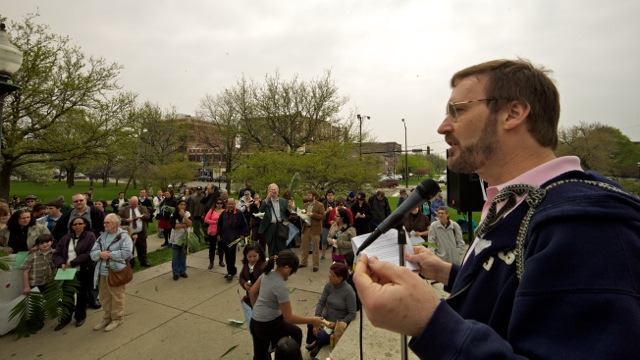
Undaunted, I got a friend to do a word-for-word translation of a presentation I was to give on Palm Sunday in 2012, and coach me so that I could stand before the crowd and say, "Usted no tiene una problema de la PRODUCCION.... tiene una problema de DISTRIBUCION!"


"People! You don't have a PRODUCTION problem ... 
you have a DISTRIBUTION problem!"
"Mi Gente! Usted no tiene una problema de la PRODUCCION.... 
tiene una problema de DISTRIBUCION!"
Joe Scarry speaking at the first "Occupy Palm Sunday" in Logan Square
(Photo courtesy FJJ)

As anyone who has tried this trick knows, toting out a few well-practiced sentences in a language you don't know well can only have one consequence: people then talk to you in that language and you are faced with the need to either pretend that you understand, or explain that actually you really don't speak the language and you were only pretending just now -- either way, it's not pretty.

And so it was a few months later at another LSEA event that I found myself standing next to Pastor Ramon. He introduced me to a friend of his from Venezuela, and then proceeded to tell us a story in Spanish, looking alternately at each of us. I smiled and nodded my head, trying to make myself as much of a passive bystander as possible; then, when there was a momentary lull, I leaned toward Pastor Ramon's ear.

Ramon and Yolanda Nieves
"Pastor Ramon," I said. "Actually, I don't really speak Spanish."

Pastor Ramon looked back at me with those glittering eyes of his -- anyone who knows him knows those glittering eyes -- and said with a smile, "Sure you do . . . . "

 . . . which I took to mean, "You may not understand every word, you may feel uncomfortable, you may have to spend time later trying to figure it out or to humble yourself now and ask for help; you may have to work at it. But in the long run . . . a Spanish speaker is what you are . . . because that's the community you're a part of!"

And that's certainly true in Chicago, where I was living then, and in California, where I'm living now. And it's becoming true for the entire US. The US story is truly becoming an American story.

Pastor Ramon fundamentally changed by orientation to community and to what it means to be an "American."  His message to me was, Don't start from what you "can" and "can't" do. Start with where the other members of your community are, and join them there.

And so when I pray, "Danos hoy nuestro pan de cada dia" I say "oy" just like my nephew taught me, and when I pray, "tuyo es el poder" I remember how I heard my pew-mate in Chicago pronounce that r . . . .

Don't speak Spanish? Sure I do . . . .


Related posts

I believe when Jesus broke the bread and poured the wine and said "Remember me this way," he was much more interested in encouraging us to keep having conversations -- conversations that really matter -- with others . . . and finding ways to be in relationship with our neighbors  . . . all the while reminding us "never underestimate the power of food"  . . .

(See Get Outside Your Comfort Zone and Have A Conversation Today (Welcome to the Ministry))


It will take me multiple posts to spell out everything that I feel needs to be said about the Ayotzinapa 43.  People in the US need to work to change their own attitude about Mexico, and about the culpability or all of us here in the US in the wrongs that are being done down there. The Ayotzinapa 43 were persecuted for saying "the future can be different." It's time for us to take up their cry.

(See Ayotzinapa43: US People Need an Attitude Adjustment )


I dedicated Indigenous Peoples Day 2015 to making some progress towards writing about the perspective of indigenous peoples in the Americas.

How do you observe Indigenous Peoples Day?

(See Reflections on Indigenous Peoples Day 2015)

Monday, February 15, 2016

Listening for Community (A Chicago Encounter)


Where do you find community?


A member of the St. Luke's community spoke one day about how she found community on the CTA.

The CTA?

I ride the CTA a lot.

It really made me think . . . .

*    *    *

We had been studying the story of Jesus meeting the Samaritan woman at the well.  We asked, "Where is the 'well' in our community?"

What I find memorable about that story is how Jesus appears to be really listening. (You can tell from the woman's amazed reaction!)

So what would happen if we really listened . . . at the 'well' in our community? . . . on the CTA . . . at Starbucks . . . . ?

*    *    *

I had gotten on the bus to ride 3 stops to the laundry.

I apologized to the man who had two cups of coffee on the rack next to the first seat -- the rack where I plopped down my laundry bag. "It's just too heavy to carry!" I said. He said, "You're only human . . . . "

Then he told me he was laid low when a car hit him -- he had to go to the hospital and have an operation on his hand.

He showed me his scar. It was on the underside of his wrist.

We had gotten to something pretty essential . . . within moments!

Afterwards I wondered at how we could have covered all that in just a minute or two -- the time it takes to go a few stops.  After all, when I walked onto that bus we were strangers.

I thought of the words of a music composition I often listen to by John Adams, "Christian Zeal and Activity." It includes a recording of a preacher, and the looped recording of his voice keeps circling back to the story of Jesus encountering a man with a withered hand. "Now what's wrong with a man with a withered hand?" the preacher asks. "Why would Jesus . . . . "

You can listen to it here:


The images that accompany this video -- together with the music itself -- are making me sense an invitation to a much wider field for conversation and listening.

To be continued . . . .


Check out Sunset Christianity on Facebook.


Related posts

I believe when Jesus broke the bread and poured the wine and said "Remember me this way," he was much more interested in encouraging us to keep having conversations -- conversations that really matter -- with others . . . and finding ways to be in relationship with our neighbors  . . . all the while reminding us "never underestimate the power of food"  . . .

(See Get Outside Your Comfort Zone and Have A Conversation Today (Welcome to the Ministry))


As I walked home from today's service, I replayed the service in my mind. "The part about the visitor card was pretty good . . . " I thought, "and yet . . . visitor card . . . ? Maybe it's not really a visitor card . . . . Maybe what we should be calling them is participant cards."

(See Being Church in Logan Square, Chicago: An Ecclesiophilic Reflection )


"Could it possibly be that we're not supposed to try to hang onto people? Is is possible that we're supposed to prepare people, and then let them go?" 

(See What I Learned in Church (7 Habits) )

Monday, August 3, 2015

What I Learned in Church (7 Habits)

Worship
About 9 or 10 months ago, I started thinking about the nature of life in community, and considered for the first time that the point may be not so much to embrace each participant in order the better to hold the community together, but rather to transform each of us and prepare us to go out and on to the next stage in our lives. I began to wonder . . .

"Could it possibly be that we're not supposed to try to hang onto people? Is is possible that we're supposed to prepare people, and then let them go??"

(See The 7 Habits of Highly Effective Apostles )

This summer I'm in Berkeley, CA, and it's giving me a good chance to reflect on experiences at my home congregation in Chicago, IL (St. Luke's Lutheran Church of Logan Square). "What has been different in the way I live my life," I've been asking myself, "as a result of being part of that church community?"

I think there are, in fact, some habits that have been nurtured in me by being part of the St. Luke's community. Some that come to mind:

* "love each other" - I put this one first, though it's the hardest to explain -- or at least to explain genuinely and honestly.

* "listen" - This one I know for sure, because I can remember specific times when groups of us have worked on it intentionally together. (See Listening for Community (A Chicago Encounter))

* "make worship happen" - We have a pretty "high church" style of worship at St. Luke's -- and it can be tempting to just sit back and let it wash over you -- but I've unquestionably gotten into the habit of coming to church in an "active" posture on Sunday mornings.

* "be part of the wider community" - Challenging!

* "have agency". . . in the sense of both "ministry" AND "governance."

* "take Jesus seriously" - (I wonder: Does this happen everywhere  . . . ?)

* "pray" - Yes, this required a kick in the pants; what's your point?

There are stories that go with each of these. I'm enjoying thinking back over them. I'll add posts in the weeks ahead to amplify on each of these.

I wonder if this resonates with the experience of others? What habits have you picked up along the way? Have those habits made a difference?


Related posts

I've been thinking about the Occupy movement and what it has to do with Christian witness. The conclusion I've come to is: a lot! In fact, I think it's central to our understanding of what Christ's life and death meant.

(See Occupy Palm Sunday! )


I believe when Jesus broke the bread and poured the wine and said "Remember me this way," he was much more interested in encouraging us to keep having conversations -- conversations that really matter -- with others . . . and finding ways to be in relationship with our neighbors  . . . all the while reminding us "never underestimate the power of food"  . . .

(See Get Outside Your Comfort Zone and Have A Conversation Today (Welcome to the Ministry))


We busted out of our big Neo-Gothic church building on Sunday and gathered for worship on the Boulevard. (Or, to be more precise, beneath the trees on the median alongside Logan Boulevard in Chicago, during the weekend-long "Boulevard Fest" sponsored by our congregation.) I've decided to embrace this new feeling of exposure and try to learn some lessons. I put them under the rubric "Congregations that worship in glass houses . . . (complete the sentence) . . . . "

(See Congregations That Worship in Glass Houses . . . )


I'm not sure the "7 habits of highly effective people" are necessarily identical to the "7 habits of highly effective apostles." But they do pose an interesting framework to consider building from.


(See The 7 Habits of Highly Effective Apostles )


I wondered at how we could have covered all that in just a minute or two -- the time it takes to go a few stops.  After all, when I walked onto that bus we were strangers.

(See Listening for Community (A Chicago Encounter))