Showing posts with label Christianity. Show all posts

Monday, April 8, 2019

A United Church of Christ (UCC) Resolution on Preventing Nuclear War ("Back From the Brink")

"Earthrise" (William Anders, 1968)


I am feeling hopeful today.

I just returned from a gathering of the Wisconsin Conference of the United Church of Christ (UCC). Being together with people from 218 different congregations, with close to 41,000 members, and seeing them all work together, reminded me of the enormous potential in the Church to bring about the better world we all seek.

At the gathering, I was reminded that in just over 2 months the full UCC will convene for its bi-annual meeting in Milwaukee. And that's particularly important to me because of a resolution on preventing nuclear war that will be brought forward at that gathering.

The "Resolution Calling for the United States to pull “Back From The Brink” and Prevent Nuclear War" calls for action in five areas:

* renouncing the option of using nuclear weapons first;
* ending any president’s sole, unchecked authority to launch a nuclear attack;
* taking US nuclear weapons off hair-trigger alert;
* cancelling the plan to replace its entire arsenal with enhanced weapons; and
* actively pursuing a verifiable agreement among nuclear armed states to eliminate their nuclear arsenals.

There are already people at work on those five areas in the US government and in governments around the world. For instance, there are four bills currently making their way through Congress:

And there is the global nuclear ban treaty currently advancing in the United Nations.

The reason, in my opinion, that the UCC resolution is particularly important lies in this sentence: If passed, "[t]he 32nd General Synod of the United Church of Christ will request that all churches, associations, conferences, and associated bodies of the United Church of Christ consider how to implement this resolution with the support and encouragement of the Covenanted Ministries." Nationally, the UCC consists of approximately 4,956 congregations with 853,778 members. These are people deeply committed to their relationships with each other and with God -- they meet weekly to worship, to socialize, and to get stuff done -- and they care profoundly about God's Creation. I can't think of another single group with more awesome potential to make a change in the fate of the Earth.

So: if you are a member of a UCC congregation, please share the news of this resolution with others and encourage them to support it at the Milwaukee meeting in June.

And if you are a member of some other denomination, you might want to begin to ask: what can our churches be doing to pull us "Back From The Brink"?

(Read more about the "Back From The Brink" campaign.)


John F. Kennedy: "... the fate of the world and the future of the human race, is
involved with preventing a nuclear war." ("Back From The Brink" campaign)

Monday, July 9, 2018

The Multimedia Church: Movie Night

Poster for screening of The Interrupters
at St. Luke's Logan Square, Chicago.
A friend brought up the idea the other night of having movie night at church.

It reminded me that we did quite a few screenings at the church I attended in Chicago, St. Luke's Lutheran Church of Logan Square. It occurs to me that the list of St. Luke's film screenings is not yet assembled in a single place, so here it is:

(We also screened Gasland, Love Free or Die, Encounter Point, and 9500 Liberty.)

The recent conversation reminded me that there were a few things we learned from our "Social Justice Film Series" at St. Luke's:

* Purpose - It's important to know what you are trying to do. We thought of ourselves as trying to encourage conversation on issues of concern to people in the congregation, and in the larger community.

* Connection to congregational activities - Often we were able to make a direct connection to one or more of the missions or activities of the congregation.

* Spread the word! - As the links above suggest, we did a number of things to tell people about each screening -- before and after each event. 

* Guest panelists - We were fortunate to be able to find one or two (or sometimes more!) knowledgeable guests to help with discussion following each film. Chicago has a wealth of community organizers and social justice activists.

* Discussion time - We learned that we needed to plan in order for there to be adequate time for discussion. Often we used Sunday afternoons for the film screenings/discussions (because after an evening film screening many people don't have the energy for discussion), and we tried to select films that were not too long.

* Steering - We had quite a robust social justice committee, and the process of programming the "Social Justice Film Series" was itself quite rewarding to the participants.

* Food - Last but not least: we always had a more lively participation and discussion if we provided ample refreshments.

Of course, this is not to say that we had all the answers. But we did start to understand some of the questions!

Now . . . I'm curious to learn about what other churches are doing with their movie nights!


Please share this post . . . .

Thursday, February 16, 2017

NUCLEAR WEAPONS BAN NEGOTIATIONS: An Opportunity to Repent?

Preparatory meetings for the UN conference to negotiate a legally binding instrument to prohibit nuclear weapons, leading towards their total elimination, commence today. The first full meetings will take place at the end of March at the UN in New York.

Which leads me to a modest recommendation . . . .


Nuclear Ban Treaty Negotiations -- United Nations, New York
27-31 March 2017 / 15 June - 7 July 2017


What if faith leaders everywhere spoke out on the need to support the effort to ban nuclear weapons? This seems particularly important in the US, Canada, Australia, and most of the countries of Europe, whose governments are opposing these negotiations. (See: Who would possibly vote "NO" to banning nuclear weapons??? )

For instance, Christian leaders could designate Sunday, March 26 -- the day before the UN sessions begin -- as a day to lift up this important peace work. This date midway through Lent seems appropriate for talking about the need to make a change, while there's still time.

Woodcut print by Sadao Watanabe
I've checked the lectionary for the day. It includes John 9:1-41. ("One thing I do know, that though I was blind, now I see.")  A fitting text . . . .

So . . . Preach it! Let the bells ring out!


Related posts . . . 

Ring Them Bells for Nuclear Disarmament in 2015

Nuclear Disarmament: Are the Churches the Key?

#NOwar Music: Sometimes you hear it in church


Key resources . . . 

Network of Christian Peace Organizations (NCPO) Nuclear Weapon Ban Briefing 2017

Nuclear Disarmament: The Time is Now (A Resolution Adopted by the General Assembly of the National Council of the Churches of Christ in the USA and Church World Service) 

World Council of Churches pushes for a prohibition on nuclear weapons


Please share this post widely . . . !

Monday, February 13, 2017

Berkeley Organizing Congregations for Action (BOCA) Leads Black History Month Vigil: "Remember Our Names"

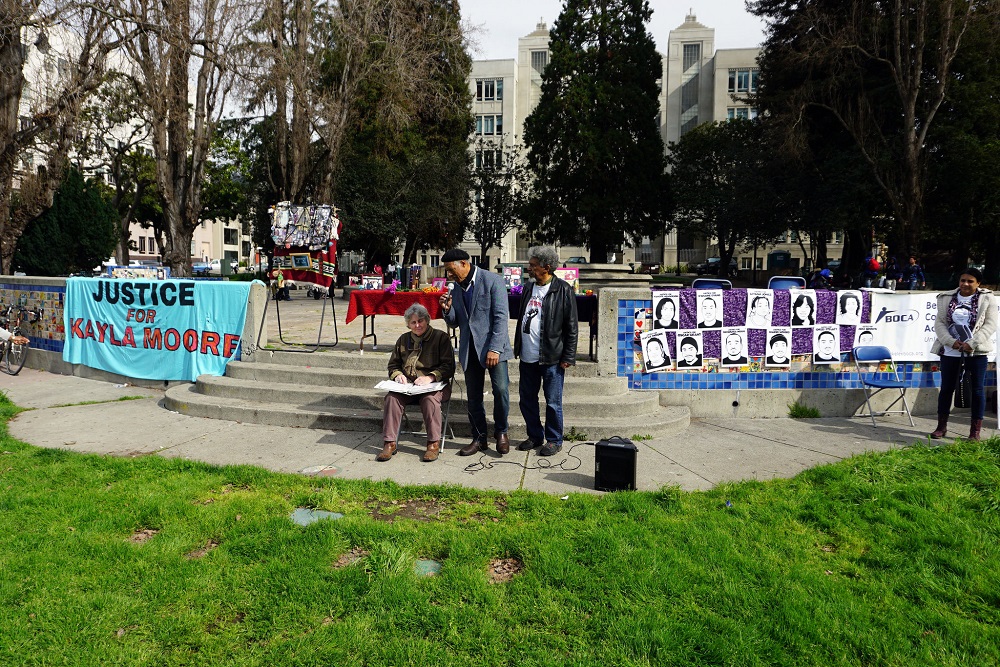
Several groups worked together on Monday in Berkeley to lift up the names and stories of people who have suffered from police violence and other forms of systemic racism in the US. The vigil by members of Berkeley Organizing Congregations for Action (BOCA), Justice 4 Kayla Moore, and Berkeley Copwatch was titled "Remember Our Names Black History Month Prayer Vigil" - and took place for five hours between noon and 5:00 p.m. in the Martin Luther King Jr. Civic Center Park, facing Berkeley City Hall and the headquarters of the Berkeley Police Department.


Members of St. John's Presbyterian Church share names and stories.
(Photo: Mark Coplan)


February 13 is the anniversary of the murder of transgender African American woman Kayla Moore by the Berkeley Police Department 4 years ago. (See SAY HER NAME: Kayla Moore and the Struggle for Justice)

"Remember Our Names Black History Month Prayer Vigil"
(Photo: Mark Coplan)
The photo at right shows the backdrop for the event: the Justice for Kayla Moore banner at left, images of victims of killings by police at right, and artwork by event founder (and BOCA executive director) Rev. Daniel Buford on the raised central area. Rev. Buford is at center, wearing the beret. Kayla Moore's sister, Maria Moore, stands at the far right.

Many people gave testimony about the violence being carried out by representatives of the state all across this country, and particularly against people of color. Dozens of accounts, from research compiled by Rev. Buford, were read and discussed. People shared stories of violence and killings and other injustice that they had been subjected to, or that had affected their friends or families or other members of their communities.

Many people from the congregation I attend, University Lutheran Church (ULC), participated in the vigil. We at ULC have made an intentional commitment to anti-racism work, joining in solidarity with other justice activists in our city, our state, and nationally.

For my own part, I used my time at the microphone during the vigil to lift up the names of some people I have known and/or learned about through my work in Chicago before coming to Berkeley.

I talked about Flint Farmer, who was shot in the back by Chicago police and killed, as he lay face down on the ground. (See: We need to get the police off the streets of Chicago. QED. ) And I talked about Flint's father, Emmett, who I has become a tireless campaigner for justice on behalf of all people subjected to police violence. I said that each time I see the way Maria Moore has devoted herself to activism in response to what happen to her sister, Kayla, I always think of Emmett Farmer.

"Remember Our Names Black History Month Prayer Vigil"
(Photo: Mark Coplan)
I talked about Rekia Boyd, who was shot in the head by an off-duty Chicago police officer. (See: Chicago Vocabulary Lesson: "Overcharging" and "Undercharging") I talked about how people in Chicago made a commitment to #SayHerName, so that everyone would know Rekia's story. I talked about how the systemic injustice included not just the police, but the also the district attorney's office that failed to hold the police accountable. And I talked about how the people of Chicago voted states attorney Anita Alvarez out of office for her failures in cases like that of Rekia Boyd.

I talked about people who had suffered from police torture in Chicago -- people like Darrell Cannon and Mark Clements. I talked about seeing Mark show up to speak at protest after protest after protest against police crimes. If Mark -- freed after spending 28 years imprisoned on trumped-up charges -- can find the energy and courage to keep showing up to be an advocate for others, what's stopping the rest of us?

In the course of the afternoon, we lifted up the names of stories of people from dozens of places around the country. Systemic violence against people of color is not just a Bay Area thing, it's not just a Chicago thing, it's happening everywhere. (Flashback: National Forum on Police Crimes, May 2014)


A full album of photographs from the event is available on Flickr.


RELATED POSTS

CHICAGO: Accountability ... Police AND City Council
Chicago Justice: Connecting the Dots


Please share this post . . . .

Saturday, February 4, 2017

SANCTUARY (Church, City, State) and Solidarity with Immigrants

I'm participating in a lot of conversations these days about Sanctuary, including developments where I live (Berkeley, CA), and the many other places across the US that are standing in solidarity with immigrants.

I decided to assemble some of the materials I've been sharing in one place.


FIRST . . . check out these awesome photos of the vigil this past Saturday at the detention center in Richmond (just north of Berkeley):


About 100 people turned out for the vigil at Richmond Detention Ctr on Feb 4!
(photo: David Bacon - see full album on Facebook)


We had a big group from University Lutheran Chapel.
(See video below for more on Sanctuary activities at ULC.)


For more information on the monthly vigils at Richmond Detention Center, and the many opportunities for involvement throughout the East Bay and other parts of California, see:

Interfaith Movement for Human Integrity (IM4HumanIntegrity)
East Bay Interfaith Immigration Coalition (EBIIC)

In particular, I want to pass along the powerful words of IM4HumanIntegrity program director Deborah Lee, shared with us on Saturday:

We stand here in prayer and solidarity with the (150-300) immigrants who are asylum seekers, green card holders, and long term residents, who are being held here under civil immigration charges.

We stand here – in front of one of the 250 immigration detention centers across this country – many county facilities like these, and the majority for profit -private prison facilities owned by GEO and CCA.

We stand here in prayer and solidarity ALS0 for the hundreds of other incarcerated individuals – 2.4 million incarcerated in our nation in 7,500 prisons -- disproportionately black and brown – reflected of persistent and unacceptable racial inequities through every social institutions and especially our criminal justice system. We painfully acknowledge that 70% of those who remain detained here in this facility are PRE-trial , have been granted bail, but cannot afford it.

We pray for All their families. Often the chief breadwinner is taken away, a mother or a father, putting children and families in economic jeopardy, facing the threat of homelessness. We pray and offer our moral, spiritual and concrete support to the families whose loved ones are held here. We invite them to speak their truth right here into our circle - to give their testimony so that they know, they are not alone.

We stand here today in solidarity with all those impacted by the illegal ban of refugees, green card holders, visa holders and family members from the 7 countries and other countries at risk - which was overturned by a judge last night. We are here to stand Against the Executive Orders that would triple ICE agents, build a comprehensive border wall, punish sanctuary cities, and collect fines and fees from undocumented persons and those who help them.

We stand here in prayer and solidarity because this prison- is a symbol of the militarized and punitive mindset towards immigration and other social problems. This prison and the proposals to build the wall – at the cost of $4 million per mile- and other anti immigration policies makes all of our communities less safe and secure. We demand that government resources be used to invest in our communities and address root causes of migration

THEREFORE…

We pray, knowing that all our faith traditions call upon us to welcome strangers and aliens, to practice compassion, forgiveness and understanding for those in prison, for they are our sisters and brothers and our families, and them, we were once strangers and aliens in this land.

We remember and must not forget that:

10 years ago – thousands of Muslims forced to register were deported and many families were torn apart.

1 grandmother ago there was the Chinese Exclusion act.- banning all from China and eventually from the whole Asia Pacific rim.

1 grandmother ago by Executive Order 120,000 Japanese Americans were Interned.

1 grandmother ago Jewish children and families in need of safety and protection were turned away and denied entry.

1 grandmother ago during the Great depression there was the mass Deportation of Mexicans and Filipinos

2 grandmothers ago slavery was legal and those of African descent were only considered 3/5 of a person.

2 grandmothers ago- this was Mexico.

3 grandmothers ago- this was Ohlone land and that despite everything it is STILL.

We lift up the dignity and resilience and love of those who endured. May their spirits strengthen us to resist and end the injustices in our time.

Rev. Deborah Lee
Program Director
Interfaith Movement for Human Integrity (IM4HumanIntegrity)

You can see Deborah speak in this brief video about the Sanctuary project at University Lutheran Church in Berkeley. (Over 700 congregations have pledged their commitment to resist deportations and discrimination through Sanctuary.)


Short video about SANCTUARY by filmmaker Theo Rigby of Immigrant Nation.


(And here's a separate blog post that I wrote on the day of the Sanctuary press conference depicted in the video: IN BERKELEY: Declaring Sanctuary, Changing Hearts and Minds.)


Three related resources

We need lots of resources to build up communities of resistance step-by-step. Here are a few . . .

First, check out the "Faith on the Move" 6-part study guide from Lutheran Immigration and Refugee Service. It was prepared by Rev. Dr. David Vásquez-Levy and invites people to think deeply about our faith tradition in connection with today's events. (Exodus, anyone?) We used it for adult study at ULC and it was fabulous.

Second, and related, pastors from First Congregational Church in a great video (under 3 minutes) that gets to the truth of what the Bible says about how to treat immigrants:


Third, a provocative set of study topics -- "9 Phrases the Migrant Rights Movement Needs to Leave in 2015" -- from Latinos Rebels. (Who's ready to tackle this during Lent?)


Finally, here are a few related posts that I wrote in past years:

WELCOME MAT USA: Come in! Come in! (Get out! Get out!)
Wanna Fix the U.S.A? Welcome an Immigrant Today!


Please share these materials widely  . . . .

Wednesday, February 1, 2017

CHURCH: What are we in the middle of?

I have been doing a lot of thinking about church life in the US - particularly about church life in mainline protestant denominations like the one I belong to, the Evangelical Lutheran Church in America (ELCA).

Almost every church-related activity I participate in stirs up memories. I think particularly of going to a Lutheran church in Summit, NJ, in the '60s and '70s.

Part of me measures today's church experiences against the yardstick of church during those growing-up years*. (*About a half a century ago. Yikes.)

Another part of me finds joy in today's church experiences for their own sake -- and even in the feeling that we might actually be creating a new thing together.


What are we in the middle of?

Sadao Watanabe, The Last Supper
I've started to wonder what "my" church -- the denomination I'm affiliated with -- will be like in ten years. It startles me to realize that the answer probably ought to have less to do with my "growing-up years" idea of church, and more to do with some newly-created thing.

I wonder about worship in new ways . . . and fellowship in new ways . . . and faith formation in new ways . . . and social justice in new ways . . . and evangelism in new ways . . . . Before long I realize that, in my imagination, I'm really just recycling a bunch of old ideas, perhaps with a bit of current affairs and/or exotic flair added.

Then it occurs to me that what church does is respond to life. So the answer to the question, "What will the newly-created thing be?" has something to do with the answer to the question, "What are we in the middle of?"

Put another way: the opportunity for the denomination lies in engaging with what our society is experiencing.  The more widespread, difficult, and amorphous that phenomenon is, the greater the likelihood that "it" is what church needs to engage with.


Centrifugal force: economic inequality

Sadao Watanabe, Lilies of the Field
My sense is that the growing economic inequality in US (and other) society is where church will find its calling more and more with each passing month and year.

A few notes:

* Economic inequality is readily apparent to a certain degree -- we care about "poverty" -- but is enormously underestimated by most people, and poorly understood by almost everybody. There was a small splash made in the last year or two on the subject of the growing (and structurally irremediable?) economic inequality in Western societies by Thomas Piketty's book Capital in the Twenty-First Century. Bernie Sanders' 2016 Democratic primary candidacy got some traction on the topic of economic inequality.

* Church communities are already inherently involved in dealing with economic equality hands-on, i.e. within congregations themselves. And yet there is almost limitless possibility to do new things in this dimension.

* Church communities are also involved in addressing economic inequality, through service and advocacy, beyond their own walls. Again, there is enormous scope to do new things in this dimension, as well.

The opportunity lies in the existence of a widespread/difficult/amorphous phenomenon which so far shows no signs of yielding to known approaches. It is tempting to see an analogy to the early Church, when the widespread/difficult/amorphous phenomenon was called the Roman Empire, and something new had to be created because the obvious approaches were not getting people anywhere.


Can church succeed?

Sadao Watanabe, Miracle of Loaves and Fishes
If we set our sights on something we already know church can succeed at, we're probably not thinking big enough. We will know we are considering the appropriate phenomenon when we realize, "This may not work."

Here's what I will be thinking about in the coming year:

* How does the Gospel witness equip church to respond to economic inequality that is massive and growing rapidly?

* What strengths and gifts do we, as church, have at our disposal as we face it?

* What might we, as church, be willing to give up in order to get it right?

* What's standing in our way?

It may not be possible to envision exactly what church will be like ten years from now. But it does seem likely that the broad outlines are close at hand, if we are willing to reach for them.


MORE:
2017: Which Way for the Church? Anti-Racism? or Comfort?
Declaring Sanctuary, Changing Hearts and Minds
DECOLONIZE THIS: The ELCA's Doctrine of Discovery Challenge
KAIROS: The Moment You've Been Waiting For?


Please share this post . . . .

Thursday, December 29, 2016

Which Way for the Church? Anti-Racism? or Comfort?

The Evangelical Lutheran Church in America (ELCA) -- and other US denominations -- can and should choose to emphasize anti-racism work in 2017. (I think it is a critical moment.)


From @scarry:
What if we all did a personal inventory of how our "personal
success story" was built on white privilege? #ELCAcwa

(Image: ELCA presiding bishop Rev. Elizabeth Eaton and quote:
"When my dad came back from the war, the GI bill meant he and
my mom could get a low interest loan. That was not available to
African American veterans. That's white privilege. It's baked into
the system. Now, we didn't create it, but if we don't work to
change it, we are complicit."


The tweet shown above was very heavily shared when I posted it during the churchwide assembly of the Evangelical Lutheran Church in America (ELCA) this past summer.

I have been very hopeful that the Church -- Lutheran and other denominations -- will be a leading force in working against racism. (If not the leading force.)

Some of the things I've written:

How Might the White Church "Die to 'Whiteness'"?

"Personal Success Story"? "White Privilege"? or Both?

Can "Lutheran" Be a #BlackLivesMatter Denomination?

Decolonize Lutheranism -- A Northern California Installment

At the same time, I think there's a lot in the Church that makes it just want to turn its back on the world and seek comfort. I think that impulse is acute as 2016 draws to a close.

Which will it be?

From where I sit, it seems that the choice to emphasize anti-racism work is a matter of life and death for the Church.

My personal belief is that it will require a choice by the entire membership -- and not just isolated acts of leadership by a few people in the churchwide office, or a handful of charismatic pastors. It certainly can't be left to a few stalwarts on the "Social Justice" committee.

It needs to be the work of the whole Church.

The Church, after all, is the people.

Please share this post . . .

Thursday, December 22, 2016

2016: My 12 Favorite Posts

In 2016, I wrote a lot about nuclear disarmament and the global peace movement, church life and social justice, and trying to understand this diverse society we live in.


January

I did a close reading of E.M. Forster's A Passage to India. It reminded me of the power of literature to help a society begin to see itself in the mirror.

(See PROBLEM: How does an entire country exorcise a national delusion?)


February

I started to listen, and to think about what I heard . . . .

(See Listening for Community (A Chicago Encounter))


March

Remembering a friend who gently opened my eyes . . .

(See Don't speak Spanish? "Sure you do . . . .")


April

I realized I have been powerfully influenced by some people I never even met.

(See Thanks, Ravi)


May

We need to stop "marking" dates . . . and start taking action.

(See OBAMA: First stop, Hiroshima; second stop, Moscow)


June

"We need to first acknowledge the genocidal origins of OUR nation’s history of ethnic cleansing and occupation."

(See Native American Rights: Acknowledge the Occupation)


July

It's time to start thinking about the saints in my life.

(See Who Ya Gonna Call? (Saints for All Times))


August

An important part of my life is the church I belong to, and its renewal as a strong force for social justice.

(See "Personal Success Story"? "White Privilege"? or Both?)


September

I spent a week in DC, and came back convinced we need to push harder to get nuclear weapons under control.

(See NUKES: Your Call to Your Congressman Matters)


October

I took time to think about what might be different about a movement directed toward a world beyond war.

(See WAR: Headed for the junkheap, yes . . . but how quickly?)


November

This map provoked a lot of thinking about what will be the most important development of 2017: negotiations on a global ban on nuclear weapons.

(See Who would possibly vote "NO" to banning nuclear weapons???)


December

An idea that I have been developing throughout 2016: a globally networked peace movement.

(See How Does the "Internet of Things (IoT)" Bear on Global Peace Work?)

Sunday, November 20, 2016

REFLECTION: When people say "the Muslim faith itself is the source of the problem"

The Trump administration has staked out a position against Islam and against Muslims. What does this mean . . . ?

The incoming administration of Donald Trump has placed itself in opposition to Islam, a religion with an estimated 1.7 billion adherents worldwide.

Donald Trump has named retired general Michael Flynn as his national security advisor. Flynn has said Islam poses an "existential threat" to the United States. "Islamist militancy poses an existential threat on a global scale, and the Muslim faith itself is the source of the problem, he said, describing it as a political ideology, not a religion." (See The New York Times, "Michael Flynn, Anti-Islamist Ex-General, Offered Security Post, Trump Aide Says.")

Read those words again: "[T]he Muslim faith itself is the source of the problem."

Now would be a good time for people in the US to learn some facts about Islam, and about its followers (Muslims), and to reflect on the adversarial position the new president has promised to adopt toward it and them.


A reflection

Muslim prayer rug, Turkey, 18th c.
(The arrow points the way)
Islam is fundamentally about submission to God:

Islam is a verbal noun originating from the triliteral root s-l-m which forms a large class of words mostly relating to concepts of wholeness, submission, safeness and peace.[32] In a religious context it means "voluntary submission to God".[33][34] Islām is the verbal noun of Form IV of the root, and means "submission" or "surrender". Muslim, the word for an adherent of Islam, is the active participle of the same verb form, and means "one who submits" or "one who surrenders". Believers demonstrate submission to God by serving God, following his commands, and rejecting polytheism. (See Wikipedia: "Islam: Etymology and Meaning")

This reminds me of the words in the Lord's Prayer: "thy will be done," and of Jesus' words on the cross: "yet not my will, but yours be done" (Luke 22:42).

I can understand people who say, "You know, putting God's will before your own -- that's really the hardest part of all this. The temptation is to just turn your back on the 'thy will be done' part. But if we're serious about our faith, we actually have to try to ask what God wants, for us and for everyone else, and to begin to see how small our own personal desires are in comparison."

And I can also understand a government that says, "If people start taking their faith in God seriously, their priorities are going to change, and they're certainly going to be a lot less in awe of us!" and "Hey, I'm the boss around here!"

It occurs to me that a lot of people of faith -- Muslim and non-Muslim -- are going to see the posture the US government is adopting, and they are going to say, "Does this government oppose anyone who has devoted themselves to serving God? How about me?"

A lot of people are going to be thinking about those words: "thy will be done."


Related posts

I've got a feeling he's gotten a lot of people to ask themselves, "What is my theology?"

(See It's a Matter of Theology)


We live in a 24/7 entertainment and media culture, and it is a constant struggle to shift from being a passive participant in the dominant cultural narrative to being an active influence on the ideas circulating in our communities.

(See In 2016, Walk the Talk: "Anti-Islamophobia." (You can do it.) )


I wonder if the outrage that many Muslims seem to feel at the suffering of other Muslims doesn't put us Christians to shame.

(See Fighting Back: It's alright as long as you're a Christian, right? )

Tuesday, November 15, 2016

Is the Outcome of the 2016 Election a Matter of Theology?

Post-Trump-election-victory USA: if ever good theology was needed . . . . Will the Evangelical Lutheran Church in America (ELCA) and its members bring it?


Detail from poster for the film Bal (Honey) by Semih Kaplanoğlu


I read a blog post yesterday by Lutheran seminarian and vicar Lenny Duncan: "The Road to 270 Was Through the ELCA." It's about the election of Trump, and it makes a very provocative claim:

"[T]he problem isn’t political. It isn’t sociological. It is theological." 

That feels right to me at a gut level. And it has forced me to think. "What is my theology?"

Before last week, I kind of took theology for granted. "We know what we need to know about God," I thought. "We just need to do a better job of getting organized."

But Pastor Lenny's blog post has made me go back to square one.

I'm hoping to get clear on some theology that will make as much sense this week, and next week, and beyond, as it seemed to make before November 8.

I've been turning a lot over in my mind. I'm realizing that I'm carrying around a lot of snippets of scriptural wisdom, but not all of them rise to the level of theology. And I've been taught a lot of theology, but very little of it feels totally reliable at the moment.

The best I've been able to come up with as of today is this:

We've nearly perfected the practice of treating other people as objects;
what might happen if we tried treating each other as children of God?

I know, I know, that's rather tentative. It's what I can manage right now, using what little I am carrying with confidence with me every day, and using words that I hope others can understand. (Perhaps what it lacks in certainty, it makes up for in possibility.)

The good news is that I know I'm not the only person reading what Pastor Lenny writes. I've got a feeling he's gotten a lot of people to ask themselves, "What is my theology?"

I look forward to seeing what others come up with.

Tuesday, October 25, 2016

How Might the White Church "Die to 'Whiteness'"?

"White" Christians, "white" congregations, the "white" church -- these words don't make any sense. But how do we change them?


Edvard Munch, Two Women on the Shore


At University Lutheran Chapel in Berkeley, we've been reading Between the World and Me by Ta-Nehisi Coates. Among other things, the book is a wake-up call for "people who think themselves white." And once awake, it's impossible for those people not to ask, "How might I think of myself?"

Three days ago, I attended a panel discussion featuring four ministers from the Bay Area. The discussion took place at the Oakland Museum of California, during a multi-day symposium on the 50th anniversary of the Black Panther Party, and the topic of the panel was "Liberation Theology - The Black Panther Party and the Church." In response from a question from an audience member about what the white church needs to do, Rev. Michael McBride said,

"The white church needs to die to 'whiteness'."

And I thought, "Of course."


How might the white church "die to 'whiteness'"?

For the past three days, I've been thinking a lot about what Pastor Mike said.

I certainly like the sound of it.

I'm not sure I know how to do it.

My first impulse is to say: we need to quash symbols of white ethnicity -- Bach hymns and Norwegian sweaters and Swedish coffee cake -- and open ourselves up to other cultural referents.

Pretty soon I'm off and running with visions of different ways to adorn the church, different ways to do worship, different ways to do fellowship . . . .

But something brings me up short.

I think there is valuable conversation to be had about music and attire and food -- about the signals we send to ourselves and others about who we are and where we seek our comfort -- but I also think it can obscure the heart of the matter.

The heart of the matter, at least as I understand it, is that race is a social construct, and it's concerned with power. "Whiteness" is a condition of power over and against people who get defined as "not white." "Dying to 'whiteness'," then, will involved giving up power, I think.

It may be difficult to understand how to give up power, particularly in a church context, in which (we may think) we aren't exercising any power. (At least not in the sense of physical power.)

But several possibilities come to mind.

In the church context, a lot of our power comes from our prerogative to interpret and re-interpret . . .

What might happen if we devoted ourselves to ("merely") listening to the experiences of those who have been defined as "not white" -- and check our habit of explaining what the "real" meaning of what we are hearing is?

In the church context, a lot of our power comes from our position as mediators . . .

What might happen if we took upon ourselves the demands of those who have been defined as "not white" -- and forgo our habit of watering down those demands to make them more "palatable" or "realistic"?

In the church context, a lot of our power comes from our role as managers . . .

What might happen if we went to work in the service of the solutions devised by those who have been defined as "not white" -- even solutions that we don't get to direct and control?

These are just a few thoughts that have occurred to me.

The real value, of course, will come as large numbers of people who "think themselves white" devote themselves to this question: How might I -- how might this Church -- "die to 'whiteness'"? (And: What lies on the other side?)


Related posts

Maybe a good next step is to read Coates' book and sit with it . . . listening to what comes up . . . but not jumping immediately into "solving."

(See On Reading Ta-Nehisi Coates (A Confession))


"I am convinced that we are in denial about the racism that saturates our society and from which we directly benefit. That denial produces predictable twin reactions from white people: either silence about the racism that plainly reinforces our way of living or surprise at the frustration and outrage African Americans and others express at how they are treated."

(See Can "Lutheran" Be a #BlackLivesMatter Denomination?)


How will the organized power of 4 million Lutherans in the US be brought to bear on the fact that we are living on occupied land.

(See DECOLONIZE THIS: The ELCA's Doctrine of Discovery Challenge)

Wednesday, August 31, 2016

ON SOCIAL MEDIA: Will a Renewed Church Require New Communications?

Martin Luther spurred a miracle of movement building during the Reformation. (The printing press helped.) Just think what he might have done with social media!

I'm excited by a movement for change within the Lutheran denomination in the US. It's called "decolonize Lutheranism" and you can get at taste of it on Twitter at #decolonizelutheranism.

By coincidence -- or not? -- Lutherans (and others) are marking the 500th anniversary of the Protestant Reformation over the next year.  Along the way we'll be talking a lot about Martin Luther and and all the different ways he played a role in renewing the Church.

Andrew Pettegree, Brand Luther
It's interesting to note that Martin Luther was a person who cared as much about communications as about theology. (Or, you might say, his ideas about communications were inherent in his theology . . . . )  The title of a recent book by Andrew Pettegree says it all: Brand Luther: How an Unheralded Monk Turned His Small Town into a Center of Publishing, Made Himself the Most Famous Man in Europe--and Started the Protestant Reformation.

This led me to wonder: Communications is central to renewing the Church. So what does this mean for us today?

First, I think we need to EMBRACE social media. I was struck at a recent presentation on the subject of young adult ministry when the pastor was showing the congregation the Facebook group for the young adult group. She gently reminded her audience, "online community is community." It was a small thing but it was part of the process of getting encouraging all of us to "get with the times."

Food for thought: do we understand our theology differently if we begin to envision our community as much in terms of a social media network as we do in terms of people in the pews?

Second, we need to have a functional understanding (as well as an app-specific one) of why some things "go" on social media. Some people love to use Twitter, some people love to use Facebook . . . but some of the breakthrough insights of social media are application-independent. Like ... visuals drive interaction. Like ... people are accessing this stuff on the go.

By the way: as we learn more and more about how people interact on social media, what does this bring up for us? 

Connecting via Facebook
Third, get ready to meet new people. When we go to where the conversation is taking place -- #BlackLivesMatter, #FreePalestine, #LoveIsLove -- we engage with people we didn't necessarily know before. Our ideas of community are challenged.

Cue the ecclesiologists . . . . 

Fourth, think more and more about how connections between things are formed, and give yourself permission to worry less about the perfectibility of any particular thing. Everything we do is interconnected via the Internet these days. But certain threads in the web are connecting many, many more nodes.

I think if Martin Luther were alive today, he'd be less concerned with assembling the ultimate work on theology than with encouraging an information architecture that might help give connection to an renewed mode of Christian life. (#ImAllAboutThatGrace?)

Finally -- and this we Lutherans can do! -- we need to work at it. Effective social media isn't all intuitive, and it takes time. Serious practitioners need to invest in learning, and churches need to recognize the contributions in time and talent that people (staff as well as volunteers) make to do this work .

How, for instance, would you account for social media work within the context of a congregational budget?


I'm looking forward to see how this new reformation proceeds!


Update February 23, 2017: Deconstruct this . . . !


Pope Francis: 
"Do not underestimate the value of example, for it is more powerful
than a thousand words, a thousand "likes", retweets or Youtube videos.


Related posts

The ELCA's presiding bishop, Rev. Elizabeth Eaton, has set an example: own the white privilege we've experienced in our lives. Will Lutherans step up?

(See "Personal Success Story"? "White Privilege"? or Both?)


As I read the article, I kept hearing echoes of lessons that I have been learning in the last several years as I have worked to communicate online about peace and justice issues. Herewith the top of my hit parade, with reference to stories from the USA Today newsroom . . . .

(See Social Media: If It's Good Enough for USA Today, It's Good Enough for Me )


Eventually, in large part due to Harriet Beecher Stowe's novel, Uncle Tom's Cabin, the United States was converted from a country in which a small number of people thought slavery needed to be ended into a country determined to act to end slavery. This literary work took the movement wide, and it took it deep.

Why is a novel an important tool for creative resistance?

(See Creative Resistance 101: Uncle Tom's Cabin )


What I'm feeling particularly energized about is the potential for the thousands of people who have already signed on as supporters of World Beyond War -- as well as millions more who are expected to do so soon -- to become active participants in spreading this good news.

(See News Worth Spreading: "There IS An Alternative to War!" )


To be sitting in Berkeley and seeing in front of my eyes the spreading of this idea that started in Texas and was nurtured in Philadelphia and got agitated in Chicago felt like a real Pentecost moment.


(See Decolonize Lutheranism -- A Northern California Installment)

Saturday, August 27, 2016

ELCA Resolution on Palestine / Israel: What Does It Mean for Us?

The Evangelical Lutheran Church in America (ELCA) has passed a resolution concerning justice in Palestine / Israel. What should Lutherans do?


ELCA delegation visits the Dome of the Rock in Jerusalem
during January 2015 pilgrimage to the Holy Land.  
(Details at Metro Chicago Synod Working Group on Middle East site.)


I was at a meeting yesterday and we were discussing the upcoming trip of some church folk to the Holy Land, and the question came up: "How will their plans change to reflect the resolution on Palestine / Israel passed at the ELCA churchwide assembly a couple of weeks ago?"

In particular, the ELCA resolved: "To urge this church’s members, congregations, synods, agencies and presiding bishop to call on their U.S. Representatives, Senators and the Administration to take action requiring that, to continue receiving U.S. financial and military aid, Israel must comply with internationally recognized human rights standards as specified in existing U.S. law, stop settlement building and the expansion of existing settlements in East Jerusalem and the West Bank, end its occupation of Palestinian territory, and enable an independent Palestinian state" (Emphasis added - read the full resolution below.)

The simple answer, of course, is "read the resolution, think about it, pray about it, discuss it with others (inside and outside your church community), and act faithfully."

Here are a few more specific suggestions for people to think about in the months ahead:

The next few months . . .  As you gather with other congregants returning from the summer and starting the fall season of gatherings and activities, ask, "Have you read the resolution? What does it mean to you? What are we called upon to do?"

Advent and Christmas - As we think about what it meant that God responded to our expectations by entering the world in the flesh, consider how to take up the words of the resolution concretely. What does this have to do with the here and now? Can we relish what happened in Bethlehem two thousand years ago without being deeply concerned about, and taking action on, what's happening in the lives of real people living in Bethlehem today?

Time after Epiphany - For many of us in the US, this time is referred to as "those long winter months." Take the time to read a book that sheds light on the ELCA resolution. (How about Faith in the Face of Empire by Mitri Raheb?)

Lent and Easter - A time to repent -- "turn around." Join with others in your congregation, conference, synod, and churchwide, as well as those of other church bodies and other faiths to carry out a brand new behavior toward Palestine / Israel. Move from just being "with them in spirit" to being with them in practice.

Time after Pentecost (know to some as "summer vacation") - Will you be traveling to Palestine / Israel next summer? Consider how your itinerary and trip objectives will faithfully respond to the ELCA resolution.

The suggestions above are just food for thought.  Other suggestions? Add them as comments below!


Related posts

Can there be any more clear illustration than the one at left to remind us that the work of the Church is liberation?

(See Christian "Church"? How about Christian "Liberation Organization"? )


Just imagine the effect of qualifying the usual blanket statements about "what Jews think" or "what Jews say" with specifics about which Jews are under discussion. I believe 2015 will turn out to be the year that people everywhere begin to tease apart the the notions of "Jewish" and "unconditional supporter of Israel."

(See The End of the Myth of Monolithic Jewish Support for the Actions of the Israeli State )


To be sitting in Berkeley and seeing in front of my eyes the spreading of this idea that started in Texas and was nurtured in Philadelphia and got agitated in Chicago felt like a real Pentecost moment.


(See Decolonize Lutheranism -- A Northern California Installment) 


Full text - Evangelical Lutheran Church in America (ELCA) resolution on Palestine / Israel - August 2016 
(retrieved from http://download.elca.org/ELCA%20Resource%20Repository/Legislative_Updates_for_the_2016_Churchwide_Assembly.pdf on August 27, 2016)

ASSEMBLY ACTION
YES-751; NO-162
CA16.05.13

To receive with gratitude the memorials of the Northwest Washington, Sierra Pacific, Southwest California, Rocky Mountain, Minneapolis Area, Southwestern Texas, Southeastern Iowa, South-Central Wisconsin, Southeast Michigan, Indiana-Kentucky, Metropolitan New York, Northeastern Pennsylvania, Upper Susquehanna and West Virginia-Western Maryland synods related to Israel and Palestine;

To reaffirm the commitment of this church to:

1. Continue its awareness-building, accompaniment, and advocacy on behalf of a peaceful resolution of the conflict between Israel and Palestine;
2. Take steps to assist the Evangelical Lutheran Church in Jordan and the Holy Land (ELCJHL) and other Christians in sustaining their endangered presence in the Holy Land;
3. Promote the economic empowerment of Palestinians, including investment in Palestinian projects and businesses;
4. Promote the protection of the human rights of Palestinians and Israelis and oppose all violence and actions which discriminate against or deny any people their basic freedom, dignity or human rights;
5. Embrace the principles of restorative justice as part of the ELCA’s advocacy and engagement for the just resolution of the Israeli-Palestinian conflict and actively seek ways to support Palestinians and Israelis engaging in restorative justice dialogue and other projects; and
6. Continue to pray for the ELCJHL and the work of The Lutheran World Federation Jerusalem program;

To encourage this church’s members, congregations, synods, and agencies as well as the presiding bishop to call on the U.S. President, in coordination with the United Nations Security Council, to offer a new, comprehensive and time-bound agreement to the governments of Israel and Palestine, resulting in a negotiated final status agreement between Israel and Palestine leading to two viable and secure states with a shared Jerusalem;

To urge this church’s members, congregations, synods, agencies and presiding bishop to call on their U.S. Representatives, Senators and the Administration to take action requiring that, to continue receiving U.S. financial and military aid, Israel must comply with internationally recognized human rights standards as specified in existing U.S. law, stop settlement building and the expansion of existing settlements in East Jerusalem and the West Bank, end its occupation of Palestinian territory, and enable an independent Palestinian state; and

To encourage this church’s members, congregations, synods, and agencies to call on the U.S. President to recognize the State of Palestine and not prevent the application of the State of Palestine for full membership in the United Nations.