Showing posts with label economy of the future. Show all posts

Saturday, July 1, 2017

Food for Thought: Global Markets, Global Brands, and the #Nuclearban

The negotiations on a global nuclear weapons ban are moving inexorably to conclusion at the United Nations.

By coincidence, the US -- the great #nuclearban refusenik -- will celebrate Independence Day this week, just as the negotiations are wrapping up. So it seems like a good moment to remember what Independence Day is all about . . . .


Consumers saying NO!: The Boston Tea Party


Scholars have recently begun to stress that the real revolutionary power of the American Revolution lay in the organized action of consumers in North America who hit their imperial rulers where it hurt: in their trading businesses. (See, for instance, The Marketplace of Revolution: How Consumer Politics Shaped American Independence, by H.T. Breen)

As someone who had a long career in international trade, I look at the map of all the #nuclearban-supporting countries from the standpoint of a US-based global marketer, and I think, "Uh-oh ...."


Interactive #nuclearban map from @icanaustria.
(Please share this message on Twitter.)


People ask, "Even if all the #nuclearban-supporting countries enter into a treaty, what difference does it make if countries like the US remain outside the treaty? Where is the leverage to make the US change?"

I suspect that we have an enormous amount of leverage . . . !


Top 100 Global Brands ... including Coca-Cola, IBM, Microsoft, Google,
GE, McDonald's, Intel, Apple, Disney, HP, and more ...


Everything that is happening in the US right now -- really, a state of political chaos -- is a function of how rapidly our economy is changing, and our inability to understand where we sit relative to the global economy. We are the beneficiaries of our integration with global markets . . . and we don't seem to realize how good we've got it, or how quickly we could lose the benefits of that integration.

One thing that I learned during my years traveling around the world as a US business person: people in other countries don't actually love us that much.  I'm not saying that people in other countries have anything against people in the US, but we often float through life in a kind of trance in which we imagine that everything about the US is great! and people everywhere are filled with warm feelings about the US. The truth is that there is a lot of ambivalence.

And that means the US -- the government, the people, the businesses -- don't get a free pass for bad behavior.

I was very intrigued by the actions of Apple CEO Tim Cook several weeks ago. When Donald Trump rejected US participation in the Paris climate accord, Cook hastened to reassure the community of Apple stakeholders:

I know many of you share my disappointment with the White House's decision to withdraw the United States from the Paris climate agreement. I spoke with President Trump on Tuesday and tried to persuade him to keep the U.S. in the agreement. But it wasn't enough.

Climate change is real and we all share a responsibility to fight it. I want to reassure you that today's developments will have no impact on Apple's efforts to protect the environment. We power nearly all of our operations with renewable energy, which we believe is an example of something that's good for our planet and makes good business sense as well.

We will keep working toward the ambitious goals of a closed-loop supply chain, and to eventually stop mining new materials altogether. Of course, we're going to keep working with our suppliers to help them do more to power their businesses with clean energy. And we will keep challenging ourselves to do even more. Knowing the good work that we and countless others around the world are doing, there are plenty of reasons to be optimistic about our planet's future.

Our mission has always been to leave the world better than we found it. We will never waver, because we know that future generations depend on us.

(See "Tim Cook emails Apple employees after failing to change Donald Trump’s mind about the Paris climate deal")

I believe business leaders like Tim Cook are gravely concerned about the political risk to their brands. They understand that their wildly popular brands may be tarred by association with the US - the country where they just happen to be domiciled. In the case of climate, there is a world consensus on the problem, and a daily-growing awareness that those who stand to be hurt the most by the problem are in the Global South. The problem for Tim Cook and Apple (and many other global brands based in the US) is: how can we let our customers throughout the world know that we're good guys -- that we're the ones wearing white hats -- despite the fact that we live in painfully close proximity to a practically outlaw regime?

In the days and weeks ahead, we will likely have a global consensus on outlawing nuclear weapons. And in boardrooms across this country, heated discussion of a new kind of political risk will begin . . . .

RELATED POST: Is there a relationship between #nuclearban and #G20?


Please share this post . . . .

Tuesday, June 13, 2017

Is there a relationship between #nuclearban and #G20?

THIS WEEK: #nuclearban talks resume at @UN!


I noticed that two events are happening in rapid succession:

Negotiations on a global nuclear weapons ban treaty take place at the UN in New York City June 15 through July 7.

The G20 meets July 7 through 9 in Hamburg.

The United States opposes the former, and has convinced most of its allies to oppose it, too.

The United States views the latter as "home turf" -- it consists of the countries it sees itself leading into a new century of global economic interdependence and prosperity.

What will it look like when US President Donald Trump stands before his colleagues in Hamburg, after opposing the nuclear disarmament efforts of 100+ countries at the UN in New York?

When I first thought about this question, I had the recent NATO events in mind. So my first thought was, "Oh, well, the G20 is a lot like NATO -- those are all the same allies the US has roped in to opposing the #nuclearban . . . ."

But when I looked more closely, I realized that the G20 is not just another rooting section for the USA and its wishes. In fact, with specific reference to #nuclearban, it's a very mixed bag:

* G20 members Mexico, South Africa, and Indonesia were co-sponsors of the original motion to hold nuclear ban negotiations. And since the EU is a G20 member, we need to count co-sponsors Austria, Ireland, Malta, and Sweden. (In addition, Philippines and Vietnam, who will be in Hamburg as guest attendees, were also co-sponsors.)

* Argentina, Brazil, Saudi Arabia, and EU-member Cyprus voted in favor of the nuclear ban negotiations. (In addition, so did Hamburg guests Guinea, Senegal, and Singapore.)

Sure, there will big opponents of #nuclearban at Hamburg (USA, Russia, UK, Australia), as well as some nominal opponents (Germany, France, Italy, Canada, Turkey).

But what about China, India, Japan, and South Korea? Where exactly they stand (or will stand) on #nuclearban is an open question.


G20 economies (see theconversation.com)


Now, it may seem that #G20 has nothing to do with #nuclearban. The #G20 is about trade and development, and #nuclearban is about weapons, right? And isn't most of the #G20 economic activity is accounted for by the opponents of the #nuclearban?

Perhaps. But what if we flip that on its head and ask: "What would the chart of the economic activity of the big 20 economies look like in a world without nuclear weapons?" After all, the #G20 is all about shaping the world economy of tomorrow, not perpetuating the past.

#G20 and #nuclearban may end up having quite a bit to do with each other.


Please share this post . . . .

Monday, January 23, 2017

Can Trump Drink the Pentagon's Milkshake?

Base data at Global Research
People who oppose war tend to notice two things.

First: the US has by far the biggest military in the world, spends the most money, has its forces and bases and weapons and technology spread out to every corner in the world, and is engaged in conflicts -- small and large, high-profile and clandestine -- everywhere.

Second: it's very difficult to arouse the general public in the US to want to change that.

We try moral arguments. We try economic arguments. People are really not interested.

*   *   *

So: it is intriguing to see the statement in Donald Trump's inaugural address, consistent with what he said in his campaign, about pulling back militarily:

We've defended other nations' borders while refusing to defend our own and spent trillions and trillions of dollars overseas while America's infrastructure has fallen into disrepair and decay. We've made other countries rich while the wealth, strength and confidence of our country has dissipated over the horizon.

I wonder what people think when they hear that "trillions and trillions of dollars." Does that make them want to see what would happen if money was taken away from the Pentagon and used in a way that they could actually see the benefit?

Let's not quibble for a moment with whether all that US military spending has really been directed at "defending other nations' borders." The immediate question for me is whether anyone -- Donald Trump or anyone else -- has the power to make any significant changes to the defense spending or any other aspect of the defense establishment in this country.

I'll be blunt: for the past eight years, we've seen what happens under the command of a nice, respectful person. Maybe we need to what a mean, disrespectful person can do.

I fully expect the defense establishment to seek to crush Trump if/when he attempts to make any changes. I frankly don't know how someone in his position manages to survive. And yet . . . .

Trump sent a signal with the bit about the F-35 spending. Of course, that was all theater. But I think the point we should not miss is that he does have a lot of support from people "out there" -- and the F-35 gambit was part of shoring up support as the buildup to something bigger.

A lot of us cringe at the "us vs. them" narrative, and the "disrepair and decay" narrative, and the "wealth = strength and confidence" narrative.  Although, to be honest, many of us have tried variations on these narratives -- we just found that they didn't work. So maybe what we find so cringe-worthy is that someone else has actually tweaked them into utility.


The Art of the Deal?

Make no mistake, Donald Trump isn't going to embark on a negative -- taking money away from the military -- without leveraging it into a much bigger positive:

We will build new roads and highways and bridges and airports and tunnels and railways all across our wonderful nation. We will get our people off of welfare and back to work rebuilding our country with American hands and American labor.

Can you spend "trillions and trillions of dollars" on that? You bet you can.

If Donald Trump knows one thing, it is that when you embark on building stuff, it creates a lot of jobs for ordinary people, and that money enters the local economy in a way that has a big multiplier effect.

I keep remembering John Maynard Keynes saying something to the effect that, if you can't think of anything better to do, just have people dig a hole and then fill it up again. And we've got a lot better things to do than dig holes.

Vision for a nationwide rail system
(See An Infrastructural Alternative to Military Spending)
Just a few weeks ago, I wrote a piece about how, if we hope to move towards a world beyond war, we need to shift our infrastructure spending -- to something like a national high-speed rail network. I didn't take quite the same tack as Donald Trump. But what if his approach gets us to the same place?

Sure, the Republican establishment won't be thrilled with this kind of Rooseveltesque program. (Oh wait -- that's right -- the Republican establishment didn't elect Donald Trump.)

It becomes a lot harder for the military establishment to crush you when people are feeling really, really hopeful about what your infrastructure development plan is going to mean for them and their communities.

A clue to how important this is to Donald Trump, and what his strategy is, may lie in his appointment of Elaine Chao as Transportation Secretary. (How is this picture not like the others . . . ?)


Last week I wrote about what might possibly be motivating Donald Trump to cut nuclear weapons. (Hint: think about where hotels go.) When it comes to trading military bases abroad for urban transit hubs in the US, maybe we should ask the same question. Need a hotel with that, fella?


Please share this post . . . .

Friday, January 6, 2017

Connect the Dots: Obama Drones Threat Capital Inequality

By perpetuating the idea that we live under threat of terrorism, and that drones are the answer, Obama has guaranteed the economic inequality engine will continue to function unimpeded for a very long time to come . . . .


"Obama's embrace of drone strikes will be a lasting legacy."
(Graphic: @pariewolf)


Barack Obama is scheduled to give his farewell speech in Chicago on January 10, 2017.

Over the past six years, I have written again and again about the expansion of drone killings under Obama. The graphic above reminded me that I should not let the occasion of Obama's "legacy" speech pass without saying what his real legacy will be.

As Mark Landler explained in The New York Times this past summer, Obama's legacy really does seem to be the use of military force by the US around the world in an uninterrupted way, while still operating beneath the notice of the vast majority of US people.

The use of drones perfectly encapsulates the Obama legacy: as long as you keep boots off the ground, you can assert US military power anywhere and everywhere without alarming the public. If a few spoilsports object, you can point out that drones are limited, cost-effective, high-tech. (And did we mention there are no boots on the ground?)

As someone who has called written about this phenomenon as "permawar" . . . and worked with drone warfare opponents throughout the country . . . and even tried revoking Obama's Nobel Prize . . . I enjoy a kind of satisfaction in seeing other voices affirm my reading of the situation.

 . . . HOWEVER . . .

I've come to the conclusion that it is not enough to simply protest drone warfare.

We need to connect the dots between this new way of war and the economic crisis that has brought Donald Trump to power.


Inequality: "Where's Mine?"

WHERE'S MINE? Inequality in the US
and the Military-Industrial Complex
About a year ago, I took a stab at connecting the problem of inequality in the US to the problem of military spending and war.

I shared data on the real extent of economic inequality in the US, and noted that this information is widely available. "I'm wondering when people are going to decide to do something about it," I wrote, "and when they're going to begin to ask about the connections between inequality and the military-industrial complex."

I think we got the answer to the first half of my query with the election of Donald Trump.


How US Military Spending Contributes to Economic Inequality

US government spending:
military vs "all other"
(More details here.)
To many of us, it seems obvious that the connection between the enormous levels of US military spending and economic inequality is that tax money is used for war instead of to make the lives of people in the US better. ("Money for jobs and education, not for war and occupation.")

As a very loyal but honest critic of the antiwar movement has said, "We just can't seem to get any traction with the money argument for opposing war."

We're not getting traction with the simple argument -- "Stop spending so much money!" -- and we're also not getting traction with the more sweeping argument that takes the form of a critique of "Neoliberalism."

In my opinion, the former argument fails because it is too simplistic: it's just too difficult for people to detach their idea of today's military spending from the idea of the "Good War" and the "arsenal of democracy" -- the notion of "security" validated for them by WWII. They know just enough about today's regional conflicts and militant activities -- i.e. the warlike ways of "those people" and their resort to "terrorism," but nothing about the role of the US and other countries in fomenting same -- to reinforce the idea that military spending is unavoidable. In-district military spending (jobs) seals the deal.

(Put another way: Eisenhower's warning about the military-industrial complex is too abstract to be helpful.)

The latter argument -- the critique of Neoliberalism -- is, in contrast, too wide-ranging and diffuse. At its core, it plays into exactly the psychology that perpetuates inequality, even in the face of grotesque inequities: people hear "freedom of opportunity" and they imagine it means "freedom of opportunity" for ordinary people. They imagine themselves, and people like themselves, getting a break.

No, we need a different argument.

Ideally, something with a conspiratorial edge to it.


Stacking the Deck

In my "Where's Mine?" post, I alluded to the work of Thomas Piketty. But it wasn't until I read Joseph Stiglitz's gloss on Piketty in his book The Great Divide that I was able to connect the dots.

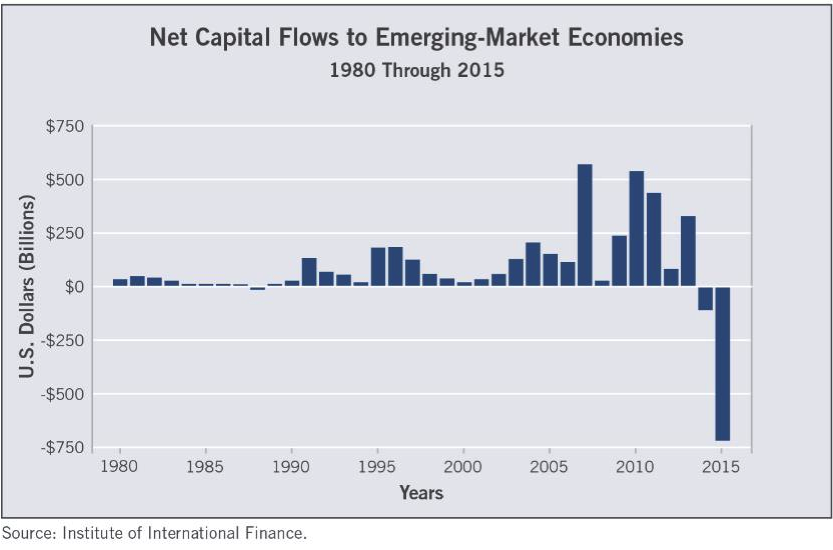
Stiglitz explains that what Piketty is pointing out is that the 1% keeps getting richer and richer because something's out of whack. The wealth that they invest is able to keep earning super high returns, despite the normal expectation that, at some point, returns weaken. In particular, they have the ability to keep pumping money into emerging, high-growth economies, which will pay a higher return on capital, compared to older, low-growth, stable economies (read: the US).


Net Capital Flows to Emerging-Market Economies (1980-2015)
(Source: Advisor Perspectives)


(As the graph above shows, the past few years have seen phenomenally high levels of capital flow into emerging markets.)

Stiglitz says this can't go on indefinitely, but by the time it peters out, there is likely to be extreme inequality globally -- i.e. much worse than there is now.

What Stiglitz doesn't explain is this: what has prevented the market from correcting this situation?

In particular, I wondered about the risk of investing in those emerging markets. Having spent a large part of my career doing business in China (and other parts of Asia), I have always been very focused on the degree to which investments are put at risk by the absence of good information in those societies. (It has often seemed to me that there is a bubble in China, supported by perception that the overall market is growing so fast that the inability to monitor the true performance of individual investments is a minor concern.)

Stiglitz gives a clue that we should be looking in a different direction. He invites us to think about "rents." This refers to the idea of sources of assured returns -- think of an oil well or music royalties -- where the underlying asset is not involved in a complicated, risky operation like manufacturing or providing a service.

I think the answer to how the rate of return on capital all around the world can continue to remain high, despite the expectations of market theory, is that capital is able, in effect, to find unnatural ways to shield it from risk in those "other" countries. The returns are more like "rents" than they are like "dividends."

Moreover, I think the most important "unnatural way" involves the threat of military force to protect capital -- i.e. the investments of the 1% from the US (and the rest of the West).


"America's most elite troops deployed to 138 nations in 2016 . . . ."
(Source: Nick Turse in Truthout)


Conveniently, Nick Turse just published a piece with the updated map above of elite troops deployments and US military installations around the world.

To complete the picture, all you need to do is think about the fact that the places in-between are all covered (or coverable) by drone flights.

This picture is not keeping the world safe for democracy; it's keeping the world safe for capital.


Really?

As someone who has grown up in the US, it is not automatically possible for me to understand that the presence of US military forces around the world necessarily translates into the message: "No US financial losses allowed here." Do people in foreign countries really think that accepting US investment means they have to guarantee the returns of those US people? Shouldn't foreign investors have to face normal financial risk, just like everyone else?

By coincidence, I noticed a reference the other day by Howard Zinn to "Instances of Use of United States Armed Forces Abroad." A few of the examples Zinn cites:

1853-1854 - Japan. Commodore Matthew C. Perry and his naval expedition made a display of force leading to the “opening of Japan."

1859 - China. July 3 I to August 2. A naval force landed to protect American interests in Shanghai.

1860 - Angola, Portuguese West Africa. March I . American residents at Kissembo called upon American and British ships to protect lives and property during problems with natives.

1893 - Hawaii. January 16 to April 1. Marines were landed ostensibly to protect American lives and property, but many believed actually to promote a provisional government under Sanford B. Dole. This action was disavowed by the United States.

And the list continues . . .

1912 - Honduras. A small force landed to prevent seizure by the government of an American-owned railroad at Puerto Cortez. The forces were withdrawn after the United States disapproved the action.

1917-1922 - Cuba. U.S. forces protected American interests during an insurrection and subsequent unsettled conditions. . . .

1922 - Turkey. September and October. A landing force was sent ashore with consent of both Greek and Turkish authorities to protect American lives and property when the Turkish Nationalists entered Smyrna.

1965 - Dominican Republic. The United States intervened to protect lives and property during a Dominican revolt and sent more troops as fears grew that the revolutionary forces were coming increasingly under Communist control.

1988 Panama. In mid-March and April 1988, during a period of instability in Panama and as pressure grew for Panamanian military leader General Manuel Noriega to resign, the United States sent 1 ,000 troops to Panama, to “further safeguard the canal, U.S. lives, property and interests in the area.” The forces supplemented 1 0,000 U.S. military personnel already in Panama.

Don't take it from me. The official US history says that the US military intervenes again and again and again to protect US capital. ("Instances of Use of United States Armed Forces Abroad, 1798-2015" by the Congressional Record Service.) And that doesn't include CIA operations (e.g. 1953: Iraq, oil; 1961, Cuba; 1980s: Central America) or much of the post-WWII intervention in the name of "fighting Communism" (Korea, Vietnam, Laos, Cambodia), "humanitarian" purposes, or for fighting "terrorism" (Afghanistan, Pakistan, Somalia, Yemen) and "weapons of mass destruction" (2013: Iraq, oil).

Its easy to see why countries around the world understand that using the capital proffered from the US comes with a proviso: "You will guarantee that this cash injection brings nothing but upside. We expect rents in perpetuity."


Connecting the Dots: Obama - Drones - Threat - Capital - Inequality

I propose that the global movement against war should celebrate the departure of Barack Obama.

We should seize upon the recognition that the economic inequality that vast numbers of people in the US are angry about stems directly from the way the US military is used. (Including, in its newest form, the move toward drone warfare.)

If We the People have any gumption, we will see that the very reason we are becoming more and more impoverished, while the super-rich get richer and richer, is that our taxes are being used to stack the deck for the rich.

That giant sucking sound? It's the investment dollars that we need to refresh our productive economy fleeing to "rents" in distant parts of the world. And OUR tax dollars are paying for the military that guarantees the economic inequality engine will continue to function unimpeded for a very long time to come.


Please share this post . . .

Monday, December 12, 2016

An Infrastructural Alternative to Military Spending

The Trump victory has drawn attention to large parts of the US that feel left behind. Maybe the military-industrial complex was never really designed with their interests in mind . . .

As we consider how we can move towards a world beyond war, it is obvious that one key is to change the way we are investing our money:

In a world beyond war, it will no longer make sense to be in possession of massive amounts of infrastructure for carrying out war.

Although this axiom seems obvious, several factors make its application challenging. Some of those factors are general, and some are particular to the US, so important because of the degree to which it leads the world in military spending.


The circularity of military infrastructure spending

I think everyone can agree on the fact that, to some extent, military spending is not just a consequence of war, but also an instigator of it. Conversely, to the degree that war is going to go away, that going away can be hastened by an early decrease in military spending.

Prepare . . .
Yes, George Washington saddled the US (and the world) with one of history's most unfortunate bon mots: "If you want peace, prepare for war." It's a statement that is tedious to try to refute, but only because of its delightful symmetry (and its source). It just doesn't happen to be true.

Or at least: even if it was true once, that doesn't make it true for all time . . . .

For it is self-evident that there will be a moment when the market realizes that arms are out and something else is in -- much as the market is currently figuring out that fossil fuels are out and alternative energy sources are in. When that moment comes, profit trumps bon mots, and the paradigm change goes from being hesitant to being an avalanche.

This is especially true if the "something else" has a strong international/commercial emphasis. (Think tourists, not troop ships.)

"If you want prosperity, you need to be open for business."


The electoral stranglehold

The peculiar nature of US public spending is that it must be authorized by a Congress that takes its shape from our peculiar electoral system.

Without working out here the logical steps -- you can do this for yourself, at your leisure -- the fact is that electability at the congressional level is a function of the ability to bring dollars to the district from the federal budget, and the one sure instrument of nationwide distribution is military spending. No one gets to stay in Congress if they don't bring home the bacon. (See, for instance, "Congress’s Deep Hypocrisy on Defense Spending," Bonnie Kristian in TIME, March 17, 2016.)


Military bases in the continental US. (Militarybases.com)

Bases, defense labs, military contracting, military academies and colleges, and recruitment - they all add to the tab. The money is spread across the country according to a very logical calculus.

I don't think we're going to change the congressional system any time soon. But can we give members of Congress some different bacon to bring home?


A grand bargain

Everyone knows that domestic infrastructure in the US is in a woeful state. It should be possible to make a trade-off: cut spending on military, increase spending on infrastructure.

In my view, the problem with that proposition is that it is not enough of a sure thing. In other words, it's not enough to say, "We'll put together a list of bridges to fix and be assured that sooner or later we'll get around to your district." No, there needs to be a comprehensive project, such that at the very moment a given politician signs away the benefits of military spending in his/her district, the alternative spending gets delivered.


Vision for a nationwide rail system (US High Speed Rail Association)


An example of such a comprehensive system is a national rail system. Pictured above is a vision supplied by the US High Speed Rail Association. To become interested in the possibilities of such a system, it is necessary only to look into the rail maps of Europe or China.

The jobs and other opportunities created in districts throughout the US by all the primary, secondary, and tertiary lines in such a rail system would provide enormous incentive to move spending from military uses to civilian uses. And perhaps as people got a taste of the benefits that spending could provide nearby they would see the desirability of moving the money from far-flung foreign bases, as well.


What I have sketched out here is not intended to specify "the" answer; I put forward rail development by way of example. What I do hope is that this helps frame the problem for successful solving: a very different way of investing for national prosperity will become obvious the nearer we get to a war-abolition environment, and our task is to make it obvious sooner.

See also ...

IT'S A LOCK: Why the US Can't Break Its Addiction to War
What Will "Strategic" Mean in Our Children's Lifetime?
Cutting Defense: Are We STUCK?


Related posts

There is a growing movement of people focused on the "world beyond war." To many of these people, the question is not "if" but "when?" They share a conviction that the world will get there, and they see that it makes a difference how quickly (and in what manner) the world gets there.

(See WAR: Headed for the junkheap, yes . . . but how quickly?)


Adopting a "world beyond war" frame -- saying "war is going away; the question for me is how fast" -- implies optimism-realism, outcome orientation, and humility.

(See The Mind of the "World Beyond War" Activist)


It seems very hard to imagine having arrived at the world beyond war without the hand-in-hand changes in education, infrastructure investment, and the way society decides on communal action in the face of conflict.

(See Where to Put Effort for a World Beyond War)

Saturday, November 12, 2016

Surfing a Tidal Wave of Stuff

The Trump election puts a fine point on the urgency of re-directing our economy. We will fail unless we develop a deep understanding of the human factors in the economy we've arrived at.


Mr. Do-it-yourself: paintbrush, Ikea furniture, and thou ...
As I try to comprehend the fact that Donald Trump was elected US president, my mind keeps turning to all the states that voted red.

I currently live in California. For 20 years I lived in Illinois. My early years were spent on the East Coast -- the metro New York City area, then Boston, then Philadelphia.

But I haven't forgotten the other parts of the country that I learned about along the way. In particular, during the '80s I traveled a lot as a importer/exporter. I had clients in Wooster, Ohio ... Atlanta, Georgia ... Johnson City, Tennessee ... Tampa, Florida ... Milwaukee, Wisconsin ... St. Louis, Missouri . . . Charlotte, North Carolina ... Greenville, South Carolina ... Fort Worth, Texas .... I made a second foray into the world of manufacturing in the early 2000's, and that took me to places like Omaha, Nebraska ... Waterloo, Iowa ... Detroit, Michigan ... Chattanooga, Tennessee ....

It looks to me as if Donald Trump was elected president by people in places like those, and principally by people asking, "Where did my job go?" (and, ultimately, "How am I going to survive and prosper?").

This has been a wake-up call to me. I have to confess that I had felt relieved to have moved beyond the part of my career that involved touring factories and sitting in purchasing agents' offices and telexing orders and scouting competitors' products at the shopping center. It was clear to me that the US economy faced a painful restructuring, but trying to figure it out was wearing me out.

I preferred to think about peace and social justice.

It's clear to me now that we will all have to be part of figuring out this economic change. (Together with peace and social justice.) (Or . . . maybe that is peace and justice.)

So . . . herewith I begin the painful process of remembering what I've seen, and trying to make sense of it. What follows are not answers; they're not even quite questions. They are the beginnings of impressions of how the economy has been changing underneath us, and perhaps what we need to think about to get to the best next step. The thread that ties them together is: it's not just a question of creating more manufacturing jobs of the old type. We need to better understand all the ways people can contribute value in this new evolving economy - not just in the factory, but also in stores, as service providers, as designers and crasftspeople, in transport, as business people and inventors . . . and more . . . .

(1) True Value - My years in business coincided with the rise of "discount merchandising" - a.k.a. "big box retailers."  People abandoned the dinky Main Street retailers (think: the local hardware store) for mega-stores that you drive to a mall to shop at (think: Home Depot).

At the time, it seemed like that had only one important implication: more stuff! But it's worth doing the mental exercise: name ten implications of the rise discount merchandising on life in the US . . . .

(Future installment: "on wheels" and "haven't you ever heard of a buyback?")

(2) DIY - It amused me to visit suppliers in Taiwan and South Korea who referred to the "DIY" trend in the US. (You know, "do it yourself.") As someone who had grown up in a family that could not afford to hire outside help to do things like repaint the living room (and kitchen and bathroom and dining room and . . . . ), it had never occurred to me that there was anything but "doing it yourself."

Now . . . I know that the US was built on self-reliance, and I continue to love the odd weekend project as much as the next person. But is it possible that we've missed a huge point about the value of having really skilled people do work?

(Future installment: the story of the time my friend Bob and I built a deck behind his and Wendy's home in Annandale, Virginia.)

(3) Style - I had a few mini-tutorials along the way from suppliers I visited in Italy. They demonstrated that they would only take on a project if that, in doing so, they would be able to make the quality noticeably better than it was last time. They also attested to the fact that they knew where their home was and that their community's success was important to them.

It is embarrassing to think about how novel those two attitudes seemed to me, considering that, at the time, I was spending a lot of time with manufacturers and other business people all around the US.

(Future installment: lunch in the Citte Alta of Bergamo.)


Google Earth image of Omaha, Nebraska - showing Walmart locations


(4) Malcolm MacLean - If you're not familiar with that name, it's time for a Google search. MacLean was the person who figured out that the way to move stuff was not box by box, but truck by truck (i.e. via "containerization). (Cue Season 2 of The Wire.)

I came of age during a decade that revolutionized international trade, and in which we "destroyed distance."

At the time, our only concern was whether we were going to run out of oil to power our cars and trucks and ships and airplanes.

Then somebody told us the problem we needed to worry about was the one we couldn't even see: CO2 . . . .

(Future installment: mental image of Sam Walton flying his plane and identifying future store locations based on where interstates were being built.)

(5) The English Problem - When I was in middle school and high school, I took French. I was a terrible French student. My only consolation was that I wasn't taking Spanish, which I considered even more pointless.

(Luckily I lived in a very very very homogeneous town. I was completely insulated from anyone who wasn't just like me.)

When I went to college, I decided to turn over a new leaf and get serious. I studied Chinese. I took great pride in learning a lot of Chinese. And it turned out to be very useful in my business efforts.

But what I noticed along the way was that you don't have to be fluent in Chinese to gain a lot of benefits. Actually, an enormous number of doors are opened as soon as you know ten words. A hundred words practically make you a visiting prince.

The real limiting factor was not that languages are difficult, something different: was I willing to think that those people from other places and cultures might be worth talking with?

Now, about that Spanish (and French) (and . . . ).

(Future installment: the day we had a substitute teacher in my high school French class.)

(6) Electronics and stuff - An enormous part of the way our economy has changed has to do with electronics. (In fact, I imagine some people who have read this far may think everything I've talked about above is beside the point; "It's the smartphones, stupid!")

It seems to me that we are still in our infancy when it comes to deriving true benefit from the electronics revolution -- we're still swimming in noise. This, in turn, is suggestive of the degree to which we are behind the curve in dealing with the tidal wave of stuff that has come to overwhelm us, beginning in the second half of the 20th century.

What is the real lesson of electronics for our lives?

(Future installment: when I learned that "foundry" referred to semiconductor industry structure.)


To be continued . . . .

Thursday, May 19, 2016

21st c. Berkeley: More Relevant Than Ever to Antiwar Movement

As a "peace" enclave within California's concentrated military/defense economy, Berkeley and the East Bay have a role to play in the discussion about China.


BERKELEY: Looking west -- the bay, San Francisco . . . and beyond.


As I set out to understand California's entanglement in the military-industrial complex, I started where I live: Berkeley.

Reading a letter to the editor from our representative in Congress, Barbara Lee, a few days ago reminded me that the 13th district is kind of unusual: "As the National Defense Authorization Act comes up for a vote, I will once again co-lead a bipartisan amendment to audit the Pentagon." (Read more on Barbara Lee's position on the Authorization for Use of Military Force Against Terrorists (AUMF).)

Yup, this is different than the town I just came from. Chicago's star corporate citizen is mega military contractor Boeing.

Of course, Berkeley was ground zero for the antiwar movement during the '60s. But what's its relevance today?


A bridge to China

As a long-time student of China and the Chinese language, I am enchanted to find myself in a city whose university attracts lots of the very smartest students from China and other parts of Asia. (See "Berkeley - International Student Enrollment - Fall 2015") Many other Berkeley students who are US citizens claim Asian ethnicity. (See "Berkeley - Enrollment Data")

If California, and especially the Bay Area, is the historic link between the US and China, Berkeley is a particularly vital US-China hub right now.

We all say things like "youth are our future" . . . . What would happen if we encouraged a serious discussion between the diverse people in the Berkeley community (and from other communities) about the future of peace and security in the Pacific region?


SOUTH CHINA SEA FACE OFF:
Does this make ANY sense?
The discussion we need to have

I wrote recently about the growing tensions in the South China Sea.

As I read the Chinese language paper every day, it is clear to me that -- in the absence of sustained civic discourse on the security issues in the Pacific region -- our future is being shaped by military posturing.

I think a good way to re-direct the conversation would be to get a large number of young people who know and care about the situation in the region to get together and talk. It should include people from the various countries and territories concerned. It should be directed at the future we're all trying to build together. It should place a strong premium on listening. It should be open-ended.


Some possible starting points

The good thing about a university town is that it has many of the ingredients necessary to conduct forums.

Now this I understand . . . !
(Image: Android Authority)
Here are a few available in Berkeley that might assist the type of discussion I am suggesting:

* Student associations, including Chinese Students Association, Taiwanese American Student Association,
Hong Kong Student Association, . . . .

* University departments, including International Relations and  Institute of East Asian Studies

* Citizen groups, including United Nations Association - East Bay

* Relevant University affiliates, such as Office of International Relations and International House - UC Berkeley


My hope and belief is that a Berkeley forum on peace and prosperity in the Pacific would reveal a shared interest in de-escalating the South China Sea confrontation, and dramatically increase awareness of shared Pacific prospects for well-being.


Related Posts

In four hundred and thirty-five Congressional districts, there is an inseparable relationship between campaign funding for Congressional races and the military contractors. How do we push back?


(See IT'S A LOCK: Why the US Can't Break Its Addiction to War)


What people in Asia (and others) have seen for the past century is that something is happening in the Pacific, and it's being driven in part by advances in naval (and, subsequently, aviation and electronics) technology, and in part by powerful nations (principally, but not limited to, the U.S.) proximate to the area.

(See The Imperialized Pacific: What We Need to Understand)


"Although we know the end from the very beginning," says Walker, "the story is no less compelling to watch." A man, gloriously alone (except for his own reflection) on an ice-covered lake; the soothing pastel colors of the distant sky; and what seems surely to be a circle he is digging around himself with a pick-axe. A perfect parable for our headlong rush toward climate crisis?

(See How Do You Say "Suicide Narcissus" in Chinese?)

Tuesday, May 10, 2016

SOLAR PANELS: A Force for Peace in Africa?

Will the people in Africa who are starved for electricity get it via solar panels supplied from China? What impact might this have on violent conflict?

Sustainable Development Goal 9:
Industry, Innovation, Infrastructure
The UN International Day for Peace 2016 has been tied to the 17 Sustainable Development Goals. I was interested to see that an event titled World Economic Forum Africa 2016 is happening in Rwanda in the next several days. It made me curious to see what the Davos people might have to say about development (and, by extension, about peace) in Africa.

There's a big emphasis on digital and education at WEF Africa 2016. More information, more communication, more opportunity -- it's hard to argue with that as a good in general, and an essential lever in eliminating conflict in particular. Notably, WEF Africa 2016 is sponsored by a the Gates Foundation, numerous tech giants (Google, Microsoft, CISCO, Huawei, SAP), as well as the assortment of banks, consulting companies, and other corporate giants you would expect.

I'm a little curious, however, about where the power is going to come from to bring about the digital revolution in Africa.  A report on the WEF Africa 2016 website ("Africa’s digital revolution: a look at the technologies, trends and people driving it") provides this graphic:


AFRICA: Share of population without access to electricity
(Image: International Energy Agency)


Forget about electricity to power digital devices. How is it possible to talk seriously about a stable society and reversing the forces that bring about civil conflict when over 75% of a population has no access to electricity? According to the graphic, that means 60 million people in Congo, and 70 million people in Ethiopia.  In Nigeria, where somewhere between 25% and 50% of the people have access to electricity, there are still 93 million people without it.

There is a session on infrastructure at WEF Africa 2016, and I intend to watch it. I hope that it will not feature suggestions that nuclear energy is what Africa needs. (Stay tuned.)

What WEF Africa 2016 should be advocating is a massive solar energy program for Africa.


SolarGIS solar irradiation map, showing areas of highest exposure in Africa.


Trade, aid, lending, and investment between Africa and China have been growing rapidly. China is a massive supplier of solar panels. A project called Akon Lighting Africa (ALA) initiative aims to bring solar power to 600 million people in Africa -- with the help, it should be noted, of a $1 billion credit line from a Chinese solar system provider.

To get deeper into some of the underlying issues, check out this 2009 study on "China in the African Solar Energy Sector" based on the experience in Kenya.

Of course, solar power in Africa would have winners and losers. The winners would include companies in China supplying solar panels. Of course, Chinese companies could be counted on to start producing solar panels in Africa before long, so Africans would also be winners. Of course, thousands -- perhaps millions -- of local people in Africa would find employment installing and maintaining solar systems. And everyone in Africa would win from the absence of pollution.

Of course, there would be losers, too. Giant corporations like GE-Hitachi -- did I mention GE and Hitachi are sponsors of WEF Africa 2016? -- and Western engineering companies and banks will lose out if they do not get contracts to build nuclear plants in Africa.

I wonder if, when Peace Day 2016 rolls around in September, we'll be celebrating the continued progress of peaceful solar in Africa, or worrying about the creep of nuclear power across Africa?


Related posts

It will benefit us antiwar activists in the US to attend to and reflect upon the importance of these Sustainable Development Goals to achieving the goal of ending war.

(See PEACE DAY 2016: What comes first? Demilitarization? or Development?)


There's no question in my mind that Climate Action (Sustainable Development Goals #13) goes hand in hand with antiwar activity.

(See Peace Day 2016: 3 Ways Climate Action is Vital)


The U.S. could take a lesson from the "command economy" in China about government setting a bold new direction in using alternative energy.

(See #chinaEARTHusa -- Solar Panels at the Crux)


The enormous irony is that now one country -- India -- is responding to its past subjugation by the Western imperial program with this hugely self-damaging program, and another country that has struggled with its relationship to the Western imperial program -- Japan -- is doing everything it can to aid and abet.

(See INDIA: Lured into playing the "Great Power" Nuclear Game)

Tuesday, May 3, 2016

Peace Day 2016: 3 Ways Climate Action is Vital

The UN International Day for Peace 2016 has been tied to the 17 Sustainable Development Goals. Why is goal #13 -- Climate Action -- so vital to peace?

Sustainable Development Goal 13:
Climate Action
I think it is very possible to question whether many of the Sustainable Development Goals can be achieved before achieving substantial reductions in militarization, starting with the militarization of the US.

But there's no question in my mind that Climate Action (goal 13) goes hand in hand with antiwar activity.

Here are three big reasons . . .


(1) Climate Action ends the Global North's rationale for military dominance of the Middle East.

Ever wonder why the name of the US game is #permawar?
As a result of Climate Action, people have woken up to the fact that the world has far more fossil fuels than we can ever possibly burn.  People like Bill McKibben and his organization, 350.org, have made it clear that there is a carbon bubble, and the vast majority of oil, gas, and coal reserves are going to have to stay in the ground.

And once people in the US and other countries realize oil and gas will soon be a thing of the past, their very next question is "So why should we continue to try to militarily dominate the Middle East?"

Who knows? They may even begin to question whether it was just to fight for oil in the first place . . . .


(2) Our progress on Climate Action calls into question all resource-driven conflict -- the entire "race for what's left."

We need more BASES so we can get more STUFF ! ! !
Prof. Michael Klare has characterized the posture of the Global North as a "race for what's left" -- a race into which the Global South is being unwillingly dragged, and a race that is intimately tied to militarism.

A crucial element of Climate Action is recognition of our addiction to more and more and more stuff, and our inadequate attention to the possibilities of lowering consumption and moving toward economies of conservation, sustainability, and sharing.

It is inevitable that, as we do that, we will recognize the role of militarism in feeding the vicious cycle of acquisition and consumption. We have bases, therefore we must have important interests to protect; our important interests having been protected than a steady flow of economic activity -- raw materials, finished goods, investments, travel, and more?

What happens when we recognize a strategic imperative to do less, spend less, consume less?


(3) Climate Action is essential to our movement building.

Peace and Planet 2015 - model of cross-movement organizing
One of the big lessons to me of 2015 was that the peace movement and the environmental movement have realized that they are not separate movements, and they cannot accomplish their goals as separate movements.

An excellent example of this was the Peace and Planet event in New York City in April, 2015. It brought activists together from around the world to work on peace issues (particularly nuclear disarmament) and climate action.

Another example was the World Nuclear Victims Forum, which I attended in Hiroshima in November, 2015.

Yet another example is the integrated Alternative Global Security System from World Beyond War.


The closer we get to taking serious action on the climate crisis and global warming, the clearer it becomes that it is part and parcel of putting a stop to our militaristic ways.


Other Related Posts

It will benefit us antiwar activists in the US to attend to and reflect upon the importance of these Sustainable Development Goals to achieving the goal of ending war.

(See PEACE DAY 2016: What comes first? Demilitarization? or Development?)


Far more important than the historic performance of fossil fuel stocks is the future correlation of fossil fuel stocks to generalized, systemic risk in the market, and their negative correlation to the few sectors of the market that stand apart from that risk.

(See The Feel-Good Folly of Fossil-Fuel Valuation )


What if we had a massive region in the heart of the country pushing back against the war-crazed conventional wisdom of "more weapons," "more consumption," and "more destruction of the environment"?

(See Another Modest Proposal: A Green, Demilitarized Midwest! )

Tuesday, April 26, 2016

PEACE DAY 2016: What comes first? Demilitarization? or Development?


Sustainable Development Goals


According to the official UN site, this year's #PeaceDay theme is: "Sustainable Development Goals: Building Blocks for Peace."

This caught my attention because of the (close but not total) overlap between the Sustainable Development Goals and the elements of the "Alternative Global Security System" proposed by World Beyond War.

Moreover, in recent weeks, I have been putting more and more effort into interacting with the Twitter streams with peace activists in countries all over the world, and I see a strong interest in the Sustainable Development Goals. 

The Sustainable Development Goals are:

(1) No Poverty
(2) No Hunger
(3) Good Health
(4) Quality Education (See Education for Peace? or "Education IS Peace"?)
(5) Gender Equality (See Gender Equity and Peace: Let's ALL have a say in conflict resolution)
(6) Clean Water and Sanitation
(7) Renewable Energy
(8) Good Jobs and Economic Growth
(9) Innovation and Infrastructure (See SOLAR PANELS: A Force for Peace in Africa?)
(10) Reduced Inequalities
(11) Sustainable Cities/Communities
(12) Responsible Consumption
(13) Climate Action (See Peace Day 2016: 3 Ways Climate Action is Vital)
(14) Life Below Water (See Pacific Fisheries' Futile Conflict: How about sharing?)
(15) Life On Land (See SDG 15 and Peace: "We are but one thread ... ")
(16) Peace and Justice (See SDGs: Does US Militarism Harm "Peace and Justice" (and Other) Efforts?)
(17) Partnerships for the Goals

My hypothesis is that it will benefit us antiwar activists in the US to attend to and reflect upon the importance of these Sustainable Development Goals to achieving the goal of ending war.

Goal #10 -- reduced inequalities -- is one I've already made some effort to think about -- but I need to go deeper.

Moreover, I plan to spend time each week between now and September looking closely at each of the specific goals, and inviting comment on how they might fit into a unified global effort to put a stop to armed conflict and move toward peaceful development for everyone.


Related posts

In 2015, the UN International Day of Peace on September 21 nudged me to think about what -- if anything -- I feel I really know about peace and the movement for peace. Here are 10 things that are true for me . . . .

(See #PeaceDay 2015 - Ten Thoughts on Peace)


How might an uprising against inequality and dismantling the military-industrial complex dovetail?

(See WHERE'S MINE? Inequality in the US and the Military-Industrial Complex )


What value might be obtained by having a really high quality "channel" on social media that people can tune in to for news and ideas about war abolition?

(See #NOwar - Permanently Trending on Twitter? YES!)