Showing posts with label a Church renewed. Show all posts

Thursday, January 2, 2020

Noticing Nature at St. John's UCC on Madeline Island

(Originally published in October, 2019, as "Getting to Know Joe Scarry"  in the newsletter of St. John's UCC on Madeline Island, The Lighthouse.)


The wetland area in front of St. John's.


I enjoyed many beautiful late-summer days on the grounds around the parsonage and church, clearing brush and becoming familiar with the flora and fauna. I find the marsh between the parking lot and the lake to be especially interesting: the ebbing and flowing of the water there seems to encourage a fascinating variety of wildflowers and other plants. I have had many conversations with passersby about the things growing there. The conversations about just one type of flower -- tansy, those bright yellow wildflowers that look like little buttons -- could provide the material for a whole separate article!


Tansy


During my days living in Chicago, I volunteered with a stewardship group that looked after a bird sanctuary on a section of the beach near Montrose Harbor. We were led buy a tremendously knowledgeable, and uniquely sensitive, naturalist named Leslie Borns. Our particular responsibility was an area of "pan dune" which, because of the specific geography and hydrology of the area, supported a variety of wildflowers that appeared in few other places in the region. It was also home to many birds, and (I have learned) this past season has even been host to a nesting pair of piping plovers.


Cattails


I think my Chicago experience makes me look at the St. John's lakefront marsh and think, "There is a lot happening here; I should look closer."

One thing I've noticed this summer around St. John's is the variety of birds. Here's what I've written down since June: yellow-headed blackbird, cedar waxwing, American redstart, yellow warbler, Swainson's thrush, pileated woodpecker, and sharp-shinned hawk. This is, of course, in addition to the complement we have been observing since spring arrived: chickadee, red-winged blackbird, grackle, starling, goldfinch, blue jay, woodpeckers (downy and hairy), northern flicker, dark-eyed junco, northern shrike, mourning dove, purple finch, pine siskin, sparrows (white-crowned, chipping), brown thrasher, brown-headed cowbird, Baltimore oriole, hummingbird, rose-breasted grosbeak, and others.


Smartweed


Just this past week, a major report was released reminding us that there have been huge reductions in the numbers of many bird species in North America, and that those that have been reduced the most depend on the kind of habitats that people tend to fail to retain and protect. (See "Decline of the North American avifauna," Science, 19 Sept 2019.) One interesting finding is that the greatest decreases have been related to grasslands and boreal forest species; wetland species are actually doing slightly better than in the past.


Yellow-headed blackbird


This fall, Pastor Rachel is talking about "call." As I look at the natural areas surrounding St. John's, I wonder . . . . For sure, I think God wants me to notice them, to pay attention. And . . . is there a "call" in there somewhere? I also wonder: if there's a "call," is there also a "commandment"?


Sumac


I not sure where these wonderings will take me. But I'm confident that the months ahead will be filled with even more amazing things to notice here.

The Mind of an Immigrant to Madeline Island

(Originally published in May, 2019, as "Getting to Know Joe Scarry"  in the newsletter of St. John's UCC on Madeline Island, The Lighthouse.)


Joe Scarry in Berkeley


Can you remember what first stimulated your interest in Madeline Island?

Well, we were definitely both *curious* when we heard about this island in Lake Superior that you could only reach by ferry. I knew something about the Great Lakes, having lived in Chicago for 20 years; and I could picture coastal, and even island, communities, having visited many of them growing up on the East Coast. I think what really captured my imagination was learning that Madeline Island is the traditional spiritual center of the Ojibwe people. That felt very, very significant to me.

Why was that significant?

I guess it's because it seemed like something I would want to learn from. Think about it: Madeline Island is about the size of Manhattan. I've spent a lot of time in Manhattan, I love New York, and it's thrilling to see what happens when a place is treated as a center of finance, commerce, international trade, entertainment, fashion, culture, architecture . . . and yet . . . . I think there is also the potential for it to be thrilling when a place is treated as a center of spiritual life.

And what have you found since you've been here?

I'm just beginning to learn. But in the few chapters that I've had a chance to dip into so far -- the chapter called "Ice," and the chapter called "Sky," for instance -- I'm beginning to get some inklings.

I have high hopes for the upcoming chapter called "Wildflowers"!


Purple Coneflowers - done years ago with my daughter who stipulate at the
time that I indicate on the drawing "drawing by Alanna, coloriong by Daddy."


It sounds like you connect with your spiritual life through Nature?

That's one of the biggest ways for me. I need time and space to focus attention beyond some of my usual hangups -- things like ego, control, fatigue. There's nothing like watching a sparrow to help me get a new perspective on things.

Music is another way. There are certain pieces -- especially "Quartet for the End of Time" by Messaien -- that really transport me.

How does your spiritual life connect with the rest of your life?

You know, it's funny but now that I'm 60 I can pause and look back and say, "I've done a lot of stuff in these years - where did the time and energy come from??" And sometimes I think, "Wow - there's a whole stretch of years that I was running around like the Energizer bunny, and to what end? I wish I had been a little more prayerful about what I was intending. I could have put that time and energy to much better use!"

I often think of the carpenter's maxim, "Measure twice, cut once." So these days I'm trying more to be willing to look around me and say, "Somehow all of this came into being. In the overall scheme of things, nothing I'm doing is so important that I can't take a little extra time and ask, what might I do that could make a difference in this Creation?"

And what might you do?


Mitri Raheb, Faith in the
Face of Empire: The Bible
Through Palestinian Eyes
Well, I think a lot about -- and feel a lot of tension around -- Jesus' proclamation that the Kingdom of Heaven is at hand. I believe very strongly that he meant, "I'm not talking about the run-of-the-mill, political, Caesar-as-boss type of Kingdom. This is something really new, where everybody lives a full life, fully loved." And I've been very inspired of some people like Mitri Raheb, in Bethlehem, who talks in Faith in the Face of Empire about how Jesus' "organizing strategy" involved giving attention to everybody, even the most "marginal" -- in fact, especially the most marginal.

So part of it is Jesus' simple-and-difficult (simple to hear, difficult to follow) command: "love one another."

And I think he meant it in real terms -- "love the disciple 3 seats down the table from you, even though he chews with his mouth open" -- and not just in general terms of "I love humanity."

At the same time, I really struggle: don't we also need social justice? Doesn't that require us to work for social change? Don't we need to be involved in politics?

C'mon -- "love one another" -- what's so hard about that?

Well, maybe it's just me, but I have to work at it. I mean, I *like* people. And I *get along* with people. (I ADORE my granddaughters!) But after giving it a lot of thought, I've come to the conclusion that the instruction really is to *love* people -- and not just my granddaughters -- all the time. And there are so many of them!

And I think what Jesus would say is, "... so work at it!"

I see your point - that'll keep you busy. Does that leave time for politics?

As I say, I'm really not sure how much Jesus cared about politics. As I sit here right now, I feel convinced that there *are* *some* things that call for taking time and energy and working on. It's becoming pretty clear to everyone that climate is one of them. I think nuclear disarmament is another, because if we mess that one up, there will be no tomorrow in which to practice Jesus' commandments.

Okay, thanks for sharing these thoughts. So I'm guessing, as Pastor Rachel's partner, you've got some strong opinions on a few subjects. Can I ask: what's your favorite bird?

I've gotta say cardinal: on a good day I can imitate their call well enough that they will whistle back and forth with me!

Favorite ice cream flavor?

Pistachio!

Have I missed anything?

How about favorite musical genre? I'm very into classical music these days, but there is a special place in my heart for The Beatles -- definitely the inspiration for the band that I played with in high school and that gave me some very happy days.

But *that's* a story for another day . . . .

Church Activities to Repudiate the Doctrine of Discovery

(Originally published in April, 2019, as "News From St. John's" in the Madeline Island Gazette.)


Delegates from the 218 congregations of the Wisconsin Conference of the
 United Church of Christ (UCC) met in Wisconsin Dells on April 5-6, 2019.


Rev. Rachel Bauman and Joe Scarry recently attended the 57th Annual Meeting of the Wisconsin Conference of the United Church of Christ. On April 6, 2019, the Conference voted overwhelmingly in favor of "A Resolution of Witness: Repudiation of the Doctrine of Discovery."

The Doctrine of Discovery and its impact on Native Americans has been a central theme of this winter’s Soup Suppers at St. John’s. Many Christian denominations and faith organizations across the country have also been examining the Doctrine of Discovery and exploring the injustices and negative impact it continues to have on Native American lives.

What is the Doctrine of Discovery?

Pope Nicolas V issued several Papal Bulldums (Bulls) in the 1400’s authorizing and justifying the destruction, killing, and appropriation of lands of Native Americans. These Bulls served as the theological foundation for what became the tragic genocide of American Indians and were regarded as legal rationalization for invading America and debasing American Indians.

From the Resolution of Witness:

"In June of 2013, the 29th General Synod, supported and passed the resolution to repudiate the Doctrine of Discovery. This Doctrine authorized the genocide of Native Peoples and the theft of Native Lands. The Indigenous Peoples were told that God has declared that the Pope rules all people, regardless of their law, sect or belief. This includes Christians, Moors, Jews, Gentiles, or any other sect. The Native Americans were to come forward of their own free will to convert to Catholicism or ... “with the help of God we shall use force against you, declaring war upon you from all sides and with all possible means, and we shall bind you to the yoke of the Church and Their Highnesses; we shall enslave your persons, wives, and sons, sell you or dispose of you as the King sees fit; we shall seize your possessions and harm you as much as we can as disobedient and resisting vassals."

The principle provisions of the resolution are that Wisconsin Conference of the UCC "upholds and affirms the repudiation of the Doctrine of Discovery" and "declares and confesses that the doctrine has been and continues to be a shameful part of the United States and our Church's history."

What happened at the Wisconsin Conference Annual Meeting?

First, it was reported that 91 out of 218 congregations in the Wisconsin Conference had, over the previous 12 months, engaged in exploration and discussion of the Doctrine of Discovery. This surpassed the required 30% threshold that had been established to bring the resolution before the Annual Meeting. [View UCC Wisconsin Conference Doctrine of Discovery study resources.]

Second, we watched a video from the previous annual meeting, in which a member of the sole Native American congregation in the Wisconsin Conference, Larry Littlegeorge of Hocak UCC, introduced the resolution.

Third, there was general discussion on the Resolution. Numerous people spoke out strongly in favor of the Resolution. There were several notable threads of concern voiced:

* that passing the Resolution might require the Wisconsin Conference to "give back" property -- e.g. congregational real estate and/or church camps

*that the Conference should only pass the Resolution if it takes seriously the significant work, over a long period of time, that will be required to honor it

Fourth, general discussion was followed by a vote overwhelmingly in favor of the Resolution.

What Comes Next?

The Resolution of Witness calls for the Wisconsin Conference to:

* "join with ecumenical partners to explore ways to compensate American Indians, Alaskan Natives, and Native Hawaiians for the lands and resources that were stolen and are still being stolen and which are now the United States of America"

* seek educational materials from UCC entities (Justice and Witness Ministries (JWM) and Council of American Indian Ministry (CAIM))

* encourage member congregation to use such materials and "to pursue actions that may arise from their studies"

* call upon the United States government to repudiate the Doctrine of Discovery.

What is St. John’s Doing?

St. John's is working to get connected with others in the Conference who will be carrying forward the work mandated in the resolution.

There will be a two-day immersion experience with the Ho-Chunk congregation (Hocak UCC) on June 7 and 8, 2019.

St. John’s continues conversations about ways to increase awareness about the ways the Doctrine of Discovery negatively impacts all indigenous people and encourage local, state and federal governments to repudiate the Doctrine of Discovery.

If you want more information and want to become involved in taking action, contact St. John's UCC on Madeline Island.

(Supplemental to the article above, the following information was published in May, 2019, as "Understanding History" in the newsletter of St. John's UCC on Madeline Island, The Lighthouse.)

The Resolution of Witness states that “the 29th General Synod, supported and passed the resolution to repudiate the Doctrine of Discovery.  This Doctrine authorized the genocide of Native Peoples and the theft of Native Lands. The Indigenous Peoples were told that God has declared that the Pope rules all people, regardless of their law, sect or belief. This includes Christians, Moors, Jews, Gentiles, or any other sect. The Native Americans were to come forward of their own free will to convert to Catholicism or ... with the help of God we shall use force against you, declaring war upon you from all sides and with all possible means, and we shall bind you to the yoke of the Church and Their Highnesses; we shall enslave your persons, wives, and sons, sell you or dispose of you as the King sees fit; we shall seize your possessions and harm you as much as we can as disobedient and resisting vassals."

The principle provisions of the resolution are that Wisconsin Conference of the UCC "upholds and affirms the repudiation of the Doctrine of Discovery" and "declares and confesses that the doctrine has been and continues to be a shameful part of the United States and our Church's history."

If you would like to learn more about the Doctrine of Discovery, we warmly welcome you to join us  on the last three Tuesday mornings in June (June 11, 18, 25, 2019). Each session will include a short video followed by conversation about the Doctrine, its continuing impact for Native Americans and African Americans, and how we, at St. John's, might respond to what we are learning. All are welcome!

Resource list for  Doctrine of Discovery learning sessions held at St. John's UCC on Madeline Island.


Day by day, visitors to the Wisconsin Conference booth added the names
of their congregations to the poster sharing the news of the resolution
repudiating the Doctrine of Discovery.


(Supplemental to the article above, the following information was published in July, 2019, as "An Update from Milwaukee" in the newsletter of St. John's UCC on Madeline Island, The Lighthouse.)

The UCC General Synod 2019 was a great experience, and particularly fulfilling for me because of progress made on projects to which I am deeply committed.

I had the opportunity to work together with Larry Littlegeorge (Hocak UCC, Black River Falls) on follow-up to the resolution repudiating the Doctrine of Discovery passed recently by the Wisconsin Conference.

Larry and his colleagues have plans to launch an entity to work on legal issues that stem from the Doctrine of Discovery, working in covenant with a range of UCC bodies.

A fascinating profile of Larry Littlegeorge and his work on the Doctrine of Discovery was published during the synod.

Tuesday, June 5, 2018

WHO IS SAFE? WHO IS WELCOME? Seeking a Prophetic Path Towards Liberation

Sanctuary: Caminando Hacia la Libertad
(Artist: Erkhembat Lasran, immigrant from Mongolia)


I wrote previously about the Sanctuary movement, and specific initiatives by University Lutheran Chapel in Berkeley and neighboring congregations: IN BERKELEY: Declaring Sanctuary, Changing Hearts and Minds.

This past weekend I joined several hundred other people of faith at a convening in Oakland: Sanctuary: Caminando Hacia la Libertad. The focus was "to learn tools and best practices to create a more prophetic path towards liberation."

There were many faiths represented at the convening, organized by Interfaith Movement for Human Integrity and hosted at the Islamic Cultural Center of Northern California. I noted a study of 42 sanctuary congregations in Northern California, including two belonging to the denomination with which I am associated (ELCA).

The convening was extremely thought-provoking and generative. In my opinion, this event (which I hope will be repeated and enlarged), together with the other initiatives of Interfaith Movement for Human Integrity, deserves the strong support of the ELCA and its West Coast synods.


Please share this post . . . .

Saturday, February 4, 2017

SANCTUARY (Church, City, State) and Solidarity with Immigrants

I'm participating in a lot of conversations these days about Sanctuary, including developments where I live (Berkeley, CA), and the many other places across the US that are standing in solidarity with immigrants.

I decided to assemble some of the materials I've been sharing in one place.


FIRST . . . check out these awesome photos of the vigil this past Saturday at the detention center in Richmond (just north of Berkeley):


About 100 people turned out for the vigil at Richmond Detention Ctr on Feb 4!
(photo: David Bacon - see full album on Facebook)


We had a big group from University Lutheran Chapel.
(See video below for more on Sanctuary activities at ULC.)


For more information on the monthly vigils at Richmond Detention Center, and the many opportunities for involvement throughout the East Bay and other parts of California, see:

Interfaith Movement for Human Integrity (IM4HumanIntegrity)
East Bay Interfaith Immigration Coalition (EBIIC)

In particular, I want to pass along the powerful words of IM4HumanIntegrity program director Deborah Lee, shared with us on Saturday:

We stand here in prayer and solidarity with the (150-300) immigrants who are asylum seekers, green card holders, and long term residents, who are being held here under civil immigration charges.

We stand here – in front of one of the 250 immigration detention centers across this country – many county facilities like these, and the majority for profit -private prison facilities owned by GEO and CCA.

We stand here in prayer and solidarity ALS0 for the hundreds of other incarcerated individuals – 2.4 million incarcerated in our nation in 7,500 prisons -- disproportionately black and brown – reflected of persistent and unacceptable racial inequities through every social institutions and especially our criminal justice system. We painfully acknowledge that 70% of those who remain detained here in this facility are PRE-trial , have been granted bail, but cannot afford it.

We pray for All their families. Often the chief breadwinner is taken away, a mother or a father, putting children and families in economic jeopardy, facing the threat of homelessness. We pray and offer our moral, spiritual and concrete support to the families whose loved ones are held here. We invite them to speak their truth right here into our circle - to give their testimony so that they know, they are not alone.

We stand here today in solidarity with all those impacted by the illegal ban of refugees, green card holders, visa holders and family members from the 7 countries and other countries at risk - which was overturned by a judge last night. We are here to stand Against the Executive Orders that would triple ICE agents, build a comprehensive border wall, punish sanctuary cities, and collect fines and fees from undocumented persons and those who help them.

We stand here in prayer and solidarity because this prison- is a symbol of the militarized and punitive mindset towards immigration and other social problems. This prison and the proposals to build the wall – at the cost of $4 million per mile- and other anti immigration policies makes all of our communities less safe and secure. We demand that government resources be used to invest in our communities and address root causes of migration

THEREFORE…

We pray, knowing that all our faith traditions call upon us to welcome strangers and aliens, to practice compassion, forgiveness and understanding for those in prison, for they are our sisters and brothers and our families, and them, we were once strangers and aliens in this land.

We remember and must not forget that:

10 years ago – thousands of Muslims forced to register were deported and many families were torn apart.

1 grandmother ago there was the Chinese Exclusion act.- banning all from China and eventually from the whole Asia Pacific rim.

1 grandmother ago by Executive Order 120,000 Japanese Americans were Interned.

1 grandmother ago Jewish children and families in need of safety and protection were turned away and denied entry.

1 grandmother ago during the Great depression there was the mass Deportation of Mexicans and Filipinos

2 grandmothers ago slavery was legal and those of African descent were only considered 3/5 of a person.

2 grandmothers ago- this was Mexico.

3 grandmothers ago- this was Ohlone land and that despite everything it is STILL.

We lift up the dignity and resilience and love of those who endured. May their spirits strengthen us to resist and end the injustices in our time.

Rev. Deborah Lee
Program Director
Interfaith Movement for Human Integrity (IM4HumanIntegrity)

You can see Deborah speak in this brief video about the Sanctuary project at University Lutheran Church in Berkeley. (Over 700 congregations have pledged their commitment to resist deportations and discrimination through Sanctuary.)


Short video about SANCTUARY by filmmaker Theo Rigby of Immigrant Nation.


(And here's a separate blog post that I wrote on the day of the Sanctuary press conference depicted in the video: IN BERKELEY: Declaring Sanctuary, Changing Hearts and Minds.)


Three related resources

We need lots of resources to build up communities of resistance step-by-step. Here are a few . . .

First, check out the "Faith on the Move" 6-part study guide from Lutheran Immigration and Refugee Service. It was prepared by Rev. Dr. David Vásquez-Levy and invites people to think deeply about our faith tradition in connection with today's events. (Exodus, anyone?) We used it for adult study at ULC and it was fabulous.

Second, and related, pastors from First Congregational Church in a great video (under 3 minutes) that gets to the truth of what the Bible says about how to treat immigrants:


Third, a provocative set of study topics -- "9 Phrases the Migrant Rights Movement Needs to Leave in 2015" -- from Latinos Rebels. (Who's ready to tackle this during Lent?)


Finally, here are a few related posts that I wrote in past years:

WELCOME MAT USA: Come in! Come in! (Get out! Get out!)
Wanna Fix the U.S.A? Welcome an Immigrant Today!


Please share these materials widely  . . . .

Wednesday, February 1, 2017

CHURCH: What are we in the middle of?

I have been doing a lot of thinking about church life in the US - particularly about church life in mainline protestant denominations like the one I belong to, the Evangelical Lutheran Church in America (ELCA).

Almost every church-related activity I participate in stirs up memories. I think particularly of going to a Lutheran church in Summit, NJ, in the '60s and '70s.

Part of me measures today's church experiences against the yardstick of church during those growing-up years*. (*About a half a century ago. Yikes.)

Another part of me finds joy in today's church experiences for their own sake -- and even in the feeling that we might actually be creating a new thing together.


What are we in the middle of?

Sadao Watanabe, The Last Supper
I've started to wonder what "my" church -- the denomination I'm affiliated with -- will be like in ten years. It startles me to realize that the answer probably ought to have less to do with my "growing-up years" idea of church, and more to do with some newly-created thing.

I wonder about worship in new ways . . . and fellowship in new ways . . . and faith formation in new ways . . . and social justice in new ways . . . and evangelism in new ways . . . . Before long I realize that, in my imagination, I'm really just recycling a bunch of old ideas, perhaps with a bit of current affairs and/or exotic flair added.

Then it occurs to me that what church does is respond to life. So the answer to the question, "What will the newly-created thing be?" has something to do with the answer to the question, "What are we in the middle of?"

Put another way: the opportunity for the denomination lies in engaging with what our society is experiencing.  The more widespread, difficult, and amorphous that phenomenon is, the greater the likelihood that "it" is what church needs to engage with.


Centrifugal force: economic inequality

Sadao Watanabe, Lilies of the Field
My sense is that the growing economic inequality in US (and other) society is where church will find its calling more and more with each passing month and year.

A few notes:

* Economic inequality is readily apparent to a certain degree -- we care about "poverty" -- but is enormously underestimated by most people, and poorly understood by almost everybody. There was a small splash made in the last year or two on the subject of the growing (and structurally irremediable?) economic inequality in Western societies by Thomas Piketty's book Capital in the Twenty-First Century. Bernie Sanders' 2016 Democratic primary candidacy got some traction on the topic of economic inequality.

* Church communities are already inherently involved in dealing with economic equality hands-on, i.e. within congregations themselves. And yet there is almost limitless possibility to do new things in this dimension.

* Church communities are also involved in addressing economic inequality, through service and advocacy, beyond their own walls. Again, there is enormous scope to do new things in this dimension, as well.

The opportunity lies in the existence of a widespread/difficult/amorphous phenomenon which so far shows no signs of yielding to known approaches. It is tempting to see an analogy to the early Church, when the widespread/difficult/amorphous phenomenon was called the Roman Empire, and something new had to be created because the obvious approaches were not getting people anywhere.


Can church succeed?

Sadao Watanabe, Miracle of Loaves and Fishes
If we set our sights on something we already know church can succeed at, we're probably not thinking big enough. We will know we are considering the appropriate phenomenon when we realize, "This may not work."

Here's what I will be thinking about in the coming year:

* How does the Gospel witness equip church to respond to economic inequality that is massive and growing rapidly?

* What strengths and gifts do we, as church, have at our disposal as we face it?

* What might we, as church, be willing to give up in order to get it right?

* What's standing in our way?

It may not be possible to envision exactly what church will be like ten years from now. But it does seem likely that the broad outlines are close at hand, if we are willing to reach for them.


MORE:
2017: Which Way for the Church? Anti-Racism? or Comfort?
Declaring Sanctuary, Changing Hearts and Minds
DECOLONIZE THIS: The ELCA's Doctrine of Discovery Challenge
KAIROS: The Moment You've Been Waiting For?


Please share this post . . . .

Thursday, December 29, 2016

Which Way for the Church? Anti-Racism? or Comfort?

The Evangelical Lutheran Church in America (ELCA) -- and other US denominations -- can and should choose to emphasize anti-racism work in 2017. (I think it is a critical moment.)


From @scarry:
What if we all did a personal inventory of how our "personal
success story" was built on white privilege? #ELCAcwa

(Image: ELCA presiding bishop Rev. Elizabeth Eaton and quote:
"When my dad came back from the war, the GI bill meant he and
my mom could get a low interest loan. That was not available to
African American veterans. That's white privilege. It's baked into
the system. Now, we didn't create it, but if we don't work to
change it, we are complicit."


The tweet shown above was very heavily shared when I posted it during the churchwide assembly of the Evangelical Lutheran Church in America (ELCA) this past summer.

I have been very hopeful that the Church -- Lutheran and other denominations -- will be a leading force in working against racism. (If not the leading force.)

Some of the things I've written:

How Might the White Church "Die to 'Whiteness'"?

"Personal Success Story"? "White Privilege"? or Both?

Can "Lutheran" Be a #BlackLivesMatter Denomination?

Decolonize Lutheranism -- A Northern California Installment

At the same time, I think there's a lot in the Church that makes it just want to turn its back on the world and seek comfort. I think that impulse is acute as 2016 draws to a close.

Which will it be?

From where I sit, it seems that the choice to emphasize anti-racism work is a matter of life and death for the Church.

My personal belief is that it will require a choice by the entire membership -- and not just isolated acts of leadership by a few people in the churchwide office, or a handful of charismatic pastors. It certainly can't be left to a few stalwarts on the "Social Justice" committee.

It needs to be the work of the whole Church.

The Church, after all, is the people.

Please share this post . . .

Tuesday, November 15, 2016

Is the Outcome of the 2016 Election a Matter of Theology?

Post-Trump-election-victory USA: if ever good theology was needed . . . . Will the Evangelical Lutheran Church in America (ELCA) and its members bring it?


Detail from poster for the film Bal (Honey) by Semih Kaplanoğlu


I read a blog post yesterday by Lutheran seminarian and vicar Lenny Duncan: "The Road to 270 Was Through the ELCA." It's about the election of Trump, and it makes a very provocative claim:

"[T]he problem isn’t political. It isn’t sociological. It is theological." 

That feels right to me at a gut level. And it has forced me to think. "What is my theology?"

Before last week, I kind of took theology for granted. "We know what we need to know about God," I thought. "We just need to do a better job of getting organized."

But Pastor Lenny's blog post has made me go back to square one.

I'm hoping to get clear on some theology that will make as much sense this week, and next week, and beyond, as it seemed to make before November 8.

I've been turning a lot over in my mind. I'm realizing that I'm carrying around a lot of snippets of scriptural wisdom, but not all of them rise to the level of theology. And I've been taught a lot of theology, but very little of it feels totally reliable at the moment.

The best I've been able to come up with as of today is this:

We've nearly perfected the practice of treating other people as objects;
what might happen if we tried treating each other as children of God?

I know, I know, that's rather tentative. It's what I can manage right now, using what little I am carrying with confidence with me every day, and using words that I hope others can understand. (Perhaps what it lacks in certainty, it makes up for in possibility.)

The good news is that I know I'm not the only person reading what Pastor Lenny writes. I've got a feeling he's gotten a lot of people to ask themselves, "What is my theology?"

I look forward to seeing what others come up with.

Wednesday, July 13, 2016

IN BERKELEY: Declaring Sanctuary, Changing Hearts and Minds

We are a Lutheran congregation declaring our commitment to help people facing deportation to dangerous situations . . . so of course we gathered around the waters of promise . . . .


Supporters from over a dozen area congregations and organizations gathered
around Pastor Jeff Johnson of University Lutheran Chapel in Berkeley
poured the waters of promise as part of the ceremony in which ULC declared
Sanctuary for undocumented persons facing deportation.


Today, University Lutheran Chapel in Berkeley stood shoulder to shoulder with these congregations and organizations to declare Sanctuary for undocumented persons facing deportation:

Interfaith Movement for Human Integrity / East Bay Interfaith Immigration Coalition (EBIIC)
Dominican Sisters of San Rafael and Dominican Sisters of Mission San Jose
Kehilla Community Synagogue
Hope Lutheran Church of El Sobrante
All Soul’s Episcopal Church
Newman Holy Spirit Catholic Church Non-Violent Peacemakers Group
Faith Alliance for a Moral Economy
Lake Merritt United Methodist Church
Pittsburgh-Antioch Community Church
Interfaith Council of Contra Costa County
Episcopal Diocese of California
Oakland Catholic Worker
Primera Iglesia Presbiteriana Hispana

Over the last two years, the Sanctuary Movement has had 16 Sanctuary cases, winning relief from deportation for 13 people in 9 cities throughout the country, building a growing network of over 350 congregations in 30 states.

The focus of the day was the danger many people face if they are forced to return to the places they came from. We heard testimony from and about immigrants from Honduras, El Salvador, and Guatemala giving specific examples of the threats to their lives that caused them to come here.

At today's event, the emphasis was on faith, conscience, and humanity: we are committed to helping these people simply because they need it. I couldn't help remembering that there is also another reason to help: US complicity in creating the violence in chaos in so many parts of Latin America. (See links to related posts below)

Two weeks ago the City of Berkeley affirmed its support of Sanctuary for undocumented persons facing deportation. Berkeley city councilman Kriss Worthington spoke at today's event and told those present that the movement is not just providing assistance to specific individuals, but also educating people everywhere about the need for Sanctuary, and changing hearts and minds.

More information on Sanctuary at University Lutheran Chapel in Berkeley for undocumented persons facing deportation is at ulcberkeley.org/sanctuary.


Related posts

It will take me multiple posts to spell out everything that I feel needs to be said about the Ayotzinapa 43.  People in the US need to work to change their own attitude about Mexico, and about the culpability or all of us here in the US in the wrongs that are being done down there. The Ayotzinapa 43 were persecuted for saying "the future can be different." It's time for us to take up their cry.

(See Ayotzinapa43: US People Need an Attitude Adjustment )


I dedicated Indigenous Peoples Day 2015 to making some progress towards writing about the perspective of indigenous peoples in the Americas.

How do you observe Indigenous Peoples Day?

(See Reflections on Indigenous Peoples Day 2015)


Perhaps, like me, you will read a sentence like, "In 2001, many people came to her neighbourhood looking for a new home, fleeing from the Naya River where the paramilitaries had massacred and displaced the Afro-Colombian communities," and wonder what it refers to.

(See COLOMBIA: Where did the violence come from?)


The second half of the 20th century saw massive human rights violations in countries throughout Central America and South America, committed principally by governments and government-sanctioned paramilitaries. The United States government encouraged and enabled this through arms shipments, training, and other forms of support.

(See How Is the US Implicated in Argentina's "Years of Lead"?)

Tuesday, July 5, 2016

Who Ya Gonna Call? (Saints for All Times)

The icons of St. Gregory of Nyssa church in San Francisco raise all kinds of questions about sainthood -- ours, the people the icons depict . . . everybody's.


Five of ninety saints celebrated in icons on the walls of St. Gregory
of Nyssa church in San Francisco. (Artist: Mark Dukes)


Yesterday was the annual USA "celebration of us!" -- the Fourth of July.  It is a day when I usually find myself pondering what it will take for this country to recognize how far it still has to go . . . . 

I was grateful that, on this particular Fourth of July, I had some profound material for reflection fresh in my mind. The previous day I had attended worship at St. Gregory of Nyssa church in San Francisco. There is a lot to say about worship at St. Gregory's, but the place to start is the icons.

St. Gregory of Nyssa's walls are adorned with stunning images of ninety saints, created by the artist Mark Dukes. They are joined in a dance, and these icons invite us to meditate deeply on so many lives lived in the pursuit of good for the many.

What is particularly marvelous about this group of ninety saints is that they were selected for portrayal by the people of the St. Gregory of Nyssa community: "We celebrate those whose lives show God at work, building a deep character to match the godlike image which stamps them as God's own from the start."

The image above shows several of those icons -- the saints Bartolomé de las Casas, Miriam, Origen, Malcolm X, Queen Elizabeth I, and Iqbal Mashi.

You can see more on the St. Gregory's website and this Flickr page.  And you can read about the ninety saints selected by the St. Gregory's community here.

The array of saints on the walls of St. Gregory of Nyssa raise a fascinating question for all communities of faith: who would you select to memorialize and celebrate on the walls of your church? Even if you are not fortunate enough to have the services of someone like Mark Dukes available to you, how might you share your selections with others?


MORE SAINTS . . .

Filmmaker Yasujirō Ozu
Musician Ravi Shankar
Scientist Rachel Carson
Liberator Harriet Tubman
Author Harriet Beecher Stowe 
Whistleblower Chelsea Manning
Whistleblower Edward Snowden
Political leader Chief Seattle
Choreographer Lin Hwai-min


Related posts

Perhaps what makes a book good for a discussion group is that it combines startling candor, brevity, and the courage to leap again and again into the middle of mysterious questions.

(See Finding Accidental Saints in Berkeley)


To be sitting in Berkeley and seeing in front of my eyes the spreading of this idea that started in Texas and was nurtured in Philadelphia and got agitated in Chicago felt like a real Pentecost moment.


(See Decolonize Lutheranism -- A Northern California Installment)


Ravi Shankar is a great example of someone bringing a special point of view to pierce the bubble of "normalcy" in which a vast number of people live, and to agitate for tectonic change.

(See Thanks, Ravi)

Monday, May 2, 2016

KAIROS: The Moment You've Been Waiting For?

What is the moment that we are in? Here are some indicators based on posts that have received the most attention recently.

I was inspired by the FOSNA conference this past weekend in Santa Cruz, and particularly by Mark Braverman's provocative words about "kairos."

KAIROS: that moment of clarity, in which it is no longer "business as usual"; that moment in which you feel an earthquake impending.

I came back and looked at what has surprised me in recent days and months, looking for clues to the answer to the question: what is the moment that we are in?


Don't speak Spanish? "Sure you do . . ."
. . . if you are about immigration, refugees, human rights

for people from Mexico, Central America, South America . . . .
For example: I was struck by the large number of people who have come to read the post at right -- -- as well as the ones below.

What do you think? What is the moment that we are in?


Could it be that people are deciding it's time for salvation . . .


. . . from racism, New Jim Crow,
mass incarceration, police shootings?
CHICAGO CITY COUNCIL:
Impose Civilian Control on CPD
:

These words resonate:
#BlackLivesMatter
Salvation History:
"Follow the Drinking Gourd"


Could it be that people are deciding it's time for salvation . . .


. . . from murder by drone
and human rights violations
in the name of "security"?
THIS CHANGES EVERYTHING:
Drone Pilots Speaking Out

People everywhere are saying
NO! to war - in Syria and Iraq,
Asia and Africa, and more . . . .
#NOwar - Permanently Trending
on Twitter? YES!


Could it be that people are deciding it's time for salvation . . .


. . . from gentrification in our
communities, and from cities that
won't do anything about it?
Palm Sunday March 20 in Chicago: Occupy!

Maybe it's time for
 a different kind of church?
Accidental Saints in Berkeley 
(with Nadia Bolz-Weber)


What do you think it's time for?


Tuesday, March 22, 2016

Finding Accidental Saints in Berkeley (Reading Nadia Bolz-Weber)

Accidental Saints: Finding God in All
the Wrong People
by Nadia Bolz-Weber
I was part of a small group at the church I attend in Berkeley -- University Lutheran Chapel -- where we read and discussed Accidental Saints: Finding God in All the Wrong People by Nadia Bolz-Weber. (Actually, the whole congregation read the book -- discussions took place in a variety of settings.)

I am here to report that, at least in our experience, Accidental Saints proved to be a wonderful springboard for discussion.

I'm tempted to share some of my favorite lines from the book, but maybe it would be better if I invite you to pick the book up and find them for yourself.

(Well okay -- here's a clue -- you might want to start by going to chapter 12 where Nadia is puzzling over when the cool people are gonna start showing up. Classic.)

Perhaps what makes a book good for a discussion group is that it combines startling candor, brevity, and the courage to leap again and again into the middle of mysterious questions.

What we discovered is that all of us were interested in the questions she was raising, and we found the courage to share things about ourselves, and that made it compelling to listen carefully to each other.

Accidental Saints is great. Our only question now: what do we do for an encore?

Related posts

I believe when Jesus broke the bread and poured the wine and said "Remember me this way," he was much more interested in encouraging us to keep having conversations -- conversations that really matter -- with others . . . and finding ways to be in relationship with our neighbors . . . all the while reminding us "never underestimate the power of food" . . .

(See Get Outside Your Comfort Zone and Have A Conversation Today (Welcome to the Ministry))


So as I watched Ziggy for the first time last night, I asked myself, "What is it? What is it? What is the frisson that one feels? It's part charisma, part sexuality, partly the thrill of gender-bending, partly adolescent rebellion . . . . But what is it that Ziggy did (and does) for so many people?" (It can't be a single thing, can it?)

(See "You're NOT alone!" (Ziggy the Subversive) )

Monday, August 3, 2015

What I Learned in Church (7 Habits)

Worship
About 9 or 10 months ago, I started thinking about the nature of life in community, and considered for the first time that the point may be not so much to embrace each participant in order the better to hold the community together, but rather to transform each of us and prepare us to go out and on to the next stage in our lives. I began to wonder . . .

"Could it possibly be that we're not supposed to try to hang onto people? Is is possible that we're supposed to prepare people, and then let them go??"

(See The 7 Habits of Highly Effective Apostles )

This summer I'm in Berkeley, CA, and it's giving me a good chance to reflect on experiences at my home congregation in Chicago, IL (St. Luke's Lutheran Church of Logan Square). "What has been different in the way I live my life," I've been asking myself, "as a result of being part of that church community?"

I think there are, in fact, some habits that have been nurtured in me by being part of the St. Luke's community. Some that come to mind:

* "love each other" - I put this one first, though it's the hardest to explain -- or at least to explain genuinely and honestly.

* "listen" - This one I know for sure, because I can remember specific times when groups of us have worked on it intentionally together. (See Listening for Community (A Chicago Encounter))

* "make worship happen" - We have a pretty "high church" style of worship at St. Luke's -- and it can be tempting to just sit back and let it wash over you -- but I've unquestionably gotten into the habit of coming to church in an "active" posture on Sunday mornings.

* "be part of the wider community" - Challenging!

* "have agency". . . in the sense of both "ministry" AND "governance."

* "take Jesus seriously" - (I wonder: Does this happen everywhere  . . . ?)

* "pray" - Yes, this required a kick in the pants; what's your point?

There are stories that go with each of these. I'm enjoying thinking back over them. I'll add posts in the weeks ahead to amplify on each of these.

I wonder if this resonates with the experience of others? What habits have you picked up along the way? Have those habits made a difference?


Related posts

I've been thinking about the Occupy movement and what it has to do with Christian witness. The conclusion I've come to is: a lot! In fact, I think it's central to our understanding of what Christ's life and death meant.

(See Occupy Palm Sunday! )


I believe when Jesus broke the bread and poured the wine and said "Remember me this way," he was much more interested in encouraging us to keep having conversations -- conversations that really matter -- with others . . . and finding ways to be in relationship with our neighbors  . . . all the while reminding us "never underestimate the power of food"  . . .

(See Get Outside Your Comfort Zone and Have A Conversation Today (Welcome to the Ministry))


We busted out of our big Neo-Gothic church building on Sunday and gathered for worship on the Boulevard. (Or, to be more precise, beneath the trees on the median alongside Logan Boulevard in Chicago, during the weekend-long "Boulevard Fest" sponsored by our congregation.) I've decided to embrace this new feeling of exposure and try to learn some lessons. I put them under the rubric "Congregations that worship in glass houses . . . (complete the sentence) . . . . "

(See Congregations That Worship in Glass Houses . . . )


I'm not sure the "7 habits of highly effective people" are necessarily identical to the "7 habits of highly effective apostles." But they do pose an interesting framework to consider building from.


(See The 7 Habits of Highly Effective Apostles )


I wondered at how we could have covered all that in just a minute or two -- the time it takes to go a few stops.  After all, when I walked onto that bus we were strangers.

(See Listening for Community (A Chicago Encounter))


Saturday, October 18, 2014

Let the Church Out of the Closet

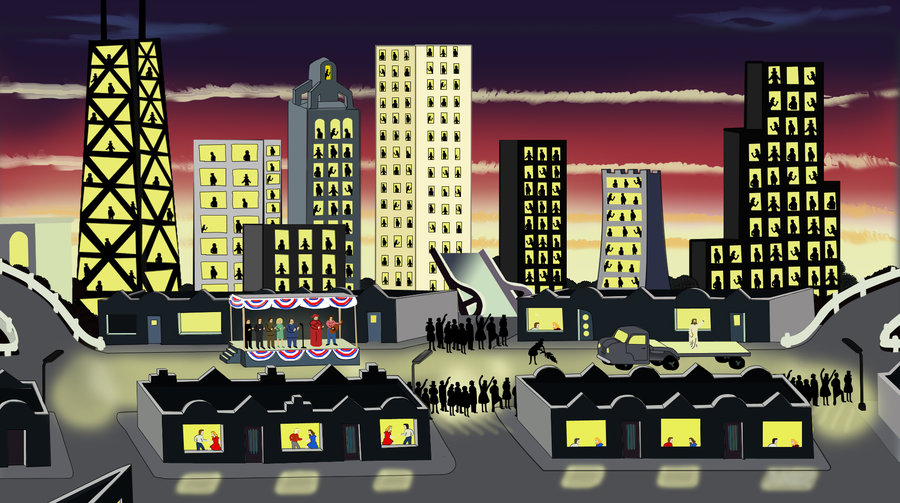
Chicago: Expectant
Roger Brown
If Christ Came to Chicago (detail)
It seems to me that one of the most revolutionary things that could happen in our society would be if the Church started being the Church.

That would require it to stop protecting the "Church as institution" and start putting itself out there as "Church as rebel."

It should be obvious that, implicit in this, is the idea of "Church as people" rather than "Church as tradition" or "Church as elders" or "Church as buildings" or "Church as rules."


If Christ Came to Chicago

Around the same time that I moved to Chicago, I was intrigued to learn that a powerfully influential book in the U.S. progressive movement at the end of the 19th century was If Christ Came to Chicago by William T. Stead.

And I thought, "What a marvelous idea! What would that look like?"

Whenever I hear a New Testament story, I now ask myself, "What would this sound like in the Chicago context, today?"

More than anything else, these words have stayed with me:

"He was speaking about this matter quite openly. " (Mark 8:32)

I believe we are called to speak openly about important matters.


"Speaking quite openly" about about sexuality and gender

I became re-involved in the Church several years ago because of a conversation with a friend about his concerns that the Church -- and particularly the Evangelical Lutheran Church in America (ELCA) -- was struggling to be inclusive of people of all sexual identities and gender orientations.


Members of St. Luke's Lutheran Church of Logan Square join
other Chicago Coalition of Welcoming Churches in Springfield
for the October, 2013, Marriage Equality rally. Pastor Kim
Beckmann's sign says "Illinois: For the love of God (and I
mean that sincerely) PASS Marriage Equality NOW!"
The ELCA has now "come out of the closet" as an open and affirming denomination, and the work continues to make all ELCA congregations fully welcoming. (You can find welcoming congregations in the Lutheran and other denominations via the Chicago Coalition of Welcoming Churches.)

One of the big challenges today is for the Church to speak quite openly about the necessity of inclusion and affirmation of people of all sexual identities and gender orientations everywhere, including in places like Africa where this is a subject of great conflict today.

On the solidarity with LGBTI people in Africa, the Metropolitan Chicago synod of the ELCA came out of the closet in May, 2014, when it passed a resolution: "Solidarity With Those Experiencing and Resisting Harsh Anti-LBTI Legislation Across Africa."

There is much more to be done . . . .


"Speaking quite openly" about about justice in the Holy Land

In recent days, the censorship of critics of Israel's treatment of Palestinians has become a major social issue in Illinois.

Members of the Metro Chicago Synod, ELCA, Working
Group on the Middle East depicting weeping women
of Palestine during the 2014 8th Day Center
Good Friday Justice Walk.
As I have reflected on the firing of Prof. Steven Salaita by the University of Illinois, I have asked myself, "Is this just a narrow issue that has to do with university governance?" I reached the conclusion that it was something much broader -- it is a spiritual issue that slams right up against our call to "speak openly" on issues of justice.

If I had any doubts about this, the fact that Palestine solidarity activist Rabbi Brant Rosen felt the necessity to resign from the leadership of his Evanston congregation reassured me that this is about more than just UIUC.

The ELCA has a substantial effort devoted to working for peace in the Holy Land, and the Chicago arm of that effort is especially strong. And yet people in Christian denominations -- and especially Lutherans -- are extremely careful about appearing to criticize Israel, so as not to offend Jewish people.

If the Salaita affair has taught us anything, it is that we have got to get clear on the fact that criticizing Israel is not the same as offending Jewish people.  The Church needs to come out of the closet and speak quite openly about issues of justice in the Holy Land.


"Speaking quite openly" about about immigration

Jesus Loves Immigrants
Occupy Palm Sunday, Logan Square, Chicago, 2012
I've heard two very radical statements in recent years.

One of them was by the lead singer of the band Outernational. At a concert taking place at St. Luke's Lutheran Church in Logan Square several days before the protests against NATO in Chicago in 2012, Leo Mintek introduced the song "Todos Somos Ilegales (We are all illegals)" by saying, "Someday we will look back and say that the idea that a person could be considered 'illegal' is as incomprehensible as the idea that one person could own another person."

The second was a statement by an ELCA leader who said, "The only papers that we should concern ourselves with are a person's baptism certificate."

A lot of people may not understand the second statement, and it's probably not quite properly expressed.  I think what it means is that being Christian means seeing the person, not what the State says about the person. (And that this is what baptism -- both baptism as physical rite and baptism as abstraction -- means, too.) In other words, what I think he was driving at was, "Papers? We don't need no stinkin' papers!"

One small way the Church is speaking out is by opening its doors to immigrants and standing shoulder to shoulder with them as they deal with the challenges presented by the State. For instance, see the Justice for Our Neighbors program -- one branch of which is active in Logan Square, Chicago.


"Speaking quite openly" about about money

A couple of years ago, Occupy Chicago was in full swing here. Some of us started to ask, "What would Jesus do?"

The result was the beginning of a new tradition: "Occupy Palm Sunday!"

"Is there room at the inn at the CHA’s Lathrop Homes?"
Logan Square churches' 2013 posada for affordable housing
Occupy Palm Sunday has become an important reminder to us to get out of our church sanctuaries and into the public square.  And doing that has encouraged us to do more and more and more thinking about what are the big topics we really want to speak openly about.

Some of those topics have included food insecurity, the lack of affordable housing, the need for security and justice for immigrants, the unavailability of quality health care for all, and the way in which certain people in our community are subjected to various forms of violence.

Ultimately, this has forced us to speak quite openly about what's wrong with the way money is thought about and talked about in our society.


Roger Brown, If Christ Came to Chicago
(Click to view large format image)


William T. Stead concluded If Christ Came to Chicago with a description of the Church that he envisioned in Chicago a hundred years hence.  Notably, his vision was of a unified Church that had put aside minor differences to focus on the main thing:

"The Church of God in Chicago has only one belief, and that is to do what Christ would have done if He were confronted with the problems with which they have to deal."

(You can read the full text of If Christ Came to Chicago online.)

And I believe that once the Church comes out of the closet -- that is, once we start speaking quite openly about the difference between the world as we find it and the world as we believe God wishes it to be -- there is no way this old world will be able to stay the same.


9 More Ideas You Won't Hear

at Chicago Ideas Week . . .


Related posts

Faced with chorus of voices saying, "Isn't it time for you to tone it down? Can't you be more reasonable? What is it you want, anyway?" Jesus kept right on doing what he was doing. And that was a sign to us about how to live our lives.

(See WWJD? Occupy! )


In gratitude to John Kass, and in keeping with what I perceive to be our shared desire to place our faith "in the world" and share the good news (while at the same time not turning people off with too much Jesus talk) -- in short, keeping my tough guy cred intact -- I herewith share some scenes from my Holy Week 2014.

(See Holy Week 2014 in Chicago - Making a Spectacle of Ourselves )


I'm not sure the "7 habits of highly effective people" are necessarily identical to the "7 habits of highly effective apostles." But they do pose an interesting framework to consider building from.


(See The 7 Habits of Highly Effective Apostles )


I believe Easter is God's gift to humanity of victory over death, hopelessness and frailty, and I believe that God is alive and in our midst. The witness of the Guantanamo lawyers has confirmed me in those beliefs.

(See Easter Victory: The Guantanamo Lawyers )


How do we wield power without forgetting that we follow teachings of Jesus that say that there are values that are more precious than power?

(See FAITH-BASED ACTIVISM: Are there any limits to its potential? )