Showing posts with label community. Show all posts

Monday, July 9, 2018

The Multimedia Church: Movie Night

Poster for screening of The Interrupters
at St. Luke's Logan Square, Chicago.
A friend brought up the idea the other night of having movie night at church.

It reminded me that we did quite a few screenings at the church I attended in Chicago, St. Luke's Lutheran Church of Logan Square. It occurs to me that the list of St. Luke's film screenings is not yet assembled in a single place, so here it is:

(We also screened Gasland, Love Free or Die, Encounter Point, and 9500 Liberty.)

The recent conversation reminded me that there were a few things we learned from our "Social Justice Film Series" at St. Luke's:

* Purpose - It's important to know what you are trying to do. We thought of ourselves as trying to encourage conversation on issues of concern to people in the congregation, and in the larger community.

* Connection to congregational activities - Often we were able to make a direct connection to one or more of the missions or activities of the congregation.

* Spread the word! - As the links above suggest, we did a number of things to tell people about each screening -- before and after each event. 

* Guest panelists - We were fortunate to be able to find one or two (or sometimes more!) knowledgeable guests to help with discussion following each film. Chicago has a wealth of community organizers and social justice activists.

* Discussion time - We learned that we needed to plan in order for there to be adequate time for discussion. Often we used Sunday afternoons for the film screenings/discussions (because after an evening film screening many people don't have the energy for discussion), and we tried to select films that were not too long.

* Steering - We had quite a robust social justice committee, and the process of programming the "Social Justice Film Series" was itself quite rewarding to the participants.

* Food - Last but not least: we always had a more lively participation and discussion if we provided ample refreshments.

Of course, this is not to say that we had all the answers. But we did start to understand some of the questions!

Now . . . I'm curious to learn about what other churches are doing with their movie nights!


Please share this post . . . .

Wednesday, February 1, 2017

CHURCH: What are we in the middle of?

I have been doing a lot of thinking about church life in the US - particularly about church life in mainline protestant denominations like the one I belong to, the Evangelical Lutheran Church in America (ELCA).

Almost every church-related activity I participate in stirs up memories. I think particularly of going to a Lutheran church in Summit, NJ, in the '60s and '70s.

Part of me measures today's church experiences against the yardstick of church during those growing-up years*. (*About a half a century ago. Yikes.)

Another part of me finds joy in today's church experiences for their own sake -- and even in the feeling that we might actually be creating a new thing together.


What are we in the middle of?

Sadao Watanabe, The Last Supper
I've started to wonder what "my" church -- the denomination I'm affiliated with -- will be like in ten years. It startles me to realize that the answer probably ought to have less to do with my "growing-up years" idea of church, and more to do with some newly-created thing.

I wonder about worship in new ways . . . and fellowship in new ways . . . and faith formation in new ways . . . and social justice in new ways . . . and evangelism in new ways . . . . Before long I realize that, in my imagination, I'm really just recycling a bunch of old ideas, perhaps with a bit of current affairs and/or exotic flair added.

Then it occurs to me that what church does is respond to life. So the answer to the question, "What will the newly-created thing be?" has something to do with the answer to the question, "What are we in the middle of?"

Put another way: the opportunity for the denomination lies in engaging with what our society is experiencing.  The more widespread, difficult, and amorphous that phenomenon is, the greater the likelihood that "it" is what church needs to engage with.


Centrifugal force: economic inequality

Sadao Watanabe, Lilies of the Field
My sense is that the growing economic inequality in US (and other) society is where church will find its calling more and more with each passing month and year.

A few notes:

* Economic inequality is readily apparent to a certain degree -- we care about "poverty" -- but is enormously underestimated by most people, and poorly understood by almost everybody. There was a small splash made in the last year or two on the subject of the growing (and structurally irremediable?) economic inequality in Western societies by Thomas Piketty's book Capital in the Twenty-First Century. Bernie Sanders' 2016 Democratic primary candidacy got some traction on the topic of economic inequality.

* Church communities are already inherently involved in dealing with economic equality hands-on, i.e. within congregations themselves. And yet there is almost limitless possibility to do new things in this dimension.

* Church communities are also involved in addressing economic inequality, through service and advocacy, beyond their own walls. Again, there is enormous scope to do new things in this dimension, as well.

The opportunity lies in the existence of a widespread/difficult/amorphous phenomenon which so far shows no signs of yielding to known approaches. It is tempting to see an analogy to the early Church, when the widespread/difficult/amorphous phenomenon was called the Roman Empire, and something new had to be created because the obvious approaches were not getting people anywhere.


Can church succeed?

Sadao Watanabe, Miracle of Loaves and Fishes
If we set our sights on something we already know church can succeed at, we're probably not thinking big enough. We will know we are considering the appropriate phenomenon when we realize, "This may not work."

Here's what I will be thinking about in the coming year:

* How does the Gospel witness equip church to respond to economic inequality that is massive and growing rapidly?

* What strengths and gifts do we, as church, have at our disposal as we face it?

* What might we, as church, be willing to give up in order to get it right?

* What's standing in our way?

It may not be possible to envision exactly what church will be like ten years from now. But it does seem likely that the broad outlines are close at hand, if we are willing to reach for them.


MORE:
2017: Which Way for the Church? Anti-Racism? or Comfort?
Declaring Sanctuary, Changing Hearts and Minds
DECOLONIZE THIS: The ELCA's Doctrine of Discovery Challenge
KAIROS: The Moment You've Been Waiting For?


Please share this post . . . .

Tuesday, January 31, 2017

Is the Muslim Ban a "SHOCK EVENT"?

The Reichstag fire - Divide and conquer.
Reprinted below is a message from historian Heather Richardson, professor of History at Boston College. Many of you have seen it shared on Facebook.

I see a real value in this analysis. It is not saying "don't protest the Muslim ban" but pointing out that the we also have to oppose the societal division that Trump and Co. extremism is driving toward. Which may actually require us to talk with people in the "great out there" who don't see things exactly as we do (yet).

Related posts:

Have a Conversation with a Trump Supporter Today
4 Aids for Those Important, Difficult Conversations
IN THE AGE OF TRUMP: Learn from history ( ... or else ... )
The US Embrace of Torture: Can It Be Broken?


Important message from historian Heather Richardson, professor of History at Boston College:

I don't like to talk about politics on Facebook-- political history is my job, after all, and you are my friends-- but there is an important non-partisan point to make today.

What Bannon is doing, most dramatically with last night's ban on immigration from seven predominantly Muslim countries-- is creating what is known as a "shock event."

Such an event is unexpected and confusing and throws a society into chaos. People scramble to react to the event, usually along some fault line that those responsible for the event can widen by claiming that they alone know how to restore order.

When opponents speak out, the authors of the shock event call them enemies. As society reels and tempers run high, those responsible for the shock event perform a sleight of hand to achieve their real goal, a goal they know to be hugely unpopular, but from which everyone has been distracted as they fight over the initial event. There is no longer concerted opposition to the real goal; opposition divides along the partisan lines established by the shock event.

Last night's Executive Order has all the hallmarks of a shock event. It was not reviewed by any governmental agencies or lawyers before it was released, and counterterrorism experts insist they did not ask for it. People charged with enforcing it got no instructions about how to do so. Courts immediately have declared parts of it unconstitutional, but border police in some airports are refusing to stop enforcing it.

Predictably, chaos has followed and tempers are hot.

My point today is this: unless you are the person setting it up, it is in no one's interest to play the shock event game. It is designed explicitly to divide people who might otherwise come together so they cannot stand against something its authors think they won't like.

I don't know what Bannon is up to-- although I have some guesses-- but because I know Bannon's ideas well, I am positive that there is not a single person whom I consider a friend on either side of the aisle-- and my friends range pretty widely-- who will benefit from whatever it is.

If the shock event strategy works, though, many of you will blame each other, rather than Bannon, for the fallout. And the country will have been tricked into accepting their real goal.

But because shock events destabilize a society, they can also be used positively. We do not have to respond along old fault lines. We could just as easily reorganize into a different pattern that threatens the people who sparked the event.

A successful shock event depends on speed and chaos because it requires knee-jerk reactions so that people divide along established lines. This, for example, is how Confederate leaders railroaded the initial southern states out of the Union.

If people realize they are being played, though, they can reach across old lines and reorganize to challenge the leaders who are pulling the strings. This was Lincoln's strategy when he joined together Whigs, Democrats, Free-Soilers, anti-Nebraska voters, and nativists into the new Republican Party to stand against the Slave Power.

Five years before, such a coalition would have been unimaginable. Members of those groups agreed on very little other than that they wanted all Americans to have equal economic opportunity. Once they began to work together to promote a fair economic system, though, they found much common ground. They ended up rededicating the nation to a "government of the people, by the people, and for the people."

Confederate leaders and Lincoln both knew about the political potential of a shock event. As we are in the midst of one, it seems worth noting that Lincoln seemed to have the better idea about how to use it.

Thursday, December 22, 2016

2016: My 12 Favorite Posts

In 2016, I wrote a lot about nuclear disarmament and the global peace movement, church life and social justice, and trying to understand this diverse society we live in.

January

I did a close reading of E.M. Forster's A Passage to India. It reminded me of the power of literature to help a society begin to see itself in the mirror.

(See PROBLEM: How does an entire country exorcise a national delusion?)


February

I started to listen, and to think about what I heard . . . .

(See Listening for Community (A Chicago Encounter))


March

Remembering a friend who gently opened my eyes . . .

(See Don't speak Spanish? "Sure you do . . . .")


April

I realized I have been powerfully influenced by some people I never even met.

(See Thanks, Ravi)


May

We need to stop "marking" dates . . . and start taking action.

(See OBAMA: First stop, Hiroshima; second stop, Moscow)


June

"We need to first acknowledge the genocidal origins of OUR nation’s history of ethnic cleansing and occupation."

(See Native American Rights: Acknowledge the Occupation)


July

It's time to start thinking about the saints in my life.

(See Who Ya Gonna Call? (Saints for All Times))


August

An important part of my life is the church I belong to, and its renewal as a strong force for social justice.

(See "Personal Success Story"? "White Privilege"? or Both?)


September

I spent a week in DC, and came back convinced we need to push harder to get nuclear weapons under control.

(See NUKES: Your Call to Your Congressman Matters)


October

I took time to think about what might be different about a movement directed toward a world beyond war.

(See WAR: Headed for the junkheap, yes . . . but how quickly?)


November

This map provoked a lot of thinking about what will be the most important development of 2017: negotiations on a global ban on nuclear weapons.

(See Who would possibly vote "NO" to banning nuclear weapons???)


December

An idea that I have been developing throughout 2016: a globally networked peace movement.

(See How Does the "Internet of Things (IoT)" Bear on Global Peace Work?)

Tuesday, July 19, 2016

Whence this Trollish Stoop? Oh, Britain . . . !

First #Brexit, now #Trident renewal. What next? A UK lit only by fire . . . ?


 Troll Bridge - pencils by Gido


"The hell with our neighbors. We've got a big stick, that's all we need . . . . "

Where did they learn to act this way?

Oh . . . right . . . they learned it from us . . . .


Related posts

How do you formulate a statement that can somehow convince the United States to eliminate its threatening nuclear weapons?  How do you formulate the 10th request? Or the 100th? Knowing all the time that the United States is in the position -- will always be in the position -- to say, "No" ?  At what point does it dawn on you that the United States will never give up its nuclear weapons, because it has the power and the rest of the world doesn't?

(See 360 Degree Feedback in New York (2014 NPT Prepcom and How the World Views the United States))


Many people will argue that it was only because the U.S. made a threat of force that Syria offered to enter into an agreement on chemical weapons. The sequence of events certainly suggests some relationship between the two.

(See "OR ELSE!" (What the U.S. threat of force against Syria teaches us) )


The decision about whether to live with the threat of nuclear annihilation is our decision. And that is why the entire country is mobilizing for mass action for nuclear disarmament in 2015. Are we capable of making sure the messengers -- Obama, Putin, the other agents of government -- hear their instructions from us clearly?

(See NEEDED: Heroes to Bring About Nuclear Disarmament )


Take a look at the activism of people in Scotland against the stationing of Trident nuclear-weapons-equipped submarines in Scotland.

(See We're Rooting for You, Scotland! (Trident NO Scotland YES) )

Tuesday, July 5, 2016

Who Ya Gonna Call? (Saints for All Times)

The icons of St. Gregory of Nyssa church in San Francisco raise all kinds of questions about sainthood -- ours, the people the icons depict . . . everybody's.


Five of ninety saints celebrated in icons on the walls of St. Gregory
of Nyssa church in San Francisco. (Artist: Mark Dukes)


Yesterday was the annual USA "celebration of us!" -- the Fourth of July.  It is a day when I usually find myself pondering what it will take for this country to recognize how far it still has to go . . . . 

I was grateful that, on this particular Fourth of July, I had some profound material for reflection fresh in my mind. The previous day I had attended worship at St. Gregory of Nyssa church in San Francisco. There is a lot to say about worship at St. Gregory's, but the place to start is the icons.

St. Gregory of Nyssa's walls are adorned with stunning images of ninety saints, created by the artist Mark Dukes. They are joined in a dance, and these icons invite us to meditate deeply on so many lives lived in the pursuit of good for the many.

What is particularly marvelous about this group of ninety saints is that they were selected for portrayal by the people of the St. Gregory of Nyssa community: "We celebrate those whose lives show God at work, building a deep character to match the godlike image which stamps them as God's own from the start."

The image above shows several of those icons -- the saints Bartolomé de las Casas, Miriam, Origen, Malcolm X, Queen Elizabeth I, and Iqbal Mashi.

You can see more on the St. Gregory's website and this Flickr page.  And you can read about the ninety saints selected by the St. Gregory's community here.

The array of saints on the walls of St. Gregory of Nyssa raise a fascinating question for all communities of faith: who would you select to memorialize and celebrate on the walls of your church? Even if you are not fortunate enough to have the services of someone like Mark Dukes available to you, how might you share your selections with others?


MORE SAINTS . . .

Filmmaker Yasujirō Ozu
Musician Ravi Shankar
Scientist Rachel Carson
Liberator Harriet Tubman
Author Harriet Beecher Stowe 
Whistleblower Chelsea Manning
Whistleblower Edward Snowden
Political leader Chief Seattle
Choreographer Lin Hwai-min


Related posts

Perhaps what makes a book good for a discussion group is that it combines startling candor, brevity, and the courage to leap again and again into the middle of mysterious questions.

(See Finding Accidental Saints in Berkeley)


To be sitting in Berkeley and seeing in front of my eyes the spreading of this idea that started in Texas and was nurtured in Philadelphia and got agitated in Chicago felt like a real Pentecost moment.


(See Decolonize Lutheranism -- A Northern California Installment)


Ravi Shankar is a great example of someone bringing a special point of view to pierce the bubble of "normalcy" in which a vast number of people live, and to agitate for tectonic change.

(See Thanks, Ravi)

Wednesday, April 13, 2016

Clearly: THIS church is ALIVE in the city!

Window art at St. Luke's Lutheran Church in Logan Square, Chicago
(Created by Karlfred Design)
I love this new window art at St. Luke's Lutheran Church (ELCA) in Logan Square, Chicago.

Congregations That
Worship in Glass Houses . . .
It's cool that it emphasizes the transparent front window at St. Luke's Armitage Avenue location. (And isn't that the way we should be doing church? Out in the open for everyone to see?)


Palm Sunday March 20
in Chicago: Occupy!
. . . AND you can see the reflection of the neighborhood in the window. (St. Luke's is nothing if not a congregation that is connected to it's neighborhood.)


Being Church in
Logan Square, Chicago:
An Ecclesiophilic Reflection
When St. Luke's move to the new location a few months ago, I welcomed it as an opportunity to connect more, and further explore values of community, welcome, evangelism, mission, service, peace, progressiveness, neighborliness, justice, joy, ecumenism, reverence . . . . 


Clearly: THIS church is ALIVE in the city!


Wanna see more?


For the members of this congregation,
who will continue gathering as a people of God in a new place,
that today will mark not only the end of an era
but also the beginning of new opportunities for worship and service.

(See A Prayer for St. Luke's (Annotated and Illustrated) )


I believe when Jesus broke the bread and poured the wine and said "Remember me this way," he was much more interested in encouraging us to keep having conversations -- conversations that really matter -- with others . . . and finding ways to be in relationship with our neighbors  . . . all the while reminding us "never underestimate the power of food"  . . .

(See Get Outside Your Comfort Zone and Have A Conversation Today (Welcome to the Ministry))


"Could it possibly be that we're not supposed to try to hang onto people? Is is possible that we're supposed to prepare people, and then let them go?" 

(See What I Learned in Church (7 Habits)

Tuesday, March 22, 2016

Finding Accidental Saints in Berkeley (Reading Nadia Bolz-Weber)

Accidental Saints: Finding God in All
the Wrong People
by Nadia Bolz-Weber
I was part of a small group at the church I attend in Berkeley -- University Lutheran Chapel -- where we read and discussed Accidental Saints: Finding God in All the Wrong People by Nadia Bolz-Weber. (Actually, the whole congregation read the book -- discussions took place in a variety of settings.)

I am here to report that, at least in our experience, Accidental Saints proved to be a wonderful springboard for discussion.

I'm tempted to share some of my favorite lines from the book, but maybe it would be better if I invite you to pick the book up and find them for yourself.

(Well okay -- here's a clue -- you might want to start by going to chapter 12 where Nadia is puzzling over when the cool people are gonna start showing up. Classic.)

Perhaps what makes a book good for a discussion group is that it combines startling candor, brevity, and the courage to leap again and again into the middle of mysterious questions.

What we discovered is that all of us were interested in the questions she was raising, and we found the courage to share things about ourselves, and that made it compelling to listen carefully to each other.

Accidental Saints is great. Our only question now: what do we do for an encore?

Related posts

I believe when Jesus broke the bread and poured the wine and said "Remember me this way," he was much more interested in encouraging us to keep having conversations -- conversations that really matter -- with others . . . and finding ways to be in relationship with our neighbors . . . all the while reminding us "never underestimate the power of food" . . .

(See Get Outside Your Comfort Zone and Have A Conversation Today (Welcome to the Ministry))


So as I watched Ziggy for the first time last night, I asked myself, "What is it? What is it? What is the frisson that one feels? It's part charisma, part sexuality, partly the thrill of gender-bending, partly adolescent rebellion . . . . But what is it that Ziggy did (and does) for so many people?" (It can't be a single thing, can it?)

(See "You're NOT alone!" (Ziggy the Subversive) )

Monday, March 7, 2016

Don't speak Spanish? "Sure you do . . . ."

Yesterday I worshiped at University Lutheran Chapel in Berkeley. I sang "Camina, Pueblo de Dios" together with the rest of the congregation in Spanish, and spoke the words of the Lord's Prayer in Spanish while my neighbor spoke them in English.

I don't really know Spanish -

No -- wait a minute -- yes I do!

And so this post is dedicated to Pastor Ramon Nieves.

Pastor Ramon passed away suddenly just over two years ago.  He had been the pastor of Humboldt Avenue Methodist Church in Chicago, and one of the prime movers behind a coalition of congregations that came to be called the Logan Square Ecumenical Alliance.

Pastor Ramon with other LSEA pastors.
At the time we started working with Pastor Ramon, our own congregation was aware that a lot of people in our community are Spanish speakers. But we were struggling with how to adjust our activities to reflect that fact.

Pastor Ramon cut to the chase: "When we do activities like Occupy Palm Sunday together, we should use both English and Spanish."

It made sense to me. In fact, I had been trying to learn a little bit of Spanish ever day -- albeit at a hilariously slow pace. (When I mentioned the name of Chicago's free Spanish daily to my Spanish-fluent nephew and told him proudly that I was learning the language, he gently broke it to me, "OK -- lesson number one: Say "oy," not "hoy" -- the h is silent . . . . " )

Undaunted, I got a friend to do a word-for-word translation of a presentation I was to give on Palm Sunday in 2012, and coach me so that I could stand before the crowd and say, "Usted no tiene una problema de la PRODUCCION.... tiene una problema de DISTRIBUCION!"


"People! You don't have a PRODUCTION problem ... 
you have a DISTRIBUTION problem!"
"Mi Gente! Usted no tiene una problema de la PRODUCCION.... 
tiene una problema de DISTRIBUCION!"
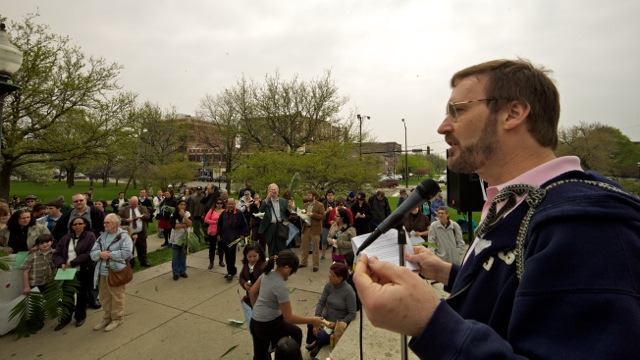
Joe Scarry speaking at the first "Occupy Palm Sunday" in Logan Square
(Photo courtesy FJJ)

As anyone who has tried this trick knows, toting out a few well-practiced sentences in a language you don't know well can only have one consequence: people then talk to you in that language and you are faced with the need to either pretend that you understand, or explain that actually you really don't speak the language and you were only pretending just now -- either way, it's not pretty.

And so it was a few months later at another LSEA event that I found myself standing next to Pastor Ramon. He introduced me to a friend of his from Venezuela, and then proceeded to tell us a story in Spanish, looking alternately at each of us. I smiled and nodded my head, trying to make myself as much of a passive bystander as possible; then, when there was a momentary lull, I leaned toward Pastor Ramon's ear.

Ramon and Yolanda Nieves
"Pastor Ramon," I said. "Actually, I don't really speak Spanish."

Pastor Ramon looked back at me with those glittering eyes of his -- anyone who knows him knows those glittering eyes -- and said with a smile, "Sure you do . . . . "

 . . . which I took to mean, "You may not understand every word, you may feel uncomfortable, you may have to spend time later trying to figure it out or to humble yourself now and ask for help; you may have to work at it. But in the long run . . . a Spanish speaker is what you are . . . because that's the community you're a part of!"

And that's certainly true in Chicago, where I was living then, and in California, where I'm living now. And it's becoming true for the entire US. The US story is truly becoming an American story.

Pastor Ramon fundamentally changed by orientation to community and to what it means to be an "American."  His message to me was, Don't start from what you "can" and "can't" do. Start with where the other members of your community are, and join them there.

And so when I pray, "Danos hoy nuestro pan de cada dia" I say "oy" just like my nephew taught me, and when I pray, "tuyo es el poder" I remember how I heard my pew-mate in Chicago pronounce that r . . . .

Don't speak Spanish? Sure I do . . . .


Related posts

I believe when Jesus broke the bread and poured the wine and said "Remember me this way," he was much more interested in encouraging us to keep having conversations -- conversations that really matter -- with others . . . and finding ways to be in relationship with our neighbors  . . . all the while reminding us "never underestimate the power of food"  . . .

(See Get Outside Your Comfort Zone and Have A Conversation Today (Welcome to the Ministry))


It will take me multiple posts to spell out everything that I feel needs to be said about the Ayotzinapa 43.  People in the US need to work to change their own attitude about Mexico, and about the culpability or all of us here in the US in the wrongs that are being done down there. The Ayotzinapa 43 were persecuted for saying "the future can be different." It's time for us to take up their cry.

(See Ayotzinapa43: US People Need an Attitude Adjustment )


I dedicated Indigenous Peoples Day 2015 to making some progress towards writing about the perspective of indigenous peoples in the Americas.

How do you observe Indigenous Peoples Day?

(See Reflections on Indigenous Peoples Day 2015)

Monday, August 3, 2015

What I Learned in Church (7 Habits)

Worship
About 9 or 10 months ago, I started thinking about the nature of life in community, and considered for the first time that the point may be not so much to embrace each participant in order the better to hold the community together, but rather to transform each of us and prepare us to go out and on to the next stage in our lives. I began to wonder . . .

"Could it possibly be that we're not supposed to try to hang onto people? Is is possible that we're supposed to prepare people, and then let them go??"

(See The 7 Habits of Highly Effective Apostles )

This summer I'm in Berkeley, CA, and it's giving me a good chance to reflect on experiences at my home congregation in Chicago, IL (St. Luke's Lutheran Church of Logan Square). "What has been different in the way I live my life," I've been asking myself, "as a result of being part of that church community?"

I think there are, in fact, some habits that have been nurtured in me by being part of the St. Luke's community. Some that come to mind:

* "love each other" - I put this one first, though it's the hardest to explain -- or at least to explain genuinely and honestly.

* "listen" - This one I know for sure, because I can remember specific times when groups of us have worked on it intentionally together. (See Listening for Community (A Chicago Encounter))

* "make worship happen" - We have a pretty "high church" style of worship at St. Luke's -- and it can be tempting to just sit back and let it wash over you -- but I've unquestionably gotten into the habit of coming to church in an "active" posture on Sunday mornings.

* "be part of the wider community" - Challenging!

* "have agency". . . in the sense of both "ministry" AND "governance."

* "take Jesus seriously" - (I wonder: Does this happen everywhere  . . . ?)

* "pray" - Yes, this required a kick in the pants; what's your point?

There are stories that go with each of these. I'm enjoying thinking back over them. I'll add posts in the weeks ahead to amplify on each of these.

I wonder if this resonates with the experience of others? What habits have you picked up along the way? Have those habits made a difference?


Related posts

I've been thinking about the Occupy movement and what it has to do with Christian witness. The conclusion I've come to is: a lot! In fact, I think it's central to our understanding of what Christ's life and death meant.

(See Occupy Palm Sunday! )


I believe when Jesus broke the bread and poured the wine and said "Remember me this way," he was much more interested in encouraging us to keep having conversations -- conversations that really matter -- with others . . . and finding ways to be in relationship with our neighbors  . . . all the while reminding us "never underestimate the power of food"  . . .

(See Get Outside Your Comfort Zone and Have A Conversation Today (Welcome to the Ministry))


We busted out of our big Neo-Gothic church building on Sunday and gathered for worship on the Boulevard. (Or, to be more precise, beneath the trees on the median alongside Logan Boulevard in Chicago, during the weekend-long "Boulevard Fest" sponsored by our congregation.) I've decided to embrace this new feeling of exposure and try to learn some lessons. I put them under the rubric "Congregations that worship in glass houses . . . (complete the sentence) . . . . "

(See Congregations That Worship in Glass Houses . . . )


I'm not sure the "7 habits of highly effective people" are necessarily identical to the "7 habits of highly effective apostles." But they do pose an interesting framework to consider building from.


(See The 7 Habits of Highly Effective Apostles )


I wondered at how we could have covered all that in just a minute or two -- the time it takes to go a few stops.  After all, when I walked onto that bus we were strangers.

(See Listening for Community (A Chicago Encounter))