Showing posts with label Chicago. Show all posts

Monday, August 15, 2022

City on Fire: Why Chicago's Resolution Opposing the Nuclear Threat Is DIfferent

The City of Chicago adopted a resolution earlier this summer calling for steps to eliminate the nuclear threat. (See "Chicago Adopts 'Back From the Brink' Resolution.")

This spring, I visited the Chicago History Museum and spent some time looking at the exhibit about the Great Chicago Fire -- City on Fire: Chicago 1871.


I was struck by the resonance of many of the objects and images with what I saw in the museum in Hiroshima when I visited there in 2015.

I've written a lot before about how Chicago has a special role to play in helping to bring about the end to the nuclear threat. Now I would add one more reason for it to take a leading role in abolishing nuclear danger: Chicago has a communal memory of what it means to be a city on fire.

Wednesday, October 20, 2021

Why Do Nuclear Weapons Matter to Chicago?

The moment you visualize the effects of it on an actual place (that is real to you) -- as an actual eventuality that is really possible -- the topic of nuclear weapons becomes completely different.

For those who live in my former hometown, it's startling to realize that a metropolitan area like Chicago could be wiped out by a nuclear weapon.

The most-read post on this blog in the past three years -- far and away -- has been:
What Would a Nuclear Weapon Do to Chicago? (Go ahead, guess . . . )


One possible reason is pending Chicago City Council Resolution R2021-920 -- "Call for United States government to cease spending federal tax dollars on nuclear weapons, embrace United Nations Treaty on Prohibition of Nuclear Weapons, and make global nuclear disarmament main focus of national security policy."

Similar resolutions have been passed in Skokie and Evanston.

In the days ahead, I'll be adding more materials to supplement the material originally provided in that post.

Wednesday, January 22, 2020

A Chicago Encounter With China: the "Golden Temple"

A little over twenty years ago, I started a newsletter called Chicago China Newslink. One of the topics I wrote about was a Chinese-themed pavilion that had been sponsored by a local industrialist and included in the 1933 Century of Progress Exposition in Chicago. Below are four articles about the "Golden Temple of Jehol." They are slightly edited from the original. In a subsequent blog post I will provide some reflections and updates on the topic.


"The Golden Temple of Jehol"
Century of Progress Exposition commemorative print


The Stuff That Dreams Are Made Of
Chicagoans Chase Elusive "Golden Temple of Jehol"

(originally published July, 1998, in Chicago China Newslink

What do you do with a temple that has been scrupulously copied from an original in North China, erected at world's fairs in Chicago and New York, then dismantled and shuffled between a series of warehouses in the U.S., and ended up languishing in storage in Sweden?

Rebuild it in Chicago! At least that's what Chicago architect Charles Gregersen says the current holders of the temple hope to do.

Gregersen is a specialist in restoring and conserving historic buildings, and he has traced in minute detail the journey of the "Golden Temple of Jehol," which was originally commissioned for the Century of Progress Exposition in Chicago in 1933.

"The temple is currently in the possession of a foundation in Sweden, disassembled and in storage. It was rescued from oblivion years ago by the Swedish foundation and its head, Max Woeler, and they had hoped to erect it as a museum," says Gregersen. "But those hopes seem to be fading." According to Gregersen, Max Woeler believes the foundation's best hopes of fulfilling the terms of its trust now lie in making the temple available to be rebuilt in some other location, such as Chicago.

The ideal location for the temple is somewhere on the Museum Campus, the site of the 1933 exposition, says Gregersen. "In fact, there is a triangle of land just east of the Field Museum that would be perfect," he says, continuing, "Don't forget -- this is the only remaining building of all those originally commissioned specially for the Century of Progress. Nothing could be more appropriate than restoring it to its original location."

With the renaissance under way in Chicago-based China activity, that plan seems all the more appropriate.

Little by little, the story of the temple is becoming known in business and cultural circles in Chicago. "Our committee has had the opportunity to learn a little bit about it, and it certainly is a fascinating story," says William Spence, a partner at Freeborn and Peters. Spence is the co-chairman of the committee of Chicagoans who are helping to build strong links between Chicago and the Chinese cities of Shanghai and Shenyang.

"Now, all that is needed is the money," says Gregersen. He cites estimates of $3 million for the cost of constructing a foundation for the 5,000 square foot temple and restoring its former condition.

And what of the original temple -- the one in China? It was reported to have fallen into disrepair, but Gregersen believes restoration is under way. The temple is ensconced in the central courtyard of the largest of a group of structures in the 18th century imperial summer retreat at Chengde (about 90 miles northeast of central Beijing), also known as Jehol.


"The Golden Pavilion of Jehol of which the Bendix Lama Temple of Chicago
is an absolutely faithful replica made in Peking by Chinese workers."
(Source: The Chinese Lama Temple Potala of Jehol exhibition booklet)


Recalled to Life
... and recalled to Chicago? How conservators on three continents are saving a piece of China's past

(originally published September, 1998, in Chicago China Newslink

The first time Swedish architect Max Woeler saw the original structure on which the "Golden Temple of Jehol" was based, in 1988, he was overwhelmed by a mixture of delight and melancholy.

Delight was inevitable for someone who had, like Woeler, spent the previous five years in a dogged effort to conserve what remained of the replica -- the pieces of the full-size re-creation of the original structure, which were in storage at the time in Stockholm. "It was the first time I had been to China, and I was filled with anticipation. There was a whole group of us, and we spent three weeks in China altogether, but the most exciting part, our real goal, was seeing the original pavilion, set within the high-walled enclosure perched in the ills of the old imperial summer resort area of Chengde [Jehol]."

At the same time, reaching that goal was bittersweet. According to Woeler, "The whole place was in a state of disrepair. The pavilion itself was dilapidated, rather run-down. None of the precious artifacts remained inside it. The area had been occupied by Japanese troops prior to WWII, and before that the warlords had sold off artifacts to buy weapons. But mainly, the problem was just the passage of time -- as if nothing had been repaired since the days of the emperors."

What Woeler saw in that moment seemed to confirm the prediction made by another Swede, nearly 60 years earlier. Sven Hedin, a famous explorer and the man who oversaw the production of the pavilion replica that later stood in Chicago, wrote in 1930, "In ten or twenty years [the original] will be nothing but a mass of ruins. When [it] has rotted away, the Western World will be able to rejoice that a faithful copy of it has been preserved." Hedin felt the structure [in Jehol] was "the most sumptuous, not only in Chengde, but in the whole of China." The replica was as sumptuous as the original. In fact, Hedin thought the replica had one advantage over the original: writing in 1930, he had commented that the surrounding walls were placed so close to the original pavilion that there was no way for a spectator to step back and get a full view of it. The replica, in contrast, was ideally situated. "In its new position in the land across the sea, this masterpiece of Chinese architecture will come into its own. There, it will be possible to see it standing alone against a background of leafy trees, and there the sinking sun will make the red colonnades glow like real gold."

Both the original and the replica were neglected for many years, but, by the late 1980s, people had begun to recognize the importance of preserving such treasures, and architect Max Woeler found that the goals of his Chinese hosts closely paralleled his own. "They were setting about to refurbish the original, just as I was trying to recondition the replica. We made a plan to work together -- to exchange technical expertise."

The refurbishing of the various structures in the Chengde complex was an enormous effort. Prof. James Hevia confirmed this after a 1991 visit to the original. He wrote: "At that time, the Potala was undergoing massive reconstruction. The center of the structure, where the Golden Pavilion stood, was completely closed off, while other portions were only partly accessible. It was clear, however, that the restoration staff had to rebuild parts of the structure from scratch." (from a pre-publication version of New Qing Imperial History: The Making of Inner Asian Empire at Qing Chengde)

The Golden Pavilion is 70 feet wide and 70 feet deep, and 60 feet high. (The replica and the original are identical in size.) Major repairs included replacing an elevated gallery in the walls surrounding it. The elevated gallery allows a closer view of some of the best parts of the pavilion, on the upper levels, but the gallery had been burnt down long before, probably prior to the wartime era.

But the intricate details, carved and painted on hundreds of wood panels, were as challenging as the expansive structural work. For the painting alone, there was a team of 70 craftsmen. At that time, there were no artisans left who knew these specialized crafts. Now, little by little, young people are learning these special skills again.

The Chengde restorations were completed in 1991. On a return visit, Hevia confirmed that a lot had changed: much of the restoration was complete, the entire site had been placed on the UNESCO world cultural heritage list, and "[its] new status as a global as well as national treasure seemed to be epitomized in part by the large crowds of domestic and foreign tourists, including large numbers of overseas Chinese . . . . [The] streets were bustling."

As for architect Woeler, since first becoming involved with the pavilion in 1983, he had spent one entire year tracking it down to a warehouse in Ohio, and then procured it for restoration, planning to put it up in a park in Stockholm.

Woeler set up a foundation to handle the massive project. First, the pieces of the pavilion replica had to be shipped to Sweden -- overall, it took nine forty-foot truckloads! Then preparations had to be made to refurbish key components, especially the beautifully painted surfaces and gold-plated copper roof tiles. In addition, a site was selected in a Stockholm park, and designs were drawn up to allow the structure to function as an exhibition hall, so that it could have a functional use, as well as serving as a symbol of growing ties with China and as an important cultural artifact.

All that was needed to situate the structure in Sweden was the final agreement on the land. Unfortunately, obstacles emerged, and bit by bit grew insurmountable. Woeler and his foundation were unable to bring the project to completion.

But Woeler hasn't given up. "It will really be like a phoenix, rising from the ashes," says Woeler, " -- when it finally gets built, that is!" Now his hopes have turned from Sweden back to the land that originally hosted the structure. "I think the pavilion should be brought back to America -- preferably Chicago!" he says.

A committee of interested Chicagoans has been formed to determine whether funds can be raised to bring the Golden Pavilion replica back to Chicago and erect it here.


Title page, The Chinese Lama Temple Potala of Jehol exhibition booklet,
with portrait of donor Vincent Bendix.


The Idea's the Thing
What inspired Vincent Bendix to create one of the century's great monuments to Chinese art and locate it in Chicago?

(originally published November, 1998, in Chicago China Newslink

Source note: Invaluable assistance for this article was provided by
Charles Gregersen, historic preservation architect
University of Illinois at Chicago: The University Library, Century of Progress Records
Mr. Pete Leatherwood, Director of Communications, retired, AlliedSignal/Bendix
Northern Indiana Center for History
King of Stop and Go by Menefee R. Clements
Family of Donald Boothby, Bendix architect


Vincent Bendix was a man who liked to make things. Even more, he was a man who liked to DO things, and do them in a BIG way. And if the things he made and the things he did caught people's attention, and captured their imagination, well, that was all right with him, too.

Bendix has been called "The King of Stop and Go," after two of his inventions which had an enormous impact on the auto industry: the Bendix brake and the automatic starter. Those two products were just the most important in a long list of products that he invented and/or commercialized, products ranging from carburetors, hydraulic steering, and u-joints, to aircraft wheels, brakes, and struts.

Bendix once said, "Business is only a collection of ideas, and you must keep getting a new idea." Bendix seemed to have an endless supply of ideas -- one former Bendix employee said Bendix "had more ideas than he had money to implement them" -- and those ideas went beyond just mechanics. It was Bendix who, in 1928, bought the Potter Palmer Mansion, together with a block of Chicago Gold Coast property, and planned to erect a $25 million dollar hotel there. It was Bendix who created the annual Bendix Transcontinental Air Race, which culminated with Gatsbyesque parties at his South Bend, Indiana estate. It was Bendix who bought a rather ordinary West Palm Beach mansion and turned it into an Italianate palace -- with the help, of course, of imported Italian palace builders.

But, more than anything else, history is likely to remember that it was Bendix who conceived and executed the erection of a magnificent Chinese structure on Chicago's lakeshore in conjunction with the 1933 Century of Progress Exposition -- one which was visited by over two million visitors. One of those visitors was Joe DeFilipps, today a Nebraska travel agent who in 1833 was an 8-year-old student at Washington Irving School on Chicago's West Side. "What I remember most of all was just how beautiful it was -- and how big!!" says DeFilipps. "When you're eight years old, a five story building looks like a twenty story building. And of course, I remember the golden roof."

Perhaps Bendix wasn't the only one who could have come up with the original idea. After all, in the 1920s, everyone was reading the headlines about China and the great archaeological discoveries made there by the Swedish explorer, Sven Hedin. It was natural to think about bringing those discoveries before the public.

Still, it was Bendix who, as a leader of the Swedish-American community (one who had, in fact, been recognized for his public service by the King of Sweden), was in a position to meet Hedin and learn about Hedin's ideas in person.

In the same way, the 1933 Century of Progress Exposition inspired scores of structures of a kind never seen before from contributors in Chicago and all over the United States, and from around the world, not just from Bendix. There were industrial exhibitions, concept pavilions like "The Future of Transport," pavilions of foreign nations, and more. The Century of Progress was as much about commerce as it was about entertainment and education. In large part, it was an explicit testament to the decade of economic development, especially in the automobile industry, that had made Bendix, himself, a rich man. By 1927, his plant was producing 26,000 brakes daily, and those brakes were used to outfit cars from Autocar, Willys, Hudson (& Essex), Marmon, Packard, Studebaker, to Lord's Lincoln and GMC's Oldsmobile. Not surprisingly, the most prominent pavilions at the Century of Progress belonged to Ford, General Motors, and Chrysler, together with exhibits by Goodyear, Firestone, and Sinclair, and the spectacular "Wings of a Century Pageant of Transportation" pavilion.

What was intriguing about the project Bendix conceived was that, although it was certainly intended as a publicity vehicle for him and his companies, it was a profoundly subtle and indirect publicity vehicle. While the auto and utility companies were using their exhibition pavilions as little more than glorified car and appliance showrooms, and the national pavilions held obvious benefits, both diplomatic as well as for trade and tourism promotion, Bendix's pavilion was intent on addressing some "better angels" of his public's nature. Bendix was flamboyant and loved publicity, but he also "preferred the soft sell over the hard sell," as one of his former employees put it.

Another important consideration in all this, beyond the Chinese theme and the idea of doing something big for the Century of Progress, was the money. Bendix wasn't the only one with automobile money in those days. Nor was he the only one funneling all that money into Gold Coast property development. However, some people's money started to dry up as the Roaring '20s gave way to the Depression '30s. The son of Bendix's architect, Donald Boothby, recalls his father saying, "To an architect, Bendix was a godsend -- it meant having a job at a time when jobs were very hard to come by." The senior Boothby, busily employed in implementing Bendix's architectural visions, was doing well enough to buy a new $3,900 Packard in the early '30s, and thought of his employer as a kind of Midwestern Medici.

Of course, even a Medici has to have influence as well as wealth, and, in the late 1920s, wealth didn't confer much influence until after it had been transformed through devotion to civic responsibility. In 1929, Harvey Warren Zorbaugh wrote in The Gold Coast and the Slum: A Sociological Study of Chicago's Near North Side: "The means by which members of the Four Hundred become the arbiters of the social world, get into the top dozen, are many and varied. One accomplishes it by managing a world's fair and taking a prominent part in notable civic movements ... One is frowned upon, a little, in more conservative circles if one does not take a part in the larger civic and social movements of the day."

Bendix seemed a step ahead of others in this respect, as well: his administrative partner in the Golden Pavilion venture was none other than Daniel Burnham (Jr.), son of the Daniel Burnham of "make no little plans" fame, and himself secretary of the entire Century of Progress project. Likewise, Bendix was living in the mansion whose renown stemmed from being the former home of the Impressionist art collection that eventually formed the core of the Art Institute's holdings; he filled it with a new collection, one consisting of precious artifacts from China, and rechristened it "The Bendix Gallery."

Bendix's imprint on this project was unmistakable: only Bendix could have done something which was at once so quixotic and at the same time so grounded in the nuts-and-bolts realities of manufacturing and construction.

In the first place, there was the procurement of the components of a pavilion in distant China. In hindsight, it is easy to say that Bendix's money was well-spent, considering the spectacular Chinese structure it bought. The man Bendix relied upon, Sven Hedin, was a generally-recognized authority and inspired great confidence. Still, in 1929, entrusting a third party to embark for warlord-run and bandit-infested North China with $125,000, knowing that you would hear nothing from him for months, took nerve.

Second, a superstructure needed to be supplied. Hedin copied and brought back reproductions of most of the intricate woodwork of the original temple. That left the structural elements -- foundation, supporting columns, and roof -- to be fabricated in the U.S.

Ah yes! That roof . . . .  The builders needed a way to re-create the gold-foil-coated roof for which the structure was so well-known. For a manufacturer like Bendix, the solution was obvious: he put his South Bend plant to work stamping out 25,000 copper roof tiles and plating them with 23-carat gold.

Finally, more than anything else, there was the management of the thousand-and-one details that go into any production of this kind. I like to imagine Bendix, in his offices on the 38th floor of the Bankers Building in the Loop (on the southwest corner of Madison and Clarke, just west of The Rookery), where he could look out to where workmen were laying the foundations of the Century of Progress pavilions. What were his days like? (The interior painting - can we get it done on time? What material will we use to pave the outside? How will admission work? How about postcard sales? Incense sales? How do we get the lighting just right?) I try to remind myself that, for someone like Bendix -- someone who had established his first manufacturing company in 1907, and had been churning through business ideas continuously ever since -- the day-to-day travails of an undertaking such as the pavilion were probably more refreshment than anything else.

Ironically, the greatest challenge for Bendix was to figure out what to do with the structure after the Century of Progress Exposition was over. Like every other exhibitor, he had agreed to abide by the Century of Progress Ordinance, guaranteeing that he would remove his structure, so that the lakeshore site could be returned in its natural condition to the South Park Commissioners. After much negotiation and request for extensions (some granted, some not), Bendix's organization in March, 1938, disassembled the structure and put it into storage. The Golden Pavilion had been created with the kind of care that goes into great and enduring buildings, and Bendix and others wanted to see it re-erected permanently. It was resurrected briefly for the 1939 World's Fair in New York, after which Bendix gave it to Oberlin College as part of a Center for Oriental Studies it was to build. It then went into deep hibernation. It passed to a series of trustees, principally other universities with interests in Asian Studies, but none could ever match Bendix's ingenuity at getting the structure erected for public display.

Bendix went on to other things. His Bendix Brake Company has had a glorious history in South Bend, Indiana; it is now Bosch Braking Systems (div. Robert Bosch Corporation). Other companies he founded included Bendix Aviation Corp. and Bendix Helicopters. According to one former employee, Bendix helped finance Amelia Earhart's ill-fated flight, was a part-owner of the original Washington Nationals (forerunners of the Senators), and helped build the original stadium at Notre Dame. Vincent Bendix died in 1945, with yet another grand project on the drawing board: "a popular type helicopter four-passenger sedan . . . to be ready for mass production after the war . . . . " Chicago skies are not yet full of family helicopters, but, with luck, they will once again soon be graced by the silhouette of Vincent Bendix's finest idea.


An imagined rendering of the Macartney mission.
(See description from Royal Museums Greenwich)


Noble Witness
Did the Golden Pavilion loom over the seminal event in Sino-Western relations?

(originally published April, 1999, in Chicago China Newslink

The Summer Palace of the Qing Emperors at Jehol was the site of perhaps the most important diplomatic encounter in China's history of engagement with the West. In 1793, Lord George Macartney traveled to China bearing messages from King George III to the Emperor of China. The Emperor's reply to those proposals contained what has become perhaps the most pithy statement of China's attitude toward the outside world: "We have never valued ingenious articles, nor do we have the slightest need of your country's manufactures." His reply went on to veto proposals for trading stations, warehouse locations, anchorages, and other aids to international intercourse. And so nearly two centuries of mutual misunderstanding was set in motion.

This encounter, along with its aftermath, is a staple of every history of China's interaction with the West. An often overlooked fact about this famous event, however, is that it took place not in Beijing but in the Imperial Summer Palace at Jehol -- the site of the original Golden Pavilion. This is not exceptional. Qing Dynasty emperors -- like any number of modern chief executives, who have discovered that, if they can rule from anywhere, why not rule from someplace they enjoy being? -- spent a very substantial portion of the year at the Jehol complex.

Sven Hedin devoted a chapter of his book, Jehol: City of Emperors, to the Macartney mission. He focused in particular on the not inconsiderable question of whether Macartney would kowtow to the Emperor, or if the Emperor would instead tolerate some lesser evidence of respect. The Chinese side had the foresight to be gracious and accept kneeling on one knee, probably reasoning that, as the ones who would make a record of the proceedings for posterity, they would have ample opportunity to spin the event. (Hedin wrote, "Court gossip asserted afterwards that the noble Lord had been so overcome in tghe presence of the mighty ruler that his legs gave way and he fell upon all fours. If he had refused to kowtow of his own accord, the presence of the Emperor obliged him to do so.")

The central business of the meeting was the transmission of a letter from the King of England to the Emperor of China, requesting a number of accommodations for the purposes of trade, as well as the presentation of a large quantity of official gifts.

[One of those gifts was described as "A clock resembling an astronomical instrument by which one can easily explain and reconcile the sun, moon, and stars in the heavens. It is useful in the study of astronomy and geography."  Was this instrument useful for navigation? Was it possibly related to the breakthrough marine chronometer (described in Dava Sobel's 1995 book, Longitude: The True Story of a Lone Genius Who Solved the Greatest Scientific Problem of His Time)? It would be ironic if this was one of the "ingenious articles" which the Emperor later said he "did not highly value."]

Macartney's visit had to compete for attention with visits by other ambassadors, such as those of Burma and Mongolia, and it was wedged in-between numerous other court functions, as well. "On the Emperor's birthday, September 17th, the Ambassador received an invitation to a review at which Captain Parish estimated 12,000 officers and 80,000 troops were present." One wonders if this display of power made Macartney feel any trepidation for himself -- did he have second thoughts about his principled refusal to follow the court ritual of the kowtow? -- or for the future of the interactions between his own, very powerful, country and the one he was visiting.

Hedin observed that "it is interesting to compare the manner in which Qianlong received the King's envoy with the deference and obsequiousness with which, thirteen years earlier, he had received the Tashi Lama. For him the King of England was merely one vassal among hundreds, whereas the Tashi Lama had power over all the Lamaist lands which were under the rule of the Middle Kingdom. In the opinion of the Emperor, Tibet was of far greater importance than Great Britain." What might the role of the Golden Pavilion in the 1780 visit by the Tashi Lama have been?

Monday, December 23, 2019

A Ceremony to Commemorate Hiroshima: "Remember the past to commit oneself to the future."

(Originally published in August, 2012, as "Our Dark Beacon: Prayer Vigil for Hiroshima and Nagasaki" on the Protest Chaplains of Chicago blog.)


Water Tower Monument
Chicago, Illinois

August 5, 2012, 6:15 PM
(Corresponds to 8:15 AM in Japan, August 6th, the exact time of the first bomb and the time of most commemoration services.)


To remember the past
is to commit oneself to the future.
To remember Hiroshima
is to abhor nuclear war.

       -- Pope Paul II


ORDER OF SERVICE

Ringing of singing bowl twice (one for the bereaved families and one for the children)

Welcome and Opening Words by Joe Scarry from No Drones Network and Rev. Loren McGrail from Protest Chaplains of Chicago
O God, tender and just
the names of Hiroshima and Nagasaki
cut through our denial
that we are capable of destroying the earth
and all that dwell therein.
Forgive us---
and help us always to remember.
We must remember because this must never happen again.
We must remember because you would have us live
in harmony with each other,
seeing the joy of your creation in our
sisters and brothers.
Holy God, God of all ages,
lead us from death to life,
to the stockpiling of hope and possibilities, and of love
rather than the stockpiling of weapons, or of stones to throw,
or of hate.

Opening Ritual

(Lighting first candle and placing it in the fountain) Sixty-seven years ago tonight, morning in Japan, a single B-29 dropped the first atomic bomb on the city of Hiroshima. This incredible blast destroyed most of the city and killed over 60,000 people almost immediately. Another 80,000 more died in subsequent months and years from the deadly radiation.

(Lighting second candle and placing it in the fountain) Three days later, another B-29 dropped the second atomic bomb on Nagasaki, killing about 20,000 people almost immediately and about 60,000 more in subsequent months and years from radiation.


From Mayor Matsui Kazumi’s Peace Declaration (2011)

“The time has come for the rest of us to learn from all the hibakusha and what they experienced and their desire for peace…

This description is from a woman who was sixteen at the time: “My forty-kilogram body was blown seven meters by the blast, and I was knocked out. When I came to, it was pitch black and utterly silent. In that soundless world, I thought I was the only one left. I was naked except for some rags around my hips. The skin on my left arm had peeled off in five-centimeter strips that were all curled up. My right arm was sort of whitish.

Putting my hands to my face, I found my right cheek quite rough while my left cheek was all slimy…Suddenly I heard lots of voices crying and screaming, ‘Help!’ ‘Mommy, help!’ Turning to a voice nearby I said, ‘I’ll help you.’ I tried to move in that direction but my body was so heavy. I did manage to move enough to save one young child, but with no skin on my hands, I was unable to help any more…’I’m really sorry…”


Now, we must communicate what we have learned to future generations and the rest of the world. Through this Peace Declaration, I would like to communicate the hibakusha experience and desire for peace to each and every person on this planet. Hiroshima will pour everything we have into working, along with Nagasaki, to expand Mayors for Peace such that all cities, those places around the world where people gather, will strive together to eliminate nuclear weapons by 2020…

The accident at Tokyo Electric Power Company’s Fukushima Daiichi Nuclear Power Station and the ongoing threat of radiation have generated tremendous anxiety among those in the affected areas and many others. The trust the Japanese people once had in nuclear power has been shattered. From the common admonition that “nuclear energy and humankind cannot coexist,” some seek to abandon nuclear power altogether.

Others advocate extremely strict control of nuclear power and increase utilization of renewable energy…

Message From Hiroshima

Dear all,

We appreciate very much the fact that you are holding a special gathering commemorating the dropping of the A-bomb on Hiroshima on August 6.

The nightmarish days following the Tsunami had nearly every person in Japan filled with fear of truly catastrophic scenarios, and actually the situation surrounding the Fukushima Nuclear Plants still remains very precarious and requires utmost caution.

Although one of the nuclear plants has been restarted, the mass demonstration of anger at the government’s decision is becoming more and more visible and intense. We hope these rising waves against nuclear power will be united around the globe so that we can advance steady steps toward creating a nuclear-free way of life.

On August 6 in Hiroshima, we are going to hold, beside many other events and conferences, the 9th NO DU gathering; this year we aim to draw people's attention to the fact that next March will mark the 10th anniversary of the start of Iraq War by announcing that we will hold a commemorative conference in Tokyo around mid-March next year in order to call into question again the military use of nuclear waste, that is, DU weapons, as a wedge problem relating to the whole nuclear cycle.

We hope you will join us in such reflection, too, and we wish you great success in your activities on August 6 and further on.

With friendship and solidarity,
Kazashi Nobuo
Director, International Coalition to Ban Uranium Weapons (ICBUW) Hiroshima Office

Song: This is My Song

Excerpts from Blessing the Bombs, a speech by Father George Zabelka

“The ethics of mass butchery cannot be found in the teachings of Jesus… What the world needs is a grouping of Christians that will stand up and pay up with Jesus Christ. What the world needs is Christians who, will proclaim: the follower of Christ cannot participate in mass slaughter. He or she must love as Christ loved, live as Christ lived and, if necessary, die as Christ died, loving ones enemies…

To fail to speak to the utter moral corruption of the mass destruction of civilians was to fail as a Christian and a priest. Hiroshima and Nagasaki happened in and to a world and a Christian Church that has asked for it---that has prepared the moral consciousness of humanity to do and justify the unthinkable…

As an Air Force chaplain, I painted a machine gun in the loving hands of the nonviolent Jesus and then handed this perverse picture to the world as truth. I sang, “Praise the Lord” and passed the ammunition…As Catholic Chaplain for the 509th composite Group, I was the final channel that communicated this fraudulent image of Christ to the crews of the Enola Gay and the Boxcar...”

Excerpts from The Drone Summit, the Lunchbox and the Invisibility of Charred Children by Hugh Gusterson

I kept thinking about the lunchbox.

The lunchbox belonged to a schoolgirl in Hiroshima. Her body was never found, but the rice and peas in her lunchbox were carbonized by the atomic bomb. The lunchbox, turned into an exhibition piece, became, in the words of historian Peter Stearns, "an intensely human atomic bomb icon."

The Smithsonian museum's plans to exhibit the lunchbox as part of its 1995 exhibit for the 50th anniversary of the end of World War II enraged military veterans and conservative pundits, who eventually forced the exhibit's cancellation.

Everyone knows, in the abstract at least, that the atom bomb killed thousands of children in Hiroshima and Nagasaki. But any visual representation of this fact - even if done obliquely, through a lunchbox, rather than through actual pictures of charred children - was deemed out-of-bounds by defenders of the bombing.

Today, we must still make an enormous effort to bring forward visual representations of the victims of U.S. attacks, such as in the remote borderlands of Pakistan. Brave activists like the Pakistani lawyer Shahzad Akbar of the Foundation for Fundamental Rights -- a Pakistani lawyer who represents civilian victims of US drone strikes in Waziristan (a tribal area on Pakistan's border with Afghanistan) -- are making sure this happens.

In Japan after World War II, the US occupying authorities made it illegal for Japanese citizens to own any pictures of the aftermath of Hiroshima or Nagasaki. In Japan, Akbar would have been locked up by General MacArthur.

Excerpt from The Drone and the Bomb by Ed Kinane

“The lessons of Hiroshima and Nagasaki belong always before us. The agony of those two cities must remain our dark beacon.

Hiroshima/Nagasaki wasn’t so much about targets as about audiences. We---or rather, the very highest reaches of the U.S. government---annihilated a couple hundred thousand nameless, unarmed, undefended human beings to warn the world: “Don’t mess with us; we run things now…”

Afghanistan/Pakistan/Yemen echo Hiroshima/Nagasaki. With its new cutting edge technology, the Pentagon still trots out the old myth: the Reaper drone is all about “saving our boys’ lives.”

And Bomb-like, the Reaper proclaims: “If you defy us, wherever you are, we will hunt you down and kill you.” Déjà vu.

Like Japan’s hundreds of thousands of civilian casualties, the Reaper’s civilian casualties in Afghanistan/Pakistan/Yemen fail to matter. Few ask: What’s the human cost? What’s the blowback?”

Excerpt from Twilight of the Bomb a speech prepared by Jay Kvale

“This week an international conference on nuclear disarmament is being held in Hiroshima and Nagasaki to promote reductions in arsenals, given impetus by the stories of some of the last survivors of the bombings.

In addition to actual warheads, the problem of securing loose nuclear materials is also being addressed since 1,600 tons of enriched uranium and 500 tons of plutonium, enough to make tens of thousands of bombs, are still scattered around, mostly in the former Soviet Union…

Teams of specialists expect to have more than 80% of loose nuclear material from the world’s 129 research reactors secured by 2014…The Non-Proliferation Treaty has limited the number of nations with nuclear weapons to nine.”

Song: Lead Us From Death to Life (World Peace Prayer)

Litany of Remembrance

We remember each child born since the dawn of the Nuclear Age, the miracle and sacredness of each living being.

We remember the image of the first mushroom cloud of the Trinity atomic test rising above the earth in New Mexico.

We remember the words of Robert Oppenheimer, director of the Manhattan Project, “I have become death, the Destroyer of Worlds.”

We will remember “ Little Boy” and “Fat Man”---the bombs that destroyed the Japanese cities of Hiroshima and Nagasaki on August 6th and August 9th, 1945.

We remember the 300,000 people in Hiroshima and Nagasaki who died as a result of the atomic bombs. May they rest in peace.

Sixty-seven years, the people of the earth remember the terrible destructive power and violence latent within us and made manifest in the bomb.

We will meet this power of destruction by drawing on the rich sources of our human and spiritual traditions and the deep wells of faith, beauty, humor, and creativity of the human spirit in order to nourish a culture of nonviolence and peace.

We will remember the cost to all life of our commitment to death.

We will remember the indigenous people, on whose land we mined for uranium, tested our nuclear weapons, and now fill our nuclear waste.

We will remember the plants and animals of the earth, whose waters, soil, and air we contaminate in the name of “security.”

We will remember our children and grandchildren and all beings of the future whose toxic radioactive inheritance we cannot keep from them.

We will remember our nuclear history so that we will not repeat it.


Closing Ritual

Children at the Yamazato elementary school in Nagasaki gather to commemorate the 1,300 students who were killed when the atomic bomb fell on their city. As part of their ceremony, they pour water on a stone monument symbolically quenching the thirst of the bomb’s victims and offering a prayer for their souls.

Tonight, we gather at this fountain in front of Chicago’s Water Tower, to remember not only those students but also all the people killed by these atomic bombs, all the civilians killed by our new drone weapons; we remember and pray for all their souls. You are invited to put your hands in the water---let it pour through your fingers in memory of all those whose thirst could not be quenched. In the fountain, you will also find some stones. You are invited to take one as a remembrance of these lives, of this day and your commitment to work for a nuclear free world and peace.


Liturgy for First Annual Prayer Vigil for Hiroshima and Nagasaki: Our Dark Beacon was created by Rev. Loren McGrail and Joe Scarry.

For more information on this service or other anti-war or militarism information or events contact:

Rev. Loren McGrail at lorenmcgrail [at] gmail.com or visit Protest Chaplains of Chicago on Facebook or go to Awake to Drones for writings on drone warfare and surveillance by area faith leaders.

Joe Scarry at jtscarry [at] yahoo.com for information on the No Drones Network.


WORSHIP RESOURCES

Cover Image by Laurence Hyde: woodcut print from the novel Southern Cross, a book about atomic testing in the Pacific

from Christian Prayer by Rev. Loey Powell, Justice and Witness Ministries of the United Church of Christ.

Excerpts from Mayor Matsui Kazumi’s Peace Declaration (2011).

Message from Hiroshima: Kazashi Nobuo, Director, International Coalition to Ban Uranium Weapons (ICBUW) Hiroshima Office.

Excerpts from The Drone Summit, the Lunchbox and the Invisibility of Charred Children by Hugh Gusterson at Truthout | Op-Ed.

Excerpts from Blessing the Bombs, a speech by Father George Zabelka, Catholic Chaplain for the 509th Composite Group, the atomic crew. Speech was given at Pax Christi conference in August 1985.

Excerpts from The Drone and the Bomb by Ed Kinane, an anti-militarism activist on Fellowship of Reconciliation’s website July 28, 2012.

Excerpts from Twilight of the Bomb a speech prepared by Jay Kvale for Hiroshima Commemoration ceremony at Lake Harriet Peace Garden in Minneapolis, August 6, 2012. Published on War is Crime.org.

Litany of Remembrance adapted from Pax Christi, St. Joseph’s Watford way, Hendon, London

Photograph of the Closing Ritual at the Chicago Water Tower, August 5, 2012, by Meghan Trimm, Fellowship of Reconciliation (FOR), Chicago

A Ceremony to Commemorate Hiroshima: "People Will Find the Way to Eliminate Nuclear Injury"

(Originally published in February, 2015, as "Good Friday 2015: People Will Find the Way to Eliminate Nuclear Injury" on the Chicago Nuclear Injury Action Group blog.)


Good Friday 2015 Walk for Justice in downtown Chicago:
Remembering the 70th anniversary year of the atomic
bombings of Hiroshima and Nagasaki by the United States.
(Image courtesy FJJ.)


Our new group participated in the April 3, 2015, Good Friday Justice Walk sponsored every year by the 8th Day Center for Justice in Chicago.

This year's theme was "Give Light and People Will Find the Way." We hosted Station 6: "Falling."

Below is our prayer, followed by references about the sources we used.


Reader 1: The 70th anniversary of the U.S. atomic bombing of Hiroshima and Nagasaki falls this year. Despite the facts of nuclear injury -- which are undisputed and taught in every school – we allow our government to maintain an arsenal of nuclear weapons on alert, capable of destroying the world at the flip of a switch.

Why do we allow this?

Is it that we don't know? Or that we are unwilling to see?

Response (all): Awaken our hearts. Give us hearts capable of seeing.

from Hiroshima No Pika
Reader 1: The testimony of thousands of people about the reality of atomic bombing is preserved in books, art, and film. These materials are available in every library in the United States. Listen to these words from popular children's books . . . .

Reader 2: "There were crowds of people fleeing the fire. Mii saw children with their clothes burned away, lips and eyelids swollen. They were like ghosts, wandering about, crying in weak voices. Some people, all their strength gone, fell face down on the ground, and others fell on top of them. There were heaps of people everywhere."
[p. 14, Hiroshima No Pika [The Flash of Hiroshima], by Toshi Maruki]

Response (all): We see you have fallen. We don't have the strength to lift you up. But we will not turn our backs on you.

Reader 3: "Every school became a hospital for the badly injured. I heard people screaming and moaning in pain, and there was a horrible smell of burnt skin."

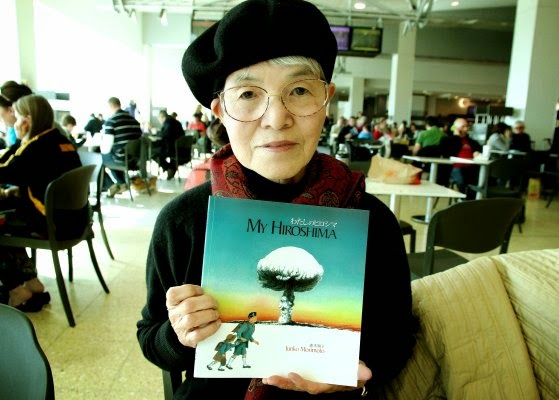
[p. 24, My Hiroshima, by Junko Morimoto]

Response (all): We can hear you are in pain. We can smell your injuries. We don't have the power to restore your health. But we will NOT forget you.

Shin's Tricycle
Reader 4: "I stumbled over our fallen house and found Mother digging in the rubble. There was Shin, pinned under a big beam. He was too weak to talk but his hand still held the red handlebar grip from his tricycle. That night he died, ten days before his fourth birthday."
[p. 15-20, Shin's Tricycle, by Tatsuharu Kodama; Noriyuki Ando, ill. ]

Response (all): We will keep Shin's tricycle. We will remember Shin.

Reader 2: "Mii watched as her mother examined her father. 'He's hurt badly,' she said. She untied the sash from her kimono and wrapped it around her husband's body as a bandage. Then she did something amazing. She lifted him onto her back and, taking Mii by the hand, started running."


Response (people on the right): Who will lift us up?
Response (people on the left): We are living in the dust of the nuclear threat.
Response (all): Help us lift each other up, for we cannot rise alone from the dust.

Response (people on the right): How will we see the way?
Response (people on the left): The truth has been hidden by smoke and ash.
Response (all): Give light and people will find the way.

Reader 4: "Maybe if enough people could see Shin's tricycle, they would remember that the world should be a peaceful place where children can play and laugh."

[p. 30, Shin's Tricycle]

Response (all): Thank you, Tatsuharu Kodama, for giving light. The people will find the way.

Junko Morimoto
Reader 3: "War, the atomic bomb . . . They are the crimes of adults who forget the precious value of life. I believe it is the duty and the responsibility of adults to teach our children the importance of not repeating these mistakes and to give them the heart to care for and value all life on earth."

[afterward, My Hiroshima]

Response (all): Thank you, Junko Morimoto, for giving light. The people will find the way.

Reader 2: "Every year on August 6 the people of Hiroshima inscribe the names of loved ones who died because of the bomb on lanterns. The lanterns are lit and set adrift on the seven rivers that flow through Hiroshima. The rivers flow slowly to the sea, carrying the lanterns in memory of those who died."


Response (all): Thank you, people of Hiroshima, for giving light. The people will find the way.


Annual commemoration of the bombing of Hiroshima.


About Hiroshima No Pika [The Flash of Hiroshima], by Toshi Maruki

Hiroshima No Pika on Amazon

Maruki Toshi (1912-2000) and Maruki Iri (1901-1995)

Maruki Gallery for the Hiroshima Panels

About Shin's Tricycle, by Tatsuharu Kodama (Noriyuki Ando, ill.)

Shin's Tricycle on Amazon

Shin's tricycle in the Hiroshima Peace Museum

About My Hiroshima, by Junko Morimoto

My Hiroshima on Amazon

"80 year old artist paints the horror of atomic bombing live"

Wednesday, December 18, 2019

Heaven in Chicago: North Pond

(Originally published in September, 2014, on the blog of St. Luke's Lutheran Church, Logan Square, Chicago.)

Near where I live is a pond ringed by a small number of trees and a large number of native prairie wildflowers.

I walked around the pond yesterday. As I often do, I set off there at a fast pace, but as I got close I slowed down, and eventually I was doing a slow-motion creep that allowed me to register each flower and butterfly and sun-basking turtle.


Black-crowned night heron


You make friends of a certain kind when you visit the pond. Yesterday I was pleased to see the black-crowned night heron in his usual place. A little farther along -- though I wasn't really looking -- I spotted a little green heron on a branch. Near the end of my circuit I saw a great blue heron, wading in the shallows; that was a special treat because I had spotted him only after making a short detour to get a close look at some wild columbine.

The limitation, if you can call it that, of the pond is that, well, one can't own it.  And I don't just mean own it in the legal sense, but also in the sense of having total dominion over it. "What was the name of that flower again?" "I don't remember the joe pye weed being THIS tall!" "The goldenrod is really EVERYwhere! (Will we ever be able to get ahead of it?)"

Of course, in another sense, the pond surrenders itself to a rather startling degree of "ownership."

"These are 'obedient plants'." (When I described to someone how they got their name, how you can bend them and they slowly spring back to their original shape, he said 'Shouldn't it be 'UN-obedient plants?')

"These are the wild senna, with their late summer yellow blossoms; they say that after the destruction of the atom bomb, it was the wild senna that came back and grew in wild profusion in Hiroshima . . . " 

"These are elderberries -- so beautiful with their rich purple-red branches -- I wonder what the old ladies' elderberry wine in Arsenic and Old Lace tasted like?"

"This is the path where I can disappear behind a screen of 7-foot tall compass plants and prairie grasses, even though I'm still just a few feet from the main trail!"

It's a place where one can nearly simultaneously lament the past ("All that's left of the bee balm is their skeletons; the summer sped by so fast!") and live in the expectation of what is to come ("Soon the purple asters will be EVERYwhere!")


Obedient plant


I ask myself if there is a gospel message in all of this. Perhaps material for a parable? I imagine Jesus saying, "The Kingdom of Heaven pond ringed by a small number of trees and a large number of native prairie wildflowers . . . ."

Read more about North Pond in Chicago.

The Beauty of Chicago Wildflowers

(Originally published June 20, 2014, as "One Word: Wildflowers" on the Zero Carbon Chicago blog.)

I'm fresh off a screening of a fabulous documentary by Carey Lundin about the life of Jens Jensen, Jens Jensen: The Living Green.


It reminded me of the hours and hours I've spent sketching wildflowers in the many Jensen-designed and Jensen-inspired gardens and parks in and around Chicago.

And that reminded me of the tremendous head start Chicago has in being a place that is inspired by the beauty all around us to do the difficult things that are needed.

And Chicago is so beautiful all summer long, there's no reason to leave the city. Think of all the carbon emissions save on car and jet travel!

Don't just watch the documentary; get out and see the beauty that Jensen has bequeathed us.


(click to enlarge)
It seems that an entire industry has emerged around the challenge of fully
capturing the beauty of the Jensen-inspired Lurie Garden in Millennium Park.


(click to enlarge)
One of the things I learned from The Living Green is the careful thought that
Jensen gave to the pleasure of sitting in the shade and looking out into the sunlight.
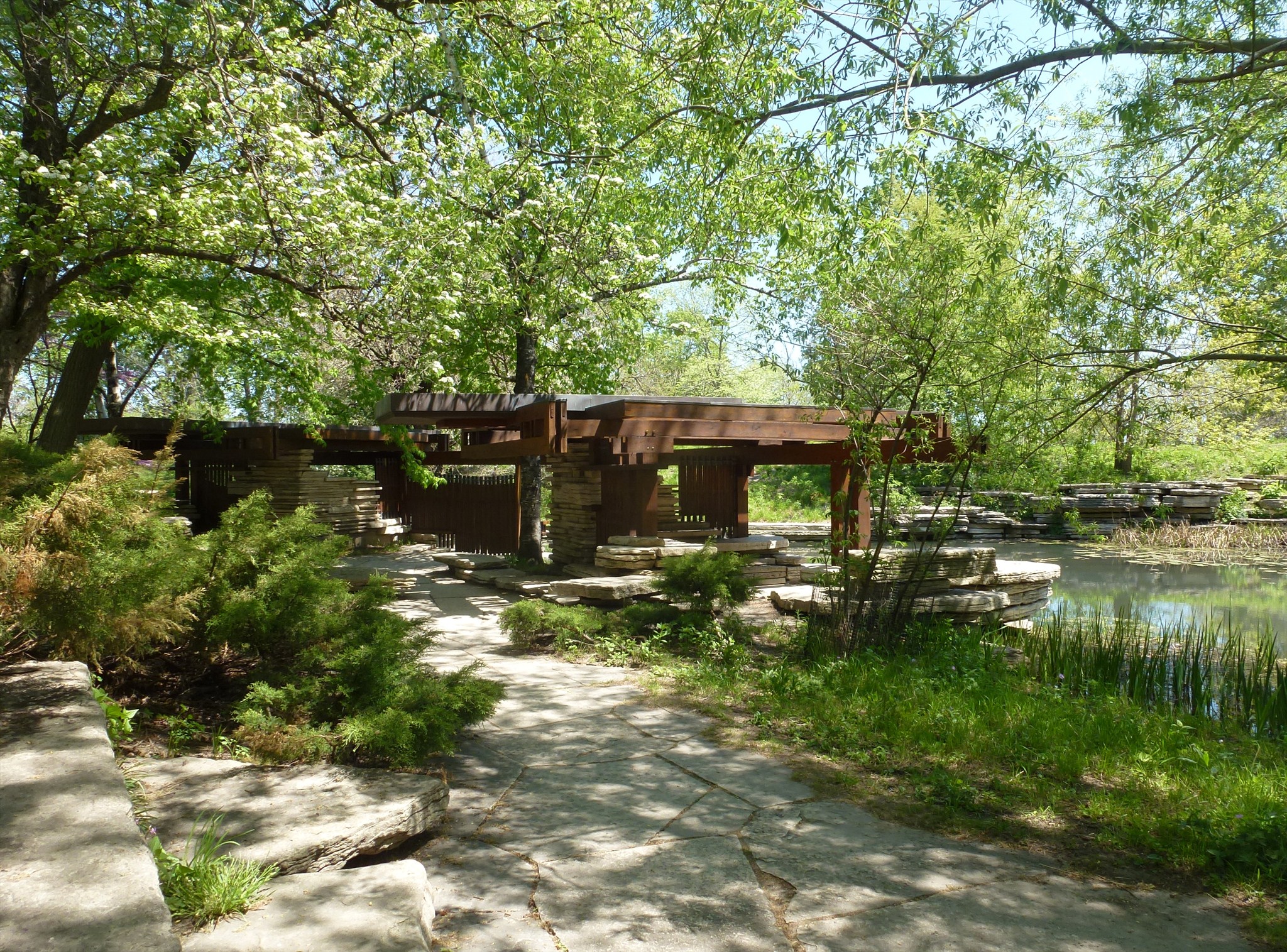
A perfect place to see this is at the Alfred Caldwell Lily Pool, just north of the
Lincoln Park Zoo. This jewel of a park honors Jensen acolyte Alfred Caldwell.


Just a block north of the Caldwell Lily Pool, North Pond is surrounded by
an inspiring diversity of wildflowers. (See map and be amazed!)


(click to enlarge)
A few miles farther north is the nature area at Montrose. Describing it will
require an entire blog post all its own -- it's got dunes, a bird-filled
meadow, shady groves, and a view of the city skyline above a riotously
colorful acres of wildflowers.


(click to enlarge)
The McCormick Bird Sanctuary -- an unexpected expanse of sheltered
wildflower meadow -- lies just south of McCormick Place, and is
accessible via the Lakefront Trail.


(click to enlarge)
Just north of the city, one can walk through acres of shoulder-height prairie
wildflowers of the kind that inspired Jensen at Somme Prairie Grove.


(click to enlarge)
You'll know you're really hooked when you find yourself prowling the Schulenberg
Prairie at Morton Arboretum in search of new types of wildflowers to sketch!


Summer in the city in Chicago: does it get any better than this?

Take a Walk in Chicago

(Originally published June 18, 2014, as "The Human Scale in Chicago" on the Zero Carbon Chicago blog.)

It's important for us to start discussing at a deep level the city's assets and how they can empower us to move rapidly toward a zero-carbon lifestyle.

I've just finished watching for a second time the wonderful film by Andreas M. Dalsgaard, The Human Scale, and I'm having a "Eureka!" moment. The ultimate secret to a "zero carbon Chicago" will not be bike lanes or solar panels or novel physics or botanical spaces -- though all of those things will be important -- but rather walking and remembering.

The Human Scale makes clear that the key to livable cities is putting design in support of the experience of pedestrians, and taking into account the power of memory in affording quality of life.


Chicago Theater
Goodman Theater
It was easy, as I left the movie theater, to think about walkability. My short walk to my bus stop was through a recently repaved alley that connects the landmark Chicago Theater marquee and that of the Goodman Theater. From that spot, I could trace some of the best walks in Chicago -- building after landmark building; sculpture by some of the giants of the art world.

But then I thought further about part of the movie describing the rebuilding of Christchurch, New Zealand, after the 2011 earthquake. On of the architects profiled in the film was talking about the importance of memory our experience of the city: "That's where I first saw my girlfriend; two doors down is the coffee shop where we first had coffee together."


Marc Chagall, The Four Seasons, Chicago


I thought about Chagall's mural "The Four Seasons." It is located at Monroe and Dearborn, in the plaza of Chase Bank -- what some of us remember as 1st National Bank of Chicago.  I love it not just because it's beautiful, and because I so often have the opportunity to walk by it on my walks through that beautiful neighborhood, but also because of memories.

"Pas mal, eh?"
Chagall, The Four Seasons (detail)
One memory in particular makes me smile. Back in the days when I was involved in a lot of China-related activities in the city, I was riding back from a television appearance with a former 1st National Bank of Chicago president and China hand, Norman Ross. As we rode by "The Four Seasons," Norman spoke of his memory of being with the Chagall at the dedication. "We were side by side, just as you and I are now," said Norman, "And Chagall nudged me with his elbow, and gave a nod in the direction of the mural, and said, 'Pas mal, eh?'"

During the summer, "The Four Seasons" becomes part of one of the great "living rooms" of the city: Chase Plaza. It's a place where anyone can come and eat their lunch, read the paper, get a tan, people watch, enjoy the sounds of the fountain, and meditate on great art.


Chase Plaza, Chicago


All of this is within blocks of the buildings that mark the birth of the skyscraper. A great way to get oriented is with an architecture walk by Chicago Architecture Foundation.

Chicago: take a walk and let the memories begin.

Sunday, February 11, 2018

Trump and Nuclear Weapons? We need a different future . . . .

Dunne, Raby, and Anastassiades,
"Priscilla Huggable Atomic Mushroom"
from Designs for Fragile Personalities in Anxious Times


Yesterday I was at the Art Institute of Chicago and saw a staggering piece of art: "Priscilla Huggable Atomic Mushroom," from Designs for Fragile Personalities in Anxious Times by Anthony Dunne, Fiona Raby, and Michael Anastassiades.

The plush mushroom cloud is the perfect size to hug while curled up in a fetal position: "The soft, toylike object allows users to confront (and cuddle) their fear of nuclear annihilation directly."


"The soft, toylike object allows users to confront (and
cuddle) their fear of nuclear annihilation directly."
Dunne, Raby, and Anastassiades,
"Priscilla Huggable Atomic Mushroom"
 

I immediately thought of the Kurosawa film I Live in Fear, about a man who is alert to the risk of the next atom bomb dropping and can't rest until he finds some sort of solution.


Fearless samurai portrayer Toshiro Mifune plays against type
as the haunted protagonist of I Live in Fear.


And then there is what people in Hawaii experienced recently . . . .

Dunne and Raby have a book entitled Speculative Everything: Design, Fiction, and Social Dreaming, directed to getting us outside the ruts we're stuck in and inviting us to think about how the world could be completely different: "Dunne and Raby pose 'what if' questions that are intended to open debate and discussion about the kind of future people want (and do not want)."

What a perfect coincidence with the events of the past few days! We have just seen a vote of confidence in a new future by the people of Korea, as the teams from the North and the South marched together under one flag at the opening ceremony for the 2018 Winter Olympics in Pyeongchang.


Athletes march under the flag of a united Korea
at the 2018 Winter Olympic Games in Pyeongchang.
(New York Times photo)
.


Could there be a starker contrast with the stuck-in-the-past behavior of the current US president?


"CNN BREAKING NEWS . . . .
Trump: If N Korea keeps threatening, will be met with 'fire'."


And people in the US were confronted with that very mushroom cloud imagery again this past week as the cover story of TIME described Trump administration efforts to ramp up the US nuclear weapons program. The TIME piece described how the US government is toting out all the old arguments -- "we need more, bigger, better so that they don't get a step ahead of us!" -- while also reporting the argument for an alternative future: "Enough! We don't have to do this!"

For anyone willing to imagine the alternative future, here are two ways to work to make it happen:

(1) Support the effort of members of the US Congress to restrict the US president's ability to conduct a nuclear first strike.

(2) Support the effort of countries worldwide to bring about a global ban on nuclear weapons. (It's happening now at the United Nations!)

Working for an alternative future: do we really have any other choice?


LIMITED TIME ONLY!
O F F I C I A L
Trump Administration
Collectible Plush Toy
MEMORABILIA!
offer good while supplies last . . . .


Related posts

Bunker Mentality

Is Kim Jong-un giving the US its "Suez Crisis"?

Korea: A History of Living Under Nuclear Terror

Nuclear Weapons: People Power Over Trump Power

133 Is a Lot of #Nuclearban-Supporting Countries


Please share this post . . . .