Showing posts with label citizen education. Show all posts

Sunday, February 11, 2018

Trump and Nuclear Weapons? We need a different future . . . .

Dunne, Raby, and Anastassiades,
"Priscilla Huggable Atomic Mushroom"
from Designs for Fragile Personalities in Anxious Times


Yesterday I was at the Art Institute of Chicago and saw a staggering piece of art: "Priscilla Huggable Atomic Mushroom," from Designs for Fragile Personalities in Anxious Times by Anthony Dunne, Fiona Raby, and Michael Anastassiades.

The plush mushroom cloud is the perfect size to hug while curled up in a fetal position: "The soft, toylike object allows users to confront (and cuddle) their fear of nuclear annihilation directly."


"The soft, toylike object allows users to confront (and
cuddle) their fear of nuclear annihilation directly."
Dunne, Raby, and Anastassiades,
"Priscilla Huggable Atomic Mushroom"
 

I immediately thought of the Kurosawa film I Live in Fear, about a man who is alert to the risk of the next atom bomb dropping and can't rest until he finds some sort of solution.


Fearless samurai portrayer Toshiro Mifune plays against type
as the haunted protagonist of I Live in Fear.


And then there is what people in Hawaii experienced recently . . . .

Dunne and Raby have a book entitled Speculative Everything: Design, Fiction, and Social Dreaming, directed to getting us outside the ruts we're stuck in and inviting us to think about how the world could be completely different: "Dunne and Raby pose 'what if' questions that are intended to open debate and discussion about the kind of future people want (and do not want)."

What a perfect coincidence with the events of the past few days! We have just seen a vote of confidence in a new future by the people of Korea, as the teams from the North and the South marched together under one flag at the opening ceremony for the 2018 Winter Olympics in Pyeongchang.


Athletes march under the flag of a united Korea
at the 2018 Winter Olympic Games in Pyeongchang.
(New York Times photo)
.


Could there be a starker contrast with the stuck-in-the-past behavior of the current US president?


"CNN BREAKING NEWS . . . .
Trump: If N Korea keeps threatening, will be met with 'fire'."


And people in the US were confronted with that very mushroom cloud imagery again this past week as the cover story of TIME described Trump administration efforts to ramp up the US nuclear weapons program. The TIME piece described how the US government is toting out all the old arguments -- "we need more, bigger, better so that they don't get a step ahead of us!" -- while also reporting the argument for an alternative future: "Enough! We don't have to do this!"

For anyone willing to imagine the alternative future, here are two ways to work to make it happen:

(1) Support the effort of members of the US Congress to restrict the US president's ability to conduct a nuclear first strike.

(2) Support the effort of countries worldwide to bring about a global ban on nuclear weapons. (It's happening now at the United Nations!)

Working for an alternative future: do we really have any other choice?


LIMITED TIME ONLY!
O F F I C I A L
Trump Administration
Collectible Plush Toy
MEMORABILIA!
offer good while supplies last . . . .


Related posts

Bunker Mentality

Is Kim Jong-un giving the US its "Suez Crisis"?

Korea: A History of Living Under Nuclear Terror

Nuclear Weapons: People Power Over Trump Power

133 Is a Lot of #Nuclearban-Supporting Countries


Please share this post . . . .

Monday, December 5, 2016

An Educational Alternative to Rivalry

The thinking that will usher in a "world beyond war" must include entirely new approaches to education: a re-thinking of how human society experiences "enough."


Several weeks ago, in one in an ongoing series of posts about "world beyond war thinking," I talked about the need for a overhauling education to become relevant to a time when war is over:

In a world beyond war, it will no longer make sense to spend a lot of time becoming knowledgeable about war.

I went on to talk about a different type of knowledge -- how to "resolve conflict in the absence of war -- particularly [how to provide] value in the form of outcomes that give maximum possible satisfaction to all the parties to a given conflict."

I continue to think that's a good description of what's needed. But/and I believe we need to go even deeper . . . .


What "education" looks like

I started by thinking about how history is taught in our schools. I started down the path of examining the state-mandated history curriculum in California, and to see what peace studies scholars have found about the weighting of curricula.
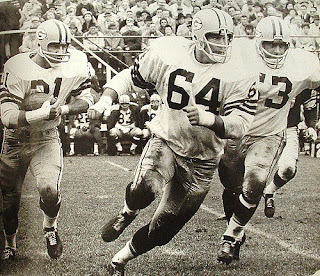
My mental image of myself, c. 1976
(Green Bay Packer Jerry Kramer leading power sweep.)
At the same time, I struggled to step further back, to ask what paradigms currently shape our education, and what we need to do to embrace a new paradigm.

(As someone who devoted year after year to playing football in high school, I am acutely aware that history class is not the only place we educate young people about social values.)

I thought of Pedagogy of the Oppressed, and the idea that if your model of life is banking, you view education as a process of shoveling "wealth" into the heads of students.

I reflected on the writing of (recently deceased) futurist Alvin Toffler, which suggested that once we no longer live in a factory-centered society, we'll need to have schools that look a lot less like factory preparatory schools.

I began to wonder if we don't need to root out an enormous amount of bias in our education system based on the idea that there's not enough to go around, and eventually it's going to come down to a fight . . . .


"Non-rivalrous" goods

I have been intrigued by a concept in economics -- one that I learned about through the study of intellectual property. As the goods and services provide each other come to consist less and less of solid "things" (think: "potatoes") and more and more of "ideas" (think: "a song"), the social consequences of consumption change dramatically. We start to notice that our existence is tending away from competition for scarce resources, and toward abundance.

In economics, this latter category of goods is referred to as "non-rivalrous" -- essentially meaning that my consumption doesn't leave less for you.

And once you wrap your head around the idea of formal rivalry, you begin to notice the much wider scope of practical rivalry. (Example: is the shortage of iPhones or tickets to Hamilton real or constructed? Example: you know how they say that there's really not a shortage of food in the world, but rather a failure to distribute it . . . ?)

"Struck it rich!"
(Prospectors in the Black Hills)
in Harper's Weekly
"A Journal of Civilization"
August 12, 1876
The story of the loaves and fishes and the feeding of the multitude in the New Testament comes to mind. One way of talking about that story is as "a miracle." Another way to think of it is that the desire to share outweighed hunger in a way that eclipsed rivalry. (Perhaps both descriptions are right.)

Another story: the conflict at Standing Rock has led me to go back and study some Native American history. I learned that one phase of the conflict during the 1800s followed the discovery of gold in the Black Hills. The Black Hills were and are sacred to the native people. It made perfect sense to them that something tremendously valuable lay buried in those mountains. The question to them, however, was, "Why wouldn't we all just leave it there, all the more confirmed in our knowledge of the great spiritual potency of those lands?" (Black Hills, including gold therein: non-rivalrous. Mined gold: rivalrous.)

"Leave it in the ground?" Just a short time ago -- in the days when the world was afraid it would run out of oil -- those words made no sense. The rapid realization that the climate crisis will require us to change our energy systems, and in fact our entire approach to consumption and to growth, has also opened the possibility of taking a hard look at our bias for rivalry.

These are just a few initial thoughts. There is room for a greatly expanded exploration of the degree of rivalry in our economics is required, with strong emphasis on the way in which our pre-existing bias for rivalry has conditioned our economic outcomes.


TR and James

Theodore Roosevelt in Africa
(Source: Almanac of Theodore Roosevelt)
I recently read The War Lovers: Roosevelt, Lodge, Hearst, and the Rush to Empire, 1898. What I was most struck by was the degree to which people like Theodore Roosevelt were conditioned to believe that conflict was just a necessary component of a healthy mental, emotional, and physical makeup for the individual -- and that the same applied to society overall. War against Spain wasn't directed at any desired outcome; it was just "the thing to do."

The philosopher William James thought about all that he saw and heard during the US rush to war with Spain, and struggled to articulate a different path for the country. In "The Moral Equivalent of War" (1910) he conceded that perhaps people couldn't resist throwing themselves into a "noble" and challenging endeavor; but, he suggested, we could use reason to identify constructive endeavors that benefit all of us.

"The Moral Equivalent of War" is an important document for all of us who are trying to think about a world beyond war.  For one thing, it is sobering to observe how even a great thinker like James could be so enmeshed in the rivalry, competition, conquest, and war thinking of his time that he had trouble stepping outside it. It is also worth noticing that a hundred years ago someone was calling on the peace movement to take ownership of the limitations it imposed on itself through rhetoric and style. Most important, James illustrates the power of offering a fresh choice.


All of this leads me to posit that our challenge as "world beyond war thinkers" will be to work together to come up with mass education that looks entirely new: an "educational alternative to rivalry."


Related posts

There is a growing movement of people focused on the "world beyond war." To many of these people, the question is not "if" but "when?" They share a conviction that the world will get there, and they see that it makes a difference how quickly (and in what manner) the world gets there.

(See WAR: Headed for the junkheap, yes . . . but how quickly?)


Adopting a "world beyond war" frame -- saying "war is going away; the question for me is how fast" -- implies optimism-realism, outcome orientation, and humility.

(See The Mind of the "World Beyond War" Activist)


It seems very hard to imagine having arrived at the world beyond war without the hand-in-hand changes in education, infrastructure investment, and the way society decides on communal action in the face of conflict.

(See Where to Put Effort for a World Beyond War)


Monday, November 14, 2016

Where to Put Effort for a World Beyond War

Are you looking ahead to a world beyond war? Education, infrastructure, and decisions about communal action are the key . . . .


"Give me a lever long enough and a fulcrum on which
to place it and I shall move the world."

Archimedes


"A lot of people are opposed to war, but what might look different when a group of people approach war as a soon-to-be-obsolete institution?"

It was a month ago that I posed that question in WAR: Headed for the junkheap, yes . . . but how quickly?

I gave one answer to the question in The Mind of the "World Beyond War" Activist: "Saying 'war is going away; the question for me is how fast' implies optimism-realism, outcome orientation, and humility."

But does the "world beyond war" approach help determine where to put effort?

It seems to me that there are some obvious places to focus. Once one is able to imagine a world in which war is a no-go, it becomes possible to imagine certain aspects of that world that will be starkly different than the world in which we live today -- aspects of life that will be inherent to a world beyond war. And, having imagined these aspects, we realize that it seems very hard to imagine having arrived at the world beyond war without the hand-in-hand changes in those aspects themselves. In other words: what would be rendered profoundly outdated if it survived into a world without war?


(1) Education - In a world beyond war, it will no longer make sense to spend a lot of time becoming knowledgeable about war.

We sometimes imagine that education is fundamentally about building up a store of absolute truths; more and more, however, we are realizing that education mostly has to do with acquiring knowledge of what works in the world.

In the world to date, there has been a prevailing emphasis on learning about wars: how they begin, how they are fought, who makes the critical decisions, who leads the fighting, who follows the orders, who derives the benefits from the wars, how the wars are ended, and what changes after they end. The result is that our society is dominated by people who are highly educated about war, and have devoted little time to learning about other ways of settling conflicts.

The inflection point will come when society begins to reward people who know a great deal about how to resolve conflict in the absence of war -- particularly those who can provide value in the form of outcomes that give maximum possible satisfaction to all the parties to a given conflict.

     ... for more see An Educational Alternative to Rivalry


(2) Infrastructure - In a world beyond war, it will no longer make sense to be in possession of massive amounts of infrastructure for carrying out war.

Infrastructure requires time to build. The process of infrastructure development inherently involves trying to imagine what will be needed in the future.

In the world to date, there has been a prevailing attitude toward war infrastructure that says, "Because the cost of failing to have it when we need it would be so high, the only sensible choice is to build as much as we possibly can -- in case we need it."

The inflection point will come when a new attitude begins to gain adherents: "Any overspending on infrastructure that turns out to be useless, will be deeply corrosive to our joint endeavors."

     ... for more see An Infrastructural Alternative to Military Spending


(3) Decisions about communal action - In a world beyond war, it will no longer make sense to hold counsels about decisions to go to war. No one will participate.

In the United States today, we are still living with a constitution that spells out certain war powers, and we maintain an ideal - only intermittently practiced, as it turns out -- in which a highly democratic process may result in a decision to go to war, or not to go to war.

In the world to date, there has been a prevailing acceptance of the wisdom of the group -- some form of democracy -- to decide whether to embark on communal violence. This is in contrast to our views about individual violence, which we tend to view as something which is virtually never ratified by a claim of "wisdom."

The inflection point will come when our systems of group decision-making begin to include norms of "more wisdom, less violence" in proportion to the scope and size of the decision-making forum.

     ... for more see "Problems from Hell" and Real Options Under Democracy


Each of these aspects of our communal life involves an inflection point. And the interesting thing is that, after the inflection point, things will change very fast. The new pattern of education . . . the new direction in infrastructure . . . the new civic decision-making . . . they will all hasten the coming of the world beyond war.

So . . . are there ways to devote effort to assure that we reach each of these inflection points sooner?


Related posts

People working for peace are intensely attuned to the way education impacts peace efforts -- and also war efforts.

(See Education for Peace? or "Education IS Peace"?)


Just like a family that has extra rooms in its house which inevitably become filled with stuff, the U.S. has thousands of bases -- here, there, and everywhere -- that inevitably create the "need" to spend.

(See What Will "Strategic" Mean in Our Children's Lifetime?)


As all the other senators sat patiently through the obfuscation of Barack Obama's Three Horsemen of the Apocalypse -- Secretary of State John Kerry, Defense Secretary Chuck Hagel, and Chairman of the Joint Chiefs General Martin Dempsey -- Rand Paul gave 'em hell.
"Stand up for us and say you’re going to obey the Constitution and if we vote you down — which is unlikely, by the way — you would go with what the people say through their Congress and you wouldn’t go forward with a war that your Congress votes against."

(See Obama's Syria "Vote" in Congress: Democracy? or Theater? )


There is a growing movement of people focused on the "world beyond war." To many of these people, the question is not "if" but "when?" They share a conviction that the world will get there, and they see that it makes a difference how quickly (and in what manner) the world gets there.

(See WAR: Headed for the junkheap, yes . . . but how quickly?)

Wednesday, June 15, 2016

"Education for Peace"? or "Education IS Peace"?

Education is peace when we value methods, humanism, formal literacy, listening, experimentation, and meta-analysis.

The UN International Day for Peace 2016 has been tied to the 17 Sustainable Development Goals. Quality Education is goal #4.

People working for peace are intensely attuned to the way education impacts peace efforts -- and also war efforts.

Hence, a major section of A Global Security System: An Alternative to War is "Spreading and Funding Peace Education and Peace Research," and education about peace is viewed as central to "Creating a Culture of Peace."

A problem is that individuals, groups, and states recognize the power of education and often co-opt it, hoping to be able to treat humans as instruments of their power.  For instance, schools become pipelines for the military. In many locations, peace groups have begun to push back against the militarization of schools. (See, for instance, the Chicago Veterans for Peace "Education not Militarization" project.)

Denial of education is another (and, thankfully, vanishing) form of the co-opting education by individuals, groups, and states. Thinking about common factors in successful education for peace requires us to consider the ways in which (a) denial of education; (b) hindering of education; (c) slanting of education; and (d) wholesale co-opting of education are all part of the overall threat to peace.

Let's face up to the impossibility of peace without education -- in fact, to the virtual congruence of peace and education! -- and expand our commitment to making education the real thing.

Some food for thought:

(1) Methods that work - The US is experiencing a crisis in education; in my opinion, it's because we have made every teacher a free agent, responsible for rising or falling by their own test results. If we were as serious about our education as we are about our business and industry, we would recognize a responsibility to equip teachers with methods that are proven to work. Not just a list of what is to be taught, but the actual methods that have been proven (see (6) below) to be successful. (Yes, I recognize this represents a wholesale change in the way the job of teaching is currently structured in the US .... )  An important value in a quality education is equipping teachers with methods that work.

(2) People, not machines - That said, our analytic and mechanistic outlook can lead us to view people as little more than another set of tools ... instruments ... input-output boxes. This is especially true now that people everywhere are connected 24/7 to the Internet. Jaron Lanier has delved into this problem in You Are Not a Gadget: A Manifesto. An important value in a quality education is recognizing the whole person.

(3) Literacy - Often what we think of when we think of "education" is literacy - being able to read, being able to write, being able to speak, and basic math skills. Unquestionably, an important value in a quality education is literacy -- literacy opens all doors. At the same time, it is essential to recognize that even the barest literacy is developed within a context, and that context can have just as much importance to the outcome as the formal literacy itself. Hence the succeeding points . . . .

(4) Listening - I spent 17 years in classrooms listening to teachers, but it has only been late in life that I have begun to listen to people -- particularly in that "people, not instruments" sense of point (2) above. Could there be any more important skill in learning to live in peace? How do we see this skill being taught in our schools? In addition to literacy, an equally important value in a quality education is developing the ability to listen to people.

(5) Experiments - The ultimate education is one which encourages people to be successful experimenters. As the world becomes more and more sophisticated, there is more and more temptation to believe that there is no real need to discover truth, that truth is just sitting around, ready to be consumed. In my opinion, the single greatest value in a quality education is that of conducting experiments in the hope of discovering truth.

(6) Meta - Now more than ever, we stand on the shoulders of those who came before us. Yes, we need to be able to go to the source and discover our own truth . . . and, yes, we need to be able to scoop up the abundance of knowledge and experience that others have put at our disposal and make the most of it.(This is, itself, a sort of experiment. It requires choices about what learnings to look to, and how many are needed to find a common truth. This is quite a bit different than simply absorbing a pre-packaged tutelage that is shoveled at you.) An important value in a quality education is being able to learn from what others have learned.

(To be continued . . . . )


Related posts

It will benefit us antiwar activists in the US to attend to and reflect upon the importance of these Sustainable Development Goals to achieving the goal of ending war.

(See PEACE DAY 2016: What comes first? Demilitarization? or Development?)


I wondered at how we could have covered all that in just a minute or two -- the time it takes to go a few stops.  After all, when I walked onto that bus we were strangers.

(See Listening for Community (A Chicago Encounter))


"You may not understand every word, you may feel uncomfortable, you may have to spend time later trying to figure it out or to humble yourself now and ask for help; you may have to work at it. But in the long run . . . a Spanish speaker is what you are . . . because that's the community you're a part of!"

(See Don't speak Spanish? "Sure you do . . . .")


I wonder if, years from now, we will be thinking back to today and feeling surprise at how little we thought about some of the developments in our world, and in our country, and how we talked about them even less. Someday will I have to explain to my kids, or to my kids' kids, why it was that "people just weren't talking about it" . . . ?

(See Why Weren't People Talking About It? )


"To see the atom bomb museum," I said. And again I wondered, what can a child in Nagasaki think when they see a person from the US who has come here to see the atom bomb museum?

(See Encounter in Nagasaki )


I don't think Alanna and I ever talked about what it must be like to be trying to escape a shower of sparks and hot ash. But she seemed to know that the sparks and hot ash are too important a part of the picture to be left out.


(See The Children Are Waiting )


Thursday, November 19, 2015

Encounter in Nagasaki

Two days ago I visited the atomic bomb memorials in Nagasaki; yesterday I walked around the city, thinking about what I had seen.


I ended up in the late afternoon at the Glover Garden, which provide a panoramic view of the city and the harbor. Jet lag was starting to set in, and I plopped down on a bench under an arbor to drink a bottle of cold green tea from one of the ubiquitous drink vending machines.

Some little boys -- part of a school group -- were enjoying looking over the low hedge and shouting into the distance. From their sheepish glances over their shoulders, they seemed to know they were on the verge of violating some kind of behavior norm.

Then they caught site of me, and started to say, "Hello!" I wasn't really in the mood to talk, partly because I was tired, and partly because any gang of a dozen little kids can make you tired, but, I think, mainly because talking reminded me of my utter failure to do the work I had intended to do before this trip to recapture some of the Japanese language that I had learned 30 years ago. I nodded politely and hoped that they would go back to their group leader.

Then one little girl started to talk to me. "Where are you from?" she asked. And while she said this she looked at her classmates and gestured for them to back away, as much as to say, "Give me some space here or the subject is going to flee the interview."

"U.S." I said.

"Oh ... " she nodded. And I began to wonder, what can a child in Nagasaki think when they see a person from the US?

"When you come to Japan?" she asked. (More shooing of curious classmates.)

"Yesterday," I said.

"Oh! ... What time yesterday?"

"7:00 o'clock." Much discussion. One little boy couldn't resist holding up seven fingers and asking in amazement, "Shichi-ji?" Much discussion followed about how many hours it takes to get to Japan from the US, what the time difference is. Then our interpreter shushed them again.

"When you come to Nagasaki?" she asked.

"Yesterday," I said.

"Oh! ... What time yesterday?"

"9:30." More discussion.

"Where else you go? In Japan?"

"Hiroshima," I said.

"Hiroshima? Oh . . ." she said.

We were getting to the heart of the matter.

"Ashita . . . Hiroshima ni ikimasu . . . " A tiny bit of Japanese started to resurface in my memory.

"Why you come to Nagasaki?" she asked.

Paper cranes left at atomic bomb sites by school groups.
"To see the atom bomb museum," I said. And again I wondered, what can a child in Nagasaki think when they see a person from the US who has come here to see the atom bomb museum?

"We also went. To atom bomb museum," she said.

"Are you from Nagasaki?" I asked.

"No, from .... " and she named another city, also on the island of Kyushu. I realized that it was

"What did you think of it? The atom bomb museum?" I asked.

She thought for a bit, her head cocked to one side and eyes turned upward. Then, "There is a lot of history," she said.

I nodded. "It makes me very sad," I said.

Suddenly, their eyes turned to look behind me. Someone was calling.

"Now we go to our hotel," she said. "Goodbye!"

"Goodbye!" I said. And one phrase jumped to my mind.

"Yoku benkyo shimasyoo ne!"

I had meant to give a stock Japanese phrase -- an admonition from a typical grownup to typical children: "Study well!"

But the verb conjugation didn't come out the way I intended.

What came out was, I think, even better.

"Let's study well!"


Related posts

I don't think Alanna and I ever talked about what it must be like to be trying to escape a shower of sparks and hot ash. But she seemed to know that the sparks and hot ash are too important a part of the picture to be left out.


(See The Children Are Waiting )


There is a monument to mothers and children killed by the atomic bomb in Nagasaki. I felt that if there was just one image to sum up my visit here, it would be this one.

(See Nagasaki: Impressions )


There are many books proffered to children that provide justifications for the atomic bombing of Hiroshima and Nagasaki. The discourse on the use of atomic weapons is certainly a worthy topic of study for young people of a certain age. However, there is a distinction between critical reading of atom bombing history and passive receiving of atom bombing dogma. I am wondering about how this can be effectively broken down.

(See Approaching Hiroshima: A Challenge for Children's Literature and Peace Education )


I believe when Jesus broke the bread and poured the wine and said "Remember me this way," he was much more interested in encouraging us to keep having conversations -- conversations that really matter -- with others . . . and finding ways to be in relationship with our neighbors  . . . all the while reminding us "never underestimate the power of food"  . . .

(See Get Outside Your Comfort Zone and Have A Conversation Today (Welcome to the Ministry))


"Tell people at your synod assembly: in the African context, what the Church does is so important, it has so much influence . . . . " he said.

(See What Happens When People Talk With Each Other (My Graeme Reid Moment))

Tuesday, November 10, 2015

Hunger Games II: What does it take for coal to catch fire?


Anthracite coal miners - Hazleton, PA
at the time of the coal strike of 1902
I've been reading the Hunger Games trilogy because I think we need to pierce the veil of popular entertainment culture and figure out how to use it to change the world we live in.

When I started Book II -- Catching Fire -- I thought this was going to be an "action" tale -- all about combat and weapons. But what really got my attention was the depiction of oppressed coal miners.

Of course any Hunger Games fan knows District 12 is the coal mining district, and that coal mining is a terrible job: "The claustrophobic tunnels, foul air, suffocating darkness on all sides. . . . [A]fter my father and several other miners were killed in an explosion, I could barely force myself onto the elevator." (II, p. 5)

What's really interesting is the way Book II depicts people becoming aware of their own oppression, including the forces of state repression, and developing consciousness of the need to resist.

It first jumped out at me the protagonist wonders if she should've acted differently -- if that would have allowed everyone in her coal mining district to remain safe. Her friend sets her straight:

"Safe to do what?" he says in a gentler tone. "Starve? Work like slaves? Send their kids to the reaping? You haven't hurt people -- you've given them an opportunity.  They just have to be brave enough to take it. There's already been talk in the mines. People who want to fight. Don't you see? It's happening! It's finally happening! . . . " (II, pp. 99-100)

When I read this, I thought, "Oh my gosh -- Germinal!"

Emile Zola, Germinal
Way back in the fall of 1978, when I was a sophomore at Harvard, I took a wonderful course on 19th century European history with a visiting professor -- Simon Schmama. I wrote a paper on the forces of repression depicted in Germinal -- Emile Zola's novel about an uprising in the French coal mining region in the 1800s. I wrote pages and pages about it -- I remember the moment when I handed in the overdue term paper and Prof. Schama said, "It's very late . . . and very long!" -- and I wish I still had a copy of it. But I also know everything I learned in doing it can be summed up in one sentence: the police are here to keep us in line; and that it begins with "subtle" hints, and by stages becomes full-on suppression of rebellion.

Sure enough, Catching Fire explores this exact phenomenon. As the rumblings of dissatisfaction in the mines increase, the state responds:

"The square has been transformed. A huge banner with the seal of Panem hangs off the roof of the Justice Building. Peacekeepers, in pristine white uniforms, march on the cleanly swept cobblestones. Along the rooftops, more of them occupy nests of machine guns. Most unnerving is a line of new constructions -- an official whipping post, several stockades, and a gallows -- set up in the center of the square." (II, p. 128)

"Justice" Building. "Peacekeepers."

And it is from this point that the rest of the plot of Book II develops . . . .

Coal . . . on fire . . .
Now, I'll admit that Catching Fire does also contain "action tale" plot elements -- combat and weapons -- but what I think is really valuable to all of us in the peace and justice field is how it is exposing millions of young people to questions like:

* Is the way that many people are treated fair? Is it acceptable?

* What does it take for people to stand up and resist their own oppression?

* What does the state try to do to stop them?

(Okay . . . off to buy Book III!)


More on the Hunger Games - Germinal connection: 

‘Suzanne Collins on the Books She Loves’

"Comparons Germinal and Hunger Games"


Related posts

Granddaddy Melker probably would have been proud to have mined any kind of coal. But he was especially proud to have been an anthracite coal miner.

(See "I was an anthracite miner . . . . ")


People in Illinois are standing up against the attempt by Governor Bruce Rauner to gut services in the state.  Courageous people are demanding change in "Moral Monday" protests.

(See PROTESTS IN ILLINOIS: Do these people look like they're gonna back down? )


When will more people begin to ask about the connections between inequality and the military-industrial complex?

(See WHERE'S MINE? Inequality in the US and the Military-Industrial Complex )


Two themes -- hunting vs. healing and the socio-economic underpinnings of war culture -- are just a few of the many that have leapt out at me as I've ready Book I of The Hunger Games.

(See Hunger Games: Hunting vs. Healing)


I recently wrote that "the means available to us today for eliminating war vary greatly from those available from those working to eliminate war in decades past." One of those means is popular literature and film!

(See War Resistance: Is "The Hunger Games" Laying the Foundation That We Want? )


The outstanding aspect of the "global hibakusha" phenomenon that I learned about at the World Nuclear Victims Forum in Hiroshima was that in situation after situation, great harm is done because someone has the attitude that "these people don't matter."

(See GLOBAL HIBAKUSHA: The Result of the "People Who Don't Matter" Mindset )

Thursday, October 8, 2015

Hunger Games: Hunting vs. Healing


The Hunger Games is everywhere. (What is it good for?)

The kids are back in school, and my mind turns to the question of how we are preparing the next generation to create a better world.

In particular, I'm fascinated by The Hunger Games trilogy -- with sales of something like 50 million copies of the book and global box office over $500 million for the first film, plus who-knows-how-many-dollars in tie-in merchandise sales -- and I want to know: Is The Hunger Games laying the foundation that we want and need for resistance to war?

I've just finished Book I. It's clear to me why so many people can't stop turning the pages of these books, and it's obvious that there is an enormous amount of material that addresses the real world problems of war in our 21st century world.

I'll just mention two big themes here.


Hunting vs. healing

Healing plants -- including boneset, which "was introduced to
American colonists by Indians who used the plant for breaking
fevers by means of heavy sweating." (Wikipedia)
See "The Eupatorium Story; Joe Pye Weed, Boneset and White
Snakeroot-Part One"
for a fascinating dive into these
and other healing plants.
A major theme of The Hunger Games is the way people dissociate themselves from injury they are causing.

As the protagonist talks about the upcoming "contest," her friend tries to reassure her:

"Katniss, it's just hunting. You're the best hunter I know," says Gale.

"It's not just hunting. They're armed. They think," I say.


"So do you. And you've had more practice. Real practice," he says. "You know how to kill."


"Not people," I say.


"How different can it be, really?" says Gale grimly.


The awful thing is that if I can forget they're people, it will be no different at all.


" . . . if I can forget they're people . . . . "

(This is a constant concern to those of us who are alarmed about the way modern warfare, particularly using drones, is accomplished by placing a veil of separation between the person doing the injury and the victim.)

There is a striking contrast between the call to hunt and harm, and the urgency of acts of healing. Katniss' mother is a healer, who cares for the people in the community who have suffered the most grievous injurious. In Book I we learn that Katniss' first impulse is to flee these situations. But we also see her learning the importance of being a healer, herself.

The contrast between hunting and healing in The Hunger Games is hard to ignore.


Socio-economic underpinnings of war culture 

Philipinos cutting lettuce, Salinas, California, 1935.
(Photographer: Dorothea Lange.)
Sourced from "A Photo Essay on the Great Depression"
You aren't more than a few pages into The Hunger Games before you realize that what this is really about is a system that combines violent repression and economic oppression, all through a complex of social structures and cultural practices.

Among many telling details, there is this conversation between two allied contestants in The Games who have the rare opportunity to learn from each other about their respective homelands:

"I'd have thought, in District Eleven, you'd have a bit more to eat than us. You know, since you grow the food," I say.

Rue's eyes widen. "Oh, no, we're not allowed to eat the crops."

Permanent hunger and permanent war are all wrapped up together.


These two themes -- hunting vs. healing and the socio-economic underpinnings of war culture -- are just two of the ones that have leapt out at me as I've ready Book I of The Hunger Games. What do you think? Please share your comments below.

As for me, I'm off to buy Book II . . .!


(Psst! Check out these 8 Hunger Games lesson plans, resources, and activities, too!)


Related posts

I recently wrote that "the means available to us today for eliminating war vary greatly from those available from those working to eliminate war in decades past." One of those means is popular literature and film!

(See War Resistance: Is "The Hunger Games" Laying the Foundation That We Want? )


What's really interesting is the way Book II depicts people becoming aware of their own oppression, including the forces of state repression, and developing consciousness of the need to resist.

(See Hunger Games II: What does it take for coal to catch fire? )


When will more people begin to ask about the connections between inequality and the military-industrial complex?

(See WHERE'S MINE? Inequality in the US and the Military-Industrial Complex )


With drones, people become just dots. "Bugs." People who no longer count as people . . . .

(See Drone Victims: Just Dots? Just Dirt? )


More than anyone else, the beneficiaries of permawar are the politicians who thrive on the power to make and control wars. The number one prime beneficiary is the President, as well as presidential aspirants. But it doesn't end there . . . .

(See J'ACCUSE: The Beneficiaries of Permawar )