Showing posts with label war abolition. Show all posts

Monday, December 26, 2016

We can reach a world beyond war if we work for it

Believe it or not, 2017 can be a year of great progress toward a world beyond war - Trump or no Trump. It starts by listening to our own minds . . .


"Most of us have been conditioned . . .
Since armies are legal, we feel that war is acceptable;
in general nobody feels that war is criminal or that accepting
it is criminal attitude. In fact we have been brainwashed.
War is monstrous.
Its very nature is one of tragedy and suffering."
- The Dalai Lama
(Share on Twitter)


In 2017, get away from the noise. Move toward what you know is true.

We can reach a world beyond war. It will happen as more and more people decide they want it, believe they can achieve it, and commit to the day-in, day-out work that will get us there faster.

Food for thought:
Where to Put Effort for a World Beyond War

WAR: Headed for the junkheap, yes . . . but how quickly?

The Mind of the "World Beyond War" Activist

Where to Put Effort for a World Beyond War

An Educational Alternative to Rivalry

An Infrastructural Alternative to Military Spending

"Problems from Hell" and Real Options Under Democracy

You've taken the first step: you know war is monstrous. The rest of your un-brainwashing will come in the course of the day-in, day-out work of bringing about a world beyond war.

Please share this post with others ...

Sunday, December 18, 2016

"Problems from Hell" and Real Options Under Democracy

The unending crisis in Syria has underlined the lack of processes in the US system for pursuing options other than military intervention . . . .


Petitions bearing over 1 million signatures being delivered to Congress.
I was struck by this photo when I saw it hanging in the cafeteria of the Hart
Senate Office Building. It underlines for me that representatives take direction
from the citizenry. This specific image relates to the demand for bonuses for
former service members c. 1922. (You can read more about it on Washington
Area Spark Flickr page from which I accessed the image.)


As we consider how we can move towards a world beyond war, it is obvious that one key is to change the way we make decisions about communal action:

The inflection point will come when our systems of group decision-making begin to include norms of "more wisdom, less violence" in proportion to the scope and size of the decision-making forum.

Our thinking about what to do about education and about infrastructure can be helpful in focusing our thinking about the process question. We're trying to imagine a world beyond war, and to work backwardsf rom there, and to imagine what exertions (spending, training) might be rendered moot by the arrival of such a new state of affairs, and what might advantageously be put in the place of those exertions.

It is somewhat more difficult to consider political process (and the exertions involved) because we often don't think of process in terms of the preparation required. We tend to think of it as something that merely happens in the moment.

I think this is what my sister, Elaine Scarry, was challenging in her book Thinking In An Emergency.  The practical lesson for me from the book is: making and carrying out the best decisions for communal action -- particularly in a pinch -- can and does happen . . . and/but . . .  intentional design and rehearsal are necessary prerequisites.  (You can see Elaine, herself, briefly introduce the book in a video greeting to incoming students at Evergreen College.)

Best decisions for communal action -- design and rehearsal -- how might this be applied to transitioning to a world beyond war?

One possibility is to consider articulating a broader set of options for communal action within the US Constitution itself.

Right now, there are two main provisions for process related to military action abroad. (Congress also has power over military action in the "homeland" setting: "[Clause 15] To provide for calling forth the Militia to execute the Laws of the Union, suppress Insurrections and repel Invasions.")

Under Article I, Section 8, of the US Constitution, the Congress shall have Power...:

* [Clause 10] To define and punish Piracies and Felonies committed on the high Seas, and Offences against the Law of Nations;

* [Clause 11] To declare War, grant Letters of Marque and Reprisal, and make Rules concerning Captures on Land and Water;

I would assert that today the public understands the "to declare war" part - if that. The rest is obscure to almost everyone, and murky at best.

And so, in the murk, we plod along. The president conducts foreign policy; the Senate ratifies treaties; the US conforms (or not) with international law and collaborates (or not) within international bodies of which it is a member; the media vets the nuances of the US approach within selected arenas; and the citizenry (principally) twists in the wind.

If we seriously intend to hasten our arrival at a world beyond war . . . we need something better.

Shouldn't the US Constitution affirmatively (and clearly) articulate processes for entering into a range of possible actions in the international arena? For instance:

* participate in negotiations

* enter into / support multilateral conventions that provide for conflict resolution

* withdraw aid/funding

* contribute peacekeepers (personnel, funding, other support)

* impose economic sanctions ("economic war")

* declare war

As we process through the options, greater and greater levels of participation would be required. Participating in negotiations is currently within the authority of the executive branch. Perhaps the opposite extreme -- a declaration of war, in absence of a direct attack on the homeland -- should require a plebiscite? The intermediate options could require ascending amounts of formal vetting and deliberation.

This is not necessarily the best list; the process by which large numbers of people participate in coming up with the best list will be, itself, a valuable first step.

Of equal importance is what is omitted from the list. On the one hand, I would suggest, our governments should de-emphasize expressions of support or censure. Of much greater importance will be the ability of civil society to mobilize itself around such expressions from the people. On the other hand, we recognize that supplying weapons is just a subset of declaring war. Finally, once we have taken the step to support multilateral conventions that provide for conflict resolution (the NPT and the IAEA, for instance), the emphasis should be on honoring our promises and recognizing the authority granted thereunder, rather than actively trying to influence the direction of the related activities.

(And in the course of doing so, let us focus on moving toward processes that can be seen to be equally legitimate no matter what country carries them out -- i.e. learn to comprehend and then transition away from American exceptionalism. What we're talking about is a worldwide transition.)

A simple way to test what I am proposing: consider it in light of the widely-read book by Samantha Power, "A Problem from Hell": America and the Age of Genocide. To the best of my understanding, this book has come to stand for the proposition that it is unacceptable to stand idly by when armed conflict creates a humanitarian crisis, and that military force is a legitimate response to such situations.

In my view, "A Problem from Hell" succeeded in unsettling people, but failed to interest people in truly participating in choosing from among possible solutions when the next crisis arose.

So the question is: accepting that there are "problems from hell," does process like the one above, or one like it -- involving a ladder of options -- create a better framework for deciding about communal action?


Related posts

US Army Capt. Nathan Michael Smith has sued the commander-in-chief, President Obama, for ordering war in violation of the US Constitution. Therein lie 5 lessons . . . .

(See Confronting Permawar: 5 Lessons from Captain Smith)


"Humanitarian intervention" -- the great pretext for US intervention in Africa. Glenn Greenwald gave an outstanding talk in Chicago in May, 2012, in which he warned against humanitarian interventions: "The US -- no, everybody -- always says the reason for military intervention is 'humanitarian.'  . . . "

(See Greenwald Was Right: "Humanitarian" War in Syria? It's Just More War)


It's way too easy to launch U.S. missiles. (Maybe if it were a little more costly, challenging, or painful to carry out these attacks, they would at least require someone to give an explanation that makes sense first.)

(See AMERICANS: Happy As Long As They're Blowing Something Up )

Monday, December 12, 2016

An Infrastructural Alternative to Military Spending

The Trump victory has drawn attention to large parts of the US that feel left behind. Maybe the military-industrial complex was never really designed with their interests in mind . . .

As we consider how we can move towards a world beyond war, it is obvious that one key is to change the way we are investing our money:

In a world beyond war, it will no longer make sense to be in possession of massive amounts of infrastructure for carrying out war.

Although this axiom seems obvious, several factors make its application challenging. Some of those factors are general, and some are particular to the US, so important because of the degree to which it leads the world in military spending.


The circularity of military infrastructure spending

I think everyone can agree on the fact that, to some extent, military spending is not just a consequence of war, but also an instigator of it. Conversely, to the degree that war is going to go away, that going away can be hastened by an early decrease in military spending.

Prepare . . .
Yes, George Washington saddled the US (and the world) with one of history's most unfortunate bon mots: "If you want peace, prepare for war." It's a statement that is tedious to try to refute, but only because of its delightful symmetry (and its source). It just doesn't happen to be true.

Or at least: even if it was true once, that doesn't make it true for all time . . . .

For it is self-evident that there will be a moment when the market realizes that arms are out and something else is in -- much as the market is currently figuring out that fossil fuels are out and alternative energy sources are in. When that moment comes, profit trumps bon mots, and the paradigm change goes from being hesitant to being an avalanche.

This is especially true if the "something else" has a strong international/commercial emphasis. (Think tourists, not troop ships.)

"If you want prosperity, you need to be open for business."


The electoral stranglehold

The peculiar nature of US public spending is that it must be authorized by a Congress that takes its shape from our peculiar electoral system.

Without working out here the logical steps -- you can do this for yourself, at your leisure -- the fact is that electability at the congressional level is a function of the ability to bring dollars to the district from the federal budget, and the one sure instrument of nationwide distribution is military spending. No one gets to stay in Congress if they don't bring home the bacon. (See, for instance, "Congress’s Deep Hypocrisy on Defense Spending," Bonnie Kristian in TIME, March 17, 2016.)


Military bases in the continental US. (Militarybases.com)

Bases, defense labs, military contracting, military academies and colleges, and recruitment - they all add to the tab. The money is spread across the country according to a very logical calculus.

I don't think we're going to change the congressional system any time soon. But can we give members of Congress some different bacon to bring home?


A grand bargain

Everyone knows that domestic infrastructure in the US is in a woeful state. It should be possible to make a trade-off: cut spending on military, increase spending on infrastructure.

In my view, the problem with that proposition is that it is not enough of a sure thing. In other words, it's not enough to say, "We'll put together a list of bridges to fix and be assured that sooner or later we'll get around to your district." No, there needs to be a comprehensive project, such that at the very moment a given politician signs away the benefits of military spending in his/her district, the alternative spending gets delivered.


Vision for a nationwide rail system (US High Speed Rail Association)


An example of such a comprehensive system is a national rail system. Pictured above is a vision supplied by the US High Speed Rail Association. To become interested in the possibilities of such a system, it is necessary only to look into the rail maps of Europe or China.

The jobs and other opportunities created in districts throughout the US by all the primary, secondary, and tertiary lines in such a rail system would provide enormous incentive to move spending from military uses to civilian uses. And perhaps as people got a taste of the benefits that spending could provide nearby they would see the desirability of moving the money from far-flung foreign bases, as well.


What I have sketched out here is not intended to specify "the" answer; I put forward rail development by way of example. What I do hope is that this helps frame the problem for successful solving: a very different way of investing for national prosperity will become obvious the nearer we get to a war-abolition environment, and our task is to make it obvious sooner.

See also ...

IT'S A LOCK: Why the US Can't Break Its Addiction to War
What Will "Strategic" Mean in Our Children's Lifetime?
Cutting Defense: Are We STUCK?


Related posts

There is a growing movement of people focused on the "world beyond war." To many of these people, the question is not "if" but "when?" They share a conviction that the world will get there, and they see that it makes a difference how quickly (and in what manner) the world gets there.

(See WAR: Headed for the junkheap, yes . . . but how quickly?)


Adopting a "world beyond war" frame -- saying "war is going away; the question for me is how fast" -- implies optimism-realism, outcome orientation, and humility.

(See The Mind of the "World Beyond War" Activist)


It seems very hard to imagine having arrived at the world beyond war without the hand-in-hand changes in education, infrastructure investment, and the way society decides on communal action in the face of conflict.

(See Where to Put Effort for a World Beyond War)

Monday, December 5, 2016

An Educational Alternative to Rivalry

The thinking that will usher in a "world beyond war" must include entirely new approaches to education: a re-thinking of how human society experiences "enough."


Several weeks ago, in one in an ongoing series of posts about "world beyond war thinking," I talked about the need for a overhauling education to become relevant to a time when war is over:

In a world beyond war, it will no longer make sense to spend a lot of time becoming knowledgeable about war.

I went on to talk about a different type of knowledge -- how to "resolve conflict in the absence of war -- particularly [how to provide] value in the form of outcomes that give maximum possible satisfaction to all the parties to a given conflict."

I continue to think that's a good description of what's needed. But/and I believe we need to go even deeper . . . .


What "education" looks like

I started by thinking about how history is taught in our schools. I started down the path of examining the state-mandated history curriculum in California, and to see what peace studies scholars have found about the weighting of curricula.
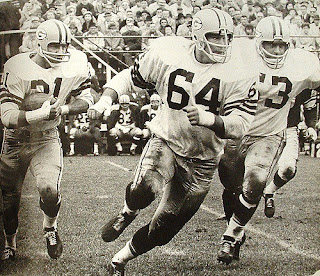
My mental image of myself, c. 1976
(Green Bay Packer Jerry Kramer leading power sweep.)
At the same time, I struggled to step further back, to ask what paradigms currently shape our education, and what we need to do to embrace a new paradigm.

(As someone who devoted year after year to playing football in high school, I am acutely aware that history class is not the only place we educate young people about social values.)

I thought of Pedagogy of the Oppressed, and the idea that if your model of life is banking, you view education as a process of shoveling "wealth" into the heads of students.

I reflected on the writing of (recently deceased) futurist Alvin Toffler, which suggested that once we no longer live in a factory-centered society, we'll need to have schools that look a lot less like factory preparatory schools.

I began to wonder if we don't need to root out an enormous amount of bias in our education system based on the idea that there's not enough to go around, and eventually it's going to come down to a fight . . . .


"Non-rivalrous" goods

I have been intrigued by a concept in economics -- one that I learned about through the study of intellectual property. As the goods and services provide each other come to consist less and less of solid "things" (think: "potatoes") and more and more of "ideas" (think: "a song"), the social consequences of consumption change dramatically. We start to notice that our existence is tending away from competition for scarce resources, and toward abundance.

In economics, this latter category of goods is referred to as "non-rivalrous" -- essentially meaning that my consumption doesn't leave less for you.

And once you wrap your head around the idea of formal rivalry, you begin to notice the much wider scope of practical rivalry. (Example: is the shortage of iPhones or tickets to Hamilton real or constructed? Example: you know how they say that there's really not a shortage of food in the world, but rather a failure to distribute it . . . ?)

"Struck it rich!"
(Prospectors in the Black Hills)
in Harper's Weekly
"A Journal of Civilization"
August 12, 1876
The story of the loaves and fishes and the feeding of the multitude in the New Testament comes to mind. One way of talking about that story is as "a miracle." Another way to think of it is that the desire to share outweighed hunger in a way that eclipsed rivalry. (Perhaps both descriptions are right.)

Another story: the conflict at Standing Rock has led me to go back and study some Native American history. I learned that one phase of the conflict during the 1800s followed the discovery of gold in the Black Hills. The Black Hills were and are sacred to the native people. It made perfect sense to them that something tremendously valuable lay buried in those mountains. The question to them, however, was, "Why wouldn't we all just leave it there, all the more confirmed in our knowledge of the great spiritual potency of those lands?" (Black Hills, including gold therein: non-rivalrous. Mined gold: rivalrous.)

"Leave it in the ground?" Just a short time ago -- in the days when the world was afraid it would run out of oil -- those words made no sense. The rapid realization that the climate crisis will require us to change our energy systems, and in fact our entire approach to consumption and to growth, has also opened the possibility of taking a hard look at our bias for rivalry.

These are just a few initial thoughts. There is room for a greatly expanded exploration of the degree of rivalry in our economics is required, with strong emphasis on the way in which our pre-existing bias for rivalry has conditioned our economic outcomes.


TR and James

Theodore Roosevelt in Africa
(Source: Almanac of Theodore Roosevelt)
I recently read The War Lovers: Roosevelt, Lodge, Hearst, and the Rush to Empire, 1898. What I was most struck by was the degree to which people like Theodore Roosevelt were conditioned to believe that conflict was just a necessary component of a healthy mental, emotional, and physical makeup for the individual -- and that the same applied to society overall. War against Spain wasn't directed at any desired outcome; it was just "the thing to do."

The philosopher William James thought about all that he saw and heard during the US rush to war with Spain, and struggled to articulate a different path for the country. In "The Moral Equivalent of War" (1910) he conceded that perhaps people couldn't resist throwing themselves into a "noble" and challenging endeavor; but, he suggested, we could use reason to identify constructive endeavors that benefit all of us.

"The Moral Equivalent of War" is an important document for all of us who are trying to think about a world beyond war.  For one thing, it is sobering to observe how even a great thinker like James could be so enmeshed in the rivalry, competition, conquest, and war thinking of his time that he had trouble stepping outside it. It is also worth noticing that a hundred years ago someone was calling on the peace movement to take ownership of the limitations it imposed on itself through rhetoric and style. Most important, James illustrates the power of offering a fresh choice.


All of this leads me to posit that our challenge as "world beyond war thinkers" will be to work together to come up with mass education that looks entirely new: an "educational alternative to rivalry."


Related posts

There is a growing movement of people focused on the "world beyond war." To many of these people, the question is not "if" but "when?" They share a conviction that the world will get there, and they see that it makes a difference how quickly (and in what manner) the world gets there.

(See WAR: Headed for the junkheap, yes . . . but how quickly?)


Adopting a "world beyond war" frame -- saying "war is going away; the question for me is how fast" -- implies optimism-realism, outcome orientation, and humility.

(See The Mind of the "World Beyond War" Activist)


It seems very hard to imagine having arrived at the world beyond war without the hand-in-hand changes in education, infrastructure investment, and the way society decides on communal action in the face of conflict.

(See Where to Put Effort for a World Beyond War)


Monday, November 14, 2016

Where to Put Effort for a World Beyond War

Are you looking ahead to a world beyond war? Education, infrastructure, and decisions about communal action are the key . . . .


"Give me a lever long enough and a fulcrum on which
to place it and I shall move the world."

Archimedes


"A lot of people are opposed to war, but what might look different when a group of people approach war as a soon-to-be-obsolete institution?"

It was a month ago that I posed that question in WAR: Headed for the junkheap, yes . . . but how quickly?

I gave one answer to the question in The Mind of the "World Beyond War" Activist: "Saying 'war is going away; the question for me is how fast' implies optimism-realism, outcome orientation, and humility."

But does the "world beyond war" approach help determine where to put effort?

It seems to me that there are some obvious places to focus. Once one is able to imagine a world in which war is a no-go, it becomes possible to imagine certain aspects of that world that will be starkly different than the world in which we live today -- aspects of life that will be inherent to a world beyond war. And, having imagined these aspects, we realize that it seems very hard to imagine having arrived at the world beyond war without the hand-in-hand changes in those aspects themselves. In other words: what would be rendered profoundly outdated if it survived into a world without war?


(1) Education - In a world beyond war, it will no longer make sense to spend a lot of time becoming knowledgeable about war.

We sometimes imagine that education is fundamentally about building up a store of absolute truths; more and more, however, we are realizing that education mostly has to do with acquiring knowledge of what works in the world.

In the world to date, there has been a prevailing emphasis on learning about wars: how they begin, how they are fought, who makes the critical decisions, who leads the fighting, who follows the orders, who derives the benefits from the wars, how the wars are ended, and what changes after they end. The result is that our society is dominated by people who are highly educated about war, and have devoted little time to learning about other ways of settling conflicts.

The inflection point will come when society begins to reward people who know a great deal about how to resolve conflict in the absence of war -- particularly those who can provide value in the form of outcomes that give maximum possible satisfaction to all the parties to a given conflict.

     ... for more see An Educational Alternative to Rivalry


(2) Infrastructure - In a world beyond war, it will no longer make sense to be in possession of massive amounts of infrastructure for carrying out war.

Infrastructure requires time to build. The process of infrastructure development inherently involves trying to imagine what will be needed in the future.

In the world to date, there has been a prevailing attitude toward war infrastructure that says, "Because the cost of failing to have it when we need it would be so high, the only sensible choice is to build as much as we possibly can -- in case we need it."

The inflection point will come when a new attitude begins to gain adherents: "Any overspending on infrastructure that turns out to be useless, will be deeply corrosive to our joint endeavors."

     ... for more see An Infrastructural Alternative to Military Spending


(3) Decisions about communal action - In a world beyond war, it will no longer make sense to hold counsels about decisions to go to war. No one will participate.

In the United States today, we are still living with a constitution that spells out certain war powers, and we maintain an ideal - only intermittently practiced, as it turns out -- in which a highly democratic process may result in a decision to go to war, or not to go to war.

In the world to date, there has been a prevailing acceptance of the wisdom of the group -- some form of democracy -- to decide whether to embark on communal violence. This is in contrast to our views about individual violence, which we tend to view as something which is virtually never ratified by a claim of "wisdom."

The inflection point will come when our systems of group decision-making begin to include norms of "more wisdom, less violence" in proportion to the scope and size of the decision-making forum.

     ... for more see "Problems from Hell" and Real Options Under Democracy


Each of these aspects of our communal life involves an inflection point. And the interesting thing is that, after the inflection point, things will change very fast. The new pattern of education . . . the new direction in infrastructure . . . the new civic decision-making . . . they will all hasten the coming of the world beyond war.

So . . . are there ways to devote effort to assure that we reach each of these inflection points sooner?


Related posts

People working for peace are intensely attuned to the way education impacts peace efforts -- and also war efforts.

(See Education for Peace? or "Education IS Peace"?)


Just like a family that has extra rooms in its house which inevitably become filled with stuff, the U.S. has thousands of bases -- here, there, and everywhere -- that inevitably create the "need" to spend.

(See What Will "Strategic" Mean in Our Children's Lifetime?)


As all the other senators sat patiently through the obfuscation of Barack Obama's Three Horsemen of the Apocalypse -- Secretary of State John Kerry, Defense Secretary Chuck Hagel, and Chairman of the Joint Chiefs General Martin Dempsey -- Rand Paul gave 'em hell.
"Stand up for us and say you’re going to obey the Constitution and if we vote you down — which is unlikely, by the way — you would go with what the people say through their Congress and you wouldn’t go forward with a war that your Congress votes against."

(See Obama's Syria "Vote" in Congress: Democracy? or Theater? )


There is a growing movement of people focused on the "world beyond war." To many of these people, the question is not "if" but "when?" They share a conviction that the world will get there, and they see that it makes a difference how quickly (and in what manner) the world gets there.

(See WAR: Headed for the junkheap, yes . . . but how quickly?)

Friday, November 11, 2016

VETERANS: A Debt You Can't Bankrupt Your Way Out Of

"The wars in Afghanistan and Iraq have costs
billions of dollars over the last decade, but
the spending won't stop when the fighting
does.Just how much money are we
spending on health care because of war?"
Veterans Day is a good day for everyone to ask about long-term health care costs for veterans. And that includes Donald Trump . . . .


I wrote a Veterans Day post three years ago that focused on long-term health care and other costs for veterans. My point was that the lies we tell ourselves to make it "okay" to engage in war begin with denying the true magnitude of taking care -- over the very long term -- of the people we force to fight.

Three days ago, a new US president was elected. His expertise is in financing big -- huge -- projects.

Here's a huge project: the US has more than 20 million veterans. (See Veterans Administration statistics.) The nation's financial obligation to them continues until they die - in many cases 30, 40, 50 or more years from now. It has been suggested that long-term benefits for veterans are a massively underfunded liability.

(Can you begin to imagine this? It's insurance "enrollment season." Take your own health insurance headaches and multiply by 20 million.)

Admittedly, projecting long-term outcomes and costs is difficult, particularly for such a large population with such a range of experiences. Naturally, some people will "blow things out of proportion," and other people will try to "sweep the problem under the rug." The solution, however, is not to do nothing. The solution is to obtain and analyze data, and come up with the most responsible estimate.

(Example: An Australian study, "Long-term Disability Associated With War-related Experience Among Vietnam Veterans(Retrospective Cohort Study)" by Philip M. Clarke, PhD, Robert Gregory, PhD, and Joshua A. Salomon, PhD, in Medical Care found "The steepest rise in disability incidence was observed among Vietnam veterans starting in the 1990s, around 20–30 years after deployment for most veterans. . . . " and "Long-term effects of deployment into military conflicts are substantial, and likelihood of war-related disability is associated with service history. If similar patterns follow from more recent conflicts, significant additional resources will be needed to prevent and treat long-term health conditions among veterans.")

A modest proposal: US president-elect Donald Trump should devote the time between now and Inauguration Day using his expertise to bring forward a new, honest evaluation of the long-term liabilities that the US has accrued as a result of its wars of recent decades, and of the necessary steps to assure those liabilities can be met.

Certainly, Donald Trump intends to do right by US veterans.

Donald Trump can do the math required to count the cost and make sure those liabilities are funded. It's just finance. As they say in business: "Just give me the number."

And most of all - Donald Trump understands the difference between playing the luxury real estate game -- in which mistakes end with a bankruptcy and a shrug -- and our obligations to our veterans. That underscores the importance of providing ironclad assurances that veterans will be taken care of. Not a "kinda sorta" plan. A platinum guarantee.

So . . . President-elect Trump. What's the number?


Related posts

It's time for us to get honest about the true costs of war, including the long term health consequences for people who serve in the military, and the corresponding long-term costs that our society must commit to bear.

(See How to REALLY Honor Veterans)


"The drone program gives people PTSD [post-traumatic stress disorder]," says a former operator in the film, against the background of her attempt to get the VA (Veterans Administration) to acknowledge her condition. "What's so surprising about that?"

(See The Truth About Drones (*NOT* APPROVED by the US Air Force))


"A terrible disease has struck the area . . . people call it the "flu" . . . many in our own community have fallen to it . . . including someone very dear to you, someone in your own family . . . I'm talking about your sister, Margaret." (See November 11, 1918: Another Veteran for Peace )


On November 11, 2015, Veterans for Peace had a message about reclaiming Armistice Day that proved itself massively spreadable on social media . . .

(See What will it take to reclaim Armistice Day for peace? ) 

Monday, October 24, 2016

The Mind of the "World Beyond War" Activist

Adopting a "world beyond war" frame -- saying "war is going away; the question for me is how fast" -- implies optimism-realism, outcome orientation, and humility.


The path ahead . . . .
(Image: Trail Racing Over Texas)


"A lot of people are opposed to war, but what might look different when a group of people approach war as a soon-to-be-obsolete institution?"

This is a question I posed a few weeks ago in WAR: Headed for the junkheap, yes . . . but how quickly?

In that post, I talked about the growing community of people who share a conviction that the world will get to the point where war is a discredited, abandoned institution (like slavery) ... and they see that it makes a difference how quickly (and in what manner) the world gets there. And then I asked, What is different when a person adopts this new frame -- "war is going away; the question for me is how fast"?

Three differences come to mind . . . .

A new relationship to optimism and to realism.  One of the greatest challenges we face, as we work for a better future, is to live in hope while at the same time not underestimating the challenges we face.  I think one of the benefits of this new frame -- "war is going away; the question for me is how fast" -- is that it is grounded in optimism, while at the same time establishing a basis for cold-eyed analysis of what's working and what isn't. (That analysis includes an understanding of the extreme depth and breadth of the current war system.) 

To put it another way, I think this is a frame that encourages us to be hopeful but not naive; realistic but not cynical.

We can disagree on the path. A good friend once told me a word that refers to the way different pathways may be taken and still successfully reach a given result: "equifinality." I think that, as more and more people adopt this new frame -- "war is going away; the question for me is how fast" -- we will become better and better at respecting different approaches, and figuring out how to gain strength from each other.

When we act from a place of frustration, it is difficult to see the value in differences. When we act from a place of hope, difference can spark inspiration.

When we act from a place of oversimplification, there is no room for people who don't fit our model. When we act from a place of realism, differences don't catch us off guard.

To put it another way, we adopt a respectful curiosity about outcomes. What we all sincerely agree on is that we're hoping for the same result in the end.

Humility. We are basing our work on a belief about the future, and that requires us to adopt a posture of humility. We simply can't know for sure how the future will pan out; we don't get to say, "I'm right and you're wrong."


I believe these three differences -- optimism-realism, outcome orientation, and humility -- are important. I think they put us in a much better position to address the next question: How might adopting this new frame enable people to see more clearly the strategic points of impact to cause the more rapid disappearance of war?


Related posts

There is a growing movement of people focused on the "world beyond war." To many of these people, the question is not "if" but "when?" They share a conviction that the world will get there, and they see that it makes a difference how quickly (and in what manner) the world gets there.

(See WAR: Headed for the junkheap, yes . . . but how quickly?)


The strategic challenge we face is to wake up to the fact that -- globally -- we are pursuing peace work in diverse ways . . . and then figure out a way to take advantage of the inherent strength in the existence of these diverse approaches.

(See Global Peace Movement: Big, Networked, Diverse)


Rachel Bauman asks: "How can we manage to talk successfully with people who believe different things than we do?"

Curiosity, leaning into conflict, humility, respect . . . .
(See 4 Aids for Those Important, Difficult Conversations)

Sunday, October 9, 2016

WAR: Headed for the junkheap, yes . . . but how quickly?

John Lennon would have been delighted to be remembered for provoking people to get serious about moving to a world beyond war -- fast!

Yoko Ono and John Lennon: "War Is Over!"
John Lennon was born on this day in 1940.

When he and Yoko Ono held up a sign saying "War Is Over!" the Vietnam War was raging and theirs was a voice in the wilderness.

Today, more and more people are realizing that war is going away. Society is moving in the direction of rejecting war, just as it has already rejected slavery, just as it has already rejected men-only voting.

There is a growing movement of people focused on the "world beyond war."

To many of these people, the question is not "if" but "when?" They share a conviction that the world will get there, and they see that it makes a difference how quickly (and in what manner) the world gets there.

Think about it: it's easy to imagine a world beyond war a thousand years from now. It even seems likely that a hundred years from now we will look back and say, "People in 2016 sat by while war raged in Syria - can you believe it?"

Would it make a difference if the change happened within 50 years, instead of a hundred?

Could it happen faster?

(What might cause it to happen faster?)

Check out Doing Good Better by William McAskill. He is a leader in the "effective altruism" movement and he stresses exactly this kind of thinking. McAskill urges us to identify some world-changing development that is on track to happening, and make it happen faster.  (More resources at https://www.effectivealtruism.org/resources/#books )


So . . . three questions for people who find this approach inspiring vis-a-vis ending war:

What is different when you adopt this new frame -- "war is going away; the question for me is how fast"?  In other words: a lot of people are opposed to war, but what might look different when a group of people approach war as a soon-to-be-obsolete institution?

     ... for more see The Mind of the "World Beyond War" Activist

How might adopting this new frame enable people to see more clearly the strategic points of impact to cause the more rapid disappearance of war? In other words: there are dozens of tremendously important ways to engage in peace work; but which ways might have the greatest impact on the rapidity with which war becomes a no-go?

     ... for more see Where to Put Effort for a World Beyond War

How could we use organizational power in the pursuit of this work? If we had a clear view of what's different about this approach, and we had prioritized strategic points of impact, the question would then become: how could we throw organized money and organized people into the effort?

(To be continued . . . )

Sunday, September 25, 2016

Global Peace Movement: Big, Networked, Diverse

The global peace movement: We're big. We're getting networked. We're diverse (and therein lies our strength).


"Peace is Universal" - shared on Twitter V @marianoGROVETON


Last year I paused to reflect after Peace Day (September 21) and identified 10 aspects of the peace movement that I thought were (and are) important.

This year I'm getting even leaner.

I think there are three (3) things we in the movement need to pay attention to. Everything else follows from that.


(1) We're BIG!

We tend to bemoan the fact that "there aren't enough of us."

In fact, there are COUNTLESS people out there devoting themselves to peace work of various kinds.

They're in every country.

They're of every gender. They're of every age.

They do it in their jobs and they do it as volunteers.

Do you doubt it? Scroll through some of the peace workers I follow on Twitter.

A big moment for me came when I realized that not everyone doing great peace work lives where I live, or looks like me, or is even doing the kind of work I'm doing. Once I started to explore the real extent of the movement, what I found surprised me!


(2) We need to be networked

"Sure," I hear you saying, "there are huge numbers of people working for peace. But how do we connect with each other?"

I'll be writing more about this. For now, I'll just put forward a couple of observations:

(a) I think we need to view "connecting" as a central and ongoing task. Each of us needs to make it a daily discipline, and I think we need to devote a significant percentage of our time to making connections.

(b) The low cost of connecting via the Internet works to our advantage.

Setting some goals is the first step.

(Here's an idea: Using social media, try to notice one new person doing peace work each day. Take a few minutes to look at the work they are doing, think about it, and bring them and their work to the attention of others. This morning, I shared information about Japanese peace activist Kozue Akibayashi.)


(3) Our diversity is our strength

We are diverse: that's a fact.

Working on A Global Security System: An Alternative to War helped me recognize the many threads in any attempt to describe the peace movement. In a given day, I might be tuning in to communities focusing on nuclear disarmament, counter-recruitment in schools, the connection of development to peace, the occupation of Palestine, faith-based activism, the use of technology for peace work, general antiwar activism, and more . . . .

Now, the peace movement is subject to self-criticism that says, "We're not united enough" and or "We're not focused enough on the main thing."

The strategic challenge we face is to wake up to the fact that -- globally -- we are pursuing peace work in diverse ways . . . and then figure out a way to take advantage of the inherent strength in the existence of these diverse approaches.


I'll be talking more about this, you can be sure!


Related posts

September is a big month for peace work organizing - the UN International Day for Peace is September 21. As you plan your peace work for September, consider how you will directly and/or indirectly participate in and support of these activities taking place around the world.

(See Make Your Plans for #PeaceWork in September)


Twitter is certainly a powerful way to quickly form connections with others in the movement.

(See Suggestions for Successful Twitter Activism)


Yesterday was the UN International Day of Peace (2015). The day nudged me to think about what -- if anything -- I feel I really know about peace and the movement for peace. Here are 10 things that are true for me . . . .

(See #PeaceDay 2015 - Ten Thoughts on Peace)

Friday, August 26, 2016

Make Your Plans for #PeaceWork in September

There are abundant events and campaigns in September 2016 that enable people to get to work for peace. Find one (or more!) and sign up, attend, volunteer, share, lead, . . . .


#peacework: September 2016 ... happening everywhere!
(Please share.)


There are many ways to work for peace. One part of achieving peace is recognizing the strength we have through the diversity of our peace efforts, and the degree to which these peace efforts are happening worldwide.

And let's be clear: this is work. All the characteristics that you find in other types of work are present in peace work, too: long-term commitment, attention to outcomes, teamwork, organization-building, resource management, problem-solving . . . .

September is a big month for peace work organizing - the UN International Day for Peace is September 21.  As you plan your peace work for September, consider how you will directly and/or indirectly participate in and support of these activities taking place around the world.

And please help involve more people by using the #peacework hashtag!

(event hashtag to be advised)
September 9-11
Build Peace 2016
Location: Zurich, Switzerland
Convener: @howtobuildpeace
Description: "How can we use technology, arts and research for peace, towards transformation?"
More information: http://howtobuildpeace.org/programs/
See also: #peacetech

(event hashtag to be advised)
September 18-25
Campaign Nonviolence Week of Actions 2016
Location: may locations - see website
Convener: @campaignnv
Description: "During Campaign Nonviolence Week, September 18-25, our goal is 500 marches for a culture of peace and nonviolence in cities and towns in all 50 states and in nations around the world, Campaign Nonviolence will march against violence and for a world of peace, justice and sustainability."
More information: http://www.paceebene.org/programs/campaign-nonviolence/campaign-nonviolence-week-of-actions/
See also: #nonviolence

#PJSA2016
September 22-24
Peace and Justice Study Association Conference
Location: Nelson, British Columbia
Convener: @PJSAtweets
Description: "At this year’s conference, we will explore methods and strategies that not only address the challenging attributes of our relationships and our world, but also showcase the success of visionary projects and movements that have built new ways of being and doing (that is, building the world we want) from the interpersonal to the global."
More information: http://www.peacejusticestudies.org/conference
See also: (additional hashtag(s) to be advised)

(event hashtag to be advised)
September 23-25
No War 2016: Real Security Without Terrorism
Location: Washington, DC
Convener: @worldbeyondwar
Description: "As the war system keeps societies in a state of permawar, we have reached a stage in human history at which we can say with confidence that there are better and more effective alternatives. Of course we know the question: “You say you are against war, but what’s the alternative?” This event will develop answers to that question, building on World Beyond War’s publication A Global Security System: An Alternative to War."
More information: http://worldbeyondwar.org/NoWar2016/
See also: (additional hashtag(s) to be advised)

#TalkingPeace
September 21 - October 2
Talking Peace Festival
Location: London, UK
Convener: @talkpeacefest
Description: "Art, Food, Film, Technology ... The Talking Peace Festival is a global unique arts and cultural platform organised by peacebuilding charity International Alert designed to engage people in the most urgent issues of peace and conflict around the world."
More information: http://talkingpeacefestival.org/
See also: #peacehack, #ART4PEACE

(event hashtag to be advised)
September 30 - October 2
Disarm! For a Climate of Peace – Creating an Action Agenda: IPB World Congress 2016 on Military and Social Spending
Location: Berlin, Germany
Convener: @intlpeacebureau
Description: "Talks, presentations, roundtables, panel discussions, workshops, information booths, exhibitions, cultural activities; high point in the recently-launched Global Campaign on Military Spending; apart from the Global Day of Action on Military Spending (mid-April), preparatory events will be held in major cities around the world over the coming year."
More information: https://www.ipb2016.berlin/
See also: (additional hashtag(s) to be advised)

 . . . PLUS more peace events worldwide - hashtag #PeaceDay!


Related posts

I've realized that when we ask ourselves, "What is it that we hope people will do?" we must include an element of recursivity: One of the things we want people to do is to involve more people in doing it. In a way, that element of recursivity -- dare I say "evangelism"? -- defines what it means for people to really become part of a movement.

(See Invite More People into Activism! (Pass It Along!) )


It will benefit us antiwar activists in the US to attend to and reflect upon the importance of these Sustainable Development Goals to achieving the goal of ending war.

(See PEACE DAY 2016: What comes first? Demilitarization? or Development?)


Yesterday was the UN International Day of Peace. The day nudged me to think about what -- if anything -- I feel I really know about peace and the movement for peace. Here are 10 things that are true for me . . . .

(See #PeaceDay 2015 - Ten Thoughts on Peace)


Tuesday, August 9, 2016

Trump? Maybe the problem is the NUCLEAR ARSENAL itself ...

Fifty GOP leaders oppose Trump, warning of danger if he controls nuclear weapons. Are they opposed to thermonuclear monarchs in general? Or just this one?


Donald Trump, December 2015:
"Why bother having nuclear weapons
if you are afraid to use them?"
(ICAN graphic)


I am perplexed reading the letter by 50 of the most powerful people in the world -- and they are, considering their inside role in the US political and national security establishment -- in which they warn about Donald Trump becoming president.

Really? A letter? That's the best you can do?

Without putting too fine a point on it: these are 50 of the people most responsible for propping up the current balance of terror, and now that it occurs to them that a catastrophe might occur, they give us a letter?

Make no mistake, even though they soft-peddle it, their ultimate fear is clearly what Trump might do with nuclear weapons:

Mr. Trump lacks the temperament to be President. In our experience, a President must be willing to listen to his advisers and department heads; must encourage consideration of conflicting views; and must acknowledge errors and learn from them. A President must be disciplined, control emotions, and act only after reflection and careful deliberation. A President must maintain cordial relationships with leaders of countries of different backgrounds and must have their respect and trust.

In our judgment, Mr. Trump has none of these critical qualities. He is unable or unwilling to separate truth from falsehood. He does not encourage conflicting views. He lacks self-control and acts impetuously. He cannot tolerate personal criticism. He has alarmed our closest allies with his erratic behavior. All of these are dangerous qualities in an individual who aspires to be President and Commander-in-Chief, with command of the U.S. nuclear arsenal
. (highlighting added)

So now it occurs to you that there's a problem? Up until now, you've assumed the US president would always be self-controlled enough, reflective enough, consistent enough . . . foolproof enough . . . that the nuclear thing would just kind of stay safely under wraps where it belongs?

If you really grasped the risk, you would be standing alongside President Obama urging him to negotiate complete nuclear disarmament as fast as he possibly can, and talking to everyone in Congress you can possibly get to support him.

See OBAMA: First stop, Hiroshima; second stop, Moscow.


Related posts

Elaine Scarry demonstrates that the power of one leader to obliterate millions of people with a nuclear weapon - a possibility that remains very real even in the wake of the Cold War - deeply violates our constitutional rights, undermines the social contract, and is fundamentally at odds with the deliberative principles of democracy.

(See Reviews of "Thermonuclear Monarchy: Choosing Between Democracy and Doom" by Elaine Scarry )


Do we have a way to immerse ourselves in the experience of what the use of those nuclear weapons would really mean -- prospectively -- so that we can truly cause ourselves to confront our own inaction?

(See Stop engaging in risky behavior )


Any advocacy for the elimination of nuclear weapons must sooner or later get around to the specifics of the steps by which we get to zero. U.S. nuclear strategists recognize that 311 is still a large number of strategic nuclear weapons for the U.S. to hold. Shouldn't our minimum demand be to get U.S. to this level (or below)?

(See Why Are These Military Experts Saying CUT CUT CUT Nukes? )