Showing posts with label MAGA (for real). Show all posts

Wednesday, January 25, 2017

Nuclear Weapons: People Power Over Trump Power

What if each of these people picked up the phone?


Women's March - January 21, 2017


It's estimated that 3 to 4 million people or more took to the streets in the US on January 21 to protest the things Donald Trump has said in the past, and the things he might do in the future.

What about nuclear weapons?

Yesterday, legislation was re-introduced in Congress to take that unilateral control away from Donald Trump (or any president).

This isn't a "nice to have" that we're hoping some sympathetic ruler will grant us. This is a must, and it is within our power to obtain it. (You can read more about the idea behind the bill here.)

It's going to take votes. So: right now, everybody who got out into the streets last Saturday needs to get on the phone today. Every US citizen should be on the phone to their member of Congress and senator . . .  Go to Find Your Representative / Contact Your Senator to get contact information for your representative and/or senator. Call them and say . . .


"I am deeply concerned about the threat of nuclear weapons."

"I agree Congress must re-assert its authority over war, including nuclear weapons."

"I urge my representative to co-sponsor the 'Restricting First Use of Nuclear Weapons Act of 2017'"

Each person who acts participates in creating a new reality:

* we CAN get rid of nuclear weapons
* with nuclear weapons, the president alone DOESN'T get to call the shots
* ordinary people DO have a voice

Tell Congress to put the brakes on nuclear weapons.

(You can check the progress of cosponsors on HR 669 / S 200 "To prohibit the conduct of a first-use nuclear strike absent a declaration of war by Congress" here.)


MORE:
"Thermonuclear Monarchy: Choosing Between Democracy and Doom" by Elaine Scarry
NEEDED: Heroes to Bring About Nuclear Disarmament


Please share this post . . . 

Monday, January 23, 2017

Can Trump Drink the Pentagon's Milkshake?

Base data at Global Research
People who oppose war tend to notice two things.

First: the US has by far the biggest military in the world, spends the most money, has its forces and bases and weapons and technology spread out to every corner in the world, and is engaged in conflicts -- small and large, high-profile and clandestine -- everywhere.

Second: it's very difficult to arouse the general public in the US to want to change that.

We try moral arguments. We try economic arguments. People are really not interested.

*   *   *

So: it is intriguing to see the statement in Donald Trump's inaugural address, consistent with what he said in his campaign, about pulling back militarily:

We've defended other nations' borders while refusing to defend our own and spent trillions and trillions of dollars overseas while America's infrastructure has fallen into disrepair and decay. We've made other countries rich while the wealth, strength and confidence of our country has dissipated over the horizon.

I wonder what people think when they hear that "trillions and trillions of dollars." Does that make them want to see what would happen if money was taken away from the Pentagon and used in a way that they could actually see the benefit?

Let's not quibble for a moment with whether all that US military spending has really been directed at "defending other nations' borders." The immediate question for me is whether anyone -- Donald Trump or anyone else -- has the power to make any significant changes to the defense spending or any other aspect of the defense establishment in this country.

I'll be blunt: for the past eight years, we've seen what happens under the command of a nice, respectful person. Maybe we need to what a mean, disrespectful person can do.

I fully expect the defense establishment to seek to crush Trump if/when he attempts to make any changes. I frankly don't know how someone in his position manages to survive. And yet . . . .

Trump sent a signal with the bit about the F-35 spending. Of course, that was all theater. But I think the point we should not miss is that he does have a lot of support from people "out there" -- and the F-35 gambit was part of shoring up support as the buildup to something bigger.

A lot of us cringe at the "us vs. them" narrative, and the "disrepair and decay" narrative, and the "wealth = strength and confidence" narrative.  Although, to be honest, many of us have tried variations on these narratives -- we just found that they didn't work. So maybe what we find so cringe-worthy is that someone else has actually tweaked them into utility.


The Art of the Deal?

Make no mistake, Donald Trump isn't going to embark on a negative -- taking money away from the military -- without leveraging it into a much bigger positive:

We will build new roads and highways and bridges and airports and tunnels and railways all across our wonderful nation. We will get our people off of welfare and back to work rebuilding our country with American hands and American labor.

Can you spend "trillions and trillions of dollars" on that? You bet you can.

If Donald Trump knows one thing, it is that when you embark on building stuff, it creates a lot of jobs for ordinary people, and that money enters the local economy in a way that has a big multiplier effect.

I keep remembering John Maynard Keynes saying something to the effect that, if you can't think of anything better to do, just have people dig a hole and then fill it up again. And we've got a lot better things to do than dig holes.

Vision for a nationwide rail system
(See An Infrastructural Alternative to Military Spending)
Just a few weeks ago, I wrote a piece about how, if we hope to move towards a world beyond war, we need to shift our infrastructure spending -- to something like a national high-speed rail network. I didn't take quite the same tack as Donald Trump. But what if his approach gets us to the same place?

Sure, the Republican establishment won't be thrilled with this kind of Rooseveltesque program. (Oh wait -- that's right -- the Republican establishment didn't elect Donald Trump.)

It becomes a lot harder for the military establishment to crush you when people are feeling really, really hopeful about what your infrastructure development plan is going to mean for them and their communities.

A clue to how important this is to Donald Trump, and what his strategy is, may lie in his appointment of Elaine Chao as Transportation Secretary. (How is this picture not like the others . . . ?)


Last week I wrote about what might possibly be motivating Donald Trump to cut nuclear weapons. (Hint: think about where hotels go.) When it comes to trading military bases abroad for urban transit hubs in the US, maybe we should ask the same question. Need a hotel with that, fella?


Please share this post . . . .

Friday, January 6, 2017

Connect the Dots: Obama Drones Threat Capital Inequality

By perpetuating the idea that we live under threat of terrorism, and that drones are the answer, Obama has guaranteed the economic inequality engine will continue to function unimpeded for a very long time to come . . . .


"Obama's embrace of drone strikes will be a lasting legacy."
(Graphic: @pariewolf)


Barack Obama is scheduled to give his farewell speech in Chicago on January 10, 2017.

Over the past six years, I have written again and again about the expansion of drone killings under Obama. The graphic above reminded me that I should not let the occasion of Obama's "legacy" speech pass without saying what his real legacy will be.

As Mark Landler explained in The New York Times this past summer, Obama's legacy really does seem to be the use of military force by the US around the world in an uninterrupted way, while still operating beneath the notice of the vast majority of US people.

The use of drones perfectly encapsulates the Obama legacy: as long as you keep boots off the ground, you can assert US military power anywhere and everywhere without alarming the public. If a few spoilsports object, you can point out that drones are limited, cost-effective, high-tech. (And did we mention there are no boots on the ground?)

As someone who has called written about this phenomenon as "permawar" . . . and worked with drone warfare opponents throughout the country . . . and even tried revoking Obama's Nobel Prize . . . I enjoy a kind of satisfaction in seeing other voices affirm my reading of the situation.

 . . . HOWEVER . . .

I've come to the conclusion that it is not enough to simply protest drone warfare.

We need to connect the dots between this new way of war and the economic crisis that has brought Donald Trump to power.


Inequality: "Where's Mine?"

WHERE'S MINE? Inequality in the US
and the Military-Industrial Complex
About a year ago, I took a stab at connecting the problem of inequality in the US to the problem of military spending and war.

I shared data on the real extent of economic inequality in the US, and noted that this information is widely available. "I'm wondering when people are going to decide to do something about it," I wrote, "and when they're going to begin to ask about the connections between inequality and the military-industrial complex."

I think we got the answer to the first half of my query with the election of Donald Trump.


How US Military Spending Contributes to Economic Inequality

US government spending:
military vs "all other"
(More details here.)
To many of us, it seems obvious that the connection between the enormous levels of US military spending and economic inequality is that tax money is used for war instead of to make the lives of people in the US better. ("Money for jobs and education, not for war and occupation.")

As a very loyal but honest critic of the antiwar movement has said, "We just can't seem to get any traction with the money argument for opposing war."

We're not getting traction with the simple argument -- "Stop spending so much money!" -- and we're also not getting traction with the more sweeping argument that takes the form of a critique of "Neoliberalism."

In my opinion, the former argument fails because it is too simplistic: it's just too difficult for people to detach their idea of today's military spending from the idea of the "Good War" and the "arsenal of democracy" -- the notion of "security" validated for them by WWII. They know just enough about today's regional conflicts and militant activities -- i.e. the warlike ways of "those people" and their resort to "terrorism," but nothing about the role of the US and other countries in fomenting same -- to reinforce the idea that military spending is unavoidable. In-district military spending (jobs) seals the deal.

(Put another way: Eisenhower's warning about the military-industrial complex is too abstract to be helpful.)

The latter argument -- the critique of Neoliberalism -- is, in contrast, too wide-ranging and diffuse. At its core, it plays into exactly the psychology that perpetuates inequality, even in the face of grotesque inequities: people hear "freedom of opportunity" and they imagine it means "freedom of opportunity" for ordinary people. They imagine themselves, and people like themselves, getting a break.

No, we need a different argument.

Ideally, something with a conspiratorial edge to it.


Stacking the Deck

In my "Where's Mine?" post, I alluded to the work of Thomas Piketty. But it wasn't until I read Joseph Stiglitz's gloss on Piketty in his book The Great Divide that I was able to connect the dots.

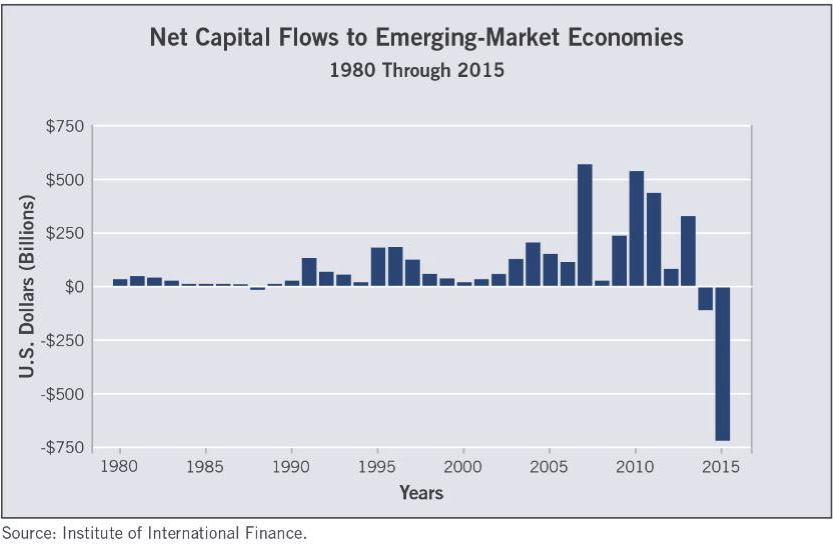
Stiglitz explains that what Piketty is pointing out is that the 1% keeps getting richer and richer because something's out of whack. The wealth that they invest is able to keep earning super high returns, despite the normal expectation that, at some point, returns weaken. In particular, they have the ability to keep pumping money into emerging, high-growth economies, which will pay a higher return on capital, compared to older, low-growth, stable economies (read: the US).


Net Capital Flows to Emerging-Market Economies (1980-2015)
(Source: Advisor Perspectives)


(As the graph above shows, the past few years have seen phenomenally high levels of capital flow into emerging markets.)

Stiglitz says this can't go on indefinitely, but by the time it peters out, there is likely to be extreme inequality globally -- i.e. much worse than there is now.

What Stiglitz doesn't explain is this: what has prevented the market from correcting this situation?

In particular, I wondered about the risk of investing in those emerging markets. Having spent a large part of my career doing business in China (and other parts of Asia), I have always been very focused on the degree to which investments are put at risk by the absence of good information in those societies. (It has often seemed to me that there is a bubble in China, supported by perception that the overall market is growing so fast that the inability to monitor the true performance of individual investments is a minor concern.)

Stiglitz gives a clue that we should be looking in a different direction. He invites us to think about "rents." This refers to the idea of sources of assured returns -- think of an oil well or music royalties -- where the underlying asset is not involved in a complicated, risky operation like manufacturing or providing a service.

I think the answer to how the rate of return on capital all around the world can continue to remain high, despite the expectations of market theory, is that capital is able, in effect, to find unnatural ways to shield it from risk in those "other" countries. The returns are more like "rents" than they are like "dividends."

Moreover, I think the most important "unnatural way" involves the threat of military force to protect capital -- i.e. the investments of the 1% from the US (and the rest of the West).


"America's most elite troops deployed to 138 nations in 2016 . . . ."
(Source: Nick Turse in Truthout)


Conveniently, Nick Turse just published a piece with the updated map above of elite troops deployments and US military installations around the world.

To complete the picture, all you need to do is think about the fact that the places in-between are all covered (or coverable) by drone flights.

This picture is not keeping the world safe for democracy; it's keeping the world safe for capital.


Really?

As someone who has grown up in the US, it is not automatically possible for me to understand that the presence of US military forces around the world necessarily translates into the message: "No US financial losses allowed here." Do people in foreign countries really think that accepting US investment means they have to guarantee the returns of those US people? Shouldn't foreign investors have to face normal financial risk, just like everyone else?

By coincidence, I noticed a reference the other day by Howard Zinn to "Instances of Use of United States Armed Forces Abroad." A few of the examples Zinn cites:

1853-1854 - Japan. Commodore Matthew C. Perry and his naval expedition made a display of force leading to the “opening of Japan."

1859 - China. July 3 I to August 2. A naval force landed to protect American interests in Shanghai.

1860 - Angola, Portuguese West Africa. March I . American residents at Kissembo called upon American and British ships to protect lives and property during problems with natives.

1893 - Hawaii. January 16 to April 1. Marines were landed ostensibly to protect American lives and property, but many believed actually to promote a provisional government under Sanford B. Dole. This action was disavowed by the United States.

And the list continues . . .

1912 - Honduras. A small force landed to prevent seizure by the government of an American-owned railroad at Puerto Cortez. The forces were withdrawn after the United States disapproved the action.

1917-1922 - Cuba. U.S. forces protected American interests during an insurrection and subsequent unsettled conditions. . . .

1922 - Turkey. September and October. A landing force was sent ashore with consent of both Greek and Turkish authorities to protect American lives and property when the Turkish Nationalists entered Smyrna.

1965 - Dominican Republic. The United States intervened to protect lives and property during a Dominican revolt and sent more troops as fears grew that the revolutionary forces were coming increasingly under Communist control.

1988 Panama. In mid-March and April 1988, during a period of instability in Panama and as pressure grew for Panamanian military leader General Manuel Noriega to resign, the United States sent 1 ,000 troops to Panama, to “further safeguard the canal, U.S. lives, property and interests in the area.” The forces supplemented 1 0,000 U.S. military personnel already in Panama.

Don't take it from me. The official US history says that the US military intervenes again and again and again to protect US capital. ("Instances of Use of United States Armed Forces Abroad, 1798-2015" by the Congressional Record Service.) And that doesn't include CIA operations (e.g. 1953: Iraq, oil; 1961, Cuba; 1980s: Central America) or much of the post-WWII intervention in the name of "fighting Communism" (Korea, Vietnam, Laos, Cambodia), "humanitarian" purposes, or for fighting "terrorism" (Afghanistan, Pakistan, Somalia, Yemen) and "weapons of mass destruction" (2013: Iraq, oil).

Its easy to see why countries around the world understand that using the capital proffered from the US comes with a proviso: "You will guarantee that this cash injection brings nothing but upside. We expect rents in perpetuity."


Connecting the Dots: Obama - Drones - Threat - Capital - Inequality

I propose that the global movement against war should celebrate the departure of Barack Obama.

We should seize upon the recognition that the economic inequality that vast numbers of people in the US are angry about stems directly from the way the US military is used. (Including, in its newest form, the move toward drone warfare.)

If We the People have any gumption, we will see that the very reason we are becoming more and more impoverished, while the super-rich get richer and richer, is that our taxes are being used to stack the deck for the rich.

That giant sucking sound? It's the investment dollars that we need to refresh our productive economy fleeing to "rents" in distant parts of the world. And OUR tax dollars are paying for the military that guarantees the economic inequality engine will continue to function unimpeded for a very long time to come.


Please share this post . . .

Saturday, December 24, 2016

Visit Congress in Person

The best cure for the post-election 2016 blues (and coming-of-Trump trepidation is to go meet with your member of Congress (and/or other representatives) in person and feel your power . . . !


Alexander Calder's Mountain and Clouds
inside Hart Senate Office Building
Washington, DC
(Richard Nowitz/National Geographic)
 I was just looking at the impressive array of posts on the Desert Beacon blog, and I saw this admonition:

Citizens Have More Power Than They Realize. Most of the staff surveyed said constituent visits to the Washington office (97%) and to the district/state office (94%) have ‘some’ or ‘a lot’ of influence on an undecided Member, more than any other influence group or strategy.

(All of the advice in this post is useful - see "Communicating With Congress: Some Advice".)

It inspired me to make a resolution: in 2017 I'm going to get in front of my representatives more. (I got a good start in 2016 - see On Nuclear Weapons: We Need Tenacity and  NUKES: Your Call to Your Congressman Matters.)

This reminds me that I once wrote some suggestions of my own for communicating with Congress. Here are some best practices for groups making office visits to representatives. I wrote it several years ago in connection with my work with No Drones Network.


(1) Build relationships

One of the secrets of effective lobbyists is that they know that the positions on issues that the politicians take rest on the shoulders of their staff.  To be effective, build relationships with the staff.

It is often confusing to find oneself in a meeting with a staff person, when one is under the impression that the really IMPORTANT person to talk to is the officeholder. However, the staff person is almost always the resident expert on a topic.  The road to "yes" has to pass through the staff person.

I have frequently found that it is the staff people who have the greatest appreciation for the issue knowledge that I am able to bring, and have the deepest commitment to doing the right thing on the issue.  And certainly they know the keys to convincing the officeholder.

Imagine the staff as your "inside" advocate . . . and then try to solve the problem of how to make that a reality.

So ... cultivate those relationships!

(2) Practice time management

One of the best ways to be taken seriously by the people you meet with is if they can see that you have prepared what you are going to say, and who is going to say it, and that you are going to make extremely efficient use of their time.

I have frequently seen how staff people begin to warm up to the group when they see this done.  In my experience, it is extremely effective to proceed as follows:

* start with a quick round of introductions: name, how connected to the district, affiliation;

* then present ~ 3 main points.  For instance, one person might give an overview of the presentation, then 3 other people in succession each speak BRIEFLY AND SUCCINCTLY to one of the main points.  Then the person you are meeting with should respond.

It is actually a good practice to have your talking points on paper, and to provide a copy to the people you are meeting with.  That encourages them to focus on what you want, and to try to give it to you.

It is extremely important to know what role each participant on your team is taking, and to have discipline.  Meetings become de-focussed if people are interrupting each other to make points and emphasizing issues that are not the most important one to emphasize at a given moment.

There should be a clear leader, and the team should take direction from the leader.

(3) Present logical arguments

Some of the best advice I ever received was, "Start to plan your meeting by writing a very well-argued, logical, informed letter of about two pages. You are talking to people who respect well-structured, well-thought-out argument."  This was very helpful to me, because I had somehow imagined other factors being more important -- for instance, impassioned rhetoric.

The other practices recommended here take their power from being done in connection with such a clear set of arguments.  This forms the core of the entire office visit.

And when you think about it, it makes sense: these are people whose work, day-in, day-out, involves laws, briefs, debate, and the process of legislation.  Naturally, they feel most comfortable when they can see a clear set of arguments presented.

(4) Speak from personal experience

People in congressional offices love to hear about the real experiences of real people.  I have very distinct memories of being in meetings, and when a member of our group started to say, "I've been interested in Pakistan ever since I went there for my junior year in college . . . " or "I've visited Pakistan every 2 years to visit my grandmother . . . " they perk right up and smile and start to ask questions. 

Think about how you can connect what you want to say to your personal experience.  Your lived experience matters!

(5) Emphasize community commitment

Ideally, you will be visiting with a small group, including multiple people who live in the district and/or have involvement in the district.  This is where your small-town location is an ASSET.

If you can, in the course of your remarks, rope in additional members of your community, that makes your position even stronger.  (e.g. "When we held an event about drones attended by 35 members of St. John's church, it was surprising to see how concerned all those people were about this issue . . . . ")

(6) Have an "ask" (or "asks")

Every visit should climax with the presentation of one or more "asks," and the response of the person you are meeting with. 

A good strategy is to include a doable "ask" in every visit.  This begins to establish a pattern of you making "asks" and them saying "yes." 

Sometimes an "ask" is very easy and concrete:  attend a community event (or send a representative).

Sometimes an "ask" is legislation-specific:  vote "YES" on such-and-such a bill.

Sometimes an "ask" is broader:  e.g. "work with your colleagues to hold hearings on the drone killings in (location)."

And, of course, there are overarching "asks," as well:  e.g. "work with us to bring about a total ban on drone killings."

(7) Be in it for the long haul

Every visit should involve the exchange of business cards, and a provision for follow-up.

It is a good practice to offer to supply specific information resources in the course of the meeting. (Example: I would like to send you the link to the article about our public meeting on drones killings in (town).)  This offers an opportunity for follow-up.

At a minimum, an email should be sent within a week of the meeting, thanking the people you met with for their time. 

If you are willing to put in a little extra effort, send a written thank you. (Believe me, it will be remembered!)

And then: get out your calendar and start planning in advance for your follow-up visit. ;-)


Related posts

When it comes down to a question of war, Congress must decide. And when Congress must decide, that means people's voices must be heard.

(See Illinois says "No U.S. Attack on Syria" (Is Congress Listening?) )


Let's focus for a moment: what might be accomplished if there was a concerted and effective push by antiwar people in precisely those states that swing election after election?

(See An Antiwar Thought Experiment: Swing the Swing States?)


The decision about whether to live with the threat of nuclear annihilation is our decision. And that is why the entire country is mobilizing for mass action for nuclear disarmament in 2015. Are we capable of making sure the messengers -- Obama, Putin, the other agents of government -- hear their instructions from us clearly?

(See NEEDED: Heroes to Bring About Nuclear Disarmament )

Monday, November 14, 2016

Where to Put Effort for a World Beyond War

Are you looking ahead to a world beyond war? Education, infrastructure, and decisions about communal action are the key . . . .


"Give me a lever long enough and a fulcrum on which
to place it and I shall move the world."

Archimedes


"A lot of people are opposed to war, but what might look different when a group of people approach war as a soon-to-be-obsolete institution?"

It was a month ago that I posed that question in WAR: Headed for the junkheap, yes . . . but how quickly?

I gave one answer to the question in The Mind of the "World Beyond War" Activist: "Saying 'war is going away; the question for me is how fast' implies optimism-realism, outcome orientation, and humility."

But does the "world beyond war" approach help determine where to put effort?

It seems to me that there are some obvious places to focus. Once one is able to imagine a world in which war is a no-go, it becomes possible to imagine certain aspects of that world that will be starkly different than the world in which we live today -- aspects of life that will be inherent to a world beyond war. And, having imagined these aspects, we realize that it seems very hard to imagine having arrived at the world beyond war without the hand-in-hand changes in those aspects themselves. In other words: what would be rendered profoundly outdated if it survived into a world without war?


(1) Education - In a world beyond war, it will no longer make sense to spend a lot of time becoming knowledgeable about war.

We sometimes imagine that education is fundamentally about building up a store of absolute truths; more and more, however, we are realizing that education mostly has to do with acquiring knowledge of what works in the world.

In the world to date, there has been a prevailing emphasis on learning about wars: how they begin, how they are fought, who makes the critical decisions, who leads the fighting, who follows the orders, who derives the benefits from the wars, how the wars are ended, and what changes after they end. The result is that our society is dominated by people who are highly educated about war, and have devoted little time to learning about other ways of settling conflicts.

The inflection point will come when society begins to reward people who know a great deal about how to resolve conflict in the absence of war -- particularly those who can provide value in the form of outcomes that give maximum possible satisfaction to all the parties to a given conflict.

     ... for more see An Educational Alternative to Rivalry


(2) Infrastructure - In a world beyond war, it will no longer make sense to be in possession of massive amounts of infrastructure for carrying out war.

Infrastructure requires time to build. The process of infrastructure development inherently involves trying to imagine what will be needed in the future.

In the world to date, there has been a prevailing attitude toward war infrastructure that says, "Because the cost of failing to have it when we need it would be so high, the only sensible choice is to build as much as we possibly can -- in case we need it."

The inflection point will come when a new attitude begins to gain adherents: "Any overspending on infrastructure that turns out to be useless, will be deeply corrosive to our joint endeavors."

     ... for more see An Infrastructural Alternative to Military Spending


(3) Decisions about communal action - In a world beyond war, it will no longer make sense to hold counsels about decisions to go to war. No one will participate.

In the United States today, we are still living with a constitution that spells out certain war powers, and we maintain an ideal - only intermittently practiced, as it turns out -- in which a highly democratic process may result in a decision to go to war, or not to go to war.

In the world to date, there has been a prevailing acceptance of the wisdom of the group -- some form of democracy -- to decide whether to embark on communal violence. This is in contrast to our views about individual violence, which we tend to view as something which is virtually never ratified by a claim of "wisdom."

The inflection point will come when our systems of group decision-making begin to include norms of "more wisdom, less violence" in proportion to the scope and size of the decision-making forum.

     ... for more see "Problems from Hell" and Real Options Under Democracy


Each of these aspects of our communal life involves an inflection point. And the interesting thing is that, after the inflection point, things will change very fast. The new pattern of education . . . the new direction in infrastructure . . . the new civic decision-making . . . they will all hasten the coming of the world beyond war.

So . . . are there ways to devote effort to assure that we reach each of these inflection points sooner?


Related posts

People working for peace are intensely attuned to the way education impacts peace efforts -- and also war efforts.

(See Education for Peace? or "Education IS Peace"?)


Just like a family that has extra rooms in its house which inevitably become filled with stuff, the U.S. has thousands of bases -- here, there, and everywhere -- that inevitably create the "need" to spend.

(See What Will "Strategic" Mean in Our Children's Lifetime?)


As all the other senators sat patiently through the obfuscation of Barack Obama's Three Horsemen of the Apocalypse -- Secretary of State John Kerry, Defense Secretary Chuck Hagel, and Chairman of the Joint Chiefs General Martin Dempsey -- Rand Paul gave 'em hell.
"Stand up for us and say you’re going to obey the Constitution and if we vote you down — which is unlikely, by the way — you would go with what the people say through their Congress and you wouldn’t go forward with a war that your Congress votes against."

(See Obama's Syria "Vote" in Congress: Democracy? or Theater? )


There is a growing movement of people focused on the "world beyond war." To many of these people, the question is not "if" but "when?" They share a conviction that the world will get there, and they see that it makes a difference how quickly (and in what manner) the world gets there.

(See WAR: Headed for the junkheap, yes . . . but how quickly?)

Thursday, March 3, 2016

An Antiwar Thought Experiment: Swing the Swing States?

There's no time like the present -- i.e. as the US stares down the throat of a possible Trump presidency -- to tee up an electoral thought experiment.

Now I understand antiwar people have totally lost faith in the electoral process. It's okay! So has everyone else!!

But this post is directed at a time in the not-to-distant future when there is a national awakening. (Think: David Byrne singing "My God! What have I done?") I'm thinking about a time when a lot of people actually start to think about how they can have an impact about what this country is and does.

So here's the thing: we all know that elections ultimately come down to the small number of uncommitted voters, especially in swing states. Anyone who wants to succeed devotes a lot of attention to what it will take to win over those voters, in those places.


Swing States 2016
(Source: UVA Center for Politics)


Now, consider a possible situation: any candidate who wants to win over those voters, in those places, will have to contend with a bunch of people who have been thinking a lot about how not to have war. What would happen if the antiwar movement zeroed in on that as a goal?

In other words, put aside for the time being the goal of turning every person in the country into an antiwar activist. In fact, put aside for the moment all of our accepted ideas about what it means to be "antiwar." (And for sure forget about the idea that "antiwar" people look the same everywhere!)

Instead, just focus on this question: if we made a concerted effort, over a reasonable period of time, in a few select places, and paid attention to local circumstances, could we influence a bunch of people in those places to think a lot about how not to have war?

What might be different if that happened?


Related posts

It will be the 2016 presidential election that will provide the main form of entertainment and distraction to the U.S. populace between now an the end of next year. An enormous amount of political fluff will fill our lives -- pushing aside, I suppose, vast amounts of sports fluff and shopping fluff and celebrity fluff and -- well, you get the point.

(See What Will Dominate Election 2016? (ANSWER: ISIS and #BlackLivesMatter) )


The decision about whether to live with the threat of nuclear annihilation is our decision. And that is why the entire country is mobilizing for mass action for nuclear disarmament in 2015. Are we capable of making sure the messengers -- Obama, Putin, the other agents of government -- hear their instructions from us clearly?

(See NEEDED: Heroes to Bring About Nuclear Disarmament )

Yesterday, as all the other senators sat patiently through the obfuscation of Barack Obama's Three Horsemen of the Apocalypse -- Secretary of State John Kerry, Defense Secretary Chuck Hagel, and Chairman of the Joint Chiefs General Martin Dempsey -- Rand Paul gave 'em hell.
"Stand up for us and say you’re going to obey the Constitution and if we vote you down — which is unlikely, by the way — you would go with what the people say through their Congress and you wouldn’t go forward with a war that your Congress votes against."

(See Obama's Syria "Vote" in Congress: Democracy? or Theater? )

Monday, February 29, 2016

Does Society "Decide" to Engage in War?

I think if you asked most people, they would say that (a) war is deeply ingrained in society; and (b) society over and over again decides to engage in war.

There is a growing discourse around point (a): people are starting to unpack the idea that "war is deeply ingrained in society," and growing in understanding that this is not the same as saying "war is part of human nature."

I worry that there is less insight around point (b). At least in the United States, I think people continue to believe that war is a societal choice. I think this is not true.

In theory our Constitution is all about the people -- through Congress -- maintaining control over the decision to go to war. As it stands now, as a practical matter, that's not really what's happening.

I invite people to study the graph of historical US military spending below. It shows that there was a time when military spending went up when the US began to engage in a specific war, and then went back down after that war. Later, that pattern changed.


US Defense Spending -- FY 1800 to FY 2010
(More at usgovernmentspending.com)


It is very interesting to consider why this change occurred. (Perhaps that's a topic for a later blog post or two.)

But I think the more fundamental point is: at some point US society stopped being the "decider" about war. The US began to engage in war, and more war, and more war . . . but US society was no longer really making that decision in any real way.

(Think about US military action during your lifetime. In what ways, if any, did society at large determine what happened?)

If we confront this reality, what might this cause us to do differently?


POSTSCRIPT March 1, 2016: Yesterday the lead editorial in The New York Times called for a "better not bigger military", saying "[g]iving the Pentagon a blank check does not ensure security," and expressing hope that the next president will get the balance right. Isn't this just part and parcel of the charade that these questions are at all under the control of the US public?

Related links

"The US Military Is America’s 51st State" by William J. Astore in The Nation.


Related posts


More than anyone else, the beneficiaries of permawar are the politicians who thrive on the power to make and control wars. The number one prime beneficiary is the President, as well as presidential aspirants. But it doesn't end there . . . .

(See J'ACCUSE: The Beneficiaries of Permawar )


The decision about whether to live with the threat of nuclear annihilation is our decision. And that is why the entire country is mobilizing for mass action for nuclear disarmament in 2015. Are we capable of making sure the messengers -- Obama, Putin, the other agents of government -- hear their instructions from us clearly?

(See NEEDED: Heroes to Bring About Nuclear Disarmament )


Right now we're "stuck" -- the portion of the public that wants to cut military spending has hovered in the high 20%s since 2004; it just can't seem to break the 30% barrier. (The percentage of people in favor of expansion is about the same.)

(See Cutting Defense: Are We STUCK? ) 


It's essential that we demand our members of Congress get on the record now about the opposition to U.S. military intervention in Syria that they are registering from their districts.

(See On Syria, It's Time for Congress to Remember Who They Represent)

Wednesday, September 2, 2015

WHERE'S MINE? Inequality in the US and the Military-Industrial Complex

"Don't like war? Don't pay for it! Your taxes arm the world."
New South Network of War Resisters banner at 2012 NATO protest in Chicago.
(Image: FJJ)

Columnist Mike Royko said in his book Boss that the motto of Chicago is "City in a Garden" but it should be "Where's mine?"

When Barack Obama and Rahm Emanuel brought NATO (and attempted to bring the G-8) to Chicago, one of the proposals was that people across the city organize around the theme "Where's mine?" (In a way, that's what happened. The protests against NATO were bolstered by the high tide of the Occupy movement.)  NATO came and went; the uprising in Chicago is just beginning.

*    *    *    *

Social scientists puzzle over a basic disconnect: when you ask people what they think would be a reasonable amount of inequality of wealth among people in the US, they respond with something like this:


When polled, people say they think the richest might
reasonably have three times as much as the poorest.


And when you ask them how much inequality they think there currently is, they tell a different story:


People think the wealthiest probably have more than half the wealth.


But the sad reality is, the vast majority of people are scrunched up in one tiny corner of the wealth distribution picture:


The wealthiest 20% have more than 80% of the wealth?
(The rest of us are screwed.)


This information is widely available. Why don't people want to acknowledge it? Why don't they want to do something about it?

*    *    *    *

Thomas Piketty,
Capital in the
Twenty-First Century
There are some rumblings.

Unexpectedly, the person grabbing all the attention in the current electioneering for the 2016 Democratic nomination is not the presumptive heir apparent, Hillary Clinton, but the socialist, Bernie Sanders. Are people starting to ask where their bread is buttered?

In the last 1-2 years, a book by Thomas Piketty -- Capital in the Twenty-First Century -- has encouraged people to recognize inequality as the mainstream problem that it is.

 *    *    *    *

 I'm wondering when people are going to decide to do something about it.

. . . and when they're going to begin to ask about the connections between inequality and the military-industrial complex.

For a long time, organizations like the American Friends Service Committee have been making the connection between the money spent on war and the money that ISN'T spent on services.


US government spending: military vs "all other"
(More details here.)


How might an uprising against inequality and dismantling the military-industrial complex dovetail?

Update - September 12, 2015 

In the UK, the twin issues of inequality and the military industrial complex are resonating with progressive leaders.  In a surprise, the Labour Party has elected a new leader, Jeremy Corbyn.

Corbyn on inequality: "We don’t have to be unequal, it doesn’t have to be unfair, poverty isn’t inevitable." Corbyn calls current levels of inequality "grotesque."

Notably, Corbyn has called for the UK to eliminate its nuclear weapons.

What will happen next?


Update -March 11, 2016

Kristine Wong reported in The Hill on a survey of 7,000 voters: "The majority trimmed the 2016 defense budget by $12 billion, including cutting $4 billion for ground forces, $3 billion for nuclear weapons, $2 billion for air power, $2 billion for naval forces and $1 billion for missile defense." ("Survey: American voters would cut defense spending by at least $12B")


Related posts

I'm grateful to my friend, Jim Barton, for framing the problem in a way that is adequately broad, and yet contains a measure of hope.  It's about the future, and whether we have one -- or can construct one -- he said.  Young people today are asking: Do I have an economic future? Does the planet have a future? Will (nuclear) war extinguish everybody's future?

(See A FUTURE: Can we construct one? )


What if we had a massive region in the heart of the country pushing back against the war-crazed conventional wisdom of "more weapons," "more consumption," and "more destruction of the environment"?

(See Another Modest Proposal: A Green, Demilitarized Midwest! )


There's no question that for the next 18 months, we members of the general public will be deluged with media about the 2016 presidential election. Maddeningly, 99 and 44/100% of that media will make no mention of the need to end U.S. wars, occupations, imperialism, and militarism.

(See I Support Antiwar Candidates! (Know Any?) )


To many people, the relationship between finance and war is obvious: banks finance the military-industrial complex. In my opinion, however, that misses the point. Banks finance everything (in our society); so why, in particular is it so desirable to have all these ongoing wars?

(See Why Permawar? It's All About the "Vol" .... )