Showing posts with label rail. Show all posts

Monday, January 23, 2017

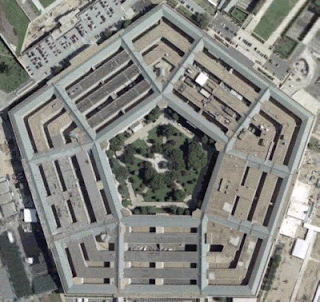
Can Trump Drink the Pentagon's Milkshake?

Base data at Global Research
People who oppose war tend to notice two things.

First: the US has by far the biggest military in the world, spends the most money, has its forces and bases and weapons and technology spread out to every corner in the world, and is engaged in conflicts -- small and large, high-profile and clandestine -- everywhere.

Second: it's very difficult to arouse the general public in the US to want to change that.

We try moral arguments. We try economic arguments. People are really not interested.

*   *   *

So: it is intriguing to see the statement in Donald Trump's inaugural address, consistent with what he said in his campaign, about pulling back militarily:

We've defended other nations' borders while refusing to defend our own and spent trillions and trillions of dollars overseas while America's infrastructure has fallen into disrepair and decay. We've made other countries rich while the wealth, strength and confidence of our country has dissipated over the horizon.

I wonder what people think when they hear that "trillions and trillions of dollars." Does that make them want to see what would happen if money was taken away from the Pentagon and used in a way that they could actually see the benefit?

Let's not quibble for a moment with whether all that US military spending has really been directed at "defending other nations' borders." The immediate question for me is whether anyone -- Donald Trump or anyone else -- has the power to make any significant changes to the defense spending or any other aspect of the defense establishment in this country.

I'll be blunt: for the past eight years, we've seen what happens under the command of a nice, respectful person. Maybe we need to what a mean, disrespectful person can do.

I fully expect the defense establishment to seek to crush Trump if/when he attempts to make any changes. I frankly don't know how someone in his position manages to survive. And yet . . . .

Trump sent a signal with the bit about the F-35 spending. Of course, that was all theater. But I think the point we should not miss is that he does have a lot of support from people "out there" -- and the F-35 gambit was part of shoring up support as the buildup to something bigger.

A lot of us cringe at the "us vs. them" narrative, and the "disrepair and decay" narrative, and the "wealth = strength and confidence" narrative.  Although, to be honest, many of us have tried variations on these narratives -- we just found that they didn't work. So maybe what we find so cringe-worthy is that someone else has actually tweaked them into utility.


The Art of the Deal?

Make no mistake, Donald Trump isn't going to embark on a negative -- taking money away from the military -- without leveraging it into a much bigger positive:

We will build new roads and highways and bridges and airports and tunnels and railways all across our wonderful nation. We will get our people off of welfare and back to work rebuilding our country with American hands and American labor.

Can you spend "trillions and trillions of dollars" on that? You bet you can.

If Donald Trump knows one thing, it is that when you embark on building stuff, it creates a lot of jobs for ordinary people, and that money enters the local economy in a way that has a big multiplier effect.

I keep remembering John Maynard Keynes saying something to the effect that, if you can't think of anything better to do, just have people dig a hole and then fill it up again. And we've got a lot better things to do than dig holes.

Vision for a nationwide rail system
(See An Infrastructural Alternative to Military Spending)
Just a few weeks ago, I wrote a piece about how, if we hope to move towards a world beyond war, we need to shift our infrastructure spending -- to something like a national high-speed rail network. I didn't take quite the same tack as Donald Trump. But what if his approach gets us to the same place?

Sure, the Republican establishment won't be thrilled with this kind of Rooseveltesque program. (Oh wait -- that's right -- the Republican establishment didn't elect Donald Trump.)

It becomes a lot harder for the military establishment to crush you when people are feeling really, really hopeful about what your infrastructure development plan is going to mean for them and their communities.

A clue to how important this is to Donald Trump, and what his strategy is, may lie in his appointment of Elaine Chao as Transportation Secretary. (How is this picture not like the others . . . ?)


Last week I wrote about what might possibly be motivating Donald Trump to cut nuclear weapons. (Hint: think about where hotels go.) When it comes to trading military bases abroad for urban transit hubs in the US, maybe we should ask the same question. Need a hotel with that, fella?


Please share this post . . . .

Monday, December 12, 2016

An Infrastructural Alternative to Military Spending

The Trump victory has drawn attention to large parts of the US that feel left behind. Maybe the military-industrial complex was never really designed with their interests in mind . . .

As we consider how we can move towards a world beyond war, it is obvious that one key is to change the way we are investing our money:

In a world beyond war, it will no longer make sense to be in possession of massive amounts of infrastructure for carrying out war.

Although this axiom seems obvious, several factors make its application challenging. Some of those factors are general, and some are particular to the US, so important because of the degree to which it leads the world in military spending.


The circularity of military infrastructure spending

I think everyone can agree on the fact that, to some extent, military spending is not just a consequence of war, but also an instigator of it. Conversely, to the degree that war is going to go away, that going away can be hastened by an early decrease in military spending.

Prepare . . .
Yes, George Washington saddled the US (and the world) with one of history's most unfortunate bon mots: "If you want peace, prepare for war." It's a statement that is tedious to try to refute, but only because of its delightful symmetry (and its source). It just doesn't happen to be true.

Or at least: even if it was true once, that doesn't make it true for all time . . . .

For it is self-evident that there will be a moment when the market realizes that arms are out and something else is in -- much as the market is currently figuring out that fossil fuels are out and alternative energy sources are in. When that moment comes, profit trumps bon mots, and the paradigm change goes from being hesitant to being an avalanche.

This is especially true if the "something else" has a strong international/commercial emphasis. (Think tourists, not troop ships.)

"If you want prosperity, you need to be open for business."


The electoral stranglehold

The peculiar nature of US public spending is that it must be authorized by a Congress that takes its shape from our peculiar electoral system.

Without working out here the logical steps -- you can do this for yourself, at your leisure -- the fact is that electability at the congressional level is a function of the ability to bring dollars to the district from the federal budget, and the one sure instrument of nationwide distribution is military spending. No one gets to stay in Congress if they don't bring home the bacon. (See, for instance, "Congress’s Deep Hypocrisy on Defense Spending," Bonnie Kristian in TIME, March 17, 2016.)


Military bases in the continental US. (Militarybases.com)

Bases, defense labs, military contracting, military academies and colleges, and recruitment - they all add to the tab. The money is spread across the country according to a very logical calculus.

I don't think we're going to change the congressional system any time soon. But can we give members of Congress some different bacon to bring home?


A grand bargain

Everyone knows that domestic infrastructure in the US is in a woeful state. It should be possible to make a trade-off: cut spending on military, increase spending on infrastructure.

In my view, the problem with that proposition is that it is not enough of a sure thing. In other words, it's not enough to say, "We'll put together a list of bridges to fix and be assured that sooner or later we'll get around to your district." No, there needs to be a comprehensive project, such that at the very moment a given politician signs away the benefits of military spending in his/her district, the alternative spending gets delivered.


Vision for a nationwide rail system (US High Speed Rail Association)


An example of such a comprehensive system is a national rail system. Pictured above is a vision supplied by the US High Speed Rail Association. To become interested in the possibilities of such a system, it is necessary only to look into the rail maps of Europe or China.

The jobs and other opportunities created in districts throughout the US by all the primary, secondary, and tertiary lines in such a rail system would provide enormous incentive to move spending from military uses to civilian uses. And perhaps as people got a taste of the benefits that spending could provide nearby they would see the desirability of moving the money from far-flung foreign bases, as well.


What I have sketched out here is not intended to specify "the" answer; I put forward rail development by way of example. What I do hope is that this helps frame the problem for successful solving: a very different way of investing for national prosperity will become obvious the nearer we get to a war-abolition environment, and our task is to make it obvious sooner.

See also ...

IT'S A LOCK: Why the US Can't Break Its Addiction to War
What Will "Strategic" Mean in Our Children's Lifetime?
Cutting Defense: Are We STUCK?


Related posts

There is a growing movement of people focused on the "world beyond war." To many of these people, the question is not "if" but "when?" They share a conviction that the world will get there, and they see that it makes a difference how quickly (and in what manner) the world gets there.

(See WAR: Headed for the junkheap, yes . . . but how quickly?)


Adopting a "world beyond war" frame -- saying "war is going away; the question for me is how fast" -- implies optimism-realism, outcome orientation, and humility.

(See The Mind of the "World Beyond War" Activist)


It seems very hard to imagine having arrived at the world beyond war without the hand-in-hand changes in education, infrastructure investment, and the way society decides on communal action in the face of conflict.

(See Where to Put Effort for a World Beyond War)