Showing posts with label drone. Show all posts

Friday, January 6, 2017

Connect the Dots: Obama Drones Threat Capital Inequality

By perpetuating the idea that we live under threat of terrorism, and that drones are the answer, Obama has guaranteed the economic inequality engine will continue to function unimpeded for a very long time to come . . . .


"Obama's embrace of drone strikes will be a lasting legacy."
(Graphic: @pariewolf)


Barack Obama is scheduled to give his farewell speech in Chicago on January 10, 2017.

Over the past six years, I have written again and again about the expansion of drone killings under Obama. The graphic above reminded me that I should not let the occasion of Obama's "legacy" speech pass without saying what his real legacy will be.

As Mark Landler explained in The New York Times this past summer, Obama's legacy really does seem to be the use of military force by the US around the world in an uninterrupted way, while still operating beneath the notice of the vast majority of US people.

The use of drones perfectly encapsulates the Obama legacy: as long as you keep boots off the ground, you can assert US military power anywhere and everywhere without alarming the public. If a few spoilsports object, you can point out that drones are limited, cost-effective, high-tech. (And did we mention there are no boots on the ground?)

As someone who has called written about this phenomenon as "permawar" . . . and worked with drone warfare opponents throughout the country . . . and even tried revoking Obama's Nobel Prize . . . I enjoy a kind of satisfaction in seeing other voices affirm my reading of the situation.

 . . . HOWEVER . . .

I've come to the conclusion that it is not enough to simply protest drone warfare.

We need to connect the dots between this new way of war and the economic crisis that has brought Donald Trump to power.


Inequality: "Where's Mine?"

WHERE'S MINE? Inequality in the US
and the Military-Industrial Complex
About a year ago, I took a stab at connecting the problem of inequality in the US to the problem of military spending and war.

I shared data on the real extent of economic inequality in the US, and noted that this information is widely available. "I'm wondering when people are going to decide to do something about it," I wrote, "and when they're going to begin to ask about the connections between inequality and the military-industrial complex."

I think we got the answer to the first half of my query with the election of Donald Trump.


How US Military Spending Contributes to Economic Inequality

US government spending:
military vs "all other"
(More details here.)
To many of us, it seems obvious that the connection between the enormous levels of US military spending and economic inequality is that tax money is used for war instead of to make the lives of people in the US better. ("Money for jobs and education, not for war and occupation.")

As a very loyal but honest critic of the antiwar movement has said, "We just can't seem to get any traction with the money argument for opposing war."

We're not getting traction with the simple argument -- "Stop spending so much money!" -- and we're also not getting traction with the more sweeping argument that takes the form of a critique of "Neoliberalism."

In my opinion, the former argument fails because it is too simplistic: it's just too difficult for people to detach their idea of today's military spending from the idea of the "Good War" and the "arsenal of democracy" -- the notion of "security" validated for them by WWII. They know just enough about today's regional conflicts and militant activities -- i.e. the warlike ways of "those people" and their resort to "terrorism," but nothing about the role of the US and other countries in fomenting same -- to reinforce the idea that military spending is unavoidable. In-district military spending (jobs) seals the deal.

(Put another way: Eisenhower's warning about the military-industrial complex is too abstract to be helpful.)

The latter argument -- the critique of Neoliberalism -- is, in contrast, too wide-ranging and diffuse. At its core, it plays into exactly the psychology that perpetuates inequality, even in the face of grotesque inequities: people hear "freedom of opportunity" and they imagine it means "freedom of opportunity" for ordinary people. They imagine themselves, and people like themselves, getting a break.

No, we need a different argument.

Ideally, something with a conspiratorial edge to it.


Stacking the Deck

In my "Where's Mine?" post, I alluded to the work of Thomas Piketty. But it wasn't until I read Joseph Stiglitz's gloss on Piketty in his book The Great Divide that I was able to connect the dots.

Stiglitz explains that what Piketty is pointing out is that the 1% keeps getting richer and richer because something's out of whack. The wealth that they invest is able to keep earning super high returns, despite the normal expectation that, at some point, returns weaken. In particular, they have the ability to keep pumping money into emerging, high-growth economies, which will pay a higher return on capital, compared to older, low-growth, stable economies (read: the US).
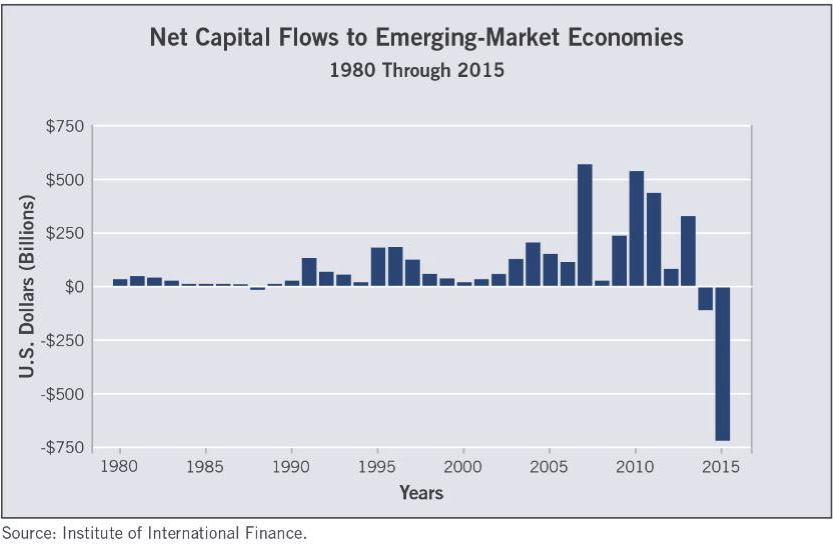

Net Capital Flows to Emerging-Market Economies (1980-2015)
(Source: Advisor Perspectives)


(As the graph above shows, the past few years have seen phenomenally high levels of capital flow into emerging markets.)

Stiglitz says this can't go on indefinitely, but by the time it peters out, there is likely to be extreme inequality globally -- i.e. much worse than there is now.

What Stiglitz doesn't explain is this: what has prevented the market from correcting this situation?

In particular, I wondered about the risk of investing in those emerging markets. Having spent a large part of my career doing business in China (and other parts of Asia), I have always been very focused on the degree to which investments are put at risk by the absence of good information in those societies. (It has often seemed to me that there is a bubble in China, supported by perception that the overall market is growing so fast that the inability to monitor the true performance of individual investments is a minor concern.)

Stiglitz gives a clue that we should be looking in a different direction. He invites us to think about "rents." This refers to the idea of sources of assured returns -- think of an oil well or music royalties -- where the underlying asset is not involved in a complicated, risky operation like manufacturing or providing a service.

I think the answer to how the rate of return on capital all around the world can continue to remain high, despite the expectations of market theory, is that capital is able, in effect, to find unnatural ways to shield it from risk in those "other" countries. The returns are more like "rents" than they are like "dividends."

Moreover, I think the most important "unnatural way" involves the threat of military force to protect capital -- i.e. the investments of the 1% from the US (and the rest of the West).


"America's most elite troops deployed to 138 nations in 2016 . . . ."
(Source: Nick Turse in Truthout)


Conveniently, Nick Turse just published a piece with the updated map above of elite troops deployments and US military installations around the world.

To complete the picture, all you need to do is think about the fact that the places in-between are all covered (or coverable) by drone flights.

This picture is not keeping the world safe for democracy; it's keeping the world safe for capital.


Really?

As someone who has grown up in the US, it is not automatically possible for me to understand that the presence of US military forces around the world necessarily translates into the message: "No US financial losses allowed here." Do people in foreign countries really think that accepting US investment means they have to guarantee the returns of those US people? Shouldn't foreign investors have to face normal financial risk, just like everyone else?

By coincidence, I noticed a reference the other day by Howard Zinn to "Instances of Use of United States Armed Forces Abroad." A few of the examples Zinn cites:

1853-1854 - Japan. Commodore Matthew C. Perry and his naval expedition made a display of force leading to the “opening of Japan."

1859 - China. July 3 I to August 2. A naval force landed to protect American interests in Shanghai.

1860 - Angola, Portuguese West Africa. March I . American residents at Kissembo called upon American and British ships to protect lives and property during problems with natives.

1893 - Hawaii. January 16 to April 1. Marines were landed ostensibly to protect American lives and property, but many believed actually to promote a provisional government under Sanford B. Dole. This action was disavowed by the United States.

And the list continues . . .

1912 - Honduras. A small force landed to prevent seizure by the government of an American-owned railroad at Puerto Cortez. The forces were withdrawn after the United States disapproved the action.

1917-1922 - Cuba. U.S. forces protected American interests during an insurrection and subsequent unsettled conditions. . . .

1922 - Turkey. September and October. A landing force was sent ashore with consent of both Greek and Turkish authorities to protect American lives and property when the Turkish Nationalists entered Smyrna.

1965 - Dominican Republic. The United States intervened to protect lives and property during a Dominican revolt and sent more troops as fears grew that the revolutionary forces were coming increasingly under Communist control.

1988 Panama. In mid-March and April 1988, during a period of instability in Panama and as pressure grew for Panamanian military leader General Manuel Noriega to resign, the United States sent 1 ,000 troops to Panama, to “further safeguard the canal, U.S. lives, property and interests in the area.” The forces supplemented 1 0,000 U.S. military personnel already in Panama.

Don't take it from me. The official US history says that the US military intervenes again and again and again to protect US capital. ("Instances of Use of United States Armed Forces Abroad, 1798-2015" by the Congressional Record Service.) And that doesn't include CIA operations (e.g. 1953: Iraq, oil; 1961, Cuba; 1980s: Central America) or much of the post-WWII intervention in the name of "fighting Communism" (Korea, Vietnam, Laos, Cambodia), "humanitarian" purposes, or for fighting "terrorism" (Afghanistan, Pakistan, Somalia, Yemen) and "weapons of mass destruction" (2013: Iraq, oil).

Its easy to see why countries around the world understand that using the capital proffered from the US comes with a proviso: "You will guarantee that this cash injection brings nothing but upside. We expect rents in perpetuity."


Connecting the Dots: Obama - Drones - Threat - Capital - Inequality

I propose that the global movement against war should celebrate the departure of Barack Obama.

We should seize upon the recognition that the economic inequality that vast numbers of people in the US are angry about stems directly from the way the US military is used. (Including, in its newest form, the move toward drone warfare.)

If We the People have any gumption, we will see that the very reason we are becoming more and more impoverished, while the super-rich get richer and richer, is that our taxes are being used to stack the deck for the rich.

That giant sucking sound? It's the investment dollars that we need to refresh our productive economy fleeing to "rents" in distant parts of the world. And OUR tax dollars are paying for the military that guarantees the economic inequality engine will continue to function unimpeded for a very long time to come.


Please share this post . . .

Thursday, May 5, 2016

The Truth About Drones (*NOT* APPROVED by the US Air Force)


National Bird screened this week in Berkeley. It gives first hand accounts of the way the US drone program ruins the lives of drone operators, undermines any real attempt to "defend" the US, and -- most of all -- massacres innocents.


More on
Drone Pilots Speaking Out
National Bird contrasts the "excitement and glory" of Air Force and Army recruiting with the reality people face when they enlist and serve in the US military.

Young people toying with the idea of becoming a drone operator will drop it like a hot potato after seeing what it's done to others. "The drone program gives people PTSD [post-traumatic stress disorder]," says a former operator in the film, against the background of her attempt to get the VA (Veterans Administration) to acknowledge her condition. "What's so surprising about that?"

Another participant in the drone program -- someone who appears again and again as calm, cool, and collected on screen -- talks in the film about his suicidal ideation. Yikes.

Can't they put it behind them? Yet another former participant in the drone program, who came in person to participate in the discussion period following the screening, put it this way: "Once you're in the drone program, there's no escape."

No wonder more and more former drone operators are speaking out . . . .


U.S. "Precision Strikes" in a Nutshell
National Bird also sums up why the officer class has become more and more skeptical about drones.

All you have to do is watch the film's clip of Gen. Stanley McChrystal going on national TV in Afghanistan to apologize for the February 21, 2010, massacre of innocent Afghans to understand why no being an officer in the US military is becoming a fool's errand.  (In an appearance at a book talk in San Francisco, McChrystal offers the understatement of the year: the drone program needs to do a better job of "not generating ill-will.")

What happens when large numbers of people decide it just isn't a good idea to become an officer because the technology and systems and approaches and policies of the US "defense" establishment are programming massive blowback into everything the military does?


Drone Victims: Just Dots? Just Dirt?
National Bird is dedicated to the people killed in the February 21, 2010, massacre, and it is the recounting of that event that is the most difficult part of the film to watch.

This film is essential watching for anyone who still thinks US air strikes kill "bad guys."


"I lost part of my humanity working in the drone program," says one of the operators profiled in National Bird. She's got company: the drone program is being carried out in the name of everyone in the US; losing our humanity has become a national condition.


Related posts

Leveling Up is the creative work that demonstrates just how thoroughly America's new ways of warfare have become intertwined with the other dominant strands in our culture.

(See Level Up, Step Up, Grow Up, Man Up . . . Wake Up)


Anyone who cares about stopping drone killing should take a friend and go see Good Kill, and then do it again, and again.

(See GOOD KILL: Struggling to Bring the Truth of Drone Killing Out of the Shadows )


Grounded raises tough questions. I was hoping that the play would challenge the idea that killing people with drones is good. It's a reflection of the seriousness of this work that that is just one of the issues it raises; others include our society's willingness to destroy the people who we employ to "serve" ("serve our country," serve us in general), our culture's worship of violence / use of force, and the consequences of pervasive surveillance.

(See Why GROUNDED Is Soaring: Putting Drone Dilemmas In Your Face )

Thursday, December 4, 2014

7 Ways the Ugly Facts About Drones Are Hidden in Plain Site in UNMANNED

Drone Pilots: Recipe for disaster
Drones.

The damage they do extends to the very people operating those drones. 

The "kill chain" includes a lot more than just uniformed military. 

They're the leading edge of the ubiquitous surveillance in American society.

Now someone's put it all together in a work of popular fiction.

Unmanned is a recent novel by Dan Fesperman, and it focuses on drones. When I first saw it, I thought, "Is this going to glorify what the U.S. government is doing with drones?" But from the first page, it was clear that (a) Fesperman knows what's really going on with drones; and (b) he's not afraid to lay it on the line.

The book opens with a drone strike that kills several children, and Fesperman zeroes right in on what it means for the drone pilot:

"Already he feels the moment taking root in a fallow corner of his imagination -- a seed of torment, a nascent preoccupation." (Unmanned, p. 4)

Unmanned by Dan Fesperman
And Unmanned takes off from there.

There were so many places in this book where I thought, "Holy mackerel - he knows about that? It's as if he was part of the same anti-drone movement that I've been so deeply involved in for the past several years!" 

And then I thought, "Is it possible that ordinary people reading this book will just 'blip' right over all of these facts? Will they think what this book is revealing is just science fiction?"

I think Unmanned is provides an extremely valuable opportunity for us -- if we can get lots of people reading and talking about this book, and if we can get people to take seriously what's described there -- to realize that it is fact, not fantasy.

A novel is a tremendous way to reach a mass audience.

It's time to encourage a base of fans for Unmanned. (And for the sequel to Unmanned. Oh yeah -- it's coming!) We need to use all the tools at our disposal -- blogs, wikis, Facebook, Twitter, and more -- to get people talking about the shocking facts that are right there in black and white in this highly readable book.

Here are a just few footnotes to kick the project off.  Please help build this conversation with further comments about Unmanned on this blog post and elsewhere!


(1) - p. "Creech Air Force Base, a bustling little place tucked against barren mountains, a mere forty miles from Vegas."

(2) - p. 57 and throughout - contractor IntelPro - a subtle reference to a hallowed tradition of surveillance and repression of dissent in the U.S.: COINTELPRO

(3) - p. "Because if you're not acting officially, then who needs a warrant? . . . read the PATRIOT act."

(4) - p. 164 "One of probably at least a hundred worldwide chapters of a bunch of tinkerers and geeks known as DIY Drones."

(5) - p. 174 "Right now the FAA is choosing six nationwide test sites."

(6) - p.190 " . . . the Global Hawk drone that crashed near Salisbury, Maryland, just a few months ago."

(7) - p. 234 "He set the drone on the coffee table, and they couldn't help but stare at it. Smaller than a butterfly, or even a hummingbird."


TAKE ACTION:


* Read Unmanned

* Add comments to this post and others to 
encourage discussion of Unmanned.

* Introduce Unmanned to a book club or 
activist group where you live.


Related posts

Hmmmm . . . it seems like the facts are right there in the open. Do people think they are exaggerated?  Or are they too wrapped up in the man-to-man intrigue (watch out Jack! he's coming up behind you!) to be troubled by the real "clear and present danger"?

(See THE UGLY FACTS IN "RED OCTOBER": And You Thought the Nuclear Threat Was Hush-Hush )


Re-reading George Orwell's 1984 recently made me see at least 15 ways 2013 is like the world he describes in the book . . . .

(See 2013 = 1984 ? )


Eventually, in large part due to Harriet Beecher Stowe's novel, Uncle Tom's Cabin, the United States was converted from a country in which a small number of people thought slavery needed to be ended into a country determined to act to end slavery. This literary work took the movement wide, and it took it deep.

Why is a novel an important tool for creative resistance?


(See Creative Resistance 101: Uncle Tom's Cabin )


A big Hollywood production of Ender's Game is scheduled for release on November 1. It's a perfect opportunity for us to ask: Are we happy seeing our schools turned into "Battle Schools"?

(See "Ender's Game" and the Militarization of Youth: Can We Talk About This? )

Monday, October 13, 2014

DRONES: Build a Foundation for Our 3-D Future


The future is now
"French high-tech venture Parrot's Japanese PR staff demonstrate a
mini-drone 'Rolling Spider,' equipped with four propellers, a camera
and detachable wheel protector in Tokyo on August 12, 2014."
(Photo: AFP-Yoshikazu Tsuno on Al-Akhbar English)


This week, audiences in Chicago and around the country will be able to see Autómata, a film about a future society in which there are explicit rules about what robots are and are not permitted to do -- and what happens when the rules get broken.

The current decade may well be remembered "The Decade of the Drones," because of the way unmanned aerial vehicals (UAVs, or "drones") have come to dominate the public discourse on national defense and domestic security, as well as beginning to dominate the imagination of university researchers and business innovators and anyone else who likes to ask, "What if . . . ?"


No Drones Network

"Make the drone killing 100% visible."
Several years ago, I began working with activists around the country to lift up the work being done to contest the current U.S. policy of killing with armed drones. There are groups of people working on this problem in nearly every state in the country, and there are websites that help the public learn more and get involved.  People can get a birds-eye view of what's going on at the central No Drones Network site.

People working in the network were able to share strategy and tactics . . . but also some very fundamental realizations.  Perhaps the most fundamental was recognizing that, at the level of phenomenology, something very significant was happening when drones were used to injure people.  For a variety of reasons, the injuries tended to be rendered 100% invisible to the general public. The response that we needed to make as activists was clear: "Make the drone killing 100% visible."

For my own part, I started thinking and writing extensively about this difficult issue. In particular, I began to focus on how drone use had come to undermine the idea that active popular consent is a prerequisite for acts of war -- and, more broadly, for government action of all kinds. (See more links to my posts about drones.)


The Snowden Reset

The major development of 2013 was the set of revelations by Edward Snowden and realization that we have a massive surveillance problem in the U.S.

Wherever you go, whatever you do, whoever you are
YOU ARE UNDER SURVEILLANCE
Department of Homeland Security
What this meant for the public discourse on drones was that two large categories of concern came to be discussed together: concern about violence and concern about surveillance.

There had long been groups working to oppose drone surveillance in the U.S., focusing on the problem of local law enforcement use of drones. Now it became clear that everyone who was concerned about one particular aspect of the drone problem -- e.g. opponents of drone killing -- needed to make common cause with those concerned primarily with other aspects (such as surveillance).

This encouraged a lot of us to connect the dots between the use of military and police force, surveillance, and broader systems of oppression.

Moreover, this development encouraged us all to become much more attuned to unseen possibilities and risks associated with drones.  Of course, it is obvious that physical injury to innocent people is deplorable; but now we started to think more deeply about the effects of drones and drone use that are not so obvious.

How are drones changing us in ways that we aren't even thinking about?


I, Robot

At the same time, we began to see more and more talk of "good uses of drones." The watershed moment was probably the announcement by Amazon that they hoped to deliver packages via drone.  That particular idea may not have been ready for prime time, but it captured people's imaginations.

Of course, when you scratched the surface you found that drone research is going on in a large number of universities.


September, 2014: Drones-eye view of protests in Hong Kong


And now, just in recent days and weeks, I've noticed more and more mainstreaming of talk of use of drones:

September 30, 2014 - "Hong Kong protests: Mesmerising drone footage shows scale of pro-democracy demonstrations " by Lizzie Dearden in The Independent. "Swooping over the Admiralty district, where demonstrations are focused around the Government headquarters, the drone captured images of protesters milling around, distributing food and making signs on Monday."

October 2, 2014 - "Drones vs. Kidneys: Google Autofill on the Economy" by Conor Dougherty in The New York Times. "Mr. Colas has been tracking Google autofill data for a while, and for most of the last three years the top three positions for completing the query, 'I want to buy…' have been won by 'a house,' 'a car' and 'stock.' . . . Last quarter, the top spot went to 'a drone'"

October 5, 2014 - "Regulation Clips Wings of U.S. Drone Makers: FAA Ban, Export Controls Weigh Down American Entrepreneurs, Even as Foreign Rivals Fly High" by Jack Nicas in The Wall Street Journal. "Outside the U.S., relatively accommodating policies have fueled a commercial-drone boom."

October 8, 2014 - "State Farm considering use of drones" by Becky Yerack in the Chicago Tribune. "Property and casualty insurers play a major role in funding the restoration of businesses and communities after major incidents, and the integration of unmanned aircraft into USAA's operations will have immediate, positive effects on the lives of Americans and the business community."

It's hard to argue with. Don't we all want -- at least a little bit -- to be freed from our earthbound existence and start to live a truly 3-D existence?

That's why I think it is particularly important to, once again, ask, "What are the unseen possibilities and risks associated with drones?"

Isaac Asimov proposed "Three Laws of Robotics"
One way to do this is to involve more people -- including the work of thinkers who are no longer living -- that are good at imagining the future and considering previously unimagined possibilities. For instance, Isaac Asimov delved in detail into the need to establish rules -- he called them the "Three Laws of Robotics" -- if we are to be able to safely use machines like drones and robots. In his 1979 essay, "The Robot As Enemy," Isaac Asimov wrote, "Will human beings deliberately build robots without the Laws? I'm afraid that is a distinct possibility . . . " (p. 448). He specifically foresaw the exact developments in the robotization of the military that we are seeing today:
"computerized planes, tanks, artillery, and so on, that would stalk the enemy relentlessly, with superhuman senses and stamina. It might be argued that this would be a way of sparing human beings. We could stay comfortably at home and let our intelligent machines do the fighting for us. If some of them were destroyed -- well, they are only machines. This approach to warfare would be particularly useful if we had such machines and the enemy didn't." (p. 449)
In the end, however, Asimov concludes: "No, I feel confident that attempts to use robots without safeguards won't work and that, in the end, we will come round to the Three Laws."


A lot of people are excited about drones. 
They're enthusiastic about "good" uses, and 
inclined to say "We'll sort out any problems later." 
But "later" is fast upon us.
  
Let's lay the foundation in advance for
what is shaping up to be a 3-D future.


9 More Ideas You Won't Hear

at Chicago Ideas Week . . .


Related posts

I'm marveling at the adjacency of a piece of public art -- one with a very clear message about the risk of human ambition and self-absorption and heedlessness -- to the center of political power in the city of Chicago.

(See NUCLEAR WEAPONS: Who will bring us down to earth? )


In my opinion, the reason to focus on drones is this: when we focus on drones, the general public is able to "get," to an unusual extent, the degree to which popular consent has been banished from the process of carrying out state violence. (Sure, it was banished long ago, but the absence of a human in the cockpit of a drone suddenly makes a light bulb go off in people's heads.) It takes some prodding, but people can sense that drone use somehow crosses a line. And that opens up the discussion about how our consent has been eliminated from the vast range of US militarism.

(See "Why focus on drone attacks?")


Beyond recognizing the inherent contradictions of "pre-emptive violence," we must confront an urgent problem related to technology: the automation of "pre-emptive violence" -- e.g. via drone technology -- is leading to a spiral (or "loop" or "recursive process") that we may not be able to get out of.

(See When "Pre-emptive Violence" Is Automated ....)


The Futurists loved airplanes, and other fast machines. Considering how we, in the U.S. today have been seduced by drones and drone warfare, we would perhaps do well to reflect on why people find these things so appealing.

(See A Future Inspired by Kinetics? )

Tuesday, September 16, 2014

U.S. "Precision Strikes" in a Nutshell

Signe Wilkinson's latest cartoon for the Philadelphia Daily News is brilliant:


Cartoon by Signe Wilkinson


It depicts a U.S. warplane (or drone) coming in for the attack, with the Barack Obama at the controls, saying, "Target is in sight!"

The only problem is that the "target" is really multiple targets:

* good terrorist
* bad terrorist
* despicable terrorist

. . . as well as . . . 

* lives near a terrorist

. . . and . . . 

* deciding whether to be a terrorist

In other words, pretty much anybody and everybody gets lumped together with "terrorists"; the vaunted "precision" of U.S. military strikes isn't precise at all.

And if those people on the ground weren't our enemies before the Hellfire missile strikes, you can be sure they will be afterwards.

My only quibble with this cartoon is that instead of depicting Obama in the driver's seat, it should make it clear that the warplane is controlled by "Americans." ('Cause we all get to share in the responsibility, the blame, and the consequences of our government's killing spree in the Mideast.)


Related posts


The U.S. has a modus operandi for conducting military strikes while slipping past any genuine public accountability. It's worth a look at the Tuesday, October 29, 2013, New York Times account of a drone strike in Somalia the previous day: "Pentagon Says Shabab Bomb Specialist Is Killed in Missile Strike in Somalia." It's a case study in what's wrong with the U.S. drone wars.

(See October 28 in Somalia: Another Day, Another Drone Killing)


A September 5, 2013, U.S. drone strike in Pakistan killed six people - including Sangeen Zadran -- a "senior militant commander" who was "implicated in a long-running kidnapping drama involving an American soldier."

(See September 5 in Pakistan: Another Day, Another Drone Killing)


The press announced a flurry of drone killings in Yemen over the April 19/20 weekend -- that is, while the rest of us were observing Easter -- and just as with U.S. drone killings in Pakistan and Somalia, the U.S. modus operandi was on full display.

(See April 19 in Yemen: Another Day, Another Drone Killing )

Tuesday, September 9, 2014

Obama Didn't Invent Permawar. He Just Perfected It.

Tomorrow, Barack Obama will make a speech to the nation about how the United States will fight ISIS.

It will be interesting to see how a president who won election on the strength of his OPPOSITION to U.S. war in Iraq will explain . . . resuming war . . . in . . . Iraq . . . .

Tomorrow's speech is really the continuation of the speech that Obama gave in May at West Point, when he defined a brilliant new twist on an old concept.

At West Point, Obama described how the United States would, in the future, rely upon a web of collaborators to fight for it, largely in "low level," counterinsurgency-type wars.  The U.S. will provide technology, know-how, and -- critically -- funding to these "partner" countries.

It was with this speech that Barack Obama could be said to have shown his true colors. He's all about that leverage. Why settle for just one war, or two, when you can provide the seed money to keep wars going on everywhere?

Tomorrow, expect Obama to stress several points:

* Somebody else (al Qaeda, ISIS, etc., etc.) started it.
* No American "boots on the ground."
* Technology (drones) is our friend in this fight.
* Anyone else who wants to be our friend has to ante up (i.e. fight in our place).
* As the provider of funding, the U.S. has the controlling hand. We provide "leadership." We're the "Big Daddy."
* Obama and his team is keeping you -- my fellow Americans -- safe.

They're calling it the Obama Doctrine.

This all sounds so convincing that there's one thing most people will miss.

This doesn't end.


Obama: 
He didn't invent #permawar. 
He just perfected it.

Watch and share this short video
from Brave New Films:
"How Does This End?"


September 10, 2014 in Chicago - Andy Thayer introduces speakers from
8th Day Center for Justice, Anti-War Committee of Chicago, Gay Liberation
Network, No Drones Network, Veterans for Peace, Voices for Creative
Nonviolence, and World Can't Wait, all speaking against the Obama
administration's latest war escalation.
 (Audio at "Demonstrators Hold Anti-War Protest Downtown" on CBS)
 (Photo courtesy FJJ.)


"We must say NO to that!"
Joe Scarry speaking on behalf of No Drones Network, emphasizing
the need to resist being tempted by government promises of "no-risk,"
"high-tech" (and unending) violence using drones and other modern weapons.
(Photo courtesy FJJ.)

Read "On Worthier Victims" by Buddy Bell, Voices for Creative Nonviolence


Related posts


More than anyone else, the beneficiaries of permawar are the politicians who thrive on the power to make and control wars. The number one prime beneficiary is the President, as well as presidential aspirants. But it doesn't end there . . . .

(See J'ACCUSE: The Beneficiaries of Permawar )


The U.S. narrative goes something like this: Somebody "bad" (e.g. ISIS) is doing bad stuff . . . . The U.S. wants to "help" -- without overcommitting. We'll just start with a few advisers (to instruct, not to fight) and a few drones (to survey, not to kill) . . . .One thing leads to another and there's yet another fight. (Lucky we were there . . . )  Does it every occur to us that we've got the narrative (and the causality) backwards?

(See Drones, ISIS, and Permawar )


It's important to recognize that Goldman, Bloomberg, and the CME -- and ALL of the entities and individuals that profit from the "vol" -- can live with more or less taxation, or more or less regulation, or more or less business-friendly legislation. The one thing they can't live with? Peace . . . .

(See Finance's Unholy Trinity of Permawar: Goldman, Bloomberg, and the CME )


The United States is very good at starting things . . . but seldom considers three moves ahead, much less how it will all end. Drones are a case in point. Now people are starting to talk about the problem of global drone proliferation.
(See GLOBAL DRONE PROLIFERATION: How does this end? on No Drones Network)


More related links

September 15, 2014: Howard Friel, Noam Chomsky, and Edward S. Herman wrote to The New York Times: "We owe the existence of ISIS in part to the Bush administration’s 2003 invasion of Iraq, which was in violation of the [UN] charter. President Obama now seems determined to match, or exceed, the lawlessness of that decision, which, without the establishment of proper checks on the president’s war powers, is likely to be repeated by the next president, and the one after that, with perpetual war (or worse) an assured outcome." (emphasis added)

September 16, 2014: Tom Engelhardt, "Power Drain: Mysteries of the Twenty-First Century in a Helter-Skelter World" on TomDispatch.com: "Nowhere, at home or abroad, does the obvious might of the United States translate into expected results, or much of anything else except a kind of roiling chaos. On much of the planet, Latin America (but not Central America) excepted, power vacuums, power breakdowns, power drains, and fragmentation are increasingly part of everyday life. And one thing is remarkably clear: each and every application of American military power globally since 9/11 has furthered the fragmentation process, destabilizing whole regions."(emphasis added)

Friday, September 5, 2014

The Secret to Understanding the "New" U.S. "Pivot to Asia"

One of two Chinese stone lions flanking the entry to
"10 Div Ave" -- the building housing the
Harvard-Yenching Library.
When I showed up on campus for my freshman year in college about 35 years ago, I quickly glommed onto the idea of giving East Asian Studies a try.

There were many reasons this seemed like a good idea.  Just a few of them:

* The U.S. had just withdrawn from Vietnam. I had grown up on a daily diet of news reports of the war. It seemed obvious to me that we had a lot to gain by approaching Asia from the standpoint of knowledge rather than that of belligerence.

* Mao Zedong had recently died, but not before initiating the opening to the U.S. In 1977, there was a feeling of great imminence about China.

* The idea of learning the Chinese and/or Japanese languages -- so recondite (at least to Westerners) -- was irresistible.

* When would I ever have the chance to take a deep dive into the unknown -- such as this -- again?

And so I dove in . . . .

Big Gulp

The organizing principle for the field of East Asian Studies was to get us students to focus on one or both of two major cultural areas -- China and Japan -- and (with luck) to wean us from some of our U.S- and Euro-centrism. The thinking was that these two "areas" -- China and Japan -- each provided an enormous body of new information for students to try to get navigate.

China's Response to the West:
A Documentary Survey 1839-1923

by Ssu-yu Teng and John K. Fairbank
In general, WWII experience was de-emphasized, though it might seem to be one of the nearest at hand to explore.  I think the concern was to avoid getting sucked in to the gravitational field of what Americans already thought they had figured out about that experience.

The trope of "the response to the West" by Japan or China was, in general, substituted for what frequently seemed to be our natural reflex: talking about "the U.S. experience in (fill in the blank)."

I'd like to say that I had a vague sense that something was missing, or not quite right about this framework. But the truth is that I was swimming in so much new information that it was all I could do to keep my head above water.

I noticed that certain topics -- such as Korea, or Vietnam, or the Philippines -- were not given much attention. Everyone I knew carried around mental lists of things they wanted to learn more about . . . someday . . . when they had whittled away further at their must-do list of characters to memorize and books to read and courses to take and trips to make.

In my senior year, for instance, I dove with great gusto into the John Fairbanks' Ch'ing Documents: An Introductory Syllabus, on the theory that it was essential that I be able to read court documents from the 19th century (in Chinese, in the formal bureaucratic lingo) in order to fully appreciate "China's response to the West."

The Missing "Area"

I have never stopped taking runs at getting my arms around "East Asian Studies." It seems that as I grow older, I run out of steam faster and faster.

But as I get older, I also seem to be more willing to challenge orthodoxy.

Emperor Hirohito: Coronation photo
I've been doing some reading which has been very provocative in light of my concerns about problems of war and peace. After books about the bombing of Hiroshima; dissidents in contemporary Japan; the maneuvering around Japan's August 15, 1945 surrender decision; and one about the discourse around race in Japan and the U.S. during WWII, I continued on to read Hirohito and the Making of Modern Japan by Herbert P. Bix. It was here that all the pieces seemed to come together for me.

The Bix book conveys the sense, through the eyes of Hirohito and others, of the increasing frequency with which developments were converging on that part of the world with each passing decade of the 20th century. Bix is centrally concerned with the responsibility of Hirohito for the war. Part of that involves seeing how deeply involved he was in understanding the activities, capabilities, and intentions of England, the U.S., Russia, and other countries as they related to the widespread geography of the Pacific region.

I felt challenged to see what people in Asia (and others) have seen for the past century: something is happening in the Pacific, and it's being driven in part by advances in naval (and, subsequently, aviation and electronics) technology, and in part by powerful nations (principally, but not limited to, the U.S.) proximate to the area.

It occurred to me that we can say there is a third "area" -- of equal importance relative to "China" and "Japan" -- that is the proper third leg of "East Asian Studies." That area is "the Pacific (as a field for empire in light of post-19th century technology)."

Clearly, this has a lot to do with the U.S. and its imperialism. But it also invites us to go beyond just seeing the U.S. as only factor at work in this area.

We've all been taught that the "Aha!" moment for many late 19th century political leaders was the advent of Alfred Thayer Mahan's The Influence of Sea Power upon History. But it had never before occurred to me to view that -- as many people likely did at the time -- in light specifically of the Pacific Ocean, including its geographic and political dimensions. 

Fall Semester 2014

I'm hoping that my new "troika" approach to East Asian Studies -- China, Japan, and the imperialized Pacific -- will help me make sense of developments in that part of the world.

So here are some of the "study assignments" I've given myself for the weeks and months ahead:

* what are the pros and cons of Chinese naval development?

* how is new technology changing the face of militarism in the Pacific?

* is the Pacific more than just a patchwork of bases?

* what would it take to make the Pacific a nuclear-weapons-free zone?

* does the Pacific need a "traffic cop"?

* is the Pacific ecosystem at risk?

. . . and more . . . .

I'm thrilled -- and a little scared -- to imagine what I might discover.


Can we adopt a new perspective on Pacific affairs?


Related posts

The problem: the U.S. "pivot to Asia."

The opportunity: asking ourselves, "What would we do differently if we revised our myths of Asia?"

(See U.S. Militarism in Asia: THINK DIFFERENT!)


Just as it did in 2001, the U.S. has had another close dangerous encounter between one of its surveillance planes and a Chinese fighter in the air near the coast of China.

Like the 2001 event, it's making a lot of people ask what the hell the U.S. is doing provoking China where they live.

(See Boeing: Where There's Trouble . . . )


Strategic analysts are pointing out that the South China Sea is an area through which a vast amount of the world's trade passes.  And some of them have made the modest suggestion that it would be a good idea for the U.S. to dominate it now, in much the same it dominated the Caribbean at the turn of the 19th century.

(See SOUTH CHINA SEA: No End of American Grand Designs)


The Republic of the Marshall Islands (RMI) has filed unprecedented lawsuits against all nine nuclear-armed nations for their failure to negotiate in good faith for nuclear disarmament, as required under the Non-Proliferation Treaty. The suits were filed against all nine nations at the International Court of Justice, with an additional complaint against the United States filed in U.S. Federal District Court.

 (See Now HERE'S an "Asia Pivot" I Can Believe In! (Marshall Islands Sues Nuclear "Haves") )


Just like a family that has extra rooms in its house which inevitably become filled with stuff, the U.S. has thousands of bases -- here, there, and everywhere -- that inevitably create the "need" to spend.

(See What Will "Strategic" Mean in Our Children's Lifetime?)

Wednesday, August 27, 2014

Drones, ISIS, and Permawar


 Let's be clear: there will always be an "ISIS" out there.

The Obama administration had no sooner re-entered the Iraq War, ordering air strikes in northern Iraq against ISIS, than it announced that it "needed" to send the military into Syria.

Oh, we're not doing anything "risky" in Syria - just having a look. In other words, using spy planes and drones to get visual control over even more of the Middle East.

The U.S. narrative goes something like this:

* Somebody "bad" (e.g. ISIS) is doing bad stuff.

* The U.S. wants to "help" -- without overcommitting. We'll just start with a few advisers (to instruct, not to fight) and a few drones (to survey, not to kill).

* One thing leads to another and there's yet another fight. (Lucky we were there . . . )

Does it every occur to us that we've got the narrative (and the causality) backwards? That the truth is something like this?

* Permanent war is what suits us.

* All we need is the next excuse for more war.

* To find an excuse, we need "eyes" there. (Send in the drones.)

* Any bad actor will do as a reason for drone surveillance.

Once again, I return to the wisdom of Michel Foucault. Total surveillance is not just playing an incidental or supporting role in total state control and permanent war. Total surveillance is the infallible and essential heart of total state control and permanent war.


Related posts

In the old order of things, power places itself on display, and hopes that the population sees fit to obey. In the new order of things, power compels every member of the population to display himself or herself . . .  In the new order of things, the courts are bypassed and the instruments of discipline -- observe, classify, examine -- run rampant.

(See "Surveiller et Punir" Indeed!)


The U.S. can get more "bang for the buck" out of each pair of boots it puts on the ground, because -- through the magic of robotics -- it can back up those boots with Hellfire missiles and 500-lb. bombs. For the folks back home, it helps maintain the illusion that the U.S. isn't really intervening in a way that risks escalation. For the population of the affected areas of Iraq, it helps maintain the balance of terror -- because those armed drones are just part of a much larger fleet of drones that is patrolling the skies over Baghdad.  ("Is that drone overhead aiming . . . or just 'looking'?" From the ground, one has to assume they're all aiming . . . . )

(See Armed Drones Over Iraq: A Force Multiplier (Which Is Precisely Why They Are So Dangerous) )


The United States perpetuates a state of permanent war. The names change -- hell, sometimes they change by just a single letter -- but the result is the same. Call it "permawar."

(See #Permawar)