Showing posts with label Obama. Show all posts

Friday, January 6, 2017

Connect the Dots: Obama Drones Threat Capital Inequality

By perpetuating the idea that we live under threat of terrorism, and that drones are the answer, Obama has guaranteed the economic inequality engine will continue to function unimpeded for a very long time to come . . . .


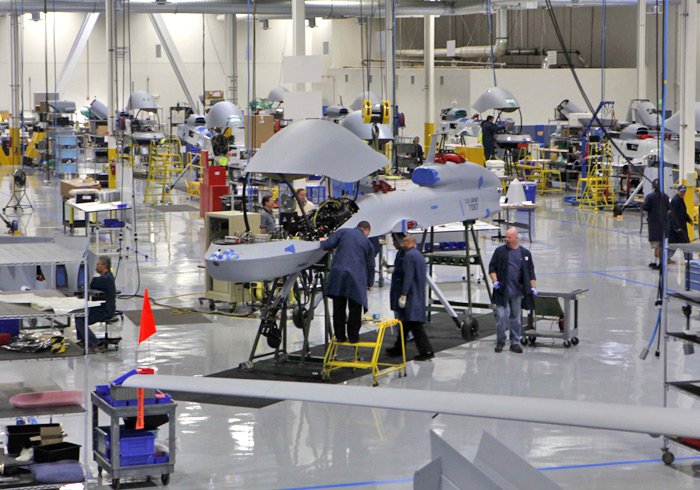
"Obama's embrace of drone strikes will be a lasting legacy."
(Graphic: @pariewolf)


Barack Obama is scheduled to give his farewell speech in Chicago on January 10, 2017.

Over the past six years, I have written again and again about the expansion of drone killings under Obama. The graphic above reminded me that I should not let the occasion of Obama's "legacy" speech pass without saying what his real legacy will be.

As Mark Landler explained in The New York Times this past summer, Obama's legacy really does seem to be the use of military force by the US around the world in an uninterrupted way, while still operating beneath the notice of the vast majority of US people.

The use of drones perfectly encapsulates the Obama legacy: as long as you keep boots off the ground, you can assert US military power anywhere and everywhere without alarming the public. If a few spoilsports object, you can point out that drones are limited, cost-effective, high-tech. (And did we mention there are no boots on the ground?)

As someone who has called written about this phenomenon as "permawar" . . . and worked with drone warfare opponents throughout the country . . . and even tried revoking Obama's Nobel Prize . . . I enjoy a kind of satisfaction in seeing other voices affirm my reading of the situation.

 . . . HOWEVER . . .

I've come to the conclusion that it is not enough to simply protest drone warfare.

We need to connect the dots between this new way of war and the economic crisis that has brought Donald Trump to power.


Inequality: "Where's Mine?"

WHERE'S MINE? Inequality in the US
and the Military-Industrial Complex
About a year ago, I took a stab at connecting the problem of inequality in the US to the problem of military spending and war.

I shared data on the real extent of economic inequality in the US, and noted that this information is widely available. "I'm wondering when people are going to decide to do something about it," I wrote, "and when they're going to begin to ask about the connections between inequality and the military-industrial complex."

I think we got the answer to the first half of my query with the election of Donald Trump.


How US Military Spending Contributes to Economic Inequality

US government spending:
military vs "all other"
(More details here.)
To many of us, it seems obvious that the connection between the enormous levels of US military spending and economic inequality is that tax money is used for war instead of to make the lives of people in the US better. ("Money for jobs and education, not for war and occupation.")

As a very loyal but honest critic of the antiwar movement has said, "We just can't seem to get any traction with the money argument for opposing war."

We're not getting traction with the simple argument -- "Stop spending so much money!" -- and we're also not getting traction with the more sweeping argument that takes the form of a critique of "Neoliberalism."

In my opinion, the former argument fails because it is too simplistic: it's just too difficult for people to detach their idea of today's military spending from the idea of the "Good War" and the "arsenal of democracy" -- the notion of "security" validated for them by WWII. They know just enough about today's regional conflicts and militant activities -- i.e. the warlike ways of "those people" and their resort to "terrorism," but nothing about the role of the US and other countries in fomenting same -- to reinforce the idea that military spending is unavoidable. In-district military spending (jobs) seals the deal.

(Put another way: Eisenhower's warning about the military-industrial complex is too abstract to be helpful.)

The latter argument -- the critique of Neoliberalism -- is, in contrast, too wide-ranging and diffuse. At its core, it plays into exactly the psychology that perpetuates inequality, even in the face of grotesque inequities: people hear "freedom of opportunity" and they imagine it means "freedom of opportunity" for ordinary people. They imagine themselves, and people like themselves, getting a break.

No, we need a different argument.

Ideally, something with a conspiratorial edge to it.


Stacking the Deck

In my "Where's Mine?" post, I alluded to the work of Thomas Piketty. But it wasn't until I read Joseph Stiglitz's gloss on Piketty in his book The Great Divide that I was able to connect the dots.

Stiglitz explains that what Piketty is pointing out is that the 1% keeps getting richer and richer because something's out of whack. The wealth that they invest is able to keep earning super high returns, despite the normal expectation that, at some point, returns weaken. In particular, they have the ability to keep pumping money into emerging, high-growth economies, which will pay a higher return on capital, compared to older, low-growth, stable economies (read: the US).
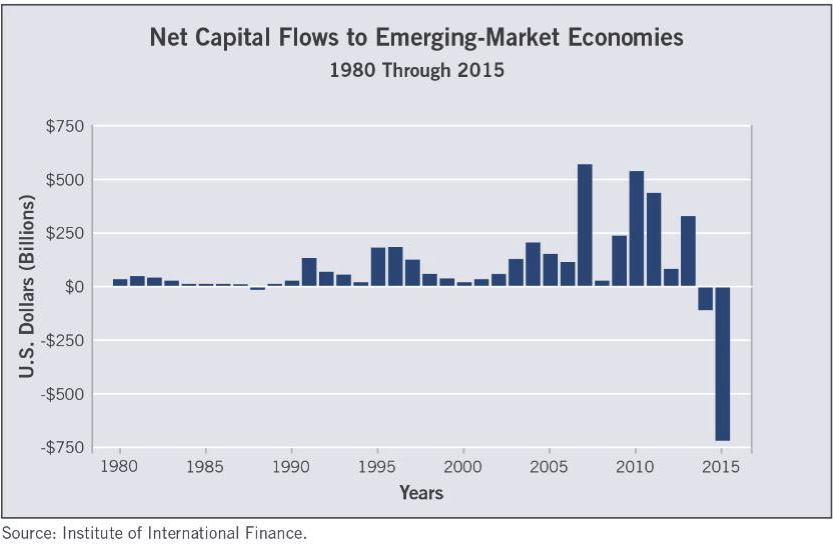

Net Capital Flows to Emerging-Market Economies (1980-2015)
(Source: Advisor Perspectives)


(As the graph above shows, the past few years have seen phenomenally high levels of capital flow into emerging markets.)

Stiglitz says this can't go on indefinitely, but by the time it peters out, there is likely to be extreme inequality globally -- i.e. much worse than there is now.

What Stiglitz doesn't explain is this: what has prevented the market from correcting this situation?

In particular, I wondered about the risk of investing in those emerging markets. Having spent a large part of my career doing business in China (and other parts of Asia), I have always been very focused on the degree to which investments are put at risk by the absence of good information in those societies. (It has often seemed to me that there is a bubble in China, supported by perception that the overall market is growing so fast that the inability to monitor the true performance of individual investments is a minor concern.)

Stiglitz gives a clue that we should be looking in a different direction. He invites us to think about "rents." This refers to the idea of sources of assured returns -- think of an oil well or music royalties -- where the underlying asset is not involved in a complicated, risky operation like manufacturing or providing a service.

I think the answer to how the rate of return on capital all around the world can continue to remain high, despite the expectations of market theory, is that capital is able, in effect, to find unnatural ways to shield it from risk in those "other" countries. The returns are more like "rents" than they are like "dividends."

Moreover, I think the most important "unnatural way" involves the threat of military force to protect capital -- i.e. the investments of the 1% from the US (and the rest of the West).


"America's most elite troops deployed to 138 nations in 2016 . . . ."
(Source: Nick Turse in Truthout)


Conveniently, Nick Turse just published a piece with the updated map above of elite troops deployments and US military installations around the world.

To complete the picture, all you need to do is think about the fact that the places in-between are all covered (or coverable) by drone flights.

This picture is not keeping the world safe for democracy; it's keeping the world safe for capital.


Really?

As someone who has grown up in the US, it is not automatically possible for me to understand that the presence of US military forces around the world necessarily translates into the message: "No US financial losses allowed here." Do people in foreign countries really think that accepting US investment means they have to guarantee the returns of those US people? Shouldn't foreign investors have to face normal financial risk, just like everyone else?

By coincidence, I noticed a reference the other day by Howard Zinn to "Instances of Use of United States Armed Forces Abroad." A few of the examples Zinn cites:

1853-1854 - Japan. Commodore Matthew C. Perry and his naval expedition made a display of force leading to the “opening of Japan."

1859 - China. July 3 I to August 2. A naval force landed to protect American interests in Shanghai.

1860 - Angola, Portuguese West Africa. March I . American residents at Kissembo called upon American and British ships to protect lives and property during problems with natives.

1893 - Hawaii. January 16 to April 1. Marines were landed ostensibly to protect American lives and property, but many believed actually to promote a provisional government under Sanford B. Dole. This action was disavowed by the United States.

And the list continues . . .

1912 - Honduras. A small force landed to prevent seizure by the government of an American-owned railroad at Puerto Cortez. The forces were withdrawn after the United States disapproved the action.

1917-1922 - Cuba. U.S. forces protected American interests during an insurrection and subsequent unsettled conditions. . . .

1922 - Turkey. September and October. A landing force was sent ashore with consent of both Greek and Turkish authorities to protect American lives and property when the Turkish Nationalists entered Smyrna.

1965 - Dominican Republic. The United States intervened to protect lives and property during a Dominican revolt and sent more troops as fears grew that the revolutionary forces were coming increasingly under Communist control.

1988 Panama. In mid-March and April 1988, during a period of instability in Panama and as pressure grew for Panamanian military leader General Manuel Noriega to resign, the United States sent 1 ,000 troops to Panama, to “further safeguard the canal, U.S. lives, property and interests in the area.” The forces supplemented 1 0,000 U.S. military personnel already in Panama.

Don't take it from me. The official US history says that the US military intervenes again and again and again to protect US capital. ("Instances of Use of United States Armed Forces Abroad, 1798-2015" by the Congressional Record Service.) And that doesn't include CIA operations (e.g. 1953: Iraq, oil; 1961, Cuba; 1980s: Central America) or much of the post-WWII intervention in the name of "fighting Communism" (Korea, Vietnam, Laos, Cambodia), "humanitarian" purposes, or for fighting "terrorism" (Afghanistan, Pakistan, Somalia, Yemen) and "weapons of mass destruction" (2013: Iraq, oil).

Its easy to see why countries around the world understand that using the capital proffered from the US comes with a proviso: "You will guarantee that this cash injection brings nothing but upside. We expect rents in perpetuity."


Connecting the Dots: Obama - Drones - Threat - Capital - Inequality

I propose that the global movement against war should celebrate the departure of Barack Obama.

We should seize upon the recognition that the economic inequality that vast numbers of people in the US are angry about stems directly from the way the US military is used. (Including, in its newest form, the move toward drone warfare.)

If We the People have any gumption, we will see that the very reason we are becoming more and more impoverished, while the super-rich get richer and richer, is that our taxes are being used to stack the deck for the rich.

That giant sucking sound? It's the investment dollars that we need to refresh our productive economy fleeing to "rents" in distant parts of the world. And OUR tax dollars are paying for the military that guarantees the economic inequality engine will continue to function unimpeded for a very long time to come.


Please share this post . . .

Thursday, July 14, 2016

Up next: Putin and Obama Talking Nuclear Disarmament?

The NATO summit fueled pessimism on US-Russia cooperation for nuclear disarmament; but things could change in an instant and Putin and Obama could sit down together. Maybe we need to demand it?


Putin and Obama: #talk


In the last 48 hours there were two pieces, both in the Washington Post, both by Josh Rogin:

"Obama plans major nuclear policy changes in his final months"

"Obama’s Syria plan teams up American and Russian forces"

Apparently Secretary of State Kerry is in Moscow for talks as I write this.

Now . . . what's the over/under on an Obama-Putin meeting on nuclear weapons before November? (Or better yet, before the August 6 Hiroshima anniversary??)

(For more background, here's the A-B-C on why Obama needs to go to Moscow to negotiate nuclear disarmament.)


Today, we may not be seeing kinetic (currently unleashed) violence on anything like the scale that consumed Europe and other parts of the world and resulted in 60 million deaths. Instead, thanks to technology, we have potential (waiting to be unleashed) violence -- nuclear devastation just the push of a button away.


(See Obama's (and Putin's) Missed Opportunity at Hiroshima)


There are three centers of power that will impact nuclear disarmament: the President, the Congress, and the people. One of them will have to make nuclear disarmament happen.

(See Countdown to U.S. Nuclear Disarmament (With or Without the Politicians) )

Friday, May 27, 2016

Obama's (and Putin's) Missed Opportunity at Hiroshima

At Hiroshima, Barack Obama missed the connection between the number of WW II deaths, 60 million, and the killing power of a single nuclear exchange today.


Barack Obama's Hiroshima speech was a missed opportunity.
(Please retweet this message.)


Obama's Hiroshima speech was well crafted and seemed to hit all the right notes. But it said, essentially, "war and violence is a bad thing." It was as if he was trying to dilute the importance of the nuclear threat by mixing it in with human suffering since the dawn of time. By talking broadly about peace and the need for a moral awakening, Obama sidestepped the urgency that exists for him to act.

Speaking of World War II, Obama said, "In the span of a few years, some 60 million people would die." Yes, that was a time of horror --take a minute to let the number 60 million sink in.  (If you've got a strong stomach, read Bloodlands: Europe Between Hitler and Stalin, by Timothy Snyder.)

But, if anything this should have alerted Obama to point to the difference between then and now.

Then, massive violence was being carried out by large states taking advantage of the fragility of smaller states. Today, that pattern continues in many ways, but the scale is just not the same.

The August 6 and 9, 1945, atomic bombings were, more than anything else, an announcement by the United States, principally for the benefit of the USSR, that the way of doing violence was going to be different in the future.

Today, we may not be seeing kinetic (currently unleashed) violence on anything like the scale that consumed Europe and other parts of the world and resulted in 60 million deaths. Instead, thanks to technology, we have potential (waiting to be unleashed) violence -- nuclear devastation just the push of a button away.

Obama knows it. Putin knows it. The arsenals of the US and Russia are far and away the greatest threat to all of us. I fault both of them for missing the opportunity at Hiroshima. You should, too.

I've spelled out this logic in this post: OBAMA: First stop, Hiroshima; second stop, Moscow. Here's what Obama's speech at Hiroshima should have been about:


Putin and Obama: #talk


If they won't act, we must.


Related posts

That's right . . .  just take a map of your local metropolis, spread it out on the floor, and put the whole family to work learning the geometry of nuclear strike using high quality wood-crafted educational aids.

(See Obscene Geometry: The Hard Facts about Death and Injury from Nuclear Weapons )


Perhaps most startling of all, the area affected by 3rd degree burns would extend far beyond the city limits to encompass towns as far north as Waukegan, as far west as St. Charles, and as far south as Crete, and as far east as Gary, IN.

(See What Would a Nuclear Weapon Do to Chicago? (Go ahead, guess . . . ) )


Do we have a way to immerse ourselves in the experience of what the use of those nuclear weapons would really mean -- prospectively -- so that we can truly cause ourselves to confront our own inaction?

(See Stop engaging in risky behavior )


There are three centers of power that will impact nuclear disarmament: the President, the Congress, and the people. One of them will have to make nuclear disarmament happen.

(See Countdown to U.S. Nuclear Disarmament (With or Without the Politicians) )


The following is a transcript of President Obama’s speech in Hiroshima, Japan, as recorded by The New York Times:

Seventy-one years ago, on a bright cloudless morning, death fell from the sky and the world was changed. A flash of light and a wall of fire destroyed a city and demonstrated that mankind possessed the means to destroy itself.

Why do we come to this place, to Hiroshima? We come to ponder a terrible force unleashed in a not-so-distant past. We come to mourn the dead, including over 100,000 Japanese men, women and children, thousands of Koreans, a dozen Americans held prisoner.

Their souls speak to us. They ask us to look inward, to take stock of who we are and what we might become.

It is not the fact of war that sets Hiroshima apart. Artifacts tell us that violent conflict appeared with the very first man. Our early ancestors having learned to make blades from flint and spears from wood used these tools not just for hunting but against their own kind. On every continent, the history of civilization is filled with war, whether driven by scarcity of grain or hunger for gold, compelled by nationalist fervor or religious zeal. Empires have risen and fallen. Peoples have been subjugated and liberated. And at each juncture, innocents have suffered, a countless toll, their names forgotten by time.

The world war that reached its brutal end in Hiroshima and Nagasaki was fought among the wealthiest and most powerful of nations. Their civilizations had given the world great cities and magnificent art. Their thinkers had advanced ideas of justice and harmony and truth. And yet the war grew out of the same base instinct for domination or conquest that had caused conflicts among the simplest tribes, an old pattern amplified by new capabilities and without new constraints.

In the span of a few years, some 60 million people would die. Men, women, children, no different than us. Shot, beaten, marched, bombed, jailed, starved, gassed to death. There are many sites around the world that chronicle this war, memorials that tell stories of courage and heroism, graves and empty camps that echo of unspeakable depravity.

Yet in the image of a mushroom cloud that rose into these skies, we are most starkly reminded of humanity’s core contradiction. How the very spark that marks us as a species, our thoughts, our imagination, our language, our toolmaking, our ability to set ourselves apart from nature and bend it to our will — those very things also give us the capacity for unmatched destruction.

How often does material advancement or social innovation blind us to this truth? How easily we learn to justify violence in the name of some higher cause.

Every great religion promises a pathway to love and peace and righteousness, and yet no religion has been spared from believers who have claimed their faith as a license to kill.

Nations arise telling a story that binds people together in sacrifice and cooperation, allowing for remarkable feats. But those same stories have so often been used to oppress and dehumanize those who are different.

Science allows us to communicate across the seas and fly above the clouds, to cure disease and understand the cosmos, but those same discoveries can be turned into ever more efficient killing machines.

The wars of the modern age teach us this truth. Hiroshima teaches this truth. Technological progress without an equivalent progress in human institutions can doom us. The scientific revolution that led to the splitting of an atom requires a moral revolution as well.

That is why we come to this place. We stand here in the middle of this city and force ourselves to imagine the moment the bomb fell. We force ourselves to feel the dread of children confused by what they see. We listen to a silent cry. We remember all the innocents killed across the arc of that terrible war and the wars that came before and the wars that would follow.

Mere words cannot give voice to such suffering. But we have a shared responsibility to look directly into the eye of history and ask what we must do differently to curb such suffering again.

Some day, the voices of the hibakusha will no longer be with us to bear witness. But the memory of the morning of Aug. 6, 1945, must never fade. That memory allows us to fight complacency. It fuels our moral imagination. It allows us to change.

And since that fateful day, we have made choices that give us hope. The United States and Japan have forged not only an alliance but a friendship that has won far more for our people than we could ever claim through war. The nations of Europe built a union that replaced battlefields with bonds of commerce and democracy. Oppressed people and nations won liberation. An international community established institutions and treaties that work to avoid war and aspire to restrict and roll back and ultimately eliminate the existence of nuclear weapons.

Still, every act of aggression between nations, every act of terror and corruption and cruelty and oppression that we see around the world shows our work is never done. We may not be able to eliminate man’s capacity to do evil, so nations and the alliances that we form must possess the means to defend ourselves. But among those nations like my own that hold nuclear stockpiles, we must have the courage to escape the logic of fear and pursue a world without them.

We may not realize this goal in my lifetime, but persistent effort can roll back the possibility of catastrophe. We can chart a course that leads to the destruction of these stockpiles. We can stop the spread to new nations and secure deadly materials from fanatics.

And yet that is not enough. For we see around the world today how even the crudest rifles and barrel bombs can serve up violence on a terrible scale. We must change our mind-set about war itself. To prevent conflict through diplomacy and strive to end conflicts after they’ve begun. To see our growing interdependence as a cause for peaceful cooperation and not violent competition. To define our nations not by our capacity to destroy but by what we build. And perhaps, above all, we must reimagine our connection to one another as members of one human race.

For this, too, is what makes our species unique. We’re not bound by genetic code to repeat the mistakes of the past. We can learn. We can choose. We can tell our children a different story, one that describes a common humanity, one that makes war less likely and cruelty less easily accepted.

We see these stories in the hibakusha. The woman who forgave a pilot who flew the plane that dropped the atomic bomb because she recognized that what she really hated was war itself. The man who sought out families of Americans killed here because he believed their loss was equal to his own.

My own nation’s story began with simple words: All men are created equal and endowed by our creator with certain unalienable rights including life, liberty and the pursuit of happiness. Realizing that ideal has never been easy, even within our own borders, even among our own citizens. But staying true to that story is worth the effort. It is an ideal to be strived for, an ideal that extends across continents and across oceans. The irreducible worth of every person, the insistence that every life is precious, the radical and necessary notion that we are part of a single human family — that is the story that we all must tell.

That is why we come to Hiroshima. So that we might think of people we love. The first smile from our children in the morning. The gentle touch from a spouse over the kitchen table. The comforting embrace of a parent. We can think of those things and know that those same precious moments took place here, 71 years ago.

Those who died, they are like us. Ordinary people understand this, I think. They do not want more war. They would rather that the wonders of science be focused on improving life and not eliminating it. When the choices made by nations, when the choices made by leaders, reflect this simple wisdom, then the lesson of Hiroshima is done.

The world was forever changed here, but today the children of this city will go through their day in peace. What a precious thing that is. It is worth protecting, and then extending to every child. That is a future we can choose, a future in which Hiroshima and Nagasaki are known not as the dawn of atomic warfare but as the start of our own moral awakening.

Monday, May 16, 2016

Confronting Permawar: 5 Lessons from Captain Smith

Captain Nathan Michael Smith -- US Army photo

 
US Army Capt. Nathan Michael Smith has sued the commander-in-chief, President Obama, for ordering war in violation of the US Constitution. Therein lie 5 lessons.


(1) What we've got: permawar
"Permawar" (who benefits?)

The US is making war in so many places, and so continuously, that it not longer makes sense to speak of this war or that war; it is a state of permanent war -- "permawar."

George W. Bush's "Mission Accomplished" stunt only serves to underline the fact that it's never mission accomplished -- the US rolls from conflict to conflict to conflict -- Iraq, Somalia, Afghanistan, Iraq, Pakistan, Libya, Somalia, Yemen, Syria, Iraq . . . .

The next war is always just around the corner (e.g. Iran) or being carried out by a proxy (e.g. in Palestine).

Many people seem to have forgotten this is not the way it's supposed to be. But Capt. Smith hasn't. (He remembers the Constitution he's sworn to to uphold.)


(2) Why we've got it: Congress is asleep

One explanation for the
Congressional coma . . .
People can disagree over Congress' performance in general, but there can be no disagreement that Congress has failed to do it's job with respect to war. Under Article I, Section 8, of the US Constitution, the Congress shall have Power...:
* [Clause 10] To define and punish Piracies and Felonies committed on the high Seas, and Offences against the Law of Nations;

* [Clause 11] To declare War, grant Letters of Marque and Reprisal, and make Rules concerning Captures on Land and Water;

* [Clause 12] To raise and support Armies, but no Appropriation of Money to that Use shall be for a longer Term than two Years;

* [Clause 13] To provide and maintain a Navy;

* [Clause 14] To make Rules for the Government and Regulation of the land and naval Forces;

* [Clause 15] To provide for calling forth the Militia to execute the Laws of the Union, suppress Insurrections and repel Invasions;

* [Clause 16] To provide for organizing, arming, and disciplining, the Militia, and for governing such Part of them as may be employed in the Service of the United States, reserving to the States respectively, the Appointment of the Officers, and the Authority of training the Militia according to the discipline prescribed by Congress;


(3) PS: WE're asleep!

Tell Congress: say NO to war!
And before we ordinary citizens get all huffy, we need to remember: Congress works for us!

Ask yourself:

* do you know the details of Congress' war powers under the US Constitution?

* when was the last time you told your congressman in detail how you wanted her/him to represent you in war deliberations?

* which advocacy group(s) do you work with on issues of war and peace?


(4) It's not hopeless

FLASHBACK:
On Syria, It's Time for Congress
to Remember Who They Represent
It's important to remember that there is a very recent example of the People telling Congress, and then Congress telling the President, that the US should not go to war.

In summer/fall 2013, President Obama was on the verge of going to war in Syria. Congress debated the issue and the US public resoundingly told their members of Congress they opposed war.

The US finds all kinds of ways to contribute to war and violence in places like Syria. But there's no question that US citizens and the US Congress can slow it and stop it when they try.


(5) It will take courage

I am (I will become) Bradley Manning
I can't imagine the courage that Capt. Nathan Michael Smith has mustered to challenge his commander-in-chief.

However, I've noticed we're seeing more and more people come forward to put the truth and justice above their own personal convenience and comfort.

For those of us who lack the opportunity and/or courage to make such big contributions, we can still ask: what can I do to lift up and support the work of such citizen leaders?


Related posts

In four hundred and thirty-five Congressional districts, there is an inseparable relationship between campaign funding for Congressional races and the military contractors. How do we push back?


(See IT'S A LOCK: Why the US Can't Break Its Addiction to War)


Anyone who has had to write a speech knows that the hardest part is to land on the main idea. Once you've got that right, the rest practically writes itself.

(See "The way to respond to ISIS is not through violence." )


First Reps. Raúl M. Grijalva (D-AZ) and Keith Ellison (D-MN) called the U.S. on the carpet for dodging the call from the international community to come clean about its drone killings. Then Reps. Adam Schiff (D-CA) and Walter Jones (R-NC) submitted a bill calling for drone transparency. So ... are we finally going to get the truth?

(See REAL Progressives Demand that the U.S. Come Clean on Drone Killings) 

Wednesday, May 11, 2016

OBAMA: First stop, Hiroshima; second stop, Moscow

#Obama in #Hiroshima
(Please retweet this message.)


Barack Obama is going to Hiroshima. The world will be expecting a big announcement - steps toward REAL nuclear disarmament, steps including Russia.

Here are five reasons why Hiroshima should be just the first stop on Obama's trip (and the second stop should be Moscow).


What Would a Nuclear Weapon Do
to Chicago? (Go ahead, guess . . . )
(1) Hiroshima? the tip of the iceberg ....

People can hardly bear to confront the horror of the atomic bombing of Hiroshima and Nagasaki.

And yet perhaps the most important thing to remember as the eyes of the world turn to the Obama visit to Hiroshima is that each of today's nuclear weapons is a thousand times more powerful and a thousand times worse than the one used at Hiroshima.


Job #1 Vis-a-vis Russia:
NUCLEAR DISARMAMENT
(2) US and Russia

People in the US are fed a daily diet of stories about other countries' nuclear weapons -- China (scary!), Pakistan (very scary!!), North Korea (very, very scary!!!) -- and possible future nuclear weapons -- IRAN!!!! -- but the two countries with THOUSANDS of nuclear weapons on alert and ready to go are the US and Russia.

We will never be safe until the US and Russia cut their own nuclear weapons.


Nuclear disarmament is
an obligation.
(3) Promises to Keep

Little has changed in 50 years. The world entered into a regime designed to prevent the proliferation of nuclear weapons -- absolutely, 100% predicated on the promise of states with nuclear weapons -- the US, Russia, and others -- to eliminate theirs.

When you hear the words "NPT" and "Nonproliferation Treaty," ask the US and Russia: have you eliminate your nuclear weapons yet, as you promised you would?


(4) The US has a problem

President, Congress, People:
Who's gonna get this done?
A year ago, people were talking about how US politicians were gridlocked and our government had become ineffective.

Today, our political class is in crisis.

Barack Obama came into office in 2009 thinking -- or at least saying he thought -- he would bring about a huge advance in creating a nuclear-weapons-free world. Somewhere along the way, he seems to have decided it's not on him.

People need to tell Obama to face facts. It is on him.

It's not the way our government is supposed to work. But it's the hand he's been dealt.


World to US: DISARM!
(5) The world is watching

The way the world views the US is this: our country -- and a few others like us -- are holding a sword over everyone else's head.

It's time for the US to wise up and see itself as others see it.

In other words, it's time for us to care about our relationship with the other people with whom we share the planet.


What more is it gonna take?


Putin and Obama: #talk


Other related posts

"It's not enough to remember this just once a year; it's not enough that we make a single book -- Hiroshima -- required reading, and never go beyond that. There should be a whole canon that people study progressively, year by year, to grasp and retain the horror of this."

(See FIRE AND BLAST: A Curriculum that Confronts Nuclear Danger?)


Do we have a way to immerse ourselves in the experience of what the use of those nuclear weapons would really mean -- prospectively -- so that we can truly cause ourselves to confront our own inaction?

(See Stop engaging in risky behavior )


Any advocacy for the elimination of nuclear weapons must sooner or later get around to the specifics of the steps by which we get to zero. U.S. nuclear strategists recognize that 311 is still a large number of strategic nuclear weapons for the U.S. to hold. Shouldn't our minimum demand be to get U.S. to this level (or below)?

(See Why Are These Military Experts Saying CUT CUT CUT Nukes? )


Elaine Scarry demonstrates that the power of one leader to obliterate millions of people with a nuclear weapon - a possibility that remains very real even in the wake of the Cold War - deeply violates our constitutional rights, undermines the social contract, and is fundamentally at odds with the deliberative principles of democracy.

(See Reviews of "Thermonuclear Monarchy: Choosing Between Democracy and Doom" by Elaine Scarry )


I'm marveling at the adjacency of a piece of public art -- one with a very clear message about the risk of human ambition and self-absorption and heedlessness -- to the center of political power in the city of Chicago.

(See NUCLEAR WEAPONS: Who will bring us down to earth? )

Monday, April 11, 2016

Nuclear Hazard: How's this gonna end?

Nuclear Weapons:
So many exist ready to be used.
(Please RT/share this post.)
In a phenomenal failure of diplomacy, the US convened a "nuclear security summit" a week ago -- without Russia.

NEWS FLASH: the biggest nuclear threat is the massive US and Russian arsenals!


EITHER:

Obama and Putin talk

OR:

Congress takes control

OR:

the people march.


Whichever way it goes, doing nothing is not an option.


Related posts

The decision about whether to live with the threat of nuclear annihilation is our decision. And that is why the entire country is mobilizing for mass action for nuclear disarmament in 2015. Are we capable of making sure the messengers -- Obama, Putin, the other agents of government -- hear their instructions from us clearly?

(See NEEDED: Heroes to Bring About Nuclear Disarmament )


Elaine Scarry demonstrates that the power of one leader to obliterate millions of people with a nuclear weapon - a possibility that remains very real even in the wake of the Cold War - deeply violates our constitutional rights, undermines the social contract, and is fundamentally at odds with the deliberative principles of democracy.

(See Reviews of "Thermonuclear Monarchy: Choosing Between Democracy and Doom" by Elaine Scarry )


Hibakusha is a word that has traditionally been used to refer to people affected by the nuclear blasts in Hiroshima and Nagaski.  It is now being broadened to recognize the many additional victims of acute affects of nuclear radiation (including fallout from tests and radioactivity from mining and processing). In fact, we are all subject to the impact and threat of nuclear radiation spread indiscriminately by nations and corporations.

(See HIROSHIMA: What does it mean to say, "We are ALL 'hibakusha'?")

Saturday, October 24, 2015

TIME FOR OBAMA TO LOWER THE BOOM: Investigate Homan Square

Watch Superintendent McCarthy Welcome You to Chicago!
Well this is embarrassing . . . .

Barack Obama is scheduled to be in Chicago next week to address the International Association of Chiefs of Police (IACP) at their annual conference.

When I woke up this morning, I thought that I would be writing about just one embarrassment: the urgent need for a Department of Justice investigation into the black site maintained by the Chicago Police Department at Homan Square.

But the first thing I saw when I opened the newspaper this morning is that FBI Director James B. Comey is now propounding a theory that increased scrutiny of police departments is leading to an increase in crime. (He said this at an event at the University of Chicago!) Comey says a "chill wind" has blown on police departments because they are being watched by the communities in which they operate to make sure cops don't break the law. (See "F.B.I. Chief Links Scrutiny of Police With Rise in Violent Crime" by Michael S. Schmidt and Matt Apuzzo in The New York Times.)

(Did I mention that the FBI is a part of the Department of Justice?)

Obama is a master of squaring the circle -- under other circumstances he could be expected to come to Chicago to deliver up a few elegant words to each constituency, leaving everybody to go away happy (or at least to go away asking, "what did he say?").  But this is one time he should avoid the temptation to do so. People feel a desperate need for the federal government to come out clearly and say whose side they're on.

The most valuable thing President Obama could do next week in Chicago is to announce -- with all due respect to CPD Chief McCarthy and Mayor Emanuel and the rest of the IACP host committee -- an expedited DOJ investigation into Homan Square.


Epilogue: Coverage of Obama's speech to the IACP confirmed everyone's worst fears: he stuck to saying things that would make the police chiefs in the audience happy. So: not a word about Homan Square. But did he have to throw the baby out with the bathwater? "I reject a story line that says, when it comes to public safety, there’s an ‘us’ and a ‘them,’" Obama said. (See "Obama Calls for Less Prison in Overhauling Sentencing Laws" by Michael D. Shear in The New York Times.) What about when "them" police are criminally liable?

Meanwhile, on Monday, the White House issued a statement disagreeing with Comey's statement. So does that mean a change will be coming at the FBI? See "The ‘Ferguson effect’ creates an ill-timed rift between the FBI and the White House" by Janell Ross in The Washington Post.


Update: December 2, 2015

Yesterday Chicago Mayor Rahm Emanuel fired Police Superintendent Garry McCarthy.

Today the New York Times called for a US Department of Justice (DOJ) investigation into the police shooting of Laquan McDonald.

Yes, the list of Chicago police abuses for the DOJ to investigate grows . . . .


Update: December 7, 2015

It's official: "Justice Dept. Plans to Investigate Chicago Police After Laquan McDonald Case" - The New York Times . . .

Critics have raised many questions. . . . Did Mayor Rahm Emanuel’s re-election fight play a role in his administration’s decision this year to pay $5 million to Mr. McDonald’s family members even before they filed a lawsuit? Why did City Hall include a provision in the settlement to keep the video private at least temporarily? And why did it take Anita Alvarez, the Cook County State’s Attorney, 13 months to charge the police officer involved in the shooting? She waited until hours before the city was forced to release the video to charge the officer, Jason Van Dyke, with first-degree murder.

Will the DOJ investigation just focus on the apparent political corruption? Or will it address the full range of CPD abuses?


Related posts

People around the world reading the exposé in The Guardian today about the thousands of (mostly African-American) people denied their rights while being detained at a secret Chicago Police Deparment location at Homan Square might wonder if anyone in Chicago is doing anything in an attempt to get control of the police.

(See CHICAGO: Twilight Zone? Constitution-Free Zone? (What's it look like to YOU?) )


We can't imagine that anti-racism work is just about specific police officers or even specific departments. Entire institutions of racist law enforcement need to be brought to heel in real time. It's a task worthy of a society-wide, national, federal effort. And it's top priority. No leader can ignore this reality . . . .

(See "If elected . . . ." (The Election 2016 and #BlackLivesMatter Nexus) )


A campaign exists to bring about a democratically-elected Civilian Police Accountability Council (CPAC) in Chicago. The campaign would involve the people in electing the watchers of the police, and put the ultimate control of (and responsibility for) the police in the hands of the citizens of Chicago.

(See Does a Civilian Police Accountability Council (CPAC) need to be part of a "new plan of Chicago"? )

Thursday, May 21, 2015

MEMORIAL DAY 2015: Can We Write Our Own Story?

In past years, I've reminded people that Memorial Day is a day, most of all, to renew our commitment to NOT waging war.

In 2012, in particular, I was thinking about this in the wake of the NATO Summit in Chicago: "THIS Memorial Day, Honor the Fallen: STOP Drone Killing!"

Instead of waiting for Memorial Day to come, and silently lamenting the useless loss of life and the fact that the world isn't turning toward peace, shouldn't we be publicly putting forward the headline we want to see on Memorial Day?

Here's mine:


The Memorial Day 2015 we want:
Obama, Putin in Direct Talks to End Nukes; "A Share Obligation to Prevent Disaster"
OBAMA: "We've heard the rest of the world loud and clear. It's time for us to disarm."
PUTIN: "We've heard the rest of the world loud and clear. It's time for us to disarm."


What headline would YOU like to see on Memorial Day 2015? (Add comments below!)


More . . . 

Key 2015 Events for Nuclear Disarmament Movement Organizers

5 Ways YOU Can Make a Difference on #NoNukesTuesday

360 Degree Feedback in New York (2014 NPT Prepcom and How the World Views the United States)

Reviews of "Thermonuclear Monarchy: Choosing Between Democracy and Doom" by Elaine Scarry

Obama Nobel Peace Prize - REVOKED!

Saturday, January 24, 2015

Congress is a Bunch of Putzes

Republican members of Congress listen to President
Obama's 2015 State of the Union address. (Reuters)
A majority of Congress thinks the President can't be trusted.

This became clear to me as I watched the State of the Union Address and looked at the scowling faces of Republican members, particularly as President Obama taunted them with a promise to veto unsatisfactory legislation they send his way. (And more - see "Obama message to Republicans comes out in speech ad-libs, body language")

Could anything be more indicative of Congress' desire to be rid of this President than its invitation to the Prime Minister of another country to come counsel them in his stead about Iran? (See "Boehner's Netanyahu Invite Is An 'Unprecedented' Diss Of Obama")

And yet . . . .

The Congress that doesn't trust the President with taxes or health care or immigration or energy policy is perfectly happy to leave him with the sole power to blow up the world.

Look: one of two things must be true.

EITHER 

Barack Obama can't be trusted, particularly with
the power to launch nuclear weapons -- a power that
would inevitably lead to a full exchange of
missiles and unimaginable devastation . . .

OR 

You're okay with Barack Obama having
his finger on the nuclear trigger
(in which case maybe STFU about the other stuff . . . . )

The choice is especially stark since the Constitution makes it very clear that the powers of the Congress and the People preclude placing the power to destroy the world in the hands of the President alone.

The choice matters. There is no question that the fate of the planet hinges on nuclear disarmament, and the fate of nuclear disarmament hinges on the massive U.S. nuclear arsenal.

So choose.

The choices are: (a) take back the power currently held by our thermonuclear monarch; or (b) shut up and pray. Those are the only two choices, and everybody gets to choose where they stand.

As for the people in Congress who won't step up to either of them?

They're nothing but a bunch of putzes.

PS:

We're the putzes who elected them.


TAKE ACTION:


Force this Congress to take back
its Constitutional powers.

AND/OR

Elect a Congress that will.


Related posts

The decision about whether to live with the threat of nuclear annihilation is our decision. And that is why the entire country is mobilizing for mass action for nuclear disarmament in 2015. Are we capable of making sure the messengers -- Obama, Putin, the other agents of government -- hear their instructions from us clearly?

(See NEEDED: Heroes to Bring About Nuclear Disarmament )


Elaine Scarry demonstrates that the power of one leader to obliterate millions of people with a nuclear weapon - a possibility that remains very real even in the wake of the Cold War - deeply violates our constitutional rights, undermines the social contract, and is fundamentally at odds with the deliberative principles of democracy.

(See Reviews of "Thermonuclear Monarchy: Choosing Between Democracy and Doom" by Elaine Scarry )


There are three centers of power that will impact nuclear disarmament: the President, the Congress, and the people. One of them will have to make nuclear disarmament happen.

(See Countdown to U.S. Nuclear Disarmament (With or Without the Politicians) )


"Please work with your colleagues (in Congress) and your constituents (here in the 5th district) to regain the People's control over war and injury, and bring to a conclusion the current crisis of our government."
(See An Open Letter to Congressman Mike Quigley: Can We Reduce (or Eliminate) the Nuclear Threat? )