Tuesday, August 18, 2015

Twitter Community for Activism: What Do We Understand?

The power of Twitter
If you are like me, you breathe a little sigh of relief every time you see some big New Media guru admit that no one really understands how Twitter works.

I spend a lot of time on Twitter, but there's still a lot about it that's mysterious to me.

So why do I use it? Because one thing that is clear to me is that the way community forms on Twitter bears the closest resemblance to the characteristics of community formation that we, as activists, need to work with from now on.

What I see on Twitter is: high autonomy (with low affiliation), personality, reciprocity, spreadability, and habit/practice.

Herewith some amplification on those characteristics, and some questions.


High autonomy (with low affiliation)

Well ... er ... some Twitter accounts are
even more "autonomous" than most. :-)
(Shown: @OpPinkPower)
The most significant characteristic of Twitter communities, I believe, is that they are made up of highly autonomous individuals. In other words, people are (in general) not readily recognizable as affiliated with the community(s) with which they meaningfully participate.

At first, this may seem untrue. "But what about the many people who identify themselves as belonging to a group, or supporting a cause?"

I believe that, while there are a very small number of clearly-affiliated activists on Twitter engaging in highly influential activity, there is a group of people that is larger by a factor of 100 who are also influential (or potentially influential) Twitter activists who are not clearly affiliated. Our job is to connect with them and encourage them!

This is supported by years of activity on Twitter, and countless examples of being led astray by the affiliation that I thought was important to people, only to realize that their stated affiliation was not reflected in their actual Twitter activity . . .

 . . . and, conversely, examples of people whose activity made them important activists, despite their lack of explicit affiliation.

This probably holds very good lessons for us about how the real world works, as well!


Personality

@HiginiaRoig on Twitter:
"Jo també reclamo l'abolició de les armes nuclears."
["I also demand the abolition of nuclear weapons."]

(More at #HiroshimaNagasaki70 - What I Learned on Twitter.)
People like to express themselves and receive attention.

These are the factors that drive Twitter.

(Note that this is slightly different than saying, "People like to engage in conversations and/or debate with other people.")

Never underestimate the power of the ego's need for attention!

I think this is confirmed by the way in which common ideas are expressed over and over again, each time in original ways -- and sometimes hitting the jackpot of mass sharing.

What that means for my own work is that I hold the hope that some kind of organic process(es) happening in social media will build towards a critical mass for peace.

Now it's just a matter of understanding those processes, and encouraging them.


Reciprocity

V @WeManifestPeace
(Can you spot the signs of reciprocity?)
Closely related to the characteristic of high autonomy (and of personality) is the fact that social media is ruled by reciprocity:

people support each other

I think many people may be misled by the fact that there are a tiny fraction of Twitter accounts with massive numbers of followers, and those accounts succeed at being unidirectional. (They put out a tweet, and a bizillion people spread it; but they don't do the same for their followers.)

In fact, I think the much more significant activity on Twitter is that which happens between people who support each other in a reciprocal fashion: "You pay attention to and retweet my stuff; I'll do the same for you."

Now, one way of looking at it is to say, "Well, that's not very idealistic!"

But isn't the real question: how do things really work? And if reciprocity rules on Twitter, shouldn't we get with the program?


Spreadability

Read about the work we're doing to make An Alternative
Global Security System
really, really spreadable.
Ultimately, our success or failure will come down to the question of whether we availed ourselves of the power of social media to spread our message.

The social media counterpart to "If a tree falls in the forest . . . " is "Think FIRST about spreadability, and only THEN about the actual content of the message."

The most productive thing any activist could do today is to carve out an hour, open up their laptop, and look at Twitter, Facebook, or some other social media app and ask him/herself "What makes certain messages get spread over and over and over?" (Notice in particular the ones that get spread even though they don't have to do with sex or celebrity or sports!)


Habit/practice

Tuesdays are #NOnukes days on Twitter: #NoNukesTuesday
People tend to think of Twitter and other social media as apps that people use randomly and ad hoc -- in other words, without much thought, whenever they have a moment.

However, I've noticed that some people use their Twitter accounts in consistent ways: it is clear that these people are thinking about how to be most effective on Twitter, are developing practices to do on a regular basis, and are gaining the advantage of habit.

I believe we will be most successful when we take seriously the work that so many activists are doing with their Twitter accounts!


Some questions

All of the above leaves me with several burning questions:

(1) Can we build mass action if people don't affiliate -- at least not in the traditional sense of affiliation?

(2) How can we better observe and learn and how people use social media -- so that we have real knowledge to apply to the work of activism?

(3) Most important of all: how can we make what we do recursive -- i.e. not just invite more people into activism, but also invite them to actually become "inviters" (and "inviters of inviters") themselves?

If you care as much about using social media for activism as I do, please get online and help me answer these questions!


TAKE ACTION

Set up a Twitter account today
and follow @scarry.


#NOwar! Please share this message on Twitter!


Related posts

I've realized that when we ask ourselves, "What is it that we hope people will do?" we must include an element of recursivity: One of the things we want people to do is to involve more people in doing it. In a way, that element of recursivity -- dare I say "evangelism"? -- defines what it means for people to really become part of a movement.

(See Invite More People into Activism! (Pass It Along!) )


On November 11, 2015, Veterans for Peace had a message about reclaiming Armistice Day that proved itself massively spreadable on social media . . .

(See What will it take to reclaim Armistice Day for peace? )


Much of my last year has been focused on the 70th anniversary of the US atomic bombing of Hiroshima and Nagasaki -- including innumerable tweets, posts, and shares on social media. Here are some of the things I'm noticing, particularly in connection with the hashtag #HiroshimaNagasaki70 on Twitter.

(See #HiroshimaNagasaki70 - What I Learned on Twitter )


2015 is the year of nuclear disarmament. It seems like a good time to use social media to get EVERYONE on board!

(See 5 Ways YOU Can Make a Difference on #NoNukesTuesday )


I've started to organize some of the practices I've discovered, starting with the ten "guideposts" below. I'll expand on these from time to time, and hope to spur continued conversation with all of you!

(See Twitter: Scarry's Ten Guideposts )


There is an eerie similarity between events in the book Paul Revere's Ride and events in our world today. I'm thinking particularly of how a network of mass resistance springs into action.

(See American Rebellion: Just Think What They Would've Done with Twitter!)


Monday, August 17, 2015

A Modest Proposal: Replace Chicago Air and Water Show with S.O. Levinson Peace Festival


Chicago: birthplace of an idea
OUTLAWING WAR!


Every year they hold a war show on the Chicago lakefront . . .  and every year we protest.

How about if we all put our energy into something we can agree on?

And what if it could be something that is a GENUINE Chicago tradition?


Military hardware displays: who needs 'em?

"Welcome to the Chicago Air War Show"
Members of Chicago World Can't Wait engage in a little
friendly agitation at the 2015 Chicago Air and Water Show.
When I see the Chicago Air and Water Show, I can't help thinking, "This is just a big advertisement for war."

You may also have thought the same thing.

(Just don't say it out loud!)

One friend put it best:

It's funny how offended people get when you mention the Air and Water Show glorifying war and military toys while wasting millions of dollars. (happy I am no 'typical american').

Which is why, as long as there is a Chicago Air and Water Show, there will be more and more antiwar protests there!

See also:

I { love | hate } the Chicago Air and Water Show
Taking the NO DRONES! Message to the Masses at Chicago's Air and Water Show
August 16-17: Protest U.S. Kidnapping, Torture, and Drone Assassinations at the 2014 Chicago Air and Water Show Protest 

 
NIH: Not invented here

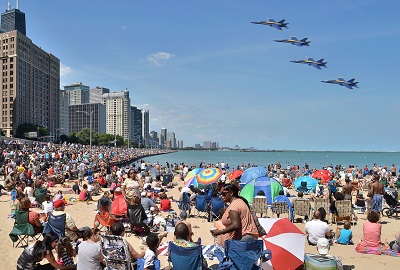
Oak Street Beach: Chicago
Blue Angels fighter jet team: not Chicago
One of the profoundest ironies of the Chicago Air and Water Show is that it pretends to be "Chicago-ish" by taking place on our beautiful lakefront -- that's the "Water" part -- but in fact it has nothing to do with Lake Michigan and everything to do with military air power.

Chicago has nothing to do with the military and military air power . . .

. . . UNLESS, of course, you count the fact that the Boeing Corporation recently moved its corporate headquarters here. (In which case, you may be tempted to ask, "Why do they get to drag us into their dirty business?")

Hmmm . . . Boeing Corporation . . . sponsor of the Chicago Air and Water Show . . . I think I see a pattern here . . . .

See:

Boeing Has an Israel Problem . . . and Chicago Has a Boeing Problem
No Drones Illinois Endorses Call to Drop Boeing from Chicago Air and Water Show


A real Chicago tradition: PEACE!

S.O. (Salmon Oliver) Levinson
David Swanson has done a great service by pointing out that it was a Chicago lawyer, S.O. (Salmon Oliver) Levinson, that came up with the idea of outlawing war.  Levinson's inspiration laid the foundation for the Kellogg-Briand pact. (See "Chicago’s unknown hero of peace" on the World Beyond War website.)

Many people don't know that the US -- together with 61 other countries -- long ago signed onto the treaty that makes it illegal to wage war. Congress ratified the treaty, and it is the law of the land.

You can learn more about the Kellogg-Briand pact and Levinson's contribution when David Swanson comes to the Chicago area on August 27 -- see Fundraising Luncheon commemorating Kellogg-Briand Pact.


Chicago has always been plagued by "second city syndrome." You know: "Saturday Night Live is 'live - from New York!' but actually it all started here!!!" and "Everybody talks about the Empire State Building but the skyscraper was really invented here!!!" and  . . .  (etc. etc. etc.)

A S.O. Levinson Peace Festival would be an opportunity for Chicago to focus on something at which it is "first."

Air shows are a dime a dozen.

Military recruiting: who needs it?

Chicagoans are tired of screaming jets on summer afternoons . . . .

But a peace festival! That would be unique! That would be something to be proud of!


TAKE ACTION


Tell organizations you are part of
that you want them to become
a founding sponsor of the
S.O. Levinson Peace Festival

(to replace the Air and Water Show!)


Related posts


There's been a lot of talk in recent weeks and months about the problem of gun trafficking in Illinois, and how we will never meet our goal of stopping the violence in our communities if we can't stop the flow of guns. Maybe it's time for us to eat our own dog food . . . .

(See What If Illinois Became a "War-Profiteer-Free Zone" ? )


What if we had a massive region in the heart of the country pushing back against the war-crazed conventional wisdom of "more weapons," "more consumption," and "more destruction of the environment"?

(See Another Modest Proposal: A Green, Demilitarized Midwest! )


I never quite understood how much of a Chicago story the Bomb and opposition to it really is. I can think of at least three reasons why people right here in Chicago -- today -- need to make themselves heard about nuclear disarmament . . .

(See Unfinished Business in Chicago (Nuclear disarmament, that is))

Sunday, August 16, 2015

Chenoweth on Why Nonviolence Gets Results (The "Cliff's Notes" Version)

Prof. Erica Chenoweth
Last week, I watched hours of coverage of the Campaign Nonviolence conference taking place in Los Alamos, NM.

I particularly liked the presentation given by Prof. Erica Chenoweth at that conference.  I found it so compelling, I tweeted the key points, just as fast as I could type.  You can watch the Chenoweth presentation here, or just read my notes below!


Basic findings

* Want to know which works better - #nonviolence or #violence? COUNT! (Retweet this.)

* Using the strictest measures - the #nonviolence approach still tallies more successes! (Retweet this.)

* "I was blown away" - the #nonviolence approach more successful by 2:1 margin! (Retweet this.)

* #Nonviolence #resistance works. (Even if YOU don't believe it!) (Retweet this.)


How nonviolence works

* #INCLUSION - #nonviolence campaigns work - 'cause they get more PEOPLE involved! (Retweet this.)

* in face of state #violence, #nonviolence #resistance actually gets MORE people involved (Retweet this.)

* (Put another way: #nonviolence is the way to get beyond "just males" protest) (Retweet this.)

* "looks like a party" ... "safety in numbers" ... [ ..... reach the tipping point!] (Retweet this.)

* fewer barriers to entry ... possibility of exit ... means MANY more participate (Retweet this.)

* Don't discount #moral factor: average person doesn't want to injure ( even in #army!) (Retweet this.)


BIG campaigns

* Q: What's the big deal about BIG campaigns? (Retweet this.)

* The bigger the campaign, the more it erodes "pillars of support" for power holders (Retweet this.)

* Big participation means you get inside heads of "instruments of repression" (#police) (Retweet this.)

* "Backfire" - even IF there's #violent repression, tends to ENCOURAGE more mass action! (Retweet this.)

* TWO big tools of #nonviolence #resistance: "concentration" AND "dispersion" (Retweet this.)


An example: IRAN

* Lessons of 100 days #revolution in #Iran - one of largest of all times (Retweet this.)

* Last 10 days of 100 days #revolution in #Iran - general strike, esp. #oil workers (Retweet this.)

* By end of 100 days #revolution in #Iran - even #POLICE were calling in sick (Retweet this.)

* #nonviolence campaigns TEN TIMES more likely to result in #democracy (measured at 5 yrs (Retweet this.)


Overcoming old myths

* all this contradicts MYTH: #nonviolence #resistance ineffective vs repressive opponents (Retweet this.)

* this ALSO contradicts MYTH: #nonviolence #resistance can't arise in closed society (Retweet this.)

* key MYTH to overcome: "little bit of #violence" helpful to (main) #nonviolence effort (Retweet this.)

* "little bit of #violence" PROBLEM #1: more generalized violence leads to lower participation (Retweet this.)

* if you're interested in #radical #change - look at the hard facts on what's worked w-w (Retweet this.)


Research challenges

* Research challenge #1: how can #minority movements draw in #majority? (Retweet this.)

* Research challenge #2: (indirect) #solidarity and #support: is it really contributing? (Retweet this.)

* Research challenge #3: what #leadership structure REALLY works? (Retweet this.)

* Research challenge #4: civil resistance in #war zones - e.g. #Iraq #Syria #Afghanistan (Retweet this.)


Taking this information to the wider world

* Big surprise: how ANGRY people get about #nonviolence! (vs. #violence) (Retweet this.)

* We're talking #paradigm shift! (Like Thomas Kuhn on #revolution in #science!) (Retweet this.)

* (PS - people's response to #Galileo was: KILL HIM!) (Retweet this.)

* "We must unlearn what we have learned." (Yoda) (Retweet this.)

* Maybe it's a problem of learning styles? (video vs text?) (Retweet this.)

* Teachers: ask for re-evaluation of #textbooks (eg #USA #history) (Retweet this.)

* #USA #history: learn about MASS CIVIL DISOBEDIENCE underpinning #American #Revolution (Retweet this.)


RECAP: 4 attributes observed in successful #nonviolence resistance movement

* "Mass and diverse participation" (Retweet this.)

* "new techniques for #resistance" (Retweet this.)

* "obtain the defections of the elites" (Retweet this.)

* "maintain discipline in the face of repression" (Retweet this.)


FOR MORE: watch the full Chenoweth presentation here.


Related posts

This tweet seems perfectly timed because of what is about to happen in a few weeks in Chicago.

(See Nonviolent Direct Action to Stop Police Crimes: Effective? )


Anyone who has had to write a speech knows that the hardest part is to land on the main idea. Once you've got that right, the rest practically writes itself.

(See "The way to respond to ISIS is not through violence." )


Think about it:
Aircraft carriers and Tomahawk missiles.
Drums.
Where's the real violence?


(See War, War Protests, and "Technology" )

Saturday, August 15, 2015

Nonviolent Direct Action to Stop Police Crimes: Effective?

As I write this, 486 people have retweeted the following message:


@BlakeDontCrack on Twitter:
Non-violent civil disobedience has never been non-violent for Black People.


It seems perfectly timed because of what is about to happen in a few weeks in Chicago.


Is non-violence just a dream?

Freedom Riders Bus Burned near Anniston, Alabama, 1961
(See blackpast.org)
The message immediately reminded me of a question raised in Between the World and Me by Ta-Nehisi Coates:  "Why were only our heroes nonviolent?" It's part of a longer passage:

Every February my classmates and I were herded into assemblies for a ritual review of the Civil Rights Movement. Our teachers urged us toward the example of freedom marchers, Freedom Riders, and Freedom Summers, and it seemed that the month could not pass without a series of films dedicated to the glories of being beaten on camera. The black people in these films seemed to love the worst things in life -- love the dogs that rent their children apart, the tear gas that clawed at their lungs, the firehoses that tore off their clothes and tumbled them into the streets.  They seemed to love the men who raped them, the women who cursed them, love the children who spat on them, the terrorists that bombed them. Why are they showing this to us? Why were only our heroes nonviolent?  . . . " (Between the World and Me, p. 31-2)

Ever since I have become involved in activism, this is a dilemma I have seen over and over again. People reject individual violence, but tolerate massive doses of state violence. (See War, War Protests, and "Technology" )

It is a dilemma that is central to Coates' book, and to his contention that US society will never be able to ease its way out of institutionalized racism (as adherents of "the Dream" hope).

It seems closely related to the question raised by Charles Blow (and retweeted over 3000 times):


@CharlesMBlow on Twitter:
Why did that reporter just ask #SamDubose's mother if she could forgive
the officer?! Why r we, but no one else, called 1st to forgiveness?!


What is the point of nonviolence, anyway?

Woolworth lunch counter sit-in in Jackson, Mississippi.
(See awesomestories.com)
Last week, I watched hours of coverage of the Campaign Nonviolence conference taking place in Los Alamos, NM.  The keynote speaker was someone who knows something about those Freedom Summer protests: Rev. James Lawson.

I particularly liked the presentation given by Prof. Erica Chenoweth at that conference.  I found it so compelling, I tweeted the key points, just as fast as I could type.  (You can watch the video of the full Chenoweth presentation or read a summary here.) The big idea that I got from Prof. Chenoweth's presentation: mass participation is what's needed to bring about change, and nonviolent tactics are proven to be more successful at bringing about mass participation (and making it effective).

Inherent in the Chenoweth presentation, is a big question: where does the mental toughness -- some people would call it "grounding" -- come from that enables people to continue following the more effective nonviolent course, particularly when confronted by a state that just keeps committing acts of violence?


Stopping state violence in Chicago

A 17-year-old civil rights demonstrator being
attacked by a police dog during protests.
(See NY Daily News.)
On August 29, a coalition of groups in Chicago will march for community control of the Chicago police.

Thousands are expected to march.

It is a significant example of the use of nonviolent protest to bring about an end to state violence.

I think everyone -- and particularly anyone who lays claim to being a political leader -- should be asking themselves the question, "How many hoops of nonviolent protest do people need to jump through before it's enough?" Put another way, "Just how much longer do you expect people to keep their righteous anger in check?"


TAKE ACTION


Participate in, promote, support


Related posts


We can't imagine that anti-racism work is just about specific police officers or even specific departments. Entire institutions of racist law enforcement need to be brought to heel in real time. It's a task worthy of a society-wide, national, federal effort. And it's top priority. No leader can ignore this reality . . . .

(See "If elected . . . ." (The Election 2016 and #BlackLivesMatter Nexus) )


It's time for Chicago's Progressive Caucus as a whole -- and all its members individually -- to come out strongly in favor of a democratically-elected Civilian Police Accountability Council (CPAC) for Chicago.

(See A Modest Proposal for Chicago's Progressive Caucus: Support CPAC )


#BlackLivesMatter: When all is said and done, how many career politicians in Chicago will have crashed and burned along the way because they couldn't or wouldn't step up and lead on this issue?

(See #PeopleOverPolice: Is This What Democracy Looks Like? )


I wonder if the outrage that many Muslims seem to feel at the suffering of other Muslims doesn't put us Christians to shame.

(See Fighting Back: It's alright as long as you're a Christian, right? )


Friday, August 7, 2015

#HiroshimaNagasaki70 - What I Learned on Twitter

Much of my last year has been focused on the 70th anniversary of the US atomic bombing of Hiroshima and Nagasaki -- including innumerable tweets, posts, and shares on social media.

Now I am watching.

Here are some of the things I'm noticing, particularly in connection with the hashtag #HiroshimaNagasaki70 on Twitter.


(1) A global groundswell: The call for nuclear abolition

I've written about the idea -- shared by so many -- that now is the time to ban nuclear weapons.

This message from @HiginiaRoig was retweeted over 300 times:


@HiginiaRoig on Twitter:
"Jo també reclamo l'abolició de les armes nuclears."
["I also demand the abolition of nuclear weapons."]


The screen in the image says "Never again" in Catalan, and shows the website of Abolim les Armes Nuclears/FundiPau - the Catalan affiliate of ICAN: International Campaign to Abolition Nuclear Weapons.

This tweet reminds me that the cause of nuclear abolition is the cause of people everywhere -- and especially of people struggling against imperial, statist, and racist oppression.


(2) "It's all our blood"

Nearly every day for the past year I've looked at images relating to the problem of nuclear weapons.

The tweet from Pentagram Design led me to this poster by Harry Pearce:


"It's all our blood"
Poster by Harry Pearce.


(Watch the video about the creation of this image here.)

This tweet reminds me of the continuing need for art in all its forms to wake people up to nuclear weapons and the work that still remains to be done.


(3) Say the word: "terror"

This simple tweet goes to the heart of the discourse on nuclear weapons (and those who have them and those who have used them):


@ShujaRabbani on Twitter:
"You'll never hear anyone refer to
#HiroshimaNagasaki70
atom bombing as an act of terror.


In a time when the West -- and particularly the US -- has itself tied up in knots over "terrorism," why can't it speak frankly about its own acts of terrorism?


(4) Scotland

One of the most hopeful signs of the past year has been the determination of people in Scotland to get nuclear weapons out of their country and out of the UK.

This tweet by Scottish National Party member of parliament Mhairi Black sums it up:


@MhairiBlack on Twitter:
"Those who do not remember the past are condemned to repeat it"
- George Santayana


This tweet reminds me that, through mass action, it is possible for the people to get the politicians to work for nuclear disarmament!

(See "No Nukes Politician" -- IS There Such a Thing ???  and "Nuclear Weapons Abolition and Economic and Energy Conversion" - the 114th Time's the Charm! )


(5) Hypocrisy

Well, at least one person said it. (And 437 people retweeted it, and 302 people favorited it:


@AbbyMartin on Twitter:
As US still lectures the world on who deserves nuclear weapons,
remember it's the only country to ever use them.
Twice.


This tweet reminds me how the rest of the world thinks of the US and its citizens.

(For more, see: 360 Degree Feedback in New York (2014 NPT Prepcom and How the World Views the United States) and  A DEAL'S A DEAL! (What part of "nuclear disarmament" doesn't the US understand?) )


(6) Mainstreaming Nuclear Abolition

This rather plain tweet got retweeted over 300 times. Maybe it had something to do with the fact that it came from Greenpeace.


@Greenpeace on Twitter:
70 years ago today, we remember #Hiroshima No war, #NoNukes Not ever.


Greenpeace: nearly 1.5 million followers on Twitter!

This tweet reminds me that we can't allow nuclear abolition to remain a fringe issue. We need the very biggest organizations -- with organized power: organized people, organized money -- to join together to make it happen.


The focus on the problem of nuclear weapons on the occasion of the 70th anniversary of the atomic bombing of Hiroshima and Nagasaki is encouraging. As always, the problem remains: What happens on the day after?


Related posts

Let's dedicate June, July, and August this year to recognizing the 70th anniversary of the atomic bombing of Hiroshima and Nagasaki (August 6 and 9, 2015). . . AND let's do something about it: make a nuclear ban a reality.

(See TIME FOR A NUCLEAR BAN? On the 70th Anniversary of Hiroshima/Nagasaki )


There are three centers of power that will impact nuclear disarmament: the President, the Congress, and the people. One of them will have to make nuclear disarmament happen.

(See Countdown to U.S. Nuclear Disarmament (With or Without the Politicians) )


In light of the upcoming review of the NPT (Treaty on the Non-Proliferation of Nuclear Weapons) and the fact that organizations throughout the country and worldwide are organizing to press the U.S. to substantially reduce its stores of nuclear weapons, it seems like a good time to use social media to get EVERYONE on board!

(See 5 Ways YOU Can Make a Difference on #NoNukesTuesday )


"It's not enough to remember this just once a year; it's not enough that we make a single book -- Hiroshima -- required reading, and never go beyond that. There should be a whole canon that people study progressively, year by year, to grasp and retain the horror of this."

(See FIRE AND BLAST: A Curriculum that Confronts Nuclear Danger?)

Monday, August 3, 2015

What I Learned in Church (7 Habits)

Worship
About 9 or 10 months ago, I started thinking about the nature of life in community, and considered for the first time that the point may be not so much to embrace each participant in order the better to hold the community together, but rather to transform each of us and prepare us to go out and on to the next stage in our lives. I began to wonder . . .

"Could it possibly be that we're not supposed to try to hang onto people? Is is possible that we're supposed to prepare people, and then let them go??"

(See The 7 Habits of Highly Effective Apostles )

This summer I'm in Berkeley, CA, and it's giving me a good chance to reflect on experiences at my home congregation in Chicago, IL (St. Luke's Lutheran Church of Logan Square). "What has been different in the way I live my life," I've been asking myself, "as a result of being part of that church community?"

I think there are, in fact, some habits that have been nurtured in me by being part of the St. Luke's community. Some that come to mind:

* "love each other" - I put this one first, though it's the hardest to explain -- or at least to explain genuinely and honestly.

* "listen" - This one I know for sure, because I can remember specific times when groups of us have worked on it intentionally together. (See Listening for Community (A Chicago Encounter))

* "make worship happen" - We have a pretty "high church" style of worship at St. Luke's -- and it can be tempting to just sit back and let it wash over you -- but I've unquestionably gotten into the habit of coming to church in an "active" posture on Sunday mornings.

* "be part of the wider community" - Challenging!

* "have agency" -  . . . in the sense of both "ministry" AND "governance."

* "take Jesus seriously" - (I wonder: Does this happen everywhere  . . . ?)

* "pray" - Yes, this required a kick in the pants; what's your point?

There are stories that go with each of these. I'm enjoying thinking back over them. I'll add posts in the weeks ahead to amplify on each of these.

I wonder if this resonates with the experience of others? What habits have you picked up along the way? Have those habits made a difference?


Related posts

I've been thinking about the Occupy movement and what it has to do with Christian witness. The conclusion I've come to is: a lot! In fact, I think it's central to our understanding of what Christ's life and death meant.

(See Occupy Palm Sunday! )


I believe when Jesus broke the bread and poured the wine and said "Remember me this way," he was much more interested in encouraging us to keep having conversations -- conversations that really matter -- with others . . . and finding ways to be in relationship with our neighbors  . . . all the while reminding us "never underestimate the power of food"  . . .

(See Get Outside Your Comfort Zone and Have A Conversation Today (Welcome to the Ministry))


We busted out of our big Neo-Gothic church building on Sunday and gathered for worship on the Boulevard. (Or, to be more precise, beneath the trees on the median alongside Logan Boulevard in Chicago, during the weekend-long "Boulevard Fest" sponsored by our congregation.) I've decided to embrace this new feeling of exposure and try to learn some lessons. I put them under the rubric "Congregations that worship in glass houses . . . (complete the sentence) . . . . "

(See Congregations That Worship in Glass Houses . . . )


I'm not sure the "7 habits of highly effective people" are necessarily identical to the "7 habits of highly effective apostles." But they do pose an interesting framework to consider building from.


(See The 7 Habits of Highly Effective Apostles )


I wondered at how we could have covered all that in just a minute or two -- the time it takes to go a few stops.  After all, when I walked onto that bus we were strangers.

(See Listening for Community (A Chicago Encounter))


Sunday, August 2, 2015

A Modest Proposal for Chicago's Progressive Caucus: Support CPAC

CPAC supporters? Go ahead - ask them!
I've said that a democratically-elected Civilian Police Accountability Council (CPAC) needs to be part of any "new plan of Chicago."

And as the 2016 national election season heats up, police reform is going to be a front-burner issue for progressives everywhere -- day-in, day-out. (See "If elected . . . ." (The Election 2016 and #BlackLivesMatter Nexus) )

What does this mean for Chicago's Progressive Caucus? The caucus website declares:

The Progressive Reform Caucus of the Chicago City Council is dedicated to creating a more just and equal Chicago, combating all forms of discrimination, and advancing public policies that offer genuine opportunity to all Chicagoans, especially those who have been left out of our society’s prosperity.

It's time for the Progressive Caucus as a whole -- and all its members individually -- to come out strongly in favor of a democratically-elected Civilian Police Accountability Council (CPAC) for Chicago.

Thousands are being mobilized to march August 29, 2015, to demonstrate for CPAC. Where will the Progressive Caucus members be standing then?

Maybe they need to hear from you.

Most of them are active talking to their constituents on Twitter. Get online and ask them a simple question:

"Do you support a democratically-elected civilian 
police accountability council (CPAC) for #Chicago?"

The Progressive Reform Caucus (@progressivechi) includes:

Ald. Leslie Hairston (5) - @5thwardchicago
Ald. Roderick Sawyer (6) - @RoderickTSawyer
Ald. Susan Sadlowski Garza (10) - @ssadlowskigarza
Ald. Toni Foukes (16) - @tonifoulkes
Ald. David Moore (17) -NOT ON TWITTER
Ald. Ricardo Munoz (22) - @AldermanMunoz22
Ald. Chris Taliaferro (29) - @Chris29thward
Ald. Scott Waguespack (32) - @ward32chicago
Ald. Carlos Rosa (35) - @cdrosa
Ald. Nick Sposato (38) - @aldsposato
Ald. John Arena (45) - @johnarena445

Tell them you're looking forward to marching with them on August 29!


Related stories

"Activists seek civilian oversight to improve police accountability" by Curtis Black in The Chicago Reporter, August 13, 2015.


Related posts

A campaign exists to bring about a democratically-elected Civilian Police Accountability Council (CPAC) in Chicago. The campaign would involve the people in electing the watchers of the police, and put the ultimate control of (and responsibility for) the police in the hands of the citizens of Chicago.

(See Does a Civilian Police Accountability Council (CPAC) need to be part of a "new plan of Chicago"? )


#BlackLivesMatter: When all is said and done, how many career politicians in Chicago will have crashed and burned along the way because they couldn't or wouldn't step up and lead on this issue?

(See #PeopleOverPolice: Is This What Democracy Looks Like? )


The State's Attorney for the Chicago area finally got around to bringing a charge against a police officer who shot and killed a citizen. Why, I wondered, didn't Anita Alvarez charge him with murder?

Then I remembered my Chicago vocabulary lesson.

(See Chicago Vocabulary Lesson: "Overcharging" and "Undercharging" )


All the cameras and microphones and reporters were out in force that day -- and their appearance suggested to me that it does make a difference to take a stand for justice. And maybe the fact that some of us thought this was important enough to come out, hold signs, chant, and march, helped back up that message.

(See Chicago Justice: Connecting the Dots )