Showing posts with label music. Show all posts

Monday, August 29, 2022

Taking the Indirect Route to Thinking About the Unthinkable

How much brain space -- and what kind of brain space -- are we humans capable of giving to certain particularly horrific risks we face?

Sunset - Madeline Island - January 2019

During the 3-1/2 years I lived on Madeline Island, I took dozens of pictures of surreal, beautiful sunsets. But the one above was a little too surreal. When I saw it, I thought, "Could that be something awful happening hundreds of miles to the south of us, in the big cities of Madison, Milwaukee?"

It reminded me of a dream I had had a few years earlier, when we were still living in Berkeley: 

Last night I dreamed that I was driving home into the Bay Area from a long trip, and I saw the mushroom cloud. ... It had really happened.  ... "What will happen now?" I wondered. "Will it reach us here?" 

I didn't have a very practical idea of what to do ... other than to keep on going.

My dream from there: traversing unfamiliar terrain ... bridge out ... try to "get back the long way 'round" .... ) 

When I woke up from that dream, I thought, "I'm involved in activism on the issue of nuclear disarmament and I talk with people about it and think about it all the time; but I've never envisioned myself actually dealing with a nuclear detonation occurring near me." And then I thought, "Am I capable of treating it like the real possibility that I believe it is?" 

I wonder if we are capable of treating the threat of nuclear weapons use like the real possibility that it is without shutting down intellectually and emotionally.

I'm thinking of this today because, as I unpacked papers in our new home in Madison, I found notes I had made about a piece of music: Symphony No. 15 by Dmitri Shostakovich. My notes reminded me that I have surmised that the clue to this enigmatic final symphony of his is that it has something to do with the fate of humanity in the face of the nuclear threat. I have nothing to base this on other than the "story" that the disparate parts of the symphony speak to me. In particular, the last minutes of the symphony seem to come down to the sound of a clock ticking . . . and then silence. (The way it ends with a whimper, like the sound of time running out, reminded me of the climax of a later work -- the opera Dr. Atomic, by John Adams -- in which the Trinity test is about to happen and time e-x-p-a-n-d-s . . . . in an excruciating type of anticipation: what will the future hold - if anything?)

Shostakovich wrote No. 15 in the 1970-71 period, coinciding with the SALT talks on arms limitations. It would not be unreasonable for the issue to have been on his mind at the time.

Once I start thinking in this way, I hear all kinds of things in the course of the symphony: skeletal xylophones, a game of "chicken" evoked with the William Tell Overture, martial music, circus music, a piccolo "whistling past the graveyard," a funeral chorale, a dirge, a desolate landscape, funereal and tentative steps, a heavy quote from the Ring Cycle (is it the "fate" motif?), followed by a very light air that seems to say, "La-di-da, life will go on as usual," then stress, trudging, plodding, ... finally blaring brass and then that ticking clock.

Besides the Adams piece referenced above, I think the piece also has connections to the stormy Dies Irae in Verdi's Requiem, and to Britten's War Requiem. (A friend of mine has also suggested I compare it to Threnody to the Victims of Hiroshima by Penderecki.

Shostakovich was depicted on the cover
of TIME magazine wearing his firefighter's
helmet during World War II.


It's almost certainly impossible to come up with "proof" about what Shostakovich intended with this symphony, and, if it were possible, that proof surely be subjected to all of the same doubt and refutation that every other aspect of Shostakovich's thinking has been.

What seems more important is what it means to me to find this meaning in the music. Why do I connect these abstract musical signals to this particular issue, the issue of nuclear weapons threat?

I think we need works of art -- just like we need dreams -- to help us work through the things we can't bear to position too concretely, too explicitly, in front of our eyes, full-on, in bright light, with sharp definition, at least not all the time. 

Maybe Shostakovich 15 has no direct utility to offer in the effort to avert the harm we face from nuclear weapons. But I do know that it -- like many other works of art -- serves to help at least one peace worker to continue to struggle to work through in his mind what to do about this staggering problem that we face.

Speaking of minds and imaginations, perhaps if I had more courage, I would follow through with my plan to concoct a Gogolesque tale of finding a yellowed letter tucked into a mildewed copy of Testimony in forgotten used bookstore in far northern Wisconsin . . . 

You have asked me about my intent in writing my 15th. Many people have remarked (rejoiced, even!) that I had not written another "programmatic" symphony. They're tired of my commemoration of historical events. 

They're right - 15 is not about an historical event, not really. But it IS about a true event. Even though it still lies in the future, is there any doubt that it IS going to happen? 

It started with a dream. You know I visited Berkeley . . . .

But who knows where that might have led?


Below is a link to the final movement of Symphony No. 15 by Dmitri Shostakovich. What do you think?


Sunday, July 5, 2020

On Moving Mountains

Silent March against Racism in Bayfield, Wisconsin, July 4, 2020


Yesterday morning -- the Fourth of July -- we participated in an important event in Bayfield, Wisconsin, the mainland community closest to Madeline Island. It was a Silent March against Racism organized with the help of area churches and members of the Red Cliff band of Ojibwe.

In the evening, we watched the great 1983 film, Born in Flames. The film imagines the possibilities for a small band of activists who are determined to change the world. 

In the film, there was a 3 second snippet of a song I recognized from my teenage years. "That's Hendrix!" I said to Rachel.

The Hendrix song was "Voodoo Chile" - a song I used to hear every morning as I listened to Jimi Hendrix' album, Hendrix in the West. Here are the lyrics:

Well, I stand up next to a mountain
And I chop it down with the edge of my hand
Well, I stand up next to a mountain
Chop it down with the edge of my hand
Well, I pick up all the pieces and make an island
Might even raise just a little sand
'Cause I'm a voodoo child
Lord knows I'm a voodoo child

I didn't mean to take you up all your sweet time
I'll give it right back to you one of these days
I said, I didn't mean to take you up all your sweet time
I'll give it right back to you one of these days
And if I don't meet you no more in this world
Then I'll, I'll meet you in the next one
And don't be late, don't be late
'Cause I'm a voodoo child
Lord knows I'm a voodoo child
I'm a voodoo child

(Lyrics by Jimi Hendrix © Sony/ATV Music Publishing LLC, source LyricFind)


Hendrix in the West


When I was 13, I found the lyrics of "Voodoo Chile" very mysterious. (Particularly in comparison to the words of "Red House" -- "There's a red house over yonder, that's where my baby stays . . . ." -- or "Lover Man" -- "Here he comes, baby, here comes your lover man.")

But something clicked yesterday hearing the words "I stand up next to a mountain, chop it down with the edge of my hand" in the context of the day -- the Bayfield march (where we saw people committed to anti-racism stream into the lakeside park from all directions) and of Born in Flames (a film about committed revolutionaries). I suddenly thought of a passage from Matthew (17:20) that we had been reading a few weeks ago, in which Jesus says:

"For truly I tell you, if you have faith the size of a mustard seed, you will say to this mountain, ‘Move from here to there,’ and it will move; and nothing will be impossible for you.”

When we reached that passage in our Bible study group, one of the participants called our attention specially to these words. She said that statement felt more true to her than a hundred other pious pronouncements of the Church.

"I stand up next to a mountain, chop it down with the edge of my hand."

 Amen.

 Videos of July 4 march in Bayfield here and here.

Tuesday, January 7, 2020

Chance Encounter: Good News About Connecting with God

(One of my goals for 2020 is to notice and amplify the diverse ways people share the Good News.)

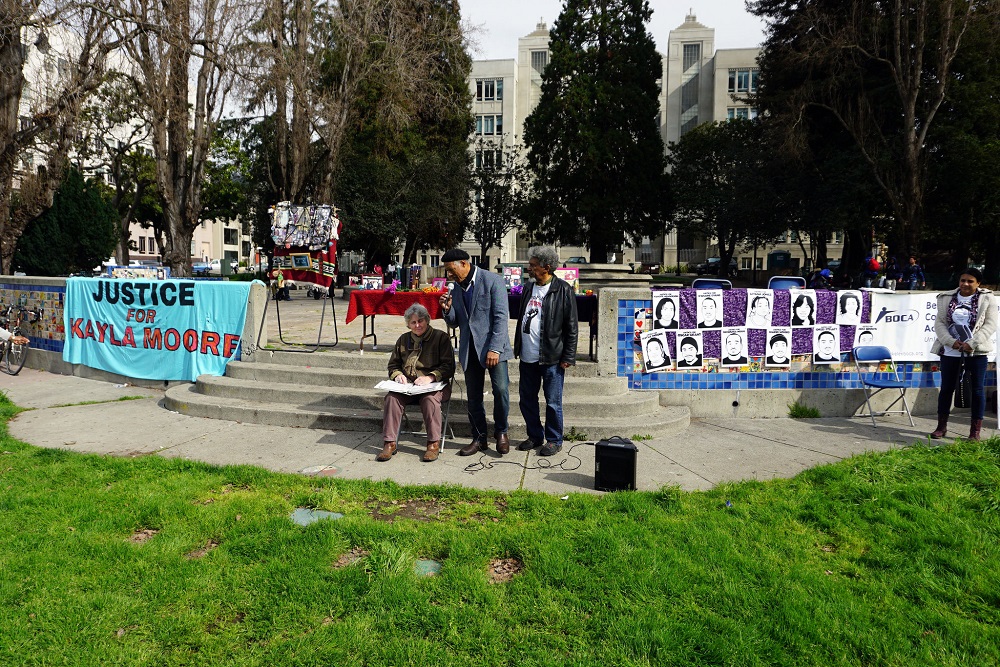
Three years ago, in Berkeley, CA, I was working with members of a community organization made up of faith communities on a "Remember Our Names Black History Month Prayer Vigil."

We were setting up our materials -- banners, displays, literature -- in Martin Luther King Jr. Civic Center Park, opposite City Hall in Berkeley. Two young men came up and started talking with us -- I supposed they attended the high school that is next to the park. We were partly grateful to be able to engage these young men in conversation about the purpose of the important event that we were preparing for -- never too early to start promoting! -- and we were partly distracted by the need to get everything set up before the main event began.


"Remember Our Names Black History Month Prayer Vigil"
(Photo: Mark Coplan)


As I worked to drape banners over a low wall and secure them in place, one of the young men talked to me. The first things I noticed about him was that he was smoking, he was dressed head to toe in some team colors, and he was a white guy. He was talking about some musician he liked -- some "rapper something" -- who had been on TV the night before and he was really relishing the glow of that event. He said that he, himself, had made a point to wear that performer's signature clothes -- he pointed to his hat, his shirt, his pants, and his sneakers. I have to confess that I thought this was a little silly -- he was so happy to be communing with the rapper guy in this way, and I didn't even recognize the name he kept mentioning.

I tried to listen respectfully, but I also remember thinking, "Hey, I'm trying to hang a banner here! I can't seem to figure out a place to tie it down. Did you notice that I could use a little help?"

But instead of coming to my aid, the young man pulled out his phone and says, "Here, I've got it on video, just watch this!" So here I am, an old white guy standing in the middle of a park squinting at this little screen on a phone being held by this young man all dressed in red and smoking a cigarette, listening to rap.

Now, as someone who is endlessly trying to get people to watch stuff that I think is interesting, I felt the irony of this situation. Here was someone who was trying to change my world by showing me this important video, and all I wanted to do was pry myself loose and finish hanging the banner.

(And anyway, didn't he see how important this vigil was that we were preparing?)


*     *     *


That night -- for reasons that I can't quite explain -- I remembered this exchange, and I wondered about that video. I wondered what had felt so meaningful to him. I remembered that it was a video of the previous night's Grammy awards, and so I searched for the video of "some rapper."

This is what I found: a performance by Chance the Rapper at the 59th Grammy Awards ceremony.

Please take a moment to watch ChancePerform on Vimeo.


Chance the Rapper: "The first is . . . . "


I wasn't expecting to hear these words:

The first is that God is better than the world's best thing

God is better than the best thing that the world has to offer

Magnify, magnify, lift it on high

 . . . and . . .

Exalt, exalt, glorify, descend upon the earth with swords

I wasn't expecting the camera to pull back, the stage lights to go on full, and white-robed gospel singers flanking the stage, singing and swaying exuberantly, doing a full-blown rendition of "How Great Is Our God."


"How great . . . is our God . . . "


Most of all: I wasn't expecting to see the huge crowd of music industry VIPs attending the Grammy ceremony joining in -- standing and waving their arms in unison as the choir sang.


And I wondered: who would dare choose to perform this song at that event in front of all those people?

And I thought: this is what it means to spread the Good News!

(You can read the full words here.)

*     *     *

Chance the Rapper's Grammy performance of "How Great is Our God" made me think about a lot of things. I thought about going to a friend's church in Chicago and seeing how that congregation used praise music like "How Great is Our God" to create a completely different feeling than I was used to during worship. I thought about other times, when we've incorporated popular music in our own worship, and how great the response was to that. But most of all I thought about the enormous power of music of all kinds to enable us to connect with God, and I wondered why I wasn't doing more to contribute to that. And I decided to change that.

*     *     *


And when it was all done, I realized that what had happened was that the young man all dressed in red and smoking a cigarette had run across me in the park, and had taken the time to give his testimony about a message of Good News that was life-changing for him, and that he hoped would be life-changing for me.

And it was.

Thursday, August 11, 2016

Is That Protest Music Coming Out of the Choir Loft? ("Touch the Earth Lightly")

Is your church community raising its voice against war and nuclear weapons? If not, why not?

Shirley Erena Murray
I got a jolt when I looked closely at the bulletin in the church service at University Lutheran Chapel a few weeks ago*. It called my attention to the hymn of the day, by New Zealander Shirley Erena Murray, particularly these words:

2 We who endanger,
who create hunger,
agents of death for all creatures that live,
we who would foster
clouds of disaster,

God of our planet, forestall and forgive!
(emphasis added)

The bulletin explained that

The "clouds of disaster" in verse 2 (which is sung in a minor key) refer to nuclear tests carried out by France in the South Pacific, which New Zealand has protested at the United Nations many times.

In fact, the Marshall Islands are currently seeking redress in connection with those tests in international courts: see "MARSHALL ISLANDS HIBAKUSHA: Can social media trump empire and entertainment?"

Coincidentally, just days later people were marking the 71st anniversary of the atomic bombing of Nagasaki with a vigil and protest at the Livermore Labs, near Berkeley, a major site of US nuclear weapons research. The foreign minister of the Marshall Islands, Tony de Brum, spoke at the event.


2016 Nagasaki Day protest at Livermore nuclear weapons lab
(Image: Margaret Lowry)


Here's the full hymn, "Touch the Earth Lightly":


Read more about the work of Shirley Erena Murray here: "A jolt of reality – the hymns of Shirley Erena Murray."And check an additional hymn by Shirley Erena Murray about the nuclear threat.


* By the way - I really shouldn't be surprised to hear any activist message at ULC Berkeley. See, for instance, "IN BERKELEY: Declaring Sanctuary, Changing Hearts and Minds."


Related posts

AK Songstress connects to the antiwar legacy of world music -- "in the era of legends like Bob Marley, he was always advocating for peace, unity, love and tolerance."

(See Product of Ghana: #NOwar / Pro Peace Music)


An amazing thing that will be happening -- in fact, has already begun happening -- here in Berkeley is a performance of Britten's War Requiem.
(See WAR: Will you hear? Will you perceive? Will you think?)


"We all live in a yellow nuclear-powered ballistic missile submarine . . . ."

(See Lady Alba: When Progressive, Antiwar Views Go Viral )


An amazing number of the world's greatest artists are long-time devoted activists for nuclear disarmament and against nuclear power.

(See IT'S SHOW TIME! 2015 Sounds Like "Nuclear Disarmament"! )

Friday, June 3, 2016

Product of Ghana: #NOwar / Pro Peace Music

It's good to get to know socially conscious musicians and other artists from around the world. One of Ghana's leading celebrities, AK Songstress, has a new song, "No War," to encourage peaceful elections.

AK Songstress: "No War"
Ghana holds national elections in November. The big issues are economic.

Ghana is hugely important to all of us. In 1957, it became the first sub-saharan African nation to declare independence from European colonisation, and its leader at the time, Kwame Nkrumah, was one of the leaders of the world decolonization and liberation movement. Today, as the world becomes more and more attuned to events in West Africa, and particularly to conflicts in Nigeria and other countries, the experience of Ghana with democracy and development is suggestive for the whole region.

I discovered the AK Songstress song via Twitter. AK Songress connects to the antiwar legacy of world music -- "in the era of legends like Bob Marley, he was always advocating for peace, unity, love and tolerance" -- and the song's press release emphasizes,


"The issue about election is of national concern to each and every discerning Ghanaian which must be healthily addressed. Without love, unity, peace, tolerance, harmony and fairness, all of our human efforts in the sight of God and man will be useless. Whether one belongs to party A, party B, party C or party D, we need to tolerate and respect each others view whenever one has a good agenda, after all we are all Ghanaians. Let’s forget about the party colours and put Ghana first."

(See AK Songstress drops peace song #NoWar)

Hmmm . . . not a bad message for everybody . . . #NOwar . . . .  

"No War": give it a listen!

PS - Check out this story about the help AK Songstress to safe sex campaigning in Ghana, too.


Related posts

If you want to hear a really angry antiwar ballad, listen to "Wooden Ships" by Crosby, Stills, and Nash:

If you smile at me, I will understand
'Cause that is something everybody everywhere does
in the same language . . . .

(See What Would It Take for Friendship to Trump War? )


An amazing thing that will be happening -- in fact, has already begun happening -- here in Berkeley is a performance of Britten's War Requiem.
(See WAR: Will you hear? Will you perceive? Will you think?)


Ravi Shankar is a great example of someone bringing a special point of view to pierce the bubble of "normalcy" in which a vast number of people live, and to agitate for tectonic change.

(See Thanks, Ravi)

Saturday, April 9, 2016

Thanks, Ravi


George Harrison and Ravi Shankar at the Concert for Bangladesh press conference.


Google honored Ravi Shankar with a doodle the other day.

Ravi Shankar is a great example of someone bringing a special point of view to pierce the bubble of "normalcy" in which a vast number of people live, and to agitate for tectonic change.

I grew up in an all-white New Jersey suburb, very sheltered from so much that was going on in the rest of the world. I have a crystal clear memory of the way in which Ravi Shankar started with a small but significant intrusion into my world, via his influence on George Harrison and the rest of the Beatles, particularly in songs like "Within You Without You" on the Sgt. Pepper album.

Ravi Shankar, My Music, My Life
So, at a time when I was expanding my musical horizons from trumpet and piano to guitar, and starting to dream about being in a real  band, checking books out of the library about "how to start your own rock 'n' roll group," I was also reading My Music, My Life and trying to make my guitar sound like a sitar.

When I did manage to put together a band with some friends, we were absorbed with the Concert for Bangladesh. Certainly there were benefit concerts before that, but that one is the first that I could really remember that was used as a call to action to respond to the suffering of people in a part of the world that people had never heard of.

It's quite moving to watch the film of the concert after all these years, and to see the press conference at the beginning where they ask George Harrison, "Why are you doing this?" He says, "Because my friend came to me and asked for help."

In 1979, when I was in Taiwan, many of my classmates and I had the opportunity to see Ravi Shankar in concert at the national concert hall in Taipei. I remember Ravi exhorting us to loosen up, to not be so stiff; he encouraged us to move with the music . . . .

I have a clear memory of being in Tower Records in the '90s, and pawing through rack after rack of "world music" CDs. It was funny to think about how a few pioneers cracked that open.

In the early '00s I saw two films that expanded my understanding of how steadily Ravi Shankar had worked to build his audience and his reach. One was the 1971 film Raga. The other was The World According to John Coltrane. (More at: John Coltrane and the integration of Indian concepts in jazz improvisation.)


Ravi Shankar playing with daughter Anoushka


In April, 2007, Ravi Shankar performed a sold-out concert in Chicago's Symphony Center with his daughter, Anoushka. I remember Ravi telling us that he was using a specially-designed sitar, a bit smaller than usual, that was easier for him to manage. I remember thinking how historic this was -- how there would a be a time in the very near future when people would not be able to see Ravi Shankar perform any more. I watched him beam as he watched Anoushka perform, and I thought, "She is a prodigy. How proud, how content he looks." And then Anoushka finished, and he played, and -- miraculously -- he took it to a whole other level.

(Of course, you don't need to be Ravi Shankar to feel proud and content . . . . )


Changing of the guard: Tip Scarry takes up my old Fender Stratocaster


I see now that one way in which I am different from many people around me is having a love of music and language and imagery and food and much more that carries me beyond what I already know and am comfortable with.

For this I am grateful.

Thanks, Ravi.


You can see a great set of Ravi Shankar clips on Youtube.


Related posts

The band was called the Evil Sun and it was the hottest thing to hit Chatham in the '70s . . . .

(See IT'S SHOW TIME! 2015 Sounds Like "Nuclear Disarmament"! )


I often refer to how important the films of Iran have been in helping me open my mind to the possibilities of a peaceful relationship with that country.  I have been fortunate to be able to go see some of the best films from Iran every year at the wonderful Siskel Film Center in downtown Chicago. The will be another Festival of Films From Iran showing there in February, 2014.

(See A Force for Peace: Getting to Know Iran Through Film)


Years later, during the time I was busily traveling to China, Taiwan, Hong Kong, Japan, South Korea, Thailand, Malaysia, and many other places, I had occasion one day to flip open my (real) passport, and all the extension pages, filled with visa stamps, cascaded out. The memory of Expo 67 and my "globetrotting" came rushing back to me . . .

(See O Canada! (We'll always have "Expo" . . . . ))


Make no mistake: Sandy was a high-powered lawyer with a high-powered lobbying firm. In that setting, Sandy was a big mahoff. But what made him really big was his ability to help the rest of us have the confidence to raise our voices.

(See REMEMBERING SANDY: Samuel Berger, 1945-2015 )


Could I point to some analogous concepts and practices that I felt characterized the Chinese approach to being in the world? I rolled the idea around in my mind for a while, and then landed on the word "cultivation."

(See "Puja" in India; "Cultivation" in China )


It suddenly occurs to me that everyone in the US should be studying the behavior of England toward India, and asking ourselves, "What might this tell people in the US about coming to our senses?"

(See PROBLEM: How does an entire country exorcise a national delusion?)

Thursday, April 7, 2016

WAR: Will you hear? Will you perceive? Will you think?

Britten's War Requiem - June 3,4,5, 2016 - Berkeley
An amazing thing that will be happening -- in fact, has already begun happening -- here in Berkeley is a performance of Britten's War Requiem. The performance itself will be at the beginning of June, and there have already been lectures at the public library about World War I, the work of Benjamin Britten, and Wilfred Owen and the other WWI-era War Poets. One more lecture will take place next Tuesday with contemporary poets writing about war.

I've written about the War Requiem in the context of other antiwar art. It's a masterpiece.

Some people may question why we need a 50-year-old piece built on the traditional Latin requiem for the dead plus poetry from World War I, created to commemorate a cathedral that was destroyed in World War II, in order to inform our lives today.

I was inspired by commentary on one of Wilfred Owen's poems, provided by Prof. C.D. Blanton at one of the library lectures. Prof. Blanton guided us through "Apologia Pro Poemate Meo" and helped us see the challenge to us in these works of art: when it comes to war, "you shall not hear ... you shall not perceive ... you will not think .... " Most of the time, this is true. (Even if we could, it might make us uncomfortable -- think of Harun Farocki.)

But on the few occasions when we do want to hear, to perceive, to think -- or at least try to begin to do so -- it is through this kind of poetry and music that we can hope to do so.

See you at Hertz Hall . . . .


Related posts

If you want to hear a really angry antiwar ballad, listen to "Wooden Ships" by Crosby, Stills, and Nash:

If you smile at me, I will understand
'Cause that is something everybody everywhere does
in the same language . . . .

(See What Would It Take for Friendship to Trump War? )


Consider the moment in the film All Quiet On the Western Front when the young soldier returns to visit his old high school. The soldier visits the class of the teacher who had goaded him and many of his classmates to enlist in the first place. Encouraged by his teacher to tell about the "glories" of being a soldier, he delivers a damning verdict . . . .

(See Back to School (All Quiet On the Western Front))


"A terrible disease has struck the area . . . people call it the "flu" . . . many in our own community have fallen to it . . . including someone very dear to you, someone in your own family . . . I'm talking about your sister, Margaret." (See November 11, 1918: Another Veteran for Peace )


"Because of the intensified division of labor," the narrator explains, "many technicians and scientists can no longer recognize the contribution the have made to weapons of destruction." "Our department extracts lareic, oleic, and naptha acids . . . . "  "I'm a chemist. What should I do? If I develop a substance, it can be good for humanity . . . ."  "Besides napalm, Dow Chemical produces 800 other products . . . ." Does this familiar to you?

(See American Fire: Still Spreading, Still Inextinguishable)

Sunday, March 27, 2016

EASTER 2016: "The darkest hour is always, always just before the dawn ...."

"Winter Storm Clouds from Lawrence Hall of Science"
(More beautiful photography of the Nature of Berkeley.)

I gathered with others from First Congregational Church of Berkeley atop the ridge overlooking San Francisco Bay at 6:00 am for the Easter sunrise service today.

As planned, our celebration began before the first signs of dawn, and I felt grateful for the reminder: in the moments before the light appears, it can feel awfully, awfully dark.

It made me think of the words by David Crosby:

But you know
the darkest hour
is always
always 
just before the dawn. 

Crosby wrote those words, it is said, during a very long, very dark night. (You can read about "Long Time Gone" here.)

I believe the US, and the world, is quickly becoming aware of the darkness into which we are plunging.

Will we make it to the dawn?


Watch Crosby, Stills, and Nash perform "Long Time Gone":


Related posts

Every time I've heard an ambulance in the past forty or so years, I've thought, "help is on the way."

(See Christmas: "Help is on the way . . . ")


The song's lyrics alternated between "talking about the passion" and "carrying the weight of the world," over and over again. It was as if to say, "This is something we are going to keep working through, again and again, until we come to grips with it."

(See Thoughts Before Holy Week: Talk About the Passion )


I believe Easter is God's gift to humanity of victory over death, hopelessness and frailty, and I believe that God is alive and in our midst. The witness of the Guantanamo lawyers has confirmed me in those beliefs.

(See Easter Victory: The Guantanamo Lawyers )

Saturday, March 26, 2016

Salvation History: "Follow the Drinking Gourd"

[Tonight at University Lutheran Chapel in Berkeley, I'll be telling one of the Easter Vigil stories. The part I'll be doing is about the salvation story in Exodus, and the specific text is Exodus 4, about the way an "unexpected leader" -- Moses -- was encouraged to act. I adapted the text to tell the story in terms of the way leaders came forward against slavery in the US . . . . ]


In 1849, Harriet Tubman was a 27 year old slave in the state of Maryland - on the Eastern Shore, in the area just south of the Choptank River.

We now know a little bit about what Harriet was going through in that year, and the most important thing is that she had come to a conclusion: "There's one of two things I have a right to. One is liberty; the other is death."

The only question in Harriet's mind was -- which was it gonna be?

We don't know what went on in Harriet's mind in those days when she was still a slave.  In my imagination, it was something like this . . . .


"Flying Geese" quilt pattern


As 27-year-old Harriet Tubman stood pondering one day, hanging out the old quilts that she had been washing, and lost in thought, she hummed a song.  [She hums "Follow the Drinking Gourd"]

An old man who worked on the farm, not a slave, but a hired hand, and a friend she could trust, came along. "Harriet, what are you so lost in thought about?" he said.

"Joe," she said, "I don't know what to do. I think I've gotta make a break for it. But I don't know if I can do it. I mean -- if God was gonna lead me to freedom, like His people he took out of Egypt, there'd be some, I don't know, some signs, or miracles, or . . . ."

"From the way you're talkin', sounds like you've gotten your first sign already," he said.


"North Star" quilt pattern
"Joe, I wouldn't even know how to start."

"Harriet," said Joe, "what's that I heard you humming?"

"Oh," she said, "it's just that old song you taught me, the one whose words don't make any sense."

"How does it go?" said Joe.

[SHE SINGS -- "Follow the drinking gourd, Follow the drinking gourd, for the old man's waiting for to carry you to freedom, follow the drinking gourd."]

"I think you've been carrying around what you need with you all along," said Joe. "The drinking gourd is the Big Dipper, and it points the way north."

[SHE SINGS AGAIN -- "Follow the drinking gourd, Follow the drinking gourd, for the old man's waiting for to carry you to freedom, follow the drinking gourd."]

She looked at Joe.  "I don't know," she said. "How will I survive? I won't even make it through one night . . . . "

"What's that you're hanging up?" he said.

"Just an old quilt - just a jumble of old pieces of cloth."

"Remember to take it with you. That jumble of old pieces of cloth will keep you warm at night."

"Joe," she said, "the worst part of it is: what about my family? How can I go without them?"

"Log Cabin" quilt pattern
"You won't be going without them," said Joe. "You'll be going AHEAD of them. There's a difference. Your real job is learn the way, and then come lead them to freedom."

"All by myself??" she said.

Joe reassured her: "How does that song go again?"

[SHE SINGS AGAIN -- "Follow the drinking gourd, Follow the drinking gourd, for the old man's waiting for to carry you to freedom, follow the drinking gourd."]

"So get going. I'll be right there with you."

"Alright, Joe, alright." (resigned)

"I'll meet you in the morning," she intoned, "I'm bound for the promised land."


Harriet Tubman escaped to Pennsylvania. She returned to Maryland to help others escape, and over the years she led so many individuals from slavery that people gave her a special nickname. Her nickname was "Moses."


You can read about Harriet Tubman on Wikipedia to see the origin of some of the references in the imagined conversation above.


Listen to Richie Havens sing "Follow the Drinking Gourd":


I first learned about the drinking gourd song when I read and performed the picture book version of "Follow the Drinking Gourd" (with story and pictures by Jeannette Winter) over 20 years ago for my son's first grade class.  Here's a reading of the Winter's book:


And here's an adaptation of "Follow the Drinking Gourd" that's unforgettable - The Ishmel Sisters, arranged by Darnell Ishmel, with poetry by George L. Davis, II:


The quilt designs that accompany this post are so-called "Underground Railroad" quilt patches. There is abundant information about the patches on the Internet, though historians have come to doubt their authenticity. I have included them to remind us that secret communications systems, to the degree they existed, were by their very nature obscure and hard for outsiders to decipher. There is so much to this story: we need to open ourselves to possibilities and imagination and myth in order to continue to grasp further aspects of it.


Related posts

What would Christians think if someone proposed carving out a slice of their Sunday services to worship the God of Entombment? Wouldn't they think that was absurd? After all, if Christianity is anything, isn't it the religion of "UN-entombment"?

(See When is Christianity Going Back to Being the Religion of "UN-entombment"?)


For the next three months, people will be talking about the film 12 Years a Slave and its Oscar prospects. And well they should. The film is about the experiences of the free man, Solomon Northrup, who was seized and enslaved for twelve years, and it may be the best thing ever to come along for enabling us to confront the true meaning of our history of oppression and racism in America. But it's not just about history. 

(See 12 Years a Detainee)


I think they are sending a message to their adherents: "We're in a struggle. Not everyone is with us -- yet. But we know what we stand for. And we're not alone!"

(See Shen Yun: Performance Posters as Resistance Art )

Saturday, March 12, 2016

RIP Paul Kantner

Many of my contemporaries noticed the obituary of one of the Jefferson Airplane founders, Paul Kantner, a few weeks ago.

I love the Airplane's music. (Memories of the founding moments of the Evil Sun!) But what I was especially interested to learn was that Kantner wrote "Wooden Ships," together with David Crosby.

Here's a reflection on "Wooden Ships" I wrote about a year ago: What Would It Take for Friendship to Trump War? ("Say, can I have some of those purple berries . . .?")

Friday, July 24, 2015

THE EYES AND EARS OF HISTORY: A Perspective on the Iran Deal

Chinese Red Guards (circa 1970) read
from their 'Little Red Books'
(GETTY IMAGES)
At the point I arrived at college in 1977, just about everything I knew about the rest of the world came from leafing through old issues of LIFE magazine while lying on the floor of the sunroom of the house I grew up in at 16 Fuller Avenue in Chatham, NJ.

One of the things I thought I "knew" was that the United States and the rest of the world was threatened by a country called China -- a very big country, and what that was very mysterious.

China had nuclear weapons, and "they" were "just crazy enough to blow up the world." Or at least that is the extremely clear impression I carried with me. (I remain fairly certain that if I spent enough time looking through stacks of old magazines in antique stores I could uncover the ur-issue of LIFE with these very words, perhaps next to a photo of parading Red Guards.)

LIFE magazine, February 11, 1966
The other thing I learned about in LIFE magazine, of course, was the Vietnam War.

So in college I embarked on a course of study about Asia, believing that if more of us learned about that part of the world, we could contribute to some other kind of interaction besides war.

I had imagined I would be a diplomat or a scholar; I ended up in the import/export business. I didn't deal in communiques, or demarches, and I never wrote a famous cable to from some US embassy somewhere back to the State Department in Washington, DC.

But I did log travel to every corner of Asia, and negotiate lots of contracts, and build relationships with people, and lay down patterns of engagement that were governed by monthly shipping schedules and inspection trips and celebration banquets and factory visits. And along the away I had a key insight:

When people are intent on doing business with each other, they're too busy to fight.

In the decade or so after I graduated from college, doing business in China went from being a curiosity to being mainstream.  Everybody was doing it.

Little by little, I realized that all of us -- even us greedy businessmen (and women) -- were doing our part for peace. By the late '80s and early '90s, the idea of military conflict between China and the US had become a dim memory.

*   *   *

John Adams: Nixon in China (An opera in three acts)
Some time in the '90s I became increasingly interested in classical music, and even (!) in opera. I discovered the work of an American composer named John Adams, and was fascinated to discover that he had written an entire opera about Nixon's 1972 opening to China: Nixon in China.

I remember thinking how remarkable it was that he had written something so specific to my interests -- even though I wasn't quite sure why the general public would or should be interested. "Seems a bit esoteric," I thought. "But: works for me!"

Sure, I understood that Nixon meeting Mao was important -- hell, I had even been a part of the activity that was borne of that meeting -- but I didn't really understand how important.

It wasn't until ten or fifteen years after that, when I was no longer focusing all my time on China, and when I had a chance to actually see a production of Nixon in China, that I saw the situation with new eyes (and heard it with new ears).

Nixon in China: historic handshake
The opera begins with Air Force One on the tarmac in Beijing, and Nixon's reflections on arriving in China. Nixon sings the words "mystery" and "history" over and over again, to stress the way in which the direction of history can be massively re-directed by a seemingly small event:

News has a kind of mystery:
when I shook hands with Chou En-lai
on this bare field outside Peking,
just now, the world was listening.
...
"the eyes and ears of history caught every gesture"
Though we spoke quietly
the eyes and ears of history
caught every gesture...
...
and every word, transforming us
as we, transfixed, made history.

(Nixon in China - from the libretto by Alice Goodman - see video clip)

It took repeated listenings to understand the way in which the entire rest of the opera swirls around those two words -- "mystery" and "history" -- recognizing that something enormous has started, while realizing that it is nearly infinite in its complexity and diverse ramifications.

I think this is similar to the years and years of reflection that it has required for me to extract myself from the thick of my own business activities, and see the main tendency: it had its good and bad aspects, but the diplomatic and commercial opening of China was part of a massive move away from conflict and toward peace.


*   *   *

Now . . .

Now we are at another historic moment -- or one that looks historic, anyway.

And though it can be difficult to say in advance that a particular step will be historic -- that it will, in fact, bring an enormous change in the world, over decades to come -- the agreement with Iran on curbing nuclear weapons development feels to me as if it could be another "Nixon in China moment."

 What do you think? Do we have the chance to "make history"? And . . . if we do, what should this lead you to do today?


Related posts

There will be no shortage of members of Congress who see this as an opportunity to puff out their chests and wave their arms and insist on continued conflict. It will be the work of the people to insist that the path of peace be followed through.

(See Talk With Somebody About Iran Today. (Maybe a Member of Congress?))


"How can it be that no one is speaking directly to what happened?" I wondered. "Should I say something? Is it just me? Can it be possible that most people aren't like me, tremendously troubled by how we should respond to what has happened in China?"

(See Remember June 4)


Ever since I went there to study Chinese as a junior in college, I've considered Taiwan my "second home."


(See Taipei c. 1979 )


What people in Asia (and others) have seen for the past century is that something is happening in the Pacific, and it's being driven in part by advances in naval (and, subsequently, aviation and electronics) technology, and in part by powerful nations (principally, but not limited to, the U.S.) proximate to the area.

(See The Imperialized Pacific: What We Need to Understand)