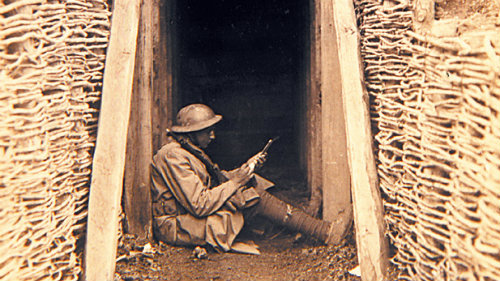
I don't know what induced Granddaddy Melker to serve in WWI. I know
there was a lot of talk about patriotism, and the pressure on US people
of German descent to prove their loyalty was especially strong. [
an update on this question here]
I
do know that my grandfather never said anything positive about the war,
and that he claimed that he used to shoot his rifle up in the air, over
the heads of the enemy.
The best glimpse I have into what he experienced there comes from a letter that I am holding in my hand right now. It's dated October 18, 1918, and it was sent from Packerton, PA. I don't know what day it reached my grandfather in France. In those days I suppose it would have taken a month to reach a soldier at the front. It probably didn't reach him until after the wonderful news on November 11 that an armistice had been signed.
 |
| Letter from home - closing days of WWI |
This is the thing my grandfather saved from World War I.
The letter is from the Lutheran pastor of the congregation Granddaddy Melker attended in Nesquehoning, PA. From the beginning, it is not encouraging:
Dear Martin;
It is about time I should answer your letters. I do hope that this will reach you; and again I rather hesitate to tell you all the news because it is none of the best.
What news? Does he mean news about how the war is going? Or . . . ?
I want you to be brave and bear it like a good soldier of Christ, always trusting in God for comfort and strength in all your trials and be diligent in studying his Word and use it as a lamp unto yourfeet while walking through this dark and sin cursed world.
(When I first read this sentence, I thought, " 'Good soldier of Christ' -- I wonder: how many times must he have heard this kind of talk to tell him to 'suck it up'?")
You have perhaps heard that our country is invaded by the plague called influenza or the "Grip." It's quite bad in some places.
So . . . the flu, right?
It has struck Nesquehoning too.
. . .
It has taken one of our members.
. . .
One who was very near and dear to all of us.
. . .
It is your sister Margaret.
The pastor's letter goes on, and I think it's worth trying to imagine what it might have been like to have been the person reading it, or the person writing it.
"She is not dead but sleepeth." Matt. 9:18, 19, to 26. Read also 1 Thess. 4:13-18. These were the lesons read at the services. We sang three hymns, "Jesus Savior Pilot Me," "It is not death to die" and "Abide with me fast falls the eventide." Our sermon was based on 2 Tim. 3:15 emphasizing the fact that she was early taught the holy scriptures which instructed her in the way of salvation and kept her faithful and made her an active member of the church. Her last act was playing for the communion service on Sunday evening Oct. 6. After service she went to doctor O'Donnell and got some medicine because she was already sick. She stayed home from work all week. On Thursday she was up and feeling pretty good. She went over to [Martin's sister] Julia's who, by the way, has a little baby. Whether she caught a fresh cold or not, anyhow she became very sick with Pneumonia. Our churches are closed on account of the Influenza epidemic but I had a baptism in Nesquehoning on Sunday last (the 13 Oct.) and I went up to see Margaret, not suspecting that she would be that sick. But when I came to the house I met the doctor and he told me before I went in, that her fever was 104 5⁄8. I felt as though I wanted to sink into the ground for I knew what it meant. When I came into her room I saw that she was suffering a great deal, and yet she tried to smile as she always did. I told her to be real calm and try to rest and not talk too much and after offering a prayer I left with a rather heavy heart. And yet because she was always so strong and robust I thought she would pull through. I was more than surprised to receive a telephone call on Tuesday following, to come up to Nesquehoning that Margaret had died. She fell asleep on Monday afternoon. Yesterday Oct 17 was her funeral. It had to be private at the house because of the quarantine. Yesterday was my birthday but I had to celebrate it with a heavy heart. Margaret was very much like a sister to me. In fact she was a friend of everybody. She had a big funeral. A big turnout came up from Palmerton bringing four or five designs of flowers. The church, choir, Sunday School and Missionary Society each had a design. The choir had a broken circle. . . .
The letter continues for several more pages.
The message for me in this souvenir is that, no matter how much you think you know about how horrible war is, each additional personal account you hear from a veteran opens fresh dimensions of the horror.
I know Granddaddy Melker was a veteran for peace. I honor him today by thinking about what he experienced.
And that's one of the reasons I'm supporting World Beyond War -- with a #NOwar message this November, and with more messages in December . . . and January . . .
and on and on . . . .
Want to know why we need a world beyond war?
Ask a veteran today.
Related posts

In order to stop the machinery of war, we need to know all about how it
works. And the most important part of war machinery -- the part that
determines whether war happens -- is the part that convinces the people of a democratic country to support and participate in war.
(See
June 5, 1917: A Close-up on the Mechanism of War )

Granddaddy Melker probably would have been proud to have mined any kind
of coal. But he was especially proud to have been an anthracite coal
miner.
(See
"I was an anthracite miner . . . . ")

It's time for us to get honest about the true costs of war, including the long term health consequences for people who serve in the military, and the corresponding
long-term costs that our society must commit to bear.
(See
How to REALLY Honor Veterans)
Consider the moment in the film
All Quiet On the Western Front
when the young soldier returns to visit his old high school. The soldier
visits the class of the teacher who had goaded him and many of his
classmates to enlist in the first place. Encouraged by his teacher to
tell about the "glories" of being a soldier, he delivers a damning
verdict . . . .
(See
Back to School (All Quiet On the Western Front))

 If you want to hear a really angry antiwar ballad, listen to "Wooden Ships" by Crosby, Stills, and Nash:
 Consider the moment in the film All Quiet On the Western Front when the young soldier returns to visit his old high school. The soldier visits the class of the teacher who had goaded him and many of his classmates to enlist in the first place. Encouraged by his teacher to tell about the "glories" of being a soldier, he delivers a damning verdict . . . .
 "A terrible disease has struck the area . . . people call it the "flu" . . . many in our own community have fallen to it . . . including someone very dear to you, someone in your own family . . . I'm talking about your sister, Margaret." (See November 11, 1918: Another Veteran for Peace )
 "Because of the intensified division of labor," the narrator explains, "many technicians and scientists can no longer recognize the contribution the have made to weapons of destruction." "Our department extracts lareic, oleic, and naptha acids . . . . " "I'm a chemist. What should I do? If I develop a substance, it can be good for humanity . . . ." "Besides napalm, Dow Chemical produces 800 other products . . . ." Does this familiar to you?