Showing posts sorted by relevance for query foucault. Sort by date Show all posts

Friday, June 22, 2012

Foucault and Drones: "Surveiller et Punir" Indeed!


It was several years ago that I first drew the connection between the work of Michel Foucault and drone surveillance and drone killing. At the time I pointed out that "Foucault understood [surveillance] to be symptomatic of the much larger project of societal rule. To Foucault, prior to the physical and bodily aspects of control and manipulation, there are aspects that have to do with seeing, knowing, naming, and categorizing."

We now know far more about how the Obama administration carries out drone surveillance and drone killing, especially in light of the New York Times article exposing Obama's "secret kill lists" several weeks ago. It seems like an appropriate time to revisit Foucault's dissection of surveillance and punishment.


"THE MEANS OF CORRECT TRAINING"
The fundamental insight of Foucault's work, "Surveiller et Punir: Naissance de la prison" (published in English as "Discipline & Punish: The Birth of the Prison") is that through a set of practices (observation, norm-imputation, examination), extra-legal compulsion in diverse forms comes to permeate society. These practices are, in part, mimetic of the truth-finding and justice-dispensing practices of a true legal system, but fall far short of judicial due process.

Why speak of "rights" and "justice" when you have the means to impose power -- i.e. "train" your subjects -- unilaterally?

"HIERARCHICAL OBSERVATION"
According to Foucault, one of the principal marks of modern social organization is that observation is so important that whole categories of roles are reserved for simply watching what others are doing; in fact, organizations now institutionalize armies of watchers, as well as watchers of the watchers. (Got supervisors?)

Drone operators are certainly quintessential "watchers" of this kind. But Foucault's insight that these systems tend toward hierarchical (and total) observation alerts us to the fact that what lies ahead will almost certainly be worse. Work is being done to make drones "autonomous," that is, fully computer-controlled. "Signature strikes" -- in which observations are processed according to an algorithm to determine if a strike should be carried out, independent of human judgement about the actual identities of the people observed -- are a first indication of how this will be done.

In other words: "drone surveillance"? You ain't seen nothing yet!

"NORMALIZING JUDGEMENT"
All of the surveillance done by the watchers can only be put to use if there are standards of "normal" or "right" or "acceptable" behavior against which to compare the observations. This sets up both a fiction that there is a "right" way to be, and that the watchers are qualified to sit in judgement over the judged.

As the New York Times' description of Obama's secret kill list makes clear, Obama and his national security team sit as judge, jury, and executioner over a process of judgement of people subject to drone observation in Pakistan.

What is less clear is the "norm" against which the people there are judged. Is any adult male in the relevant areas of Pakistan assumed to be a "militant," unless proven otherwise?
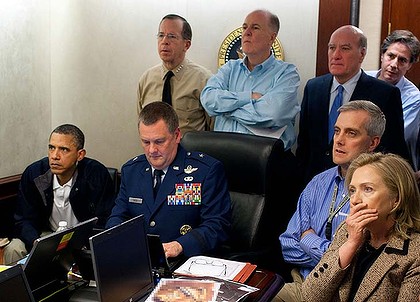

What is similarly unclear is the qualifications of the "judges." As Eric Holder made clear when he (partially) divulged the rationale for the Administration's killings during his speech several months ago in Chicago, "due process" does not necessarily mean "judicial process."

"THE EXAMINATION"
Inherent in the scheme of "training" that Foucault understands to be at the heart of modern imposition of control is a third step: examination. If everyone is subject to observation, and everyone is subject to comparison to some "acceptable" measure of behavior, there must be some ritual(s) wherein the individual is required to stand and prove that they "pass the test."

The strange thing about the current state of U.S. drone killings is that they do not yet hint at what the "examination" stage will look like. At present, people are observed, and judged, and then unilaterally killed. But is that where it will all end?

If Foucault is right, the killings are just the beginning; they are just the leading edge of a much broader pattern of social control.

* * * * *

In the old order of things, power places itself on display, and hopes that the population sees fit to obey. In the new order of things, power compels every member of the population to display himself or herself.

In the old order of things, individualism is the way of the world. In the new order of things, individualism is relegated to the margins - the abnormal - and the cost of extreme individualism is extermination.

In the old order of things, all of society's capability for science and humanism is focused on the operating of due judicial process. In the new order of things, the courts are bypassed and the instruments of discipline -- observe, classify, examine -- run rampant.


Related posts

The biggest idea coming out of the 2013 Drone Summit? We will only deal successfully with the crimes being committed using drones when we understand them as part of the much larger war against communities of color . . . .

(See Drone Gaze, Drone Injury: The War on Communities of Color )


The panopticon was a prison design that reversed the old paradigm, in which prisoners were stored away, "out of sight, out of mind," and instead arrayed them in a way in which they could be observed as efficiently as possible by the fewest number of managers.

(See Drones, 1984, and Foucault's Panopticon)


Re-reading George Orwell's 1984 recently made me see at least 15 ways 2013 is like the world he describes in the book . . . .

See 2013 = 1984 ?


More at: Can we stop the DRONES?

* * * * *

Image sources:
Predator cockpit from Drone Wars UK
Situation room from Churls Gone Wild

Sunday, February 21, 2010

Drones, 1984, and Foucault's Panopticon

Are drones such a menace because of their weapons? Or because of their surveillance? Or is it even bigger? Ask Foucault . . . .

More: "Why focus on drone attacks?"
For those of us who have been focused on the boots on the ground in Afghanistan, data published by the New York Times yesterday added a whole new dimension: it published statistics on drone sorties and strikes in Afghanistan in 2009.

The article is an important counterpoint to the headline-grabbing drone strikes by the CIA in Pakistan, and is worth reading online. What you miss by looking at the online version of the story, however, is the graphs of month-by-month activity, which show several striking trends. Strikes by missiles and bombs from drones were up sharply in the first half of the year; the second half of the year, by and large, showed a slight tapering off. (This was consistent with the overall trend in attacks by aircraft and drones.) At the same time, the number of drone sorties -- that is, missions of all types, including "just surveillance" -- showed a very steady upward trend month by month throughout the year. As the article reports:

"Predators and Reapers [are] now supplying more than 400 hours of video a day to troops in Afghanistan . . . Some of the Reapers will soon carry 10 cameras instead of just one, and 30 by 2011, adding to the profusion of video."

Up until now, when I have thought about drones, I have thought about the ethics of drones as a weapon in general, including the specific problem of whether drone strikes constitute extrajudicial executions under the Geneva Conventions.

I have always also had a nagging sense that there is something wrong with the surveillance aspects of drones, as well. But I didn't become so focused on it until confronted with the numbers.

Science fiction? 15 Ways George Orwell Was Right . . .
There is perhaps no more powerful portrayal of the problem of extreme surveillance than George Orwell's novel 1984. One of my strongest memories of 1984 was the efforts that Winston had to make simply to find a place in his own apartment where he could escape the observation of Big Brother. Perhaps it was because I, like so many other people, encountered the book as a teenager, when privacy suddenly becomes simultaneously so important as well as so hard to come by, that I remember this so clearly.

While popular culture makes frequent explicit references to "Orwellian" situations that involve doublethink, Newspeak, the Thought Police, and the other ideological nightmares of 1984, I wonder if the real nightmare isn't simply the constant surveillance. I, for one, have always thought that lack of privacy is not an absolute evil, but can only be evaluated in the context of what happens as a result of loss of privacy. I'm beginning to rethink that view.

The French philospher Michel Foucault, in his groundbreaking work Discipline and Punish, reviewed the history of society's efforts to isolate and control elements that caused it problems. Ultimately, Foucault zeroed in on the efforts of Jeremy Bentham and the Utilitarians to apply analysis and scientific thinking to prisons. The result was the panopticon.

Jeremy Bentham's "panopticon" (drafted by Willey Reveley)
The panopticon was a prison design that reversed the old paradigm, in which prisoners were stored away, "out of sight, out of mind," and instead arrayed them in a way in which they could be observed as efficiently as possible by the fewest number of managers.

Presidio Modelo prison, Cuba (2005),
followed the panopticon design.
Foucault understood this to be symptomatic of the much larger project of societal rule. To Foucault, prior to the physical and bodily aspects of control and manipulation, there are aspects that have to do with seeing, knowing, naming, and categorizing.

At the end of the day, is surveillance bad if no harm comes of it? Or is it even possible to separate the two? Consider this quote from the New York Times article. Speaking of Stephen P. Mueller, top air commander in Afghanistan, the article stated:
He said the strikes typically came when troops were caught in firefights or the drones came across people who appeared to be planting homemade bombs, the biggest source of allied casualties. The counterinsurgency strategy "isn't about going out and finding those," he said. "But when we do find them, we obviously do what's necessary."
Obviously.


MORE:

Foucault and Drones: "Surveiller et Punir" Indeed!

Drone Gaze, Drone Injury: The War on Communities of Color

Why U.S. Society is Caving in to the Lure of Wall-to-Wall Surveillance

When the President says, "The American people don't have a Big Brother who is snooping into their business," it probably means the American people have a Big Brother who is snooping into their business . . . .

Fed Up With Being Spied On

DRONES: Build a Foundation for Our 3-D Future

Drone Killings: Come Clean

Orwell Was Right

Wednesday, August 31, 2022

When Artificial Intelligence Takes Over, We'll Say, "You didn't take it. I gave it to you."

One of the earliest posts I wrote on this blog as about how technology -- particularly drones -- have put us under the the gaze of the state in a way we thought was only possible in science fiction: "Drones, 1984, and Foucault's Panopticon." I've written a lot more about drones, 1984, Foucault, and surveillance in subsequent posts.

Since that time, I've also internalized what I understand to be Foucault's central premise: the temptation to have power over other people is enormous, and it's particularly difficult to resist when it is accomplished in the guise of something else, something that we tend to consider very positive -- observing, comprehending, recording, organizing.

That has spiritual implications at the level of individual experience -- the observing, comprehending, recording, organizing that we do as we seek to navigate the external world -- and that is something I plan to write about in a future post.

But it also has implications for the ways in which we are subjected to observing, comprehending, recording, organizing. I've become more and more aware of the way that the many tiny bits of data that we now slough off each day, like so many dead skin cells, add up  -- in the hands of large computer operators (Big Data) -- to terrifyingly complete and intimate pictures of our personal lives. 

Some time in late 2020, I watched the documentary, The Social Dilemma, on Netflix: "This documentary-drama hybrid explores the dangerous human impact of social networking, with tech experts sounding the alarm on their own creations." The whole documentary is insightful, and the commentary by Jaron Lanier is particularly good. My key takeaway from that documentary was: don't talk about "if" artificial intelligence (A.I.) takes over, as if it is something in the distant future; AI is already operating on us in the form of the social networks that we participate in day after day.

What I've particularly struggled with since then is this: how can we ordinary people use social media to benefit us, without all of it falling into the maw of A.I.?

It made me think of this picture that one of my kids drew when they were about three (above).


(At the time it was amusing, and my main feeling was pride at how clever my child was. It reminded me of Grendel, and I wondered if they had been reading Beowulf behind my back. Now I'm more terrified .... )

The thing that is so painful is that, each day as any of us interacts with Facebook, Twitter, Instagram, Linkedin -- or even this blog -- not to mention every Google search or credit card purchase, we are not being strong-armed into coughing up our deepest secrets -- we're willingly surrendering them! (To quote Roy in the movie Matchstick Men, "You didn't take it. I gave it to you.")

So, yes, Foucault ... power, observing, comprehending, recording, organizing. Yes: drones. Yes: Big Brother; yes: surveillance. 

But maybe the BIG question we each need to ask ourselves when we wake up each morning is:

"How much – and what type – of data will I surrender today?"

Monday, July 28, 2014

Why U.S. Society is Caving in to the Lure of Wall-to-Wall Surveillance

I was reuning with high school friends last week. One of them is now a principal in a suburban elementary school. He loves his work -- and I can't think of a better person to be shaping young lives.

Over a diner breakfast one morning, he said, "You know, Joe, we now have cameras throughout the school. So when a parent calls and says their kid had a problem, we can pull up the video and see exactly what happened." He told me that many schools installed camera systems in the wake of the Newtown shootings. (See for instance Schools beef up security after Newtown; cameras, panic buttons installed)


For him, as a principal, total visibility into the school is great. (Just imagine trying to settle a he-said, she-said dispute without being able to go back to replay.)

And the technology supports crisis management, if that should become necessary. (Local police are able to link in to the system.)

Of course, there are limits. There are no cameras in the bathrooms. (Yet.)

My friend is aware of my work on the issues of surveillance and drones. We talked about some of the philosophical and ethical issues. In general, the children in an elementary school are assumed to require the oversight and direction of school staff, so it is not unreasonable to have adults watching the children. On the other hand . . . .

I proposed a thought experiment: "Can you envision a situation in which a parent came to you about an issue, and you might elect to not make use of the video record? What would it be like to engage the people involved in resolving the conflict without being impacted by that video?"

(I think that my proposal was stimulated by the fact that what had been really interesting to me was listening to his descriptions of engaging with young boys who were engaging in troublesome behavior. As he recounted the way he talked to them, I thought, "He is not coming at them from a position of power and threat; he's using empathy, humor, modeling.")

We talked about the work of Michel Foucault, and his insights about how observation -- especially total observation -- is the tip of the iceberg in a system of one-way control. From the time I started focusing on the problem of drones -- about four years ago -- the work of Foucault and the alarm he raised about the "panopticon" society has been in the front of my mind.

How does someone who holds in his hands the power to see everything resist the temptation to control, and instead focus on the need to understand?

This conversation helped crystallized for me the broad insight: "Surveillance is useful and also threatening."

I hope a large number of people will take this up and struggle with it.


Here's more on the issue as it relates to schools: "Privacy vs. Security: Are you prepared for the thorny issues surrounding student surveillance?" by David Rapp in Scholastic. 


Related posts

The panopticon was a prison design that reversed the old paradigm, in which prisoners were stored away, "out of sight, out of mind," and instead arrayed them in a way in which they could be observed as efficiently as possible by the fewest number of managers.

(See Drones, 1984, and Foucault's Panopticon)


In the old order of things, power places itself on display, and hopes that the population sees fit to obey. In the new order of things, power compels every member of the population to display himself or herself . . .  In the new order of things, the courts are bypassed and the instruments of discipline -- observe, classify, examine -- run rampant.

(See "Surveiller et Punir" Indeed!)


A large number of people are marked for exclusion and deprivation -- and worse -- because they have characteristics that are susceptible to the whole apparatus of power:  they are easily recognizable as  NOT "normal" or "right" or "acceptable" . . . under the gaze of surveillance this condition is recorded and propagated . . . for perpetual recording and processing within the data centers of power . . . accompanied by intermittent acts of physical and cultural injury -- random, senseless -- to reinforce their unshakeable status. 

(See Drone Gaze, Drone Injury: The War on Communities of Color)


Re-reading George Orwell's 1984 recently made me see at least 15 ways 2013 is like the world he describes in the book . . . .

See 2013 = 1984 ?

Friday, July 11, 2014

Why GROUNDED Is Soaring: Putting Drone Dilemmas In Your Face

Grounded ended its run at the Greenhouse Theater Center on July 13, and my summer wish is that it can be brought back for an extended stay.


Gwendolyn Whiteside in GROUNDED


You can get lots of detail on the production in Tony Adler's review in The Reader ("A pilot brings the war home in American Blues Theater's Grounded: George Brant scores a direct hit with his one-woman play"); what I want to stress here is:

Gwendolyn Whiteside is an amazing actress. I was sitting 2 feet away from the stage, and I found myself attracted and scared at the same time. I kept wanting to get a word in edgewise, interrupt her cocky assertions, but also just hoping to be able just to sidestep her. I had to remind myself again and again that the wasn't a real fighter/drone pilot, that this wasn't really happening to me . . . .

The play itself is pitch-perfect. Gwendolyn Whiteside has help delivering an amazing performance because every word in this play works. And the other aspects of the production - staging, sound, video projections - all contribute to putting you in the boots of a "pilot" who drives back and forth through the Nevada desert every day . . .  shuttling . . . between home (sincere husband and pink-pony-wielding toddler) . . . and "combat" (a dark, air-conditioned trailer where she stares at images of the putty-colored Middle East terrain transmitted by a Reaper drone's cameras).

Grounded raises tough questions. I was hoping that the play would challenge the idea that killing people with drones is good. It's a reflection of the seriousness of this work that that is just one of the issues it raises; others include our society's willingness to destroy the people who we employ to "serve" ("serve our country," serve us in general), our culture's worship of violence / use of force, and the consequences of pervasive surveillance.

Find a way to see Grounded. And tell others.


[UPDATE November 15, 2014 - A quick check on Google indicates that GROUNDED is being produced in numerous productions around the country.  Look for one near you -- and if there isn't a nearby production, talk to a theater company in your area and ask, "Why not?"]

[UPDATE May 17, 2015 - Anne Hathaway takes GROUNDED to Broadway: http://www.nytimes.com/2015/04/27/theater/anne-hathaways-solo-turn-as-a-fighter-pilot-in-grounded-at-the-public-theater.html ]

Anne Hathaway in GROUNDED at the Public Theater


Related posts

At the end of the day, is surveillance bad if no harm comes of it? Foucault understood this to be symptomatic of the much larger project of societal rule. To Foucault, prior to the physical and bodily aspects of control and manipulation, there are aspects that have to do with seeing, knowing, naming, and categorizing.

(See Drones, 1984, and Foucault's Panopticon)


Leveling Up is the creative work that demonstrates just how thoroughly America's new ways of warfare have become intertwined with the other dominant strands in our culture.

(See Level Up, Step Up, Grow Up, Man Up . . . Wake Up)


In Chicago on Good Friday, 2013 (March 29), a cast consisting of long-time Chicago antiwar activists was joined by a NY playwright (and defendant in actions against US drone bases), Jack Gilroy, for one of the events kicking off a month-long campaign of anti-drones events across the country: a performance of Gilroy's play, The Predator.

(See "The Predator" in Chicago - Good Friday, 2013 - "A Passion Play for the Drones Era")

Tuesday, January 21, 2014

What I Learned About Obama's Surveillance State at the NATO3 Show Trial

I won't be in the gallery when the trial of the NATO3 starts in Chicago today. The usual public access to the Cook County court system has been suspended; the courts have been overtaken by the Obama security state and its rules.

The foundation of the American system is trials that take place in "open court." Courtrooms are fundamentally public spaces; a few spaces are reserved for the officers of the court - the judge, the lawyers, etc. - but there should never be any mistake about the fact that what is taking place there is to serve the public, and is subject to scrutiny by the public.

I got a taste of this a few years ago when I was working on a patent case.  A lawsuit had been filed against Gillette for patent infringement, and we were beginning a trial in U.S. Federal Court in downtown Chicago.  When it got time to get into the details of Gillette's actual infringement of the patent, the attorney for Gillette argued that the court should be cleared, and the transcripts of the proceeding be sealed, lest the company be irreparably harmed by the leakage of the details of their manufacturing process.  The judge gently but firmly reminded counsel for Gillette that the institution of "open court" is rather important in our system; she wasn't going to start messing with it without a darn good reason.  (She did request that if there were any industrial spies working for Gillette competitors in the courtroom, they should please leave.)

So I am saddened that the judge in the NATO3 case now taking place in Chicago has set up rules that are clearly intended to keep the public out of the courtroom.  Even more shocking to me than the fact that members of the public are barred from the gallery unless they (a) make an in-person visit to the court building at 26th and California a full day in advance of the day they wish to attend and register; and (b) submit to a background check, is the fact that the judge tried (but was talked out of) barring observers from taking notes of the proceeding.

OK, we're getting used to our government conducting their affairs in secret. (By the way, that is one of the bizarre features of a "show trial" -- it is conducted for maximum publicity but there is nothing truly "public" about it.) Under our increasingly secret-driven government, the people get to see NOTHING about the conduct of the government.  On the other hand, the government sees EVERYTHING about us.  And so, if just one shred of truth manages to get into the public view as a result of this trial, it should be the way surveillance was used by the Obama administration against the Occupy movement.

The story of the surveillance of the NATO3 -- the REAL story to come out of the trial in Chicago this week -- is the tip of the iceberg of a national program of surveillance against anyone and everyone who participated in the Occupy Movement.

I predict that by the time the NATO3 trial is over, people will be saying, "Before Edward Snowden, before the revelations about the NSA, we already had clear signs that the US government wanted total surveillance over us.  Just look at how they reacted the minute they started to see dissent from the general public: the Occupy Movement."

Related posts

If you have any doubt that the U.S. government wants to observe EVERYTHING you do, perhaps its time for Foucault 101. Consider the panopticon  . . . .

(See Drones, 1984, and Foucault's Panopticon)


The Amash Conyers Amendment to curtail NSA spying was advanced in the U.S. House of Representatives shortly after the Snowden revelations. It narrowly failed -- in part due to the votes of some so-called "progressive" Illinois representatives.

(See In Chicago, Illinois: YOU ARE UNDER SURVEILLANCE! )


One issue that has a key place in the midterm elections in 2014, I believe, is surveillance.  With each passing day, I am hearing more and more people say that the surveillance issue is something that a wide spectrum of people are deeply upset about. That includes people on the right as well as people on the left -- people who don't usually talk with each other, much less work together for positive change!

(See The Surveillance Issue: The Fulcrum of the 2014 Election?)

Thursday, November 21, 2013

Drone Gaze, Drone Injury: The War on Communities of Color

Here's what I was thinking about as the 2013 CODEPINK Drones Summit concluded: "There is a wing of this movement that is concerned about surveillance; there is a wing of this movement that’s concerned about physical injury to people. If there is one area where there is not always full communication, coordination or agreement, that’s it. . . . If the people who feel most concerned about surveillance are actually successful at sitting together with the people concerned about physical injury, this is going to be an incredibly powerful movement." (See Drone Free Zone: At the second annual Drone Summit, Code Pink and Cornel West argue that all lives are equal. in In These Times quoted me the day after)

"This movement," of course, is the movement to stop drone surveillance and warfare. During the summit we need an enormous amount of progress in building the national (and soon-to-be global) network to stop drone surveillance and warfare. Are there really two different wings -- two different struggles -- or is it, in fact, a single struggle?

What do we mean by "surveillance"?

There is a full-blown effort by individuals and organizations to rein in the use of drones to do surveillance, with some notable recent successes.  A lot of this revolves around words like privacy, search, and warrants; and it is closely tied to NSA abuses and the ubiquitous stationery surveillance cameras in many cities.

Some activists are recognizing the important connections to the use of drones and other technology on the US border, and by government agencies working to repress political dissent.  People are even grudgingly recognizing the centrality of monster data storage and data processing capabilities in making the entire surveillance "octopus" functional.

I wonder if we don't need to go yet another level deeper. When I first began thinking about drones, I asked, "Does this possibly have something to do with what Foucault talked about?"

I'm not a very good philosopher, so it's taken me a long time to really understand the role of surveillance -- of the uninterrupted gaze -- within a large system of power and control.  I'm now beginning to understand that the idea that there are standards of "normal" or "right" or "acceptable" behavior, and that someone (who?) gets to set those standards, and then enforce those standards, is the inherent root condition that manifests itself in ubiquitous surveillance. (See Foucault and Drones: "Surveiller et Punir" Indeed!)

Think of that -- the desire and determination to be the "decider" about standards of "normal" or "right" or "acceptable" -- as the kernel that sits at the absolute center of the surveillance problem.

What do we mean by "injury"?

As I departed from the first drones summit -- the one held in April, 2012 -- the biggest realization for me was that the physical injury that the US inflicts on others is hidden from view, rendered invisible; and that the number one job of activists was to reverse that situation -- to make those injuries visible to everyone -- 100% visible!

The central importance of physical injury must never be lost.  At the same time, we are beginning to recognize the broader impact of drone strikes, and the daily presence of the hovering drone threat, in traumatizing whole communities, and whole sections of countries.  (See Living Under Drones.)

Salima by Nanna Tanier
Years ago, my sister wrote a book called The Body in Pain. The subtitle was "the making and unmaking of the world."  The book said many things, one of which was that the behavior of power when it inflicts pain and injures bodies is often combined with efforts to more broadly destroy the world of the victim -- and by extension, those connected to the victim -- and that the physical manifestation (pain and injured bodies) and the more abstract manifestation (individuals and communities whose are destroyed) should be understand to be inextricably interconnected, and in the service of a single end: the exercise and reinforcement of power.

What happens to communities under the gaze of drones?

One of the biggest ideas coming out of the 2013 Drone Summit, in my opinion, is that we will only deal successfully with the crimes being committed using drones when we understand them as part of the much larger war against communities of color.  This message was brought home in presentation after presentation -- starting with the inspirational words of Cornel West, continuing with the testimony of representatives of Yemen, Pakistan, Afghanistan and other countries who came to tell their stories-- and reinforced by comment after comment by conference participants.

We need to commit totally to resisting that larger war.

There is a small number of people who enjoy privilege and supremacy.  They are a useful category for those who decide what is "normal" or "right" or "acceptable." Often, they image that they are autonomous actors in the power structure. But they are just a useful category.

A far larger number of people are marked for exclusion and deprivation -- and worse -- because they have characteristics that are susceptible to the whole apparatus of power:  they are easily recognizable as  NOT "normal" or "right" or "acceptable" . . . under the gaze of surveillance this condition is recorded and propagated . . . for perpetual recording and processing within the data centers of power . . . accompanied by intermittent acts of physical and cultural injury -- random, senseless -- to reinforce their unshakeable status.  

THIS is the war on communities of color.

(Thanks to Noor Mir at CODEPINK for inspiring this post with her recommendations about the direction of the national and global movement against drones.)


Related posts


Palestine 30 CE - were Jews a "community of color?" And what was Empire doing to keep the community within "normal" or "right" or "acceptable" bounds? And what happened to people who looked like the "wrong" type?

(See Was the Crucifixion a "signature strike"?)


In the city where I live, "normal" or "right" or "acceptable" has been given a brutal construction by the power structure:

Police encounter black man on street
Police shoot black man
Black man dies
(Business as usual in Chicago.)

 (See We need to get the police off the streets of Chicago. QED.)


In 2013 America, we have been conditioned to feel anything associated with Middle Eastern and/or Muslim men should trigger feelings of suspicion, fear, and hatred. And when those cues are triggered, all of our objectivity and healthy skepticism goes out the window.

(See Orwell and the Uses of Hate)


The outstanding aspect of the "global hibakusha" phenomenon that I learned about at the World Nuclear Victims Forum in Hiroshima was that in situation after situation, great harm is done because someone has the attitude that "these people don't matter."

(See GLOBAL HIBAKUSHA: The Result of the "People Who Don't Matter" Mindset )


We live in a 24/7 entertainment and media culture, and it is a constant struggle to shift from being a passive participant in the dominant cultural narrative to being an active influence on the ideas circulating in our communities.

(See In 2016, Walk the Talk: "Anti-Islamophobia." (You can do it.) )

Monday, January 2, 2017

2016: Why was everyone reading these posts?

Posts on nuclear disarmament, the global peace movement, the Evangelical Lutheran Church in America (ELCA), social justice, and more.

Well, okay, not everyone . . . but a lot of people read an unusual combination of posts on Scarry Thoughts on 2016. Here's what I'm discovering . . . .


Can "Lutheran" Be a
#BlackLivesMatter Denomination?
Three Popular Posts

The post that lit up the most was a report on a letter about the need for anti-racism work, and for examining white privilege, within one of the mainline Protestant denominations in the US: the Evangelical Lutheran Church in America (ELCA).

(See below for two other ELCA-related posts in my 2016 top ten.)

Somewhat surprisingly, the second most frequently read post was from three years ago: "Ownlife" - A Notion Too Dangerous for the State to Tolerate? I think the reason it continues to strike a chord with people is that people feel life accelerating, and their personal space shrinking. This become terrifying in an age of big data and government surveillance.

Drones, 1984, and
Foucault's Panopticon
And in a related development . . . 

The third most frequently read post is even older: it was one of the first posts I ever wrote, back in 2010.

I'm not sure whether so many people read it because they're concerned about drones, or because they are disciples of Foucault, or because they are realizing we live in a surveillance state. Maybe all three.


Nuclear Disarmament

I have written a lot on the need for nuclear disarmament in recent years. Four posts attracted a lot of attention:

Meetings in DC in September, 2016, led me to write NUKES: Your Call to Your Congressman Matters.

What Would a Nuclear
Weapon Do to Chicago?
(Go ahead, guess . . . )
.
A post from 2 years continues to help people the grasp the terror of what nuclear weapons promise to do where they, themselves, live: What Would a Nuclear Weapon Do to Chicago? (Go ahead, guess . . . ).

And a post from my trip last year to the cities where atom bombs were used: Nagasaki: Impressions.

People continue to use this page to learn about my sister's book: Reviews of "Thermonuclear Monarchy: Choosing Between Democracy and Doom" by Elaine Scarry .

(A lot more to come on this in 2017.)


PEACE DAY 2016: What comes first?
Demilitarization? or Development?
Global Peace Movement

This past year, I wrote a number of posts related to the Sustainable Development Goals (SDGs) and the peace movement.

I have a lot of work to do in the coming year to develop ideas that will be helpful to the global peace movement.


More on Church and ELCA

In addition to the #BlackLivesMatter post mentioned above, people read two other posts a lot:

ELCA Resolution on Palestine / Israel: What Does It Mean for Us?

"Personal Success Story"? "White Privilege"? or Both?

I have high hopes that we are going to see exciting things in the ELCA and other denominations in 2017.


Please share this post with others . . . .

Wednesday, December 28, 2011

2011: Scarry Thoughts That (Maybe) Made A Difference

Looking back over my blog posts for the past year, it's interesting to discover that some definitely had a bigger impact than others. Is it because they were on subjects people care a great deal about? Or because they were well-written? Or simply because they were well-promoted? Food for thought ....

Here are the blog posts that got a lot of traffic and/or on which people spent a lot of time:

#NoIranWar
I'm A Tuesdayista!
#AfghanistanTuesday
Afghanistan Protests
Chicago: All Signs Point to Revolution
Oldies but Goodies
My Personal Favorites


(1) #NoIranWar - Published just a few weeks ago, this blog post about seven big reasons people should be wary of the growing talk of war with Iran has been the sixth most viewed post over the past four months. The high level of traffic may have to do with active promotion on Twitter, and with links from Antiwar.com.

More interestingly, the average time spent reading the post is over 6 minutes. Clearly, people are deeply interested in the threat of U.S. military action against Iran.

This blog post has become closely associated with the #NoIranWar tag on Twitter, and I hope it continues to be an important part of the movement to resist war with Iran.


(2) I'm A Tuesdayista! - This page -- about being one of the dedicated participants in #AfghanistanTuesday -- was viewed more than any other page over the past four months. I think this is mainly because many people were invited individually via Twitter messages.

Considering the large number of views that seem to be attributed to direct invitations, it is somewhat surprising that people spent an average of over 3 minutes reading the Tuesdayista blog post. I think it is because people understand how important it is to not just participate in tweeting about ending the war in Afghanistan, but also to attract additional people to do so, too. That's what being a "Tuesdayista" is all about.


(3) Making an Impact on #AfghanistanTuesday - This was the page that launched a thousand tweets -- or, anyway, became the explanation for #AfghanistanTuesday back when it was a new idea. Since this page was first published in August, I've published dozens of other #AfghanistanTuesday pages. But this is still one of the most viewed -- and, if the length of time people spend on the page is any indication, most thought about -- guides to the topic.

Here are two other posts about #AfghanistanTuesday that people have viewed a lot:

#AfghanistanTuesday - Top Tweets List - Understandably, this gets viewed a lot, because it is a growing list of the top tweets for each list, AND a list of the top tweeps, AND a list of important #AfghanistanTuesday hash tags.

#Occupy Tuesday! #UNoccupy Afghanistan! - This is one of the newest posts, and is taking #AfghanistanTuesday to the next level: how do we go beyond Twitter?


(4) The Hour is Approaching: Make a Commitment! - This was one of many posts that dealt with protests marking the 10th Anniversary of the war in Afghanistan. It asked, "What can YOU do to be an active participant in driving toward COMMITMENT on the part of millions of people to end our wars?"

Many people clearly have been -- and continue to be -- asking themselves, "What am I prepared to do?" Other big traffic pages involved the actual October 8 protests themselves, and other similar protests:

Chicago Antiwar March: October 8, 2011 - This post included links to information about all the speakers on October 8, plus press coverage and follow-up activities.

Chicago - Dec 10 Human Rights Day Protest - This post talked about the main protest on December 10, plus film screenings and talks taking place later the same weekend.


(5) Chicago: All Signs Point to Revolution - Ever since October, the Occupy movement has been a growing subject of blog posts. This one got an especially large amount of attention, and it seems to have made people think (judging by the fact that they spent an average of more than five minutes on the page!).

This was one in a series of blog posts associated with hand-drawn "Scarry Signs" that I made for protests in Chicago.


(6) Oldies But Goodies - Several posts continued to get views long after they were published. They deal with issues that people continue to be curious about, and frequently search on Google.

Holocaust Museum: "Those Nazi Bastards!" - This is a heavily-viewed piece, with a lot of organic traffic generated by the search terms "Nazi" + "dog".

Drones, 1984, and Foucault's Panopticon - This continues to get a surprising number of hits. Apparently, a lot of people search on the terms "Foucault" + "panopticon"! (Who knew?)

Flag Symbolism in Hong Kong - This was one of a series of posts about protest images from Hong Kong that I wrote about in early 2010, and they continue to get traffic!


(7) My Personal Favorites - My favorite posts aren't always the ones that are viewed most heavily. These five are very close to my heart:

Why Weren't People Talking About It? - What I learned from my mom. (I need to write a lot more posts about Mom!)

Never Try to Silence a Tuesdayista - A rare opportunity to combine two of my greatest loves: activism and botany!

Obama Nobel Peace Prize - REVOKED! - People seemed to have no trouble believing that the King of Norway made a special trip to Chicago to revoke the Nobel Peace Prize awarded to Barack Obama in 2009.

Seven Little Words in Kuwait I've been involved with the film, "The Response," for several years now. This piece described the most exciting development yet.

WWJD? Occupy! - The last shall be first? Expect to be hearing a lot more on this subject in 2012!

Sunday, June 23, 2013

Orwell: Making the Drone Killing Visible

[Part of the series: 2013 = 1984?]


I've written about how important for us to realize that drone killing is not just something that's happening "out there" somewhere; we need to make drone killing 100% visible to the rest of the American public -- i.e. to the people responsible for it.


Steamer! Bang over'ead!

George Orwell, writing in 1949, made the drone killing visible -- even though "drones" didn't technically exist at the time.
"Steamer!" he yelled. "Look out, guv'nor! Bang over'ead! Lay down quick!"

"Steamer" was a nickname which, for some reason, the proles applied to rocket bombs. Winston promptly flung ihimself on his face. The proles were nearly always right when they gave you a warning of this kind. They seemed to possess some kind of instinct which told them several secondes in advance when a rocket was coming, although the rockets supposedly traveled faste than sound. Winston clasped his forearms about his head. There was a roar that seemed to make the pavement heave; a shower of light objects pattered onto his back. When he stood up he found that he was covered with fragments of glass from the nearest window.

He walked on. The bomb had demolished a group of houses two hundred meters up the street. A black plume of smoke hung in the sky , and a below it a cloud of plaster dust in which a crowd was already forming round the ruins. There was a little pile of plaster lying on the pavement ahead of him, and in the middle of it he could see a brigh red streak. When he got up to it he saw that it was a human hand severed at the wrist. Apart from the bloody stump, the hand was so completely whitened as to resemble a plaster cast. (1984, p. 74)


Today, we have a full battery of research and analysis to document the experience of living under drones. And yet, didn't Orwell lay it out for us long ago?

They didnt oughter of showed it . . .

In 1984, the transgressive act that starts Winston Smith on the path of resistance is writing in a diary, and the memory that he chooses to record is an eerie vision of our own time:
April 45h, 1984. Last night to the flicks. All war films. One very good one of a ship full of refugees being bombed somewhere in the Mediterranean. Audience much amused by shots of a great huge fat man trying to swim away with a helicopter after him. first you saw him wallowing along in the water like a porpoise, then you saw him through the helicopters gunsights, then he was full of holes and the sea round him turned pink and he sank as suddenly as though the holes had let in the water. audience shouting with laughter when he sank. then you saw a lifeboat full of children with a helicopter hovering over it. there was a middleaged woman might have been a jewess sitting up in the bow with a little boy about three years old in her arms. little boy screaming with fright and hiding his head between her breasts as if he was trying to burrow right into her and the woman putting her arms around him and comforting him although she was blue with fright herself. all the time covering him up as much as possible as if she thought her arms could keep the bullets off him. then the helicopter planted a 20 kilo bomb in among them terrific flash and the boat went all to matchwood. then there was a wonderful shot of a childs arm going up up up right up into the air a helicopter with a camera in its nose must have followed it up and there was a lot of applause from the party seats but a woman down in the prole part of the house suddenly started kicking up a fuss and shouting they didnt oughter of showed it not in front of the kids they didnt it aint right not in front of kids it aint until the police turned her turned her out i dont suppose anything happened to her nobody cares what the proles say typical prole reaction they never -- (1984, p. 7-8)


Orwell's insightful foretelling of our love affair with aerial killing raises several questions:

(1) What Orwell describes sure sounds like drone killing. Does it really make any difference whether the killing machine actually has a human pilot in it, instead of controlling it from a distance?


(2) What's more significant here -- the killing itself, or the entire pattern of control exercised by the person(s) directing the camera? What are we to make -- really -- of the marriage of weapon to camera?


(3) How do you explain the reaction of the spectators described by Orwell? Can this possibly be realistic?


Do high school students still read 1984? How long will it be before our drone-addicted government realizes what a "dangerous" book this is and takes it out of the schools?

Read 1984. While you still can.

(Page references are to the 2009 Plume paperback edition.)


Related posts

With drones, people become just dots. "Bugs." People who no longer count as people . . . .

(See Drone Victims: Just Dots? Just Dirt? )


At the end of the first day of the 2012 CODEPINK drone conference, I came to a realization: the fundamental problem that we had all gathered to address is that drones render killing 100% invisible. And as long as the killing is invisible, we lose the most powerful tool we have for fighting the killing: the disgust and outrage of the general public.

(See Make Drone Killing 100% VISIBLE!)
 

I was back in New Jersey to visit with high school friends in July. It gave me the opportunity to visit the newly opened 9/11 Memorial. Not surprisingly, what I saw made me spend days and weeks thinking about the memorial itself, and the larger issue of 9/11 in our national life. Out of all that I have seen and heard and read and thought about, several thoughts keep rising to the top.

(See 9/11 Memory: Grieving and Celebrating Valor, Leaving Vengeance Behind )