Showing posts with label resistance. Show all posts

Sunday, December 22, 2019

A Response to "The Wall" (a.k.a "the Separation Barrier")

During my time in Chicago, an annual tradition was the Good Friday Justice Walk.

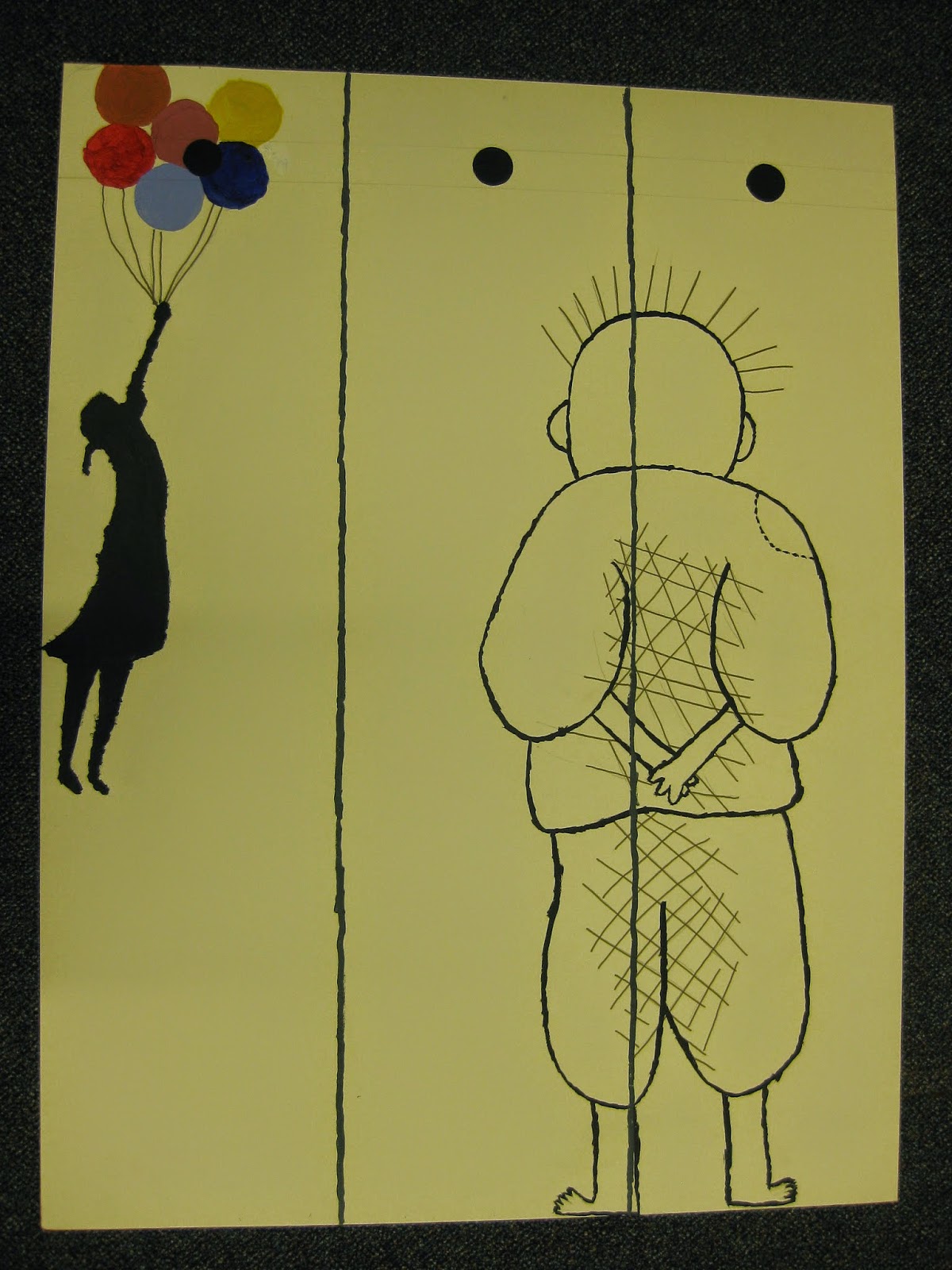
In 2014, the group of Palestine solidarity activists I worked with did a project to help people learn about and imagine the impact of the Wall (also known as the Separation Barrier) in Israel.

Palestinians and visitors from throughout the world have added their own street art, graffiti, and public art to the Wall, as a sign of protest, an invitation to peace, and a critique of the lack of global intervention. Our project consisted of making a series of posters that replicate the art on the Wall. Here's an example:


(I first became sensitized to the importance of wall-art-that-protests-the-wall -- the power of art to demand a new, liberated reality -- in an essay my sister wrote about the Berlin Wall in the late 1980s.)

I have posted photos of the other wall boards we created below.

When placed side-by-side, the boards created a replica (in miniature) of the barrier wall:


"The Women Weep" in the shadow of the containment wall
34th Annual 8th Day Good Friday Justice Walk in Chicago


You can read about the project on the blog of the ELCA Metro Chicago Synod Working Group on the the Middle East.

The project had important "before" and "after" aspects, too.

Making the boards was half the fun. Check out these photos of the "Wall" sign board painting workshops - March and April 2014

. . . and . . . several months after the event, Chicago area readers of the Evangelical Lutheran Church in America (ELCA) publication The Lutheran got to read about the project in that publication (see image at right).

In 2015, I had a chance to see the barrier wall in person. It left me with an ineradicable determination that every Christian needs to become devote to the in-this-world work of liberation.


Resistance art on the wall -- Aida refugee camp, Palestine


Full set of photos
The Wall: posters created by the ELCA Metro Chicago Synod Working Group on the the Middle East for the Good Friday Justice Walk in Chicago in 2014.


"Now that I've seen it I'm responsible for it."


"U.S. aid: injustice anywhere is a threat
to justice everywhere. (MLK Jr.)"


"The wall is lame."


"An eye for an eye leaves the whole world blind."


Hope


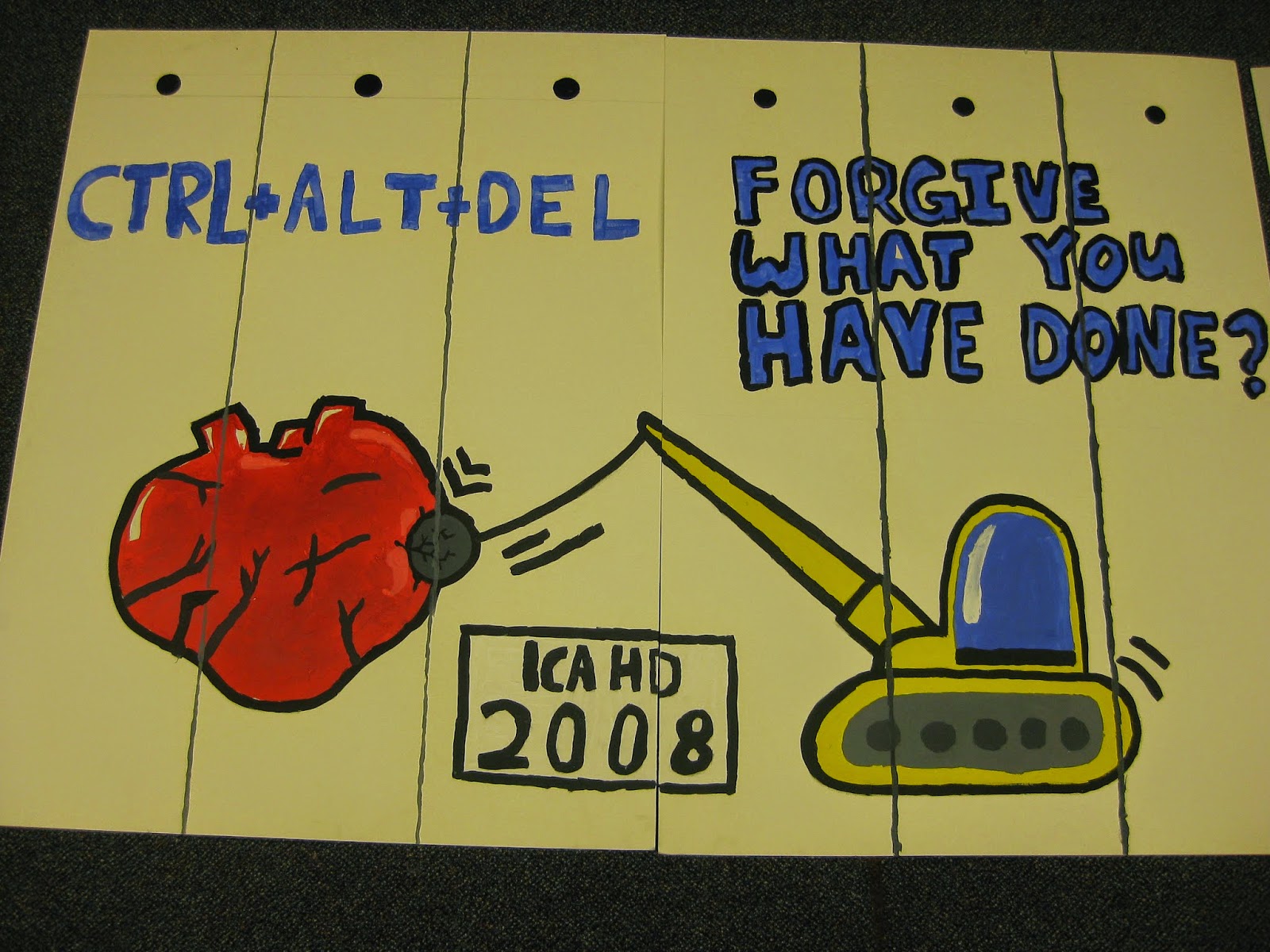
"ctrl + alt + del ... Forgive what you have done? ... ICAHD 2008"


"A country is not only what it does. It is also
what it tolerates. Kurt Tucholsky 1933"


"War is not the answer."


"Your heart is a weapon the size of your fist.
Keep fighting.
Keep loving."


"I am not a terrorist."

Monday, May 1, 2017

June 17 - March to Ban the Bomb #Nuclearban

Ban the Bomb - from A to Z!
#nuclearban
(Please share this message on Twitter.)


Ever since I learned about the massive 1982 no nukes march in New York City, I've felt a mass mobilization needed to be part of the #nuclearban campaign.

Now a march is scheduled for June 17 in NYC -- to coincide with the three week UN session to negotiate a global ban on nuclear weapons.

Please help get the word out -- share the messages below, and create messages of your own. And please support womenbanthebomb.org.


"A" is for "Activists" -- making the #nuclearban happen!
(Please share this message on Twitter.)


B, C, D ...
#banthebomb #campaign #disarmament

(Please share this message on Twitter.)


"E" is for ENOUGH!
Ban #nuclearweapons.

(Please share this message on Twitter.)


"F" is for FUTURE!
(let's make sure we have one)

(Please share this message on Twitter.)


"G" is for the GLOBAL #nuclearban movement!
(Please share this message on Twitter.)


"H" is for HEALTH
(Please share this message on Twitter.)


*     *     *


"J" for JOIN!
(Please share this message on Twitter.)


*     *     *


"L" for LIFE
(Please share this message on Twitter.)


"M" is for #MothersDay  ... and MARCH!
(Please share this message on Twitter.)


"N" is for #nuclearban ... #NOW!
(Please share this message on Twitter.)


*     *     *


"P" is for PEOPLE ... PEACE ... and PLANET!
(Please share this message on Twitter.)


*     *     *


"V" is for VOICE!
(Please share this message on Twitter.)


"W" is for #WorldWide #WednesdayWisdom: #Women #BantheBomb!
(Please share this message on Twitter.)


*     *     *


"Y" is for 100+ countries saying "YES!" to #nuclearban at the UN.
(Please share this message on Twitter.)


Thank you!

Monday, February 13, 2017

Berkeley Organizing Congregations for Action (BOCA) Leads Black History Month Vigil: "Remember Our Names"

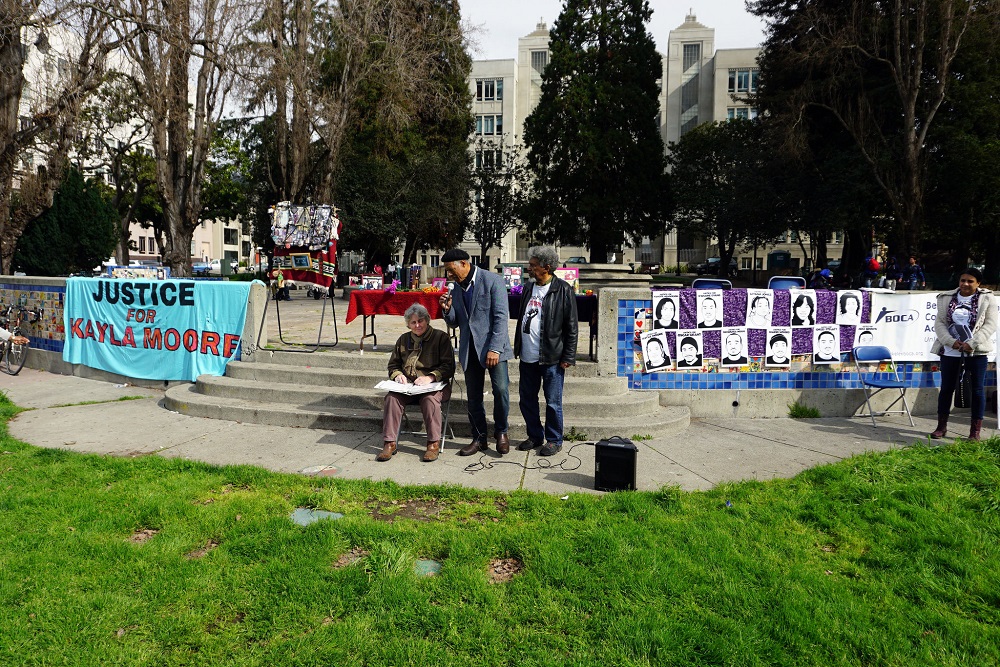
Several groups worked together on Monday in Berkeley to lift up the names and stories of people who have suffered from police violence and other forms of systemic racism in the US. The vigil by members of Berkeley Organizing Congregations for Action (BOCA), Justice 4 Kayla Moore, and Berkeley Copwatch was titled "Remember Our Names Black History Month Prayer Vigil" - and took place for five hours between noon and 5:00 p.m. in the Martin Luther King Jr. Civic Center Park, facing Berkeley City Hall and the headquarters of the Berkeley Police Department.


Members of St. John's Presbyterian Church share names and stories.
(Photo: Mark Coplan)


February 13 is the anniversary of the murder of transgender African American woman Kayla Moore by the Berkeley Police Department 4 years ago. (See SAY HER NAME: Kayla Moore and the Struggle for Justice)

"Remember Our Names Black History Month Prayer Vigil"
(Photo: Mark Coplan)
The photo at right shows the backdrop for the event: the Justice for Kayla Moore banner at left, images of victims of killings by police at right, and artwork by event founder (and BOCA executive director) Rev. Daniel Buford on the raised central area. Rev. Buford is at center, wearing the beret. Kayla Moore's sister, Maria Moore, stands at the far right.

Many people gave testimony about the violence being carried out by representatives of the state all across this country, and particularly against people of color. Dozens of accounts, from research compiled by Rev. Buford, were read and discussed. People shared stories of violence and killings and other injustice that they had been subjected to, or that had affected their friends or families or other members of their communities.

Many people from the congregation I attend, University Lutheran Church (ULC), participated in the vigil. We at ULC have made an intentional commitment to anti-racism work, joining in solidarity with other justice activists in our city, our state, and nationally.

For my own part, I used my time at the microphone during the vigil to lift up the names of some people I have known and/or learned about through my work in Chicago before coming to Berkeley.

I talked about Flint Farmer, who was shot in the back by Chicago police and killed, as he lay face down on the ground. (See: We need to get the police off the streets of Chicago. QED. ) And I talked about Flint's father, Emmett, who I has become a tireless campaigner for justice on behalf of all people subjected to police violence. I said that each time I see the way Maria Moore has devoted herself to activism in response to what happen to her sister, Kayla, I always think of Emmett Farmer.

"Remember Our Names Black History Month Prayer Vigil"
(Photo: Mark Coplan)
I talked about Rekia Boyd, who was shot in the head by an off-duty Chicago police officer. (See: Chicago Vocabulary Lesson: "Overcharging" and "Undercharging") I talked about how people in Chicago made a commitment to #SayHerName, so that everyone would know Rekia's story. I talked about how the systemic injustice included not just the police, but the also the district attorney's office that failed to hold the police accountable. And I talked about how the people of Chicago voted states attorney Anita Alvarez out of office for her failures in cases like that of Rekia Boyd.

I talked about people who had suffered from police torture in Chicago -- people like Darrell Cannon and Mark Clements. I talked about seeing Mark show up to speak at protest after protest after protest against police crimes. If Mark -- freed after spending 28 years imprisoned on trumped-up charges -- can find the energy and courage to keep showing up to be an advocate for others, what's stopping the rest of us?

In the course of the afternoon, we lifted up the names of stories of people from dozens of places around the country. Systemic violence against people of color is not just a Bay Area thing, it's not just a Chicago thing, it's happening everywhere. (Flashback: National Forum on Police Crimes, May 2014)


A full album of photographs from the event is available on Flickr.


RELATED POSTS

CHICAGO: Accountability ... Police AND City Council
Chicago Justice: Connecting the Dots


Please share this post . . . .

Tuesday, February 7, 2017

SCIENCE MARCHES: Are All These Countries In the Dark About Nuclear Weapons?

I'm excited about the Science Marches scheduled to take place around the world on April 22, 2017.

But one thing puzzles me.

Here's a map I saw today of all the Science Marches announced to date:


Science Marches (map by Doug Duffy)


I made a mental comparison with a different version of the world map that I've been studying intently in recent months:


Vote on resolution to negotiate a ban on nuclear weapons in 2017 (L-41)
Green - Yes (123, 76%)
Red - No (38, 24%)
Beige - Abstained
(see Who would possibly vote "NO" to banning nuclear weapons???)


What I notice when I compare these two maps is that the key countries who voted NO to negotiations at the UN to ban nuclear weapons in 2017 are the same countries exhibiting great enthusiasm about April 22 Science Marches -- the US, Canada, Australia, and the EU countries.

Now, there is no doubt in my mind that the people who have the most insight about the devastating consequences of nuclear weapons -- and can best grasp the nature of the risk involved -- are trained scientists.

How can it be that the countries that are so rich in scientific spirit are the same ones obstructing the effort to get rid of nuclear weapons?

So here's my question to all the scientists: will you cause your governments to hear and heed your voices in time for them to come out from under the nuclear shadow and into the light of a world free from the danger of nuclear catastrophe?


MORE:

. . . on the scientists at the Chicago Metallurgical Laboratory (the "Met Lab") who spoke up too late.
. . . how International Physicians for the Prevention of Nuclear War (IPPNW) put influenced Gorbachev on nuclear disarmament.
How to get involved in the nuclear ban campaign.


ADDITIONAL RESOURCES:


FACTS we should see at every #ScienceMarch: Impact of #nuclear #war
"Impact on Environment and Agriculture" from Reaching Critical Will
(Please share this message on Twitter)


UPDATE March 27: "Over 3,000 Scientists Support UN Nuclear Ban Negotiations" - "Delegates from most UN member states are gathering in New York to negotiate a nuclear weapons ban, where they will also receive a letter of support that has been signed by thousands of scientists from around over 80 countries – including 28 Nobel Laureates and a former US Secretary of Defense. “Scientists bear a special responsibility for nuclear weapons, since it was scientists who invented them and discovered that their effects are even more horrific than first thought”, the letter explains." (emphasis added)


Please share this post . . .

Wednesday, January 18, 2017

Network Power and the Movement to Ban Nuclear Weapons

The majority of the world's nations voted to bring about a ban on nuclear weapons through negotiations in 2017.

The negotiations will be happening at the United Nations. But make no mistake: the real action will need to be out among the people. Because if we sleep through this, the political will to get to the finish line may just evaporate.

Here's how you can dive in . . . .


Activists worldwide . . .


(1) It's all about the network(s).

We're really not alone in this!

You can instantly access the global network by going to #nuclearban on Twitter.

But our ability to achieve critical mass will depend upon how creatively and thoroughly we build and make use of multiple, intersecting networks of influence.

One small example: this list of activists worldwide helping to advance the cause of the nuclear ban.

Each person on the list connects you to their huge network of activists and thinkers.

Give them your attention for ten minutes a day: they'll give you phenomenal resources.

And then think: how can you add the leverage of your network to this effort?


(2) The central campaign.

Here are your core tools for working on the nuclear ban: nuclearban.org.

The site is provided by ICAN - the International Campaign to Abolish Nuclear Weapons.

There's a rich stream of real-time updates on the campaign blog.

And be sure to sign up for the campaign updates and activities.


(3) Many threads.

George Takei on Twitter:
Trump wants to expand our nuclear arsenal.
I think of my aunt and baby cousin,
found burnt in a ditch in Hiroshima.
These weapons must go.
It may sound simple -- ban nuclear weapons -- but it is a massive problem and will call on people from all walks of life, in every country in the world to help get the message across.

Diplomats
Celebrities
Musicians
Journalists
Speech-makers
Memoirists
Campaigners
Scientists
Students
Bloggers
Artists
Teachers
Pastors
Philanthropists
Fundraisers
Analysts
Organizers
Politicians
Physicians
Protesters
 . . . and many, many more . . .

Don't wait for someone to tell you your role. Decide how you can help and dive in!


(4) Anything can happen.

Donald Trump becomes the US president shortly.

As it stands today, the US (together with Russia) is the principal obstacle to global nuclear disarmament. That must change.

Activists and advocates should be prepared to be agile in the face of sudden (and possibly surprising) developments.

(See Messrs. Trump and Putin: CHANGE THIS MAP!)


(5) Show up.

A lot of power is in the hands of a few political powerholders - unfortunately.

 . . . AND . . .

The ultimate power is in the hands of the people. A massive popular outpouring will be necessary to move the US (and Russia) forward.


New York City, Central Park:  No Nukes Mobilization, 1982


UPDATE January 24, 2017: It's on! June 17 in New York City . . . .


There's a #nuclearban on the horizon: let's take it to the streets!
(Please share this message on Twitter.)


Please share this post . . . .

Saturday, December 24, 2016

Visit Congress in Person

The best cure for the post-election 2016 blues (and coming-of-Trump trepidation is to go meet with your member of Congress (and/or other representatives) in person and feel your power . . . !


Alexander Calder's Mountain and Clouds
inside Hart Senate Office Building
Washington, DC
(Richard Nowitz/National Geographic)
 I was just looking at the impressive array of posts on the Desert Beacon blog, and I saw this admonition:

Citizens Have More Power Than They Realize. Most of the staff surveyed said constituent visits to the Washington office (97%) and to the district/state office (94%) have ‘some’ or ‘a lot’ of influence on an undecided Member, more than any other influence group or strategy.

(All of the advice in this post is useful - see "Communicating With Congress: Some Advice".)

It inspired me to make a resolution: in 2017 I'm going to get in front of my representatives more. (I got a good start in 2016 - see On Nuclear Weapons: We Need Tenacity and  NUKES: Your Call to Your Congressman Matters.)

This reminds me that I once wrote some suggestions of my own for communicating with Congress. Here are some best practices for groups making office visits to representatives. I wrote it several years ago in connection with my work with No Drones Network.


(1) Build relationships

One of the secrets of effective lobbyists is that they know that the positions on issues that the politicians take rest on the shoulders of their staff.  To be effective, build relationships with the staff.

It is often confusing to find oneself in a meeting with a staff person, when one is under the impression that the really IMPORTANT person to talk to is the officeholder. However, the staff person is almost always the resident expert on a topic.  The road to "yes" has to pass through the staff person.

I have frequently found that it is the staff people who have the greatest appreciation for the issue knowledge that I am able to bring, and have the deepest commitment to doing the right thing on the issue.  And certainly they know the keys to convincing the officeholder.

Imagine the staff as your "inside" advocate . . . and then try to solve the problem of how to make that a reality.

So ... cultivate those relationships!

(2) Practice time management

One of the best ways to be taken seriously by the people you meet with is if they can see that you have prepared what you are going to say, and who is going to say it, and that you are going to make extremely efficient use of their time.

I have frequently seen how staff people begin to warm up to the group when they see this done.  In my experience, it is extremely effective to proceed as follows:

* start with a quick round of introductions: name, how connected to the district, affiliation;

* then present ~ 3 main points.  For instance, one person might give an overview of the presentation, then 3 other people in succession each speak BRIEFLY AND SUCCINCTLY to one of the main points.  Then the person you are meeting with should respond.

It is actually a good practice to have your talking points on paper, and to provide a copy to the people you are meeting with.  That encourages them to focus on what you want, and to try to give it to you.

It is extremely important to know what role each participant on your team is taking, and to have discipline.  Meetings become de-focussed if people are interrupting each other to make points and emphasizing issues that are not the most important one to emphasize at a given moment.

There should be a clear leader, and the team should take direction from the leader.

(3) Present logical arguments

Some of the best advice I ever received was, "Start to plan your meeting by writing a very well-argued, logical, informed letter of about two pages. You are talking to people who respect well-structured, well-thought-out argument."  This was very helpful to me, because I had somehow imagined other factors being more important -- for instance, impassioned rhetoric.

The other practices recommended here take their power from being done in connection with such a clear set of arguments.  This forms the core of the entire office visit.

And when you think about it, it makes sense: these are people whose work, day-in, day-out, involves laws, briefs, debate, and the process of legislation.  Naturally, they feel most comfortable when they can see a clear set of arguments presented.

(4) Speak from personal experience

People in congressional offices love to hear about the real experiences of real people.  I have very distinct memories of being in meetings, and when a member of our group started to say, "I've been interested in Pakistan ever since I went there for my junior year in college . . . " or "I've visited Pakistan every 2 years to visit my grandmother . . . " they perk right up and smile and start to ask questions. 

Think about how you can connect what you want to say to your personal experience.  Your lived experience matters!

(5) Emphasize community commitment

Ideally, you will be visiting with a small group, including multiple people who live in the district and/or have involvement in the district.  This is where your small-town location is an ASSET.

If you can, in the course of your remarks, rope in additional members of your community, that makes your position even stronger.  (e.g. "When we held an event about drones attended by 35 members of St. John's church, it was surprising to see how concerned all those people were about this issue . . . . ")

(6) Have an "ask" (or "asks")

Every visit should climax with the presentation of one or more "asks," and the response of the person you are meeting with. 

A good strategy is to include a doable "ask" in every visit.  This begins to establish a pattern of you making "asks" and them saying "yes." 

Sometimes an "ask" is very easy and concrete:  attend a community event (or send a representative).

Sometimes an "ask" is legislation-specific:  vote "YES" on such-and-such a bill.

Sometimes an "ask" is broader:  e.g. "work with your colleagues to hold hearings on the drone killings in (location)."

And, of course, there are overarching "asks," as well:  e.g. "work with us to bring about a total ban on drone killings."

(7) Be in it for the long haul

Every visit should involve the exchange of business cards, and a provision for follow-up.

It is a good practice to offer to supply specific information resources in the course of the meeting. (Example: I would like to send you the link to the article about our public meeting on drones killings in (town).)  This offers an opportunity for follow-up.

At a minimum, an email should be sent within a week of the meeting, thanking the people you met with for their time. 

If you are willing to put in a little extra effort, send a written thank you. (Believe me, it will be remembered!)

And then: get out your calendar and start planning in advance for your follow-up visit. ;-)


Related posts

When it comes down to a question of war, Congress must decide. And when Congress must decide, that means people's voices must be heard.

(See Illinois says "No U.S. Attack on Syria" (Is Congress Listening?) )


Let's focus for a moment: what might be accomplished if there was a concerted and effective push by antiwar people in precisely those states that swing election after election?

(See An Antiwar Thought Experiment: Swing the Swing States?)


The decision about whether to live with the threat of nuclear annihilation is our decision. And that is why the entire country is mobilizing for mass action for nuclear disarmament in 2015. Are we capable of making sure the messengers -- Obama, Putin, the other agents of government -- hear their instructions from us clearly?

(See NEEDED: Heroes to Bring About Nuclear Disarmament )