Showing posts with label theresponsemovie. Show all posts

Sunday, February 19, 2012

THE ARCHIPELAGO: U.S./NATO's Parting Gift to Afghanistan

When I was growing up, we were giving a very searing image of what was wrong with the Soviet Union -- and, by contrast, what was supposed to be right about the United States -- by a book by Alexander Solzhenitsyn. "The Gulag Archipelago" referred to the chain of prisons throughout the U.S.S.R to which enemies of the state were sent, and from which they never returned. You didn't have to actually read the book to get the point; the title said it all.


AFGHANISTAN

After several years of working with the film about Guantanamo -- "The Response" -- I've become aware that the U.S. also engages in the same practice -- setting up places to which enemies of the state are sent, and from which they never return. It's called "indefinite detention." And the highly visibly symbol of Guantanamo is just the tip of the iceberg of a chain of prisons and black sites around the world. A huge number of those prisons are in Afghanistan.

We all know the name "Bagram" -- the detention site controlled by the U.S. in Afghanistan. But much of the detention of people in Afghanistan is a joint undertaking by the U.S. in combination with the Afghanistan government, which operates the actual sites. As reported in the New York Times, a recent investigation "found evidence of routine human rights abuses and torture at 16 detention centers" in Afghanistan. That's out of 47 detention facilities, in 22 provinces, that were reviewed. It is these detention centers to which the U.S. consigns prisoners.

(And in case you thought Bagram itself was closing, see "U.S. Super-Sizing Afghan Jail It Promised to Abandon")

Beyond the question of proven abuse in these sites is the fundamental question: who are the detainees and what are the terms of their detention? Are they civilians? Or P.O.W.s? Or something in-between? Do they have a future? Or is their future indefinite detention?

What is the total number of prisoners held in the detention archipelago set up by the U.S. in Afghanistan? Five thousand? Ten thousand? More?

The U.S. (and its NATO partners) will not be done in Afghanistan until it has undone the damage that it has done by filling an archipelago of prisons -- hidden from sight -- with the "enemies" that the U.S. wants to make disappear.


The ARCHIPELAGO is just a part of the larger problem: the urgent need to DEMILITARIZE Afghanistan!


Related posts

It's not enough to just pull U.S. combat troops out of Afghanistan - we need to ground the drones, clear the prisons we've filled with detainees, remove the bases, get rid of the contractors, stop the training activities -- DEMILITARIZE Afghanistan!

(See DEMILITARIZE Afghanistan)


“The worst thing is the administrative detention regime the Afghans are adopting is exactly the same as what the U.S. government has been doing for the last 10 years .... The legacy left here by the U.S. is people disappeared into legal black holes.”

(See In June: REMEMBER #BAGRAM! )


Read this important blog post on U.S. complicity in torture in Afghanistan as captured prisoners are turned over to prisons that are known to torture them. "[E]ven though our coalition partners had already stopped transferring detainees to Afghans known to use torture in interrogations, the US continued doing so until last month."

(See VAU Afgh 101: Torture )


Monday, November 21, 2011

Seven Little Words in Kuwait

[This turned out to be one of my favorite blog posts of 2011. Check out my other 2011 favorite "Scarry Thoughts" blog posts here!]

I've been working with the film about Guantanamo, "The Response," for over two years now.

By now I know the dialog by heart; sometimes I recite it as if I wrote it myself. And it has always seemed to me as if everyone else should be thinking about that dialog, too.

But I never thought I'd see the day that the dialog from "The Response" was being adopted by activists in countries as far away as Kuwait to challenge U.S. detention practices.


The message above came in the context of a public information campaign in Kuwait to push for the liberation of two Kuwaitis who are still held in Guantanamo: Fahiz Al-Kandari and Fawzi Al-Odah. It recites the central challenge of "The Response": "the response matters; our response defines us."

(See additional coverage at Arab Times Online.)


We are all learning in real time about how politics is conducted in the Mideast. In recent months, the words "Tahrir Square" have fundamentally changed our understanding of politics everywhere. (See: "the Occupy movement.")

And now add one more concept to the list: diwan. "Diwan" and "diwaniya" are the places that people in Kuwait gather to discuss and debate current affairs. (What they do after they meet in the diwan/diwaniya depends on circumstances .... )

Diwan + film + Twitter = ?

It's a new world.


Related posts


The defense team for the Guantanamo detainee Fayiz al Kandari was in Kuwait this week, publicizing the case and encouraging people there to demand that the United States government release the two Kuwaitis held at Guantanamo.

(See People in Kuwait Raising Their Voices Against Guantanamo )


I believe Easter is God's gift to humanity of victory over death, hopelessness and frailty, and I believe that God is alive and in our midst. The witness of the Guantanamo lawyers has confirmed me in those beliefs.

(See Easter Victory: The Guantanamo Lawyers )


My most prominent memory of my first viewing of the Guantanamo film, The Response, is of one of the stars of the film -- Kate Mulgrew of Star Trek fame -- participating in a panel after the screening. I was blown away when she said, "I did this because our civil liberties in our country have been gravely damaged and we all need to contribute to repairing them."

(See Understanding What Guantanamo Means

Friday, May 13, 2011

Why Have We Built A Monument To Bin Laden?

In the film "The Response," as military judges are debating the fate of a detainee at Guantanamo, one of them says, "Okay, if 9/11 is the measuring stick, are we a great nation because of the blow we took? Or because how we, as a country, respond to that blow? The response matters. Our response defines us . . . . "

When the death of Osama bin Laden was announced, I thought, "We're not done with this guy. We're stuck with him now. Guantanamo is our monument to bin Laden. And the worst part is: we did it to ourselves . . . . "


Guantanamo Bay Detention Center


I was having lunch with my friend Steve the other day. Before I could get the words out of my mouth, he was telling me "We've given him immortality! He's gone, but he's left all this erosion of our laws behind!"

Every person who detests bin Laden and what he stood for should be at the front of the line demanding that Guantanamo be shut down and we retrace our steps and correct all the abuses that we have perpetrated since we started that whole sad chapter of our history.

Until we do that, bin Laden has won. He provoked us, and our response has been to build, in his name, a giant monument of injustice.


Related posts

I was back in New Jersey to visit with high school friends in July. It gave me the opportunity to visit the newly opened 9/11 Memorial. Not surprisingly, what I saw made me spend days and weeks thinking about the memorial itself, and the larger issue of 9/11 in our national life. Out of all that I have seen and heard and read and thought about, several thoughts keep rising to the top.

(See 9/11 Memory: Grieving and Celebrating Valor, Leaving Vengeance Behind )


My most prominent memory of my first viewing of the Guantanamo film, The Response, is of one of the stars of the film -- Kate Mulgrew of Star Trek fame -- participating in a panel after the screening. I was blown away when she said, "I did this because our civil liberties in our country have been gravely damaged and we all need to contribute to repairing them."

(See Understanding What Guantanamo Means)


As Sankari explained, when people everywhere unite to fight back against the illegitimate prosecution and persecution of Muslims, they are making an important contribution to the leading edge of resistance against the racist and political repression that affects the African-American community as well as all people of color, with harsh treatment dealt out to undocumented people, LGBT people, women, Muslims, and people involved in the labor, peace, and solidarity movements; and when Muslims join in the broad movement against racist and political repression that affects all these groups, they are contributing to the resistance against prosecution and persecution of Muslims.

(See GUANTANAMO: "Is that who we are?" )

Friday, February 19, 2010

Guantanamo: "The Response" and Obama's State Department

Guantanamo is still open. People are starting to ask pointed questions. So far, the Administration doesn't have answers.

The French Embassy's cultural center in Washington, D.C. screened "The Response" Tuesday, February 16, for a crowd of about 220 - including many representatives of the military, legal, government, and media community. Screenings of "The Response" are supposed to stimulate engaged discussion, and this one succeeded.
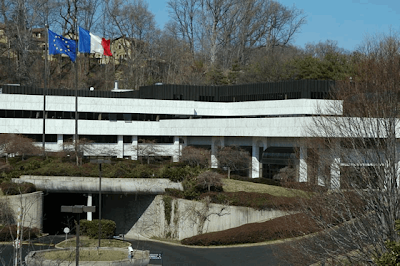

French cultural center, Washington, DC

Most strikingly, audience members politely but firmly and repeatedly asking the question, "What is the Obama Administration doing to assure that more due process is used in handling of detainees?" The Administration's representative didn't have an answer. He was able to point to court decisions that require that more due process be provided to specific detainees. But it remains to be seen what the Obama Administration itself thinks the process should be.

As filmmaker Sig Libowitz stressed, "Although the film depicts a review process (the Combatant Status Review Tribunal or "CSRT") that dates from several years ago, it is important to remember that every one of the detainees remaining at Guantanamo is being held as a result of this process." Key aspects of the process are that the detainee does not have an attorney and is not allowed to see all of the evidence against him.

Panel participant Anthony P. Ricci, deputy to the Special Envoy for the Closure of the Guantanamo Bay Detention Facility of the U.S. State Department, spoke at length in answer to pointed questions from the floor, including,"Even after Guantanamo is closed and the detainees are in some new location [such as Thomson, in Illinois], what will be different in the process they are subjected to?" and "With the change from the Bush administration to the Obama administration, what is the difference in the process that is used to deal with detainees?"

It's important to stress that the film succeeds in stimulating this kind of discussion precisely because it takes pains to lay the issues out fairly and factually. One of the panel participants was Rob Kirsch, co-leader of the Boumediene v. Bush pro-bono legal team and senior partner at WilmerHale LLP. He told the audience that much of the dialog in the film's courtroom scene was taken verbatim from the proceedings involving his own clients, and that it made a chill run down his spine to see it re-enacted. Similarly, Tony Ricci commented that he, himself, had served in Iraq and participated in deliberations similar to those depicted in the film, and that the film's deliberation scene accurately conveyed the various threads in those discussions.

If the film is realistic in showing multiple sides of the issues, the panelists were similarly realistic in admitting why it is hard to deal with detainee issues. In particular, there continues to be great uncertainty among experts about the exact categorization that should apply to accused terrorists. On the one hand, it appears that experts tend to agree with the proposition that, "There is no such thing as someone who does not have a status under the Geneva conventions." On the other, there is unease about how to deal with conduct that goes beyond what we traditionally understand to be "criminal," and yet clearly doesn't fit established notions of "soldiers" that are state-based actors. A key participant in this aspect of the discussion was panel participant Rear Admiral John D. Hutson (ret.) former Judge Advocate General of the U.S. Navy and currently Dean and President, Franklin Pierce Law Center. As audience member and journalist Jamie McIntyre stated in his blog, "The movie’s biggest virtue: It plays it right down the middle and leaves it for you to decide what the U.S. response should be to an enemy who doesn’t play by our rules, and doesn’t want the war to ever end."

Nonetheless, the panelists were all in agreement that imperfections of current legal theory do not outweigh the need for fair treatment in real time for people who are currently detained. The consensus seemed to be, "Detainees must either be tried or be released." And if they are to be tried? "Try them as civilians."


Related posts

Even if the current Obama administration approach of releases were to succeed in bringing about the release of everyone at Guantanamo, it would not have begun to address the wrong that has been committed.

(See US to its Humans Rights Violations Victims: "Shut up and take what you're given!" )


His exact words were: “It’s not sustainable . . . . The notion that we’re going to keep 100 individuals in no man’s land in perpetuity [makes no sense] . . . . . All of us should reflect on why exactly are we doing this? Why are we doing this?”

(See Does Obama Think We're Stupid? )


My most prominent memory of my first viewing of the Guantanamo film, The Response, is of one of the stars of the film -- Kate Mulgrew of Star Trek fame -- participating in a panel after the screening. I was blown away when she said, "I did this because our civil liberties in our country have been gravely damaged and we all need to contribute to repairing them."

(See Understanding What Guantanamo Means)

Wednesday, December 9, 2009

The World Turned Upside Down - Huff Post, Wash Post, and Twitter

"The World turn'd upside down"
A month or so back, I said I was bound and determined to figure out "this Twitter thing." Recent work I've been doing to promote the great Guantanamo film The Response has opened my eyes about Twitter, and a lot of other things . . .

I've been having a lot of little "Aha!" moments as I try to get the word out about screenings of The Response on Twitter. For one thing, I discovered that there is a whole group of people who are actively passing along the latest news about Guantanamo (and a whole range of other civic affairs), and they can be found by searching on Twitter. That in turn leads you to certain "hubs" who distribute and redistribute ("retweet") the news on a particular topic. The interaction between the hubs and the "spokes" allows for incredibly rapid dissemination (and *digestion*) of the right information by the right people at the right speed.

Hence, a big event for me was asking one of those "hubs," GuantanamoAndy, to spread the word . . . and within minutes seeing:

Tymlee RT @Tosfm: @GuantanamoAndy Excellent film on Gitmo - #TheResponse - shortlisted for Oscar in shorts film category - http://bit.ly/6HQFDM ...

heyjude408 RT @Tosfm: @GuantanamoAndy Excel. film on Gitmo - #TheResponse - shortlisted for Oscar in shorts film cat.- http://bit.ly/6HQFDM - Pls RT

Tosfm @GuantanamoAndy Excellent film on Gitmo - #TheResponse - shortlisted for Oscar in shorts film category - http://bit.ly/6HQFDM - Pls RT


My messages have also been faithfully re-tweeted by "Satyagraha_ji" -- who has 3,672 followers on Twitter, all of whom, one can infer, are interested in social justice issues associated with Gandhi's concept of satyagraha.

The world really is changing -- public discourse is being shaped in an entirely new way. And from where I sit, it looks like power really is getting back into the hands of ordinary people! For about the past 20 years, my sister, Elaine Scarry, has been talking about the model of Paul Revere for how we manage information in a democracy. Now I finally understand how very true that is!

Another eye-opener for me has been the way in-person meetings, blogs, individual websites, Facebook, and Twitter all interact together. To get a taste of that, just decode this Twitter post:

hoffman4IL An earnest, skeptical voter in Evanston gives @hoffman4IL a chance, and becomes a supporter: http://bit.ly/6thAu2. Thanks, @Scarry!

This post is by the Hoffman for Illinois ("hoffman4IL") campaign, telling its followers about a blog post ("http://bit.ly/6thAu2") by me ("an earnest, skeptical voter in Evanston") describing how I became a supporter, and indicate my Twitter address ("@Scarry") at the end. Hoffman is going to be great for Illinois, not least of all because he understands how to use new media to pull people into the conversation.

But the biggest single eye-opener for me came this morning when I was trading emails with Washington Post reporter Peter Slevin. I expressed amazement at the 286 comments that people had appended to his piece on the use of the Thomson Correctional Center to house Guantanamo detainees. (That's a lotta comments!) Peter said, "Yeah, well, that one got picked up by the Huff Post . . . ."

The Huff Post? Determining who talks about an article in the Wash Post? About a issue in northwest Illinois?

The World turn'd upside down:
OR
A briefe description of the ridiculous Fashions
of these distracted Times
By T.J. a well-willer to King, Parliament and Kingdom
London: Printed for John Smith 1646


Maybe it's because the Paul Revere metaphor was fresh in my mind, but Peter's story, and the 286 response, and the role of new outlets like the Huff Post in changing the whole game, reminded me of the history fact we learned in high school: about how at the surrender of the British to the American forces at Yorktown, the band played an old tune called "The World Turned Upside Down."

Well, if this is another revolution, I for one am all for it. (It turned out pretty good the first time . . . . )

(For more on the Thomson story, see "Why Illinois is Central to America's Response to Guantanamo.")


Related posts

I've started to organize some of the practices I've discovered, starting with the ten "guideposts" below. I'll expand on these from time to time, and hope to spur continued conversation with all of you!

(See Twitter: Scarry's Ten Guideposts )


As I read the article, I kept hearing echoes of lessons that I have been learning in the last several years as I have worked to communicate online about peace and justice issues. Herewith the top of my hit parade, with reference to stories from the USA Today newsroom . . . .

(See Social Media: If It's Good Enough for USA Today, It's Good Enough for Me )


I've realized that when we ask ourselves, "What is it that we hope people will do?" we must include an element of recursivity: One of the things we want people to do is to involve more people in doing it. In a way, that element of recursivity -- dare I say "evangelism"? -- defines what it means for people to really become part of a movement.

(See Invite More People into Activism! (Pass It Along!) )

Friday, November 20, 2009

IMPACT FILM: Understanding What Guantanamo Means From "The Response"


On reflection, I think the biggest event of 2009 for me turned out to be a screening of "The Response" --a film about Guantanamo detainees and the military tribunals at the Siskel Film Center this past summer.

The experience was a knockout for me, for at least three reasons. My most prominent memory is of one of the stars of the film -- Kate Mulgrew of Star Trek fame -- participating in a panel after the screening. I was blown away when she said, "I did this because our civil liberties in our country have been gravely damaged and we all need to contribute to repairing them."


The Response
Kate Mulgrew, Peter Riegert, and Sig Libowitz portray military judges
in a Combatant Status Review Tribunal (CSRT) at Guantanamo

The second thing that struck me was the presentation by Thomas Sullivan, a prominent Chicago lawyer who also participated in the panel and described his work defending Guantanamo suspects pro bono. I thought to myself, "Here's this hugely successful big city lawyer, and yet it's important enough to him to spend a massive amount of his time making sure these guys get the benefit of a proper defense."

Third, but far from least, was the quality of the film itself. It raised the basic question: is due process important? What does it really look and feel like when corners are being cut? The filmmaker, Sig Libowitz, did a spectacular job of bringing the core issue -- legal process -- into the foreground and making it compelling. (That's probably why the American Bar Association gave the film its prestigious Silver Gavel Award.)

"The Response" and its creator, Sig, have spurred me to learn a lot more about this issue, share what I've learned with others, and try to contribute to solutions in any way I possibly can.

This past week, the Governor Quinn announced a plan to house Guantanamo detainees at a correctional facility in Thomson, IL. When I went to see "The Response" months ago, I had no idea at the time that Guantanamo -- and all the issues related to it -- would soon become a special concern to all of us in Illinois!

 Related posts

The French Embassy's cultural center in Washington, D.C. screened The Response Tuesday, February 16, for a crowd of about 220 - including many representatives of the military, legal, government, and media community. Screenings of "The Response" are supposed to stimulate engaged discussion, and this one succeeded.

(See Guantanamo: "The Response" and Obama's State Department )


I believe Easter is God's gift to humanity of victory over death, hopelessness and frailty, and I believe that God is alive and in our midst. The witness of the Guantanamo lawyers has confirmed me in those beliefs.

(See Easter Victory: The Guantanamo Lawyers )


Chicago was the site of major protests against U.S. detention practices in Guantanamo, as well as in Bagram, other prisons throughout Afghanistan, and elsewhere in the world, on and around January 11, 2012. We called for an end to indefinite detention, unfair trials, and torture.

(See Chicago Protests Guantanamo Detention)


I think the U.S. is in the midst of a big shift.  I think that for over a decade following 9/11 people have been so enmeshed in fear that their instincts weren't working properly. I think that we are in the midst of a slow process of awakening: people are emerging from the shadow of fear to a wider range of sensibility -- and they are realizing there are some things that are out of joint.

(See Too Much State Power? (Asymmetric Warfare and Asymmetric Policing))