Showing posts with label defense spending. Show all posts

Monday, November 14, 2016

Where to Put Effort for a World Beyond War

Are you looking ahead to a world beyond war? Education, infrastructure, and decisions about communal action are the key . . . .


"Give me a lever long enough and a fulcrum on which
to place it and I shall move the world."

Archimedes


"A lot of people are opposed to war, but what might look different when a group of people approach war as a soon-to-be-obsolete institution?"

It was a month ago that I posed that question in WAR: Headed for the junkheap, yes . . . but how quickly?

I gave one answer to the question in The Mind of the "World Beyond War" Activist: "Saying 'war is going away; the question for me is how fast' implies optimism-realism, outcome orientation, and humility."

But does the "world beyond war" approach help determine where to put effort?

It seems to me that there are some obvious places to focus. Once one is able to imagine a world in which war is a no-go, it becomes possible to imagine certain aspects of that world that will be starkly different than the world in which we live today -- aspects of life that will be inherent to a world beyond war. And, having imagined these aspects, we realize that it seems very hard to imagine having arrived at the world beyond war without the hand-in-hand changes in those aspects themselves. In other words: what would be rendered profoundly outdated if it survived into a world without war?


(1) Education - In a world beyond war, it will no longer make sense to spend a lot of time becoming knowledgeable about war.

We sometimes imagine that education is fundamentally about building up a store of absolute truths; more and more, however, we are realizing that education mostly has to do with acquiring knowledge of what works in the world.

In the world to date, there has been a prevailing emphasis on learning about wars: how they begin, how they are fought, who makes the critical decisions, who leads the fighting, who follows the orders, who derives the benefits from the wars, how the wars are ended, and what changes after they end. The result is that our society is dominated by people who are highly educated about war, and have devoted little time to learning about other ways of settling conflicts.

The inflection point will come when society begins to reward people who know a great deal about how to resolve conflict in the absence of war -- particularly those who can provide value in the form of outcomes that give maximum possible satisfaction to all the parties to a given conflict.

     ... for more see An Educational Alternative to Rivalry


(2) Infrastructure - In a world beyond war, it will no longer make sense to be in possession of massive amounts of infrastructure for carrying out war.

Infrastructure requires time to build. The process of infrastructure development inherently involves trying to imagine what will be needed in the future.

In the world to date, there has been a prevailing attitude toward war infrastructure that says, "Because the cost of failing to have it when we need it would be so high, the only sensible choice is to build as much as we possibly can -- in case we need it."

The inflection point will come when a new attitude begins to gain adherents: "Any overspending on infrastructure that turns out to be useless, will be deeply corrosive to our joint endeavors."

     ... for more see An Infrastructural Alternative to Military Spending


(3) Decisions about communal action - In a world beyond war, it will no longer make sense to hold counsels about decisions to go to war. No one will participate.

In the United States today, we are still living with a constitution that spells out certain war powers, and we maintain an ideal - only intermittently practiced, as it turns out -- in which a highly democratic process may result in a decision to go to war, or not to go to war.

In the world to date, there has been a prevailing acceptance of the wisdom of the group -- some form of democracy -- to decide whether to embark on communal violence. This is in contrast to our views about individual violence, which we tend to view as something which is virtually never ratified by a claim of "wisdom."

The inflection point will come when our systems of group decision-making begin to include norms of "more wisdom, less violence" in proportion to the scope and size of the decision-making forum.

     ... for more see "Problems from Hell" and Real Options Under Democracy


Each of these aspects of our communal life involves an inflection point. And the interesting thing is that, after the inflection point, things will change very fast. The new pattern of education . . . the new direction in infrastructure . . . the new civic decision-making . . . they will all hasten the coming of the world beyond war.

So . . . are there ways to devote effort to assure that we reach each of these inflection points sooner?


Related posts

People working for peace are intensely attuned to the way education impacts peace efforts -- and also war efforts.

(See Education for Peace? or "Education IS Peace"?)


Just like a family that has extra rooms in its house which inevitably become filled with stuff, the U.S. has thousands of bases -- here, there, and everywhere -- that inevitably create the "need" to spend.

(See What Will "Strategic" Mean in Our Children's Lifetime?)


As all the other senators sat patiently through the obfuscation of Barack Obama's Three Horsemen of the Apocalypse -- Secretary of State John Kerry, Defense Secretary Chuck Hagel, and Chairman of the Joint Chiefs General Martin Dempsey -- Rand Paul gave 'em hell.
"Stand up for us and say you’re going to obey the Constitution and if we vote you down — which is unlikely, by the way — you would go with what the people say through their Congress and you wouldn’t go forward with a war that your Congress votes against."

(See Obama's Syria "Vote" in Congress: Democracy? or Theater? )


There is a growing movement of people focused on the "world beyond war." To many of these people, the question is not "if" but "when?" They share a conviction that the world will get there, and they see that it makes a difference how quickly (and in what manner) the world gets there.

(See WAR: Headed for the junkheap, yes . . . but how quickly?)

Friday, November 11, 2016

VETERANS: A Debt You Can't Bankrupt Your Way Out Of

"The wars in Afghanistan and Iraq have costs
billions of dollars over the last decade, but
the spending won't stop when the fighting
does.Just how much money are we
spending on health care because of war?"
Veterans Day is a good day for everyone to ask about long-term health care costs for veterans. And that includes Donald Trump . . . .


I wrote a Veterans Day post three years ago that focused on long-term health care and other costs for veterans. My point was that the lies we tell ourselves to make it "okay" to engage in war begin with denying the true magnitude of taking care -- over the very long term -- of the people we force to fight.

Three days ago, a new US president was elected. His expertise is in financing big -- huge -- projects.

Here's a huge project: the US has more than 20 million veterans. (See Veterans Administration statistics.) The nation's financial obligation to them continues until they die - in many cases 30, 40, 50 or more years from now. It has been suggested that long-term benefits for veterans are a massively underfunded liability.

(Can you begin to imagine this? It's insurance "enrollment season." Take your own health insurance headaches and multiply by 20 million.)

Admittedly, projecting long-term outcomes and costs is difficult, particularly for such a large population with such a range of experiences. Naturally, some people will "blow things out of proportion," and other people will try to "sweep the problem under the rug." The solution, however, is not to do nothing. The solution is to obtain and analyze data, and come up with the most responsible estimate.

(Example: An Australian study, "Long-term Disability Associated With War-related Experience Among Vietnam Veterans(Retrospective Cohort Study)" by Philip M. Clarke, PhD, Robert Gregory, PhD, and Joshua A. Salomon, PhD, in Medical Care found "The steepest rise in disability incidence was observed among Vietnam veterans starting in the 1990s, around 20–30 years after deployment for most veterans. . . . " and "Long-term effects of deployment into military conflicts are substantial, and likelihood of war-related disability is associated with service history. If similar patterns follow from more recent conflicts, significant additional resources will be needed to prevent and treat long-term health conditions among veterans.")

A modest proposal: US president-elect Donald Trump should devote the time between now and Inauguration Day using his expertise to bring forward a new, honest evaluation of the long-term liabilities that the US has accrued as a result of its wars of recent decades, and of the necessary steps to assure those liabilities can be met.

Certainly, Donald Trump intends to do right by US veterans.

Donald Trump can do the math required to count the cost and make sure those liabilities are funded. It's just finance. As they say in business: "Just give me the number."

And most of all - Donald Trump understands the difference between playing the luxury real estate game -- in which mistakes end with a bankruptcy and a shrug -- and our obligations to our veterans. That underscores the importance of providing ironclad assurances that veterans will be taken care of. Not a "kinda sorta" plan. A platinum guarantee.

So . . . President-elect Trump. What's the number?


Related posts

It's time for us to get honest about the true costs of war, including the long term health consequences for people who serve in the military, and the corresponding long-term costs that our society must commit to bear.

(See How to REALLY Honor Veterans)


"The drone program gives people PTSD [post-traumatic stress disorder]," says a former operator in the film, against the background of her attempt to get the VA (Veterans Administration) to acknowledge her condition. "What's so surprising about that?"

(See The Truth About Drones (*NOT* APPROVED by the US Air Force))


"A terrible disease has struck the area . . . people call it the "flu" . . . many in our own community have fallen to it . . . including someone very dear to you, someone in your own family . . . I'm talking about your sister, Margaret." (See November 11, 1918: Another Veteran for Peace )


On November 11, 2015, Veterans for Peace had a message about reclaiming Armistice Day that proved itself massively spreadable on social media . . .

(See What will it take to reclaim Armistice Day for peace? ) 

Thursday, June 2, 2016

Worldwide War and Conflict (Brought to you by Silicon Valley)

Are high tech workers and communities adequately owning up to their responsibility in providing ever more lethal generations of weaponry and other war materiel?

Image from PC World: "DARPA, SRC pony up
$194 million to fund chip research"
I've been attentive to the predicament of technologists involved in providing the machines of modern war since I wrote about the Chicago scientists who played such a large role in creating nuclear weapons. (See Unfinished Business in Chicago (Nuclear disarmament, that is))

When I worked in the field of patent licensing about a decade ago, I had a crash course in the structure of the semiconductor industry, and a peek into how many semiconductors find application in the military field.  If I needed any reminder of this fact, I got it when the Secretary of Defense payed a high-profile visit to California a few weeks ago: "Pentagon Turns to Silicon Valley for Edge in Artificial Intelligence."

When we think about high-tech weapons, we often think of big stuff like fighter jets and drones. But none of today's weapons are possible without the semiconductors and software that make them smart.

In the California defense industry, Southern California has been where the military aerospace comes together. But all those Silicon Valley chip and software engineers in Northern California are the key link.

(I don't know how many people living in California's 17th congressional district, the Silicon Valley area represented by Mike Honda, think of themselves as dependent on the defense industry . . . . )

It's really a fascinating dilemma. "Hey, I just make this little part of the thing .... " The protestations of scientists involved in napalm production come to mind: "Hey, I just work in the quality control department .... " (See American Fire: Still Spreading, Still Inextinguishable)


High tech weaponry (last year's model).
There are some people inside the technology field who are starting to ask questions about engineers' involvement in supporting innovations in killing. Notably, the International Committee for Robot Arms Control consists of computer scientists, engineers, artificial intelligence experts, roboticists and professionals from related disciplines who have called for "a ban on the development and deployment of weapon systems in which the decision to apply violent force is made autonomously." (See also "UC Berkeley Professor Leads Call for Ban on Autonomous Weapons," interview of Stuart Russell by Michael Krasny, Forum on KQED, August 5, 2015. )

Autonomous weapons are the cutting edge. What would happen if people working in the tech industry said that they wanted to give all military applications a wide berth? What if they quit the weapons business cold turkey?

"Social responsibility" and "ethics" is a topic that appears to be just beginning to gain traction within the EE community. I note that an annual "humanitarian" conference associated with IEEE will take place again in October, 2016, in Seattle. (You can get a sense of the proceedings from the Global Humanitarian Technology Conference (GHTC) 2015 program book.)

Right now, "humanitarian" in the EE field seems to be associated principally with affirmative efforts -- providing energy, health, communications, education, aid and similar benefits. But what about ceasing to contribute to violence?

Can we see a clear path to enabling EEs to choose to work in weapons-free zones?


Related posts

In four hundred and thirty-five Congressional districts, there is an inseparable relationship between campaign funding for Congressional races and the military contractors. How do we push back?


(See IT'S A LOCK: Why the US Can't Break Its Addiction to War)


Met Lab scientists had a rude awakening: "We're interested in your technology, not your political advice." As one of the Met Lab scientists said, "I might as well have thrown those recommendations [about abstaining from using the bomb] into Lake Michigan."

(See Unfinished Business in Chicago (Nuclear disarmament, that is))


"Because of the intensified division of labor," the narrator explains, "many technicians and scientists can no longer recognize the contribution the have made to weapons of destruction." "Our department extracts lareic, oleic, and naptha acids . . . . "  "I'm a chemist. What should I do? If I develop a substance, it can be good for humanity . . . ."  "Besides napalm, Dow Chemical produces 800 other products . . . ." Does this familiar to you?

(See American Fire: Still Spreading, Still Inextinguishable) 

Thursday, May 19, 2016

21st c. Berkeley: More Relevant Than Ever to Antiwar Movement

As a "peace" enclave within California's concentrated military/defense economy, Berkeley and the East Bay have a role to play in the discussion about China.


BERKELEY: Looking west -- the bay, San Francisco . . . and beyond.


As I set out to understand California's entanglement in the military-industrial complex, I started where I live: Berkeley.

Reading a letter to the editor from our representative in Congress, Barbara Lee, a few days ago reminded me that the 13th district is kind of unusual: "As the National Defense Authorization Act comes up for a vote, I will once again co-lead a bipartisan amendment to audit the Pentagon." (Read more on Barbara Lee's position on the Authorization for Use of Military Force Against Terrorists (AUMF).)

Yup, this is different than the town I just came from. Chicago's star corporate citizen is mega military contractor Boeing.

Of course, Berkeley was ground zero for the antiwar movement during the '60s. But what's its relevance today?


A bridge to China

As a long-time student of China and the Chinese language, I am enchanted to find myself in a city whose university attracts lots of the very smartest students from China and other parts of Asia. (See "Berkeley - International Student Enrollment - Fall 2015") Many other Berkeley students who are US citizens claim Asian ethnicity. (See "Berkeley - Enrollment Data")

If California, and especially the Bay Area, is the historic link between the US and China, Berkeley is a particularly vital US-China hub right now.

We all say things like "youth are our future" . . . . What would happen if we encouraged a serious discussion between the diverse people in the Berkeley community (and from other communities) about the future of peace and security in the Pacific region?


SOUTH CHINA SEA FACE OFF:
Does this make ANY sense?
The discussion we need to have

I wrote recently about the growing tensions in the South China Sea.

As I read the Chinese language paper every day, it is clear to me that -- in the absence of sustained civic discourse on the security issues in the Pacific region -- our future is being shaped by military posturing.

I think a good way to re-direct the conversation would be to get a large number of young people who know and care about the situation in the region to get together and talk. It should include people from the various countries and territories concerned. It should be directed at the future we're all trying to build together. It should place a strong premium on listening. It should be open-ended.


Some possible starting points

The good thing about a university town is that it has many of the ingredients necessary to conduct forums.

Now this I understand . . . !
(Image: Android Authority)
Here are a few available in Berkeley that might assist the type of discussion I am suggesting:

* Student associations, including Chinese Students Association, Taiwanese American Student Association,
Hong Kong Student Association, . . . .

* University departments, including International Relations and  Institute of East Asian Studies

* Citizen groups, including United Nations Association - East Bay

* Relevant University affiliates, such as Office of International Relations and International House - UC Berkeley


My hope and belief is that a Berkeley forum on peace and prosperity in the Pacific would reveal a shared interest in de-escalating the South China Sea confrontation, and dramatically increase awareness of shared Pacific prospects for well-being.


Related Posts

In four hundred and thirty-five Congressional districts, there is an inseparable relationship between campaign funding for Congressional races and the military contractors. How do we push back?


(See IT'S A LOCK: Why the US Can't Break Its Addiction to War)


What people in Asia (and others) have seen for the past century is that something is happening in the Pacific, and it's being driven in part by advances in naval (and, subsequently, aviation and electronics) technology, and in part by powerful nations (principally, but not limited to, the U.S.) proximate to the area.

(See The Imperialized Pacific: What We Need to Understand)


"Although we know the end from the very beginning," says Walker, "the story is no less compelling to watch." A man, gloriously alone (except for his own reflection) on an ice-covered lake; the soothing pastel colors of the distant sky; and what seems surely to be a circle he is digging around himself with a pick-axe. A perfect parable for our headlong rush toward climate crisis?

(See How Do You Say "Suicide Narcissus" in Chinese?)

Thursday, April 28, 2016

IT'S A LOCK: Why the US Can't Break Its Addiction to War


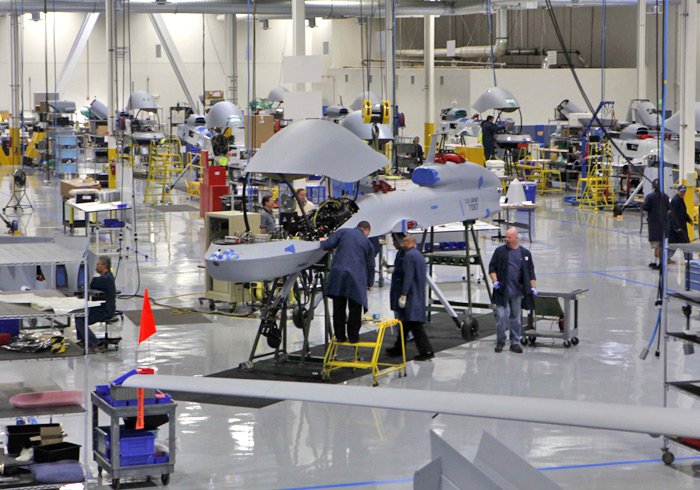
"Technicians at Poway [CA]-based General Atomics Aeronautical Systems
worked on the fuselage of a Sky Warrior drone . . . . The company’s unmanned-
aerial-vehicle program includes the Sky Warrior, the Predator and the Predator B."
(2009 photo - John Gibbins / Union-Tribune)


The new film about the arms trade, Shadow World, screened last night in Berkeley.

There is much that is provocative in the film, and everybody who cares about ending war should see it and share it with others in their community.

In particular, the segment about the Pentagon whistleblower Franklin Spinney caught my attention. Spinney talked about the systemic nature of the problem -- military spending that penetrates every single Congressional district. In effect, we're stuck. To break the hold of war on the US, we need to break the hold of military spending on every Congressional district.

Let's admit it: we've got a problem.
This was reinforced in the discussion following the screening, when Andrew Feinstein -- author of the book on which the film is based -- pointed to the inseparable relationship between campaign funding for Congressional races and the military contractors.

This idea is not new to me. I moved to California last year, fully aware that much of the beautiful California lifestyle is built on weapons manufacturing. The Concise Untold History of the United States by Oliver Stone and Peter Kuznick tells us that, between 1951 and 1963, California benefited from $67 billion in defense contracts (p. 218-9). In my own work on the problem of drones, I've come to learn that a relatively new player in defense, General Atomics, has become a star in the San Diego area economy by building Predator and Reaper drones.

Can drone jobs be "good jobs"?
But the question of how to push back against the problem has seemed gargantuan. Four hundred and thirty-five Congressional districts: how to begin?

It occurred to me that I could start by looking into California's 53 Congressional districts. But that alone is a huge job . . . and it's still just one state.

By coincidence, yesterday I was also thinking about another question: the readership of my blog is growing very fast . . . but where is it all headed? What do I hope the outcome is?

And then I realized that what I hope for is actually quite simple: I hope to suggest to people that they can use simple tools like blogs to get important information out to a wider audience.  In effect, these blogs and other social media are our answer to the complaint that the mainstream media doesn't report the important stories, and distorts the stories they do report. We need to be our own media.

Chicago activists are taking on Boeing
None of us has to do the whole job his/her self. We're a swarm.

So here's my promise: I will knuckle down and get to work on those 53 districts in California. And if you're writing about the hold of defense contractors and the Pentagon on those or other districts around the country, share your work with me via Twitter at @scarry. I'll make sure that it gets a big audience.

Posts related to California congressional districts

13th (East Bay): 21st c. Berkeley: More Relevant Than Ever to Antiwar Movement

17th (Silicon Valley): Worldwide War and Conflict (Brought to you by Silicon Valley)


More related posts

There's been a lot of talk in recent weeks and months about the problem of gun trafficking in Illinois, and how we will never meet our goal of stopping the violence in our communities if we can't stop the flow of guns. Maybe it's time for us to eat our own dog food . . . .

(See What If Illinois Became a "War-Profiteer-Free Zone" ? )


How might an uprising against inequality and dismantling the military-industrial complex dovetail?

(See WHERE'S MINE? Inequality in the US and the Military-Industrial Complex )


I've realized that when we ask ourselves, "What is it that we hope people will do?" we must include an element of recursivity: One of the things we want people to do is to involve more people in doing it. In a way, that element of recursivity -- dare I say "evangelism"? -- defines what it means for people to really become part of a movement.

(See Invite More People into Activism! (Pass It Along!) )


More than anyone else, the beneficiaries of permawar are the politicians who thrive on the power to make and control wars. The number one prime beneficiary is the President, as well as presidential aspirants. But it doesn't end there . . . .

(See J'ACCUSE: The Beneficiaries of Permawar )

Monday, February 29, 2016

Does Society "Decide" to Engage in War?

I think if you asked most people, they would say that (a) war is deeply ingrained in society; and (b) society over and over again decides to engage in war.

There is a growing discourse around point (a): people are starting to unpack the idea that "war is deeply ingrained in society," and growing in understanding that this is not the same as saying "war is part of human nature."

I worry that there is less insight around point (b). At least in the United States, I think people continue to believe that war is a societal choice. I think this is not true.

In theory our Constitution is all about the people -- through Congress -- maintaining control over the decision to go to war. As it stands now, as a practical matter, that's not really what's happening.

I invite people to study the graph of historical US military spending below. It shows that there was a time when military spending went up when the US began to engage in a specific war, and then went back down after that war. Later, that pattern changed.


US Defense Spending -- FY 1800 to FY 2010
(More at usgovernmentspending.com)


It is very interesting to consider why this change occurred. (Perhaps that's a topic for a later blog post or two.)

But I think the more fundamental point is: at some point US society stopped being the "decider" about war. The US began to engage in war, and more war, and more war . . . but US society was no longer really making that decision in any real way.

(Think about US military action during your lifetime. In what ways, if any, did society at large determine what happened?)

If we confront this reality, what might this cause us to do differently?


POSTSCRIPT March 1, 2016: Yesterday the lead editorial in The New York Times called for a "better not bigger military", saying "[g]iving the Pentagon a blank check does not ensure security," and expressing hope that the next president will get the balance right. Isn't this just part and parcel of the charade that these questions are at all under the control of the US public?

Related links

"The US Military Is America’s 51st State" by William J. Astore in The Nation.


Related posts


More than anyone else, the beneficiaries of permawar are the politicians who thrive on the power to make and control wars. The number one prime beneficiary is the President, as well as presidential aspirants. But it doesn't end there . . . .

(See J'ACCUSE: The Beneficiaries of Permawar )


The decision about whether to live with the threat of nuclear annihilation is our decision. And that is why the entire country is mobilizing for mass action for nuclear disarmament in 2015. Are we capable of making sure the messengers -- Obama, Putin, the other agents of government -- hear their instructions from us clearly?

(See NEEDED: Heroes to Bring About Nuclear Disarmament )


Right now we're "stuck" -- the portion of the public that wants to cut military spending has hovered in the high 20%s since 2004; it just can't seem to break the 30% barrier. (The percentage of people in favor of expansion is about the same.)

(See Cutting Defense: Are We STUCK? ) 


It's essential that we demand our members of Congress get on the record now about the opposition to U.S. military intervention in Syria that they are registering from their districts.

(See On Syria, It's Time for Congress to Remember Who They Represent)

Thursday, October 23, 2014

Which Boeing Are We Talking About Again?

Boeing 787 Dreamliner troubles build (2010-2013)
(image © Graphic News)
As far as anyone can tell, Boeing loses money on every Dreamliner it produces. (Apparently the plan is to make it up on volume.)

And so it is to questions about Dreamliner profitability that some attribute the disappearance of $3.5 billion in corporate value (poof!) when Boeing stock dropped 5 points on Wednesday after its latest earnings report.

Let's be clear: the announcement was of an earnings increase. And many analysts are sanguine about the number of orders Boeing has been getting for its commercial jets.

It's just . . . no one knows when (if ever) the bet-the-future-of-the-company product, the Dreamliner, will be able to be sold at a profit. (See "Why a Boeing 787-9 Costs $250 Million" by Paul Ausick on 24/7 Wall Street)


Which Boeing are we talking about?

Lots of analysts have opinions about Boeing. The confusing thing is that the opinions tend to alternate between commercial Boeing and military Boeing.

Some analysts emphasize the commercial airline business and they like what they see:

"The Slow Death Of 4 Engine Airliners Will Play Into Boeing's Hands"

"Update: Boeing's Widebody Aircrafts Are On A Roll"

"Boeing: Expect Upside To Be Driven By Commercial Airplanes"

Sounds good . . . life is good in the commercial airline sector! But . . . then we look at analysis that focuses on Boeing's position as a military contractor and we see things like . . .

"This Rival Makes Boeing Look Overpriced" [comparison with Lockheed Martin]

"Why We Think Boeing Could Lose Out To This Sector Peer" [comparison to Northrup Grumman]

The stakes are high
The Dreamliner comes to the rescue after years of market 
share reversalsin commerical airplanes for Boeing.
 (Reuters graphic)
So . . . which is it, anyway?  Boeing good or Boeing bad?

Maybe it would help to know which Boeing we're talking about.


This Ain't No Hedge

There was a time when the business world would have bought the argument that commercial Boeing + military Boeing = diversification.  The ups and downs of military Boeing could cushion the downs and ups of commercial Boeing (and vice versa).

Today, however, investors want to see companies focus on their core business.  If there's risk-offsetting to be done, hedges can be set up by risk managers, thank you very much.

(And how does the risk-strewn field of military contracting amount to a hedge for risk in commercial aviation?)


The time has come for Boeing to be split up, so that investors can figure out what they're buying.


Related posts

Isn't the time fast approaching when Boeing recognizes that it's not just one or another of their weapons systems -- or weapons systems customers -- that's the problem? Isn't Boeing's entire defense systems division "bad Boeing"?

(See BOEING: "Breaking Up Is (Is Not) Hard to Do" )


Now that the Israeli government's killings in Gaza are front-page news -- particularly the way military aircraft is being used to mow down innocent men, women, and children -- Boeing's involvement is in everyone's face.

(See Boeing Has an Israel Problem . . . and Chicago Has a Boeing Problem)


People are talking about cuts to the military. It couldn't happen to a more deserving half of our national budget.
HOWEVER . . . we need a lot more people jumping into this debate, because the cuts being talked about are too timid . . . AND because the most dangerous and illegitimate (and frequently illegal) forms of military force are being advocated for the "efficiency" and "cost-effectivneness."

(See Talk of the Town: Shrink the Military )

Tuesday, October 7, 2014

BOEING: "Breaking Up Is (Is Not) Hard to Do"

Chicago-based Boeing Corporation makes 
civilian jets . . . and weapons.
When I lived in Philadelphia in the '80s, there were two related events in the business world that made me sit up and take notice.

The first was the acquisition of a venerable Philadelphia bank -- Girard Bank -- by a big Pittsburgh institution -- Mellon Bank.  People were pissed.  It didn't make complete sense to me, but I eventually learned a little bit about Philadelphia philanthropist Stephen Girard, and I came to understand a little better why people had feelings about the bank. (Hey, nothing personal, Mellon . . . we just like things in Philadelphia the way they are . . . . )

The second was the recognition by Mellon that Mellon had a substantial volume of bad assets on the books -- as in, enough to bring the company down.

In the event, Mellon made a brilliant decision: they split Mellon into two parts -- dubbed "the bad bank" and "the good bank" -- and dealt with them separately. They recognized that as long as Mellon remained a single entity, the investment community would value the entire company in light of the problems occurring in some of its assets. The solution was to quarantine the bad assets, take the hit, and focus on saving the the part of the bank that still had (substantial) value. (See "Rich Bank, Poor Bank: Mellon's Surprise Success" in Business Week, March 8, 1992.)

Every time we talk about the substantial part of the Boeing Corporations that is used for war and violence, I can't help thinking: "bad Boeing, good Boeing."


Everybody's Doing It

There's a lot that goes into making an argument for the breakup of a multinational corporation, and I have been meaning to develop this idea in more detail before posting it to my blog.  However, it seems that we're in a moment where people are talking about corporate breakups and how they're the right thing to do.

Hewlett-Packard Announces Breakup
Today we had the news that Hewlett-Packard will break itself into two companies. (See "Hewlett-Packard Announces Breakup Plan as Technology Landscape Shifts" by Quentin Hardy and David Gelles in The New York Times, October 6, 2014.)

A few weeks ago I noted that an investor was leading an effort to break up the DuPont company. The investor "argues that an overly complex and bloated corporate structure overburdens DuPont's seven business lines, some of which the activist firm argues bear little relation to one another, making it difficult for both investors and the company itself to gauge its prospects." (Wall Street Journal, September 16, 2014) Sound familiar?

In the last decades there have been big corporate breakups of firms like Viacom, Altria, Morgan Stanley, Time Warner, ConocoPhilips, and -- recently right here in the Chicago area -- Abbott Labs.

Sure, "breaking up is hard to do" -- sometimes. But now, it seems, "breaking up is the thing to do."


It seemed like a good idea at the time

It should be remembered, by the way, that today's Boeing Corporation is really a mashup of two aerospace companies -- the civilian aviation oriented Boeing and the military aviation oriented McDonnell Douglas -- in 1997. (See "Building a new Boeing" in The Economist)

The merger was sort of a case of "misery loves company": civilian aviation was in crisis, and the Cold War was over and drastic economizing in defense spending was expected, so why not put both these problems under the same roof?

Boeing has struggled to make things work. It announced in 2006 that it would reorganize the defense division.

"We'll get this thing working eventually . . . . " 
Boeing said it would eat $272 million in the development
of the new KC-46A aerial refueling tanker after discovering
wiring issues in test aircraft." (Defense News, July 26, 2014)
Boeing did a big round of layoffs in its defense business in 2009, following a big drop in defense orders. "In a single day during the spring of 2009, Defense Secretary Robert Gates wiped out a quarter-trillion dollars in potential bookings at Boeing Defense, Space and Security by proposing termination of an array of programs begun during the Bush years, forcing the company to rethink its business plan and reorganize its operations. " (More in Forbes, October 12, 2010.)

Boeing announced another reorganization of its defense division in 2012.

On September 29, 2014, Boeing "said it would move up to 1,400 jobs and change or eliminate hundreds of others over the next three years as part of the consolidation of its defense operations away from its manufacturing base in Washington state." (Wall Street Journal)

Yup -- it's been a tough row to hoe for defense at Boeing. (And that's not even counting things like the refueling tanker fiasco -- a contract awarded, then the award frozen due to a bribery investigation, then the contract re-awarded, then the CFO sentenced to jail for trying improperly influence the contracting process, then a write-off on the program reported this summer due to production issues . . . .)

Hey, shouldn't Boeing stick to its knitting and get its commercial business working? How about shipping the Dreamliner without those pesky battery fires?


Time to jettison "bad Boeing"

In recent months, people have become more and more aware of the role of Boeing's weapons in the violence that we deplore -- in Gaza, in the form of next-generation killer drones, in the creation of deadlier and deadlier nuclear weapons, in provoking conflict on the borders of China.

Isn't the time fast approaching when Boeing recognizes that it's not just one or another of their weapons systems -- or weapons systems customers -- that's the problem? Isn't Boeing's entire defense systems division "bad Boeing"?

Last night I watched a new film about the evacuation of Saigon at the end of the Vietnam War. As I watched Huey helicopters being shoved off the deck of a Navy ship into the ocean, to make room for more people seeking refuge, I thought, "That's right: it's gotta go; it's the people that matter."


As they say in business, "The first cut is the easiest."


A no-brainer
During the evacuation of Saigon, Huey helicopters were jettisoned
after delivering passengers to Navy ships, in order to make room
for more incoming rescuers.


9 More Ideas You Won't Hear

at Chicago Ideas Week . . .


Related posts

There was a time when the business world would have bought the argument that commercial Boeing + military Boeing = diversification. The ups and downs of military Boeing could cushion the downs and ups of commercial Boeing (and vice versa). Today, however, investors want to see companies focus on their core business. If there's risk-offsetting to be done, hedges can be set up by risk managers, thank you very much.

(See Which Boeing Are We Talking About Again?)


Now that the Israeli government's killings in Gaza are front-page news -- particularly the way military aircraft is being used to mow down innocent men, women, and children -- Boeing's involvement is in everyone's face.

(See Boeing Has an Israel Problem . . . and Chicago Has a Boeing Problem)


People are talking about cuts to the military. It couldn't happen to a more deserving half of our national budget.
HOWEVER . . . we need a lot more people jumping into this debate, because the cuts being talked about are too timid . . . AND because the most dangerous and illegitimate (and frequently illegal) forms of military force are being advocated for the "efficiency" and "cost-effectivneness."

(See Talk of the Town: Shrink the Military )


Isn't the real problem that fully half of Boeing's business consists of making and selling war materiel? Is it really necessary to identify the one, or two, or three most egregious weapons that Boeing makes? Do we need to pick and choose?  Isn't the real issue that nice, all-American, fly-the-friendly-skies Boeing is one of the core purveyors of war and misery in the world today, by virtue of its Military Aircraft division? I mean, look at their own sanitized version of what they do -- "Strike, Mobility, Surveillance & Engagement, Unmanned & Missile Systems, Global Support" -- even in their own words its readily apparent that they're peddling poison.

(See The Wrong Labor Struggle at Boeing )

It is time now to turn to the dirty secret of American life and the primary dilemma of the antiwar movement: the military money that flows to EVERY Congressional district, and in particular the "good jobs" that members of Congress think they are protecting when they vote for ever-higher levels of military spending.

(See Drones, Permawar, and the Problem of "Good Jobs")


"The U.S.'s use of drone warfare has resulted in the deaths of hundreds of children, many of whom live in countries where we have not declared war, yet Boeing has decided to pursue a Navy contract for the prototype for the next combat drone. This is unacceptable", said Kait McIntyre of the Chicago Anti-War Committee (AWC), at the annual stockholders' meeting of the Boeing Corporation.

 (See Activists Challenge Boeing to Disinvest from Drone Research)


There's been a lot of talk in recent weeks and months about the problem of gun trafficking in Illinois, and how we will never meet our goal of stopping the violence in our communities if we can't stop the flow of guns. Maybe it's time for us to eat our own dog food . . . .

(See What If Illinois Became a "War-Profiteer-Free Zone" ? )


What if we had a massive region in the heart of the country pushing back against the war-crazed conventional wisdom of "more weapons," "more consumption," and "more destruction of the environment"?

(See Another Modest Proposal: A Green, Demilitarized Midwest! )


Other related links

Chris Chadwick
President, Boeing’s defense, space and security unit
"You have to face reality": In recent weeks, the business press has been buzzing about Boeing's admission that it needs to take a major new direction in its military division:

September 18, 2014 - "Boeing Faces a Future Without Fighter Jets As Orders for F/A-18 Dry Up, Executives Shift Focus to Bombers, Drones and Trainers" by Doug Cameron and Robert Wall in The Wall Street Journal

September 18, 2014 - "Report: Boeing plans for post-fighter future" by Brendan McGarry on FoxNews.com

September 18, 2014 - "Are Military Fighter Planes Finished at Boeing?" by Paul Ausick on 24/7 Wall Street

September 18, 2014 - "Boeing shifts focus off fighter jets" by Angela Mueller in St. Louis Business Journal

Chris Chadwick, president of Boeing’s defense, space and security unit, was quoted as saying "You have to face reality."

Just one more reason to break up the company . . .