Showing posts with label Turkey. Show all posts

Sunday, April 30, 2017

(Most of) The Mideast Wants a Nuclear-Weapons-Free World

MIDEAST:
Which countries are giving the green light to #nuclearban?
(Please share this message on Twitter.)


An important component in the global effort to achieve a total ban on nuclear weapons is the commitment of (most of) the countries in the Middle East.

The map reproduced above is from the ICAN Austria interactive map of countries supporting the nuclear weapons ban negotiations at the UN. The countries marked with a green dot support a nuclear ban.

The situation in the Middle East is suggestive of the larger global effort to ban nuclear weapons. Efforts for a nuclear weapons-free zone in the Mideast have been thwarted for years. Now the supporters have joined together with the global effort to ban nuclear weapons worldwide. See:

Wikipedia: Middle East nuclear weapon free zone

Wikipedia: Haifa International Conference for a WMD-Free Middle East

"Netanyahu thanks US for blocking push for Middle East nuclear arms ban."

You can help get the word out about the efforts of all these nations to bring about a world free of nuclear weapons by sharing messages like the ones below on social media (and by creating your own!).


Thank you #BAHRAIN.
(Please share this message on Twitter.)


Thank you #CYPRUS.
(Please share this message on Twitter.)


Thank you #EGYPT.
(Please share this message on Twitter.)


Thank you #IRAN.
(Please share this message on Twitter.)


Thank you #IRAQ.
(Please share this message on Twitter.)


Thank you #JORDAN.
(Please share this message on Twitter.)


Thank you #KUWAIT.
(Please share this message on Twitter.)


Thank you #LEBANON.
(Please share this message on Twitter.)


Thank you #LIBYA.
(Please share this message on Twitter.)


Thank you #OMAN.
(Please share this message on Twitter.)


Thank you #QATAR.
(Please share this message on Twitter.)


Thank you #TUNISIA.
(Please share this message on Twitter.)


Thank you #UAE.
(Please share this message on Twitter.)


More memes to share: 133 Is a Lot of #Nuclearban-Supporting Countries


Please share this post . . . . 

Tuesday, April 19, 2016

Your Country Needs YOU! (to do something stupid)


Gallipoli: Anzac Cove (source: MattGauldie.com)


"The country is much more difficult than I imagined . . .
and the Turkish positions . . . are natural fortresses which,
if not taken by surprise at first, could be held against very
serious attack by larger forces than have been engaged."

(Field Marshall Herbert Kitchener, reporting on his first in-person
reconnaissance of the ground at Gallipoli, November 13, 1915,
 from Rogan,The Fall of the Ottomans, p. 209.)


I've been reading The Fall of the Ottomans: The Great War in the Middle East by Eugene Rogan.

Rogan's book is more than just a way to get context before your next viewing of Lawrence of Arabia  -- it really is required reading for anyone who cares about Turkey and its relationship with the countries that were part of that war, or which were born out of that war: Germany, Russia, France, and England; Bulgaria and the Balkans;  Iraq, Syria, Saudi Arabia, Palestine, and Israel; and others.

Moreover, the introduction it gives to the key facts surrounding the Armenian genocide are reason enough to read the book.

What I found most disturbing about the book was discovering the way, during World War I, one Western country toyed with "jihad" -- hoping to use the authority of the Ottoman caliph to call on Muslims everywhere to rise up against the other Western countries it opposed. (More on this in a future blog post . . . . )

And it tells the story of Gallipoli . . . .

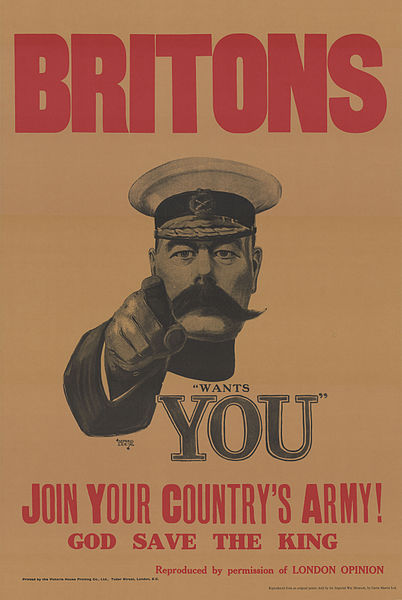
"Britons (Kitchener) wants you"
UK. Alfred Leete (1882-1933). 1914
(Eybl, Plakatmuseum Wien/
Wikimedia Commons / CC-BY-SA-4.0)
Many people are familiar with the British assault on the part of Turkey guarding the route to the Bosphorus, Istanbul, and the Black Sea from the 1981 film Gallipoli.  In a way, The Fall of the Ottomans is dedicated to that part of the conflict: Rogan introduces the book by describing a visit to the old battlefields, and by acknowledging the "terrible waste of ... life," British and French as well as Turkish, that took place there.  He provides these totals at the end of Chapter 8, "The Ottoman Triumph at Gallipoli":

Of the roughly 800,000 men who fought at Gallipoli, over 500,000 were wounded, taken prisoner, or killed in the conflict. The casualty figures were neatly divided between defenders and invaders in the eight-and-a-half-month struggle for mastery of the Dardanelles: 205,000 British and dominion casualties, 47,000 French and imperial soldiers, and between 250,000 and 290,000 Ottomans. As many as 140,000 men died in Gallipoli: 86,500 Turks, 42,000 British and dominion troops, and 14,000 French and imperial soldiers. (Rogan, p. 214)

This entire book -- and especially its account of Gallipoli -- is painful to read by anyone who opposes war and the senselessness of war. But a passage on p. 209 made me stop short. It is the quote reproduced above, a quote by the commander who had ordered it all - Field Marshall Herbert Kitchener, the "great military man" familiar to people everywhere from the British recruiting poster.

Kitchener had been making the decisions about where to attack, and who to send. But he had never been to Gallipoli. By the time he finally got there, it was clear to everyone that the campaign had been a catastrophe and it was time to evacuate -- too late,of course, for the tens of thousands already dead and the hundreds of thousands wounded. Only then did Kitchener actually make an in-person visit to the battlefield he had chosen. He reported, "The country is much more difficult than I imagined . . . and the Turkish positions . . . are natural fortresses which, if not taken by surprise at first, could be held against very serious attack by larger forces than have been engaged."

What the quote tells us is that the system permitted one man to command tens of thousands to go to their deaths, and to do so out of sheer ignorance. The field marshall had neglected to visit the field. The Gallipoli assault turned out to be "much more difficult" than he had imagined.

As observations of the centenary of WWI continue -- for instance, with a performance of Britten's War Requiem in a few weeks here in Berkeley -- it's a good time to continue to point to all the reasons that young people should question the call to battle.

Question authority: so often, staggering ignorance lies beneath.


Related posts

A person may not feel that s/he is another Daniel Ellsberg ... or Paul Revere ... or Otto and Elise Hampel ... or Ai Weiwei ... or Bradley [Chelsea] Manning. But these are heroes we can aspire to emulate.

(See I am (I will become) Bradley Manning )


We need to do several things for our young people. First of all, we need to show them pictures of war and explain: "This is what real chaos looks like." And then we need to ask, "Still think this sounds appealing?"

(See The Few, the Proud ... and the Chaos)


Consider the moment in the film All Quiet On the Western Front when the young soldier returns to visit his old high school. The soldier visits the class of the teacher who had goaded him and many of his classmates to enlist in the first place. Encouraged by his teacher to tell about the "glories" of being a soldier, he delivers a damning verdict . . . .

(See Back to School (All Quiet On the Western Front))


An amazing thing that will be happening -- in fact, has already begun happening -- here in Berkeley is a performance of Britten's War Requiem.
(See WAR: Will you hear? Will you perceive? Will you think?)


It suddenly occurs to me that everyone in the US should be studying the behavior of England toward India, and asking ourselves, "What might this tell people in the US about coming to our senses?"

(See PROBLEM: How does an entire country exorcise a national delusion?)


Sometimes you can know a place without ever having been there. I feel that way about Istanbul. It came about because during a few months in 2010, when I was caring for my mother, I read all of the books of the Turkish author (and Nobel Prize in Literature winner) Orhan Pamuk.

(See TURKEY: Terra Incognita No Longer .... )

Friday, June 5, 2015

TURKEY: Terra Incognita No Longer ....

Ara Güler, Istanbul (1962)

Sometimes you can know a place without ever having been there.

I feel that way about Istanbul.

It came about because during a few months in 2010, when I was caring for my mother, I read all of the books of the Turkish author (and Nobel Prize in Literature winner) Orhan Pamuk.

I was looking through some papers yesterday, and found notes that I made while reading Pamuk's Istanbul: Memories and the City, which consists of a series of essays about the city. It reminded me of how those essays made the city come alive for me. I wrote notes on just about every essay, and circled the names of my favorites in red pen (often accompanied by three, four, or five stars!).

Here are some of my favorites, the chapters that have brought Istanbul alive in my imagination. (With accompanying photos by the great Turkish photographer, Ara Güler, lauded by Pamuk.)

Chapter 36 The Ship on the Golden Horn (Ferry Ride)

Ara Güler, [ferry]
This is one of several chapters that bring the water-focused existence of Istanbul people alive. (Others include Chapter 6 Exploring the Bosphorous; Chapter 22 On the Ships That Passed Through the Bosphorus, Famous Fires, Moving House, and Other Disasters; and Chapter 30 The Smoke Rising from Ships on the Bosphorus.)

This chapter in particular describes a turning point, where Pamuk becomes re-anchored (or re-moored) by walking the city, and by collecting stuff. It is this sensibility, I think, that defines him as a novelist and as an artist, and the discovery of this practice seems to have been for him the moment of his salvation.


Chapter 10 Hüzün

Ara Güler, Karakoy (1959)
Pamuk returns again and again in the book to the idea that collective melancholy (hüzün) is the characteristic of Istanbul experience. ("Ruins unaccompanied by pride.")

It reminded me of my study of other cultures, and the way specific types of feelings or attitudes can be characteristic of a particular people.

For instance, this made me think of the way a slightly different type of melancholy -- mono no aware -- is often said to be a quintessential Japanese sentiment. (And it made me think of a great Japanese novelist, Jun'ichirō Tanizaki, and his book on Japanese aesthetics, In Praise of Shadows, which deals with mono no aware.


Chapter 18 Reşat Ekrem Koçu's Collection of Facts and Curiosities: The Istanbul Encyclopedia

Pamuk delves into the impulse to create, and to consume, collections of facts, and of stories -- showing how it is sort of the natural hobby of anyone who is also capable of falling in love with a robust city.

There is a natural link to the work of a city's popular press, and the columnists who find employment filling its pages with stories.

Turkish edition of 
Istanbul: Memories and the City 
(showing Pamuk in his formative years)
It is through this chapter, in particular, that I felt him making the connection to the Istanbul described in his novel The Black Book.


 . . . and much more . . .

Other chapters I loved were more about Pamuk and his personal and artistic formation, rather than the city itself.  These included Chapter 8 My Mother, My Father, and Various Disappearances; Chapter 12 My Grandmother; Chapter 28 Painting Istanbul; and Chapter 35 First Love.


Postscript: Flying Over Istanbul

I traveled to Palestine in March, 2015, and our group flew on Turkish Airlines and transited Istanbul.

It was a thrill for me to see the harbor and the city all around us as our plane descended toward the airport. (As I had imagined, it was very reminiscent of Hong Kong!)

I've gotten close to the real thing! All that remains is to go the next step and leave the airport!


Istanbul from above
(More at skyscrapercity.com)


Related posts

I often refer to how important the films of Iran have been in helping me open my mind to the possibilities of a peaceful relationship with that country.  I have been fortunate to be able to go see some of the best films from Iran every year at the wonderful Siskel Film Center in downtown Chicago. The will be another Festival of Films From Iran showing there in February, 2014.

(See A Force for Peace: Getting to Know Iran Through Film)


Years later, during the time I was busily traveling to China, Taiwan, Hong Kong, Japan, South Korea, Thailand, Malaysia, and many other places, I had occasion one day to flip open my (real) passport, and all the extension pages, filled with visa stamps, cascaded out. The memory of Expo 67 and my "globetrotting" came rushing back to me . . .

(See O Canada! (We'll always have "Expo" . . . . ))  


I could go on and on about City of Sadness: about everything from the sound of slippers scraping across the floor to the history of the 228 incident that the film illuminates . . . the funeral scene, and the wedding scene . . . . But more than anything, it's about Taiwan nature, Taiwan separateness, and Taiwan rebelliousness.

(See Taiwan Through "City of Sadness")